
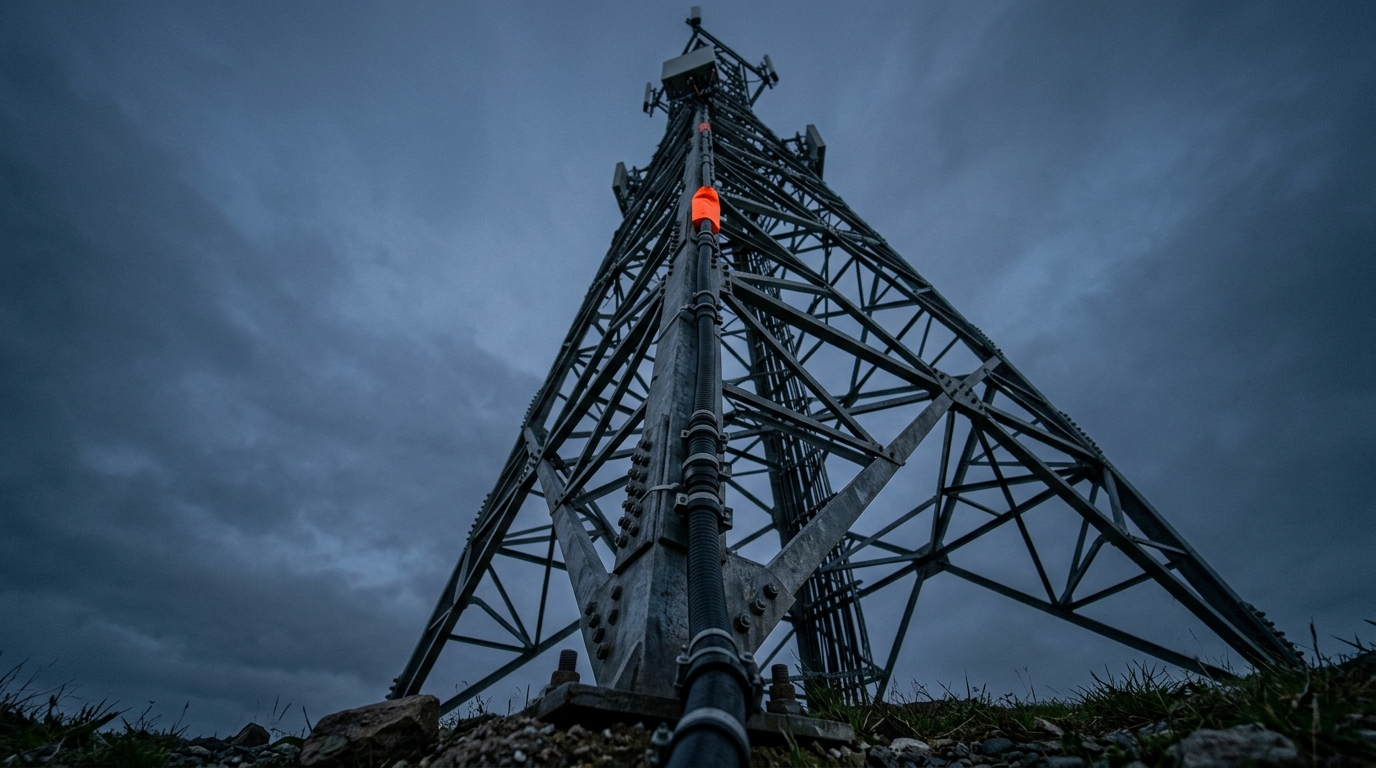
FTTA / 5G
5G Fiber Cable Types: Fronthaul, Midhaul, Backhaul
A 5G site does not have one fiber run. It has three, and each one is asked to do a different job: carry digitized radio signal from an antenna down to a distributed unit (DU) at the base of the site, move that traffic from one equipment room to another, and push it out toward the core network. The fiber cable types used across a 5G network are not interchangeable between those three jobs. Most of the expensive 5G fiber problems turn out to be specification errors rather than connector failures — the right cable, chosen for the wrong segment.
That is why a catalog of fiber optic cable types is a misleading place to start a 5G build. The vendor catalogs sort cable by optical property — single-mode versus multimode, OM3 versus OS2 — but a radio planner who sorts by optical property is sorting by the wrong axis. What decides the cable on a 5G site is the segment it sits in and the distance, latency, and fiber-count budget that segment imposes. This guide takes the three segments in order — fronthaul, midhaul, backhaul — and works out what each one demands from the fiber, the jacket, and the connector.
Why 5G Has Three Fiber Segments, Not One
A traditional macro base station was one cabinet: baseband processing, radios, and power amplifiers together, joined to the antennas by short coaxial jumpers. Splitting that cabinet apart — first as C-RAN, then as the distributed architecture that 3GPP standardizes for the 5G radio access network — turned one cable into three.
In the 3GPP architecture, the base station is separated into a centralized unit (CU) and a distributed unit (DU), with the radio unit (RU) remaining at the antenna itself — the 3GPP 5G System Overview is the reference description of that NG-RAN split. Site documentation often still uses the older FTTA vocabulary for the same two boxes, where the DU end is the BBU and the radio unit is the RRU, so it pays to hold both names. Four nodes, three links:
- Fronthaul — the RU at the antenna to the DU at the base of the site.
- Midhaul — the DU to the CU, which is usually aggregated in a regional site or a central office.
- Backhaul — the CU to the mobile core.
The split did not happen all at once, and the intermediate stages still shape what you find in the field. First-generation centralized RAN — C-RAN — pulled baseband from many sites into one pool, which created a long fronthaul link and made the latency budget the binding constraint. The later two-level split moved the boundary: the DU stays close to the radios, and only the packet-based midhaul has to reach the aggregation site. That is why the fronthaul run on a modern site is short again, and why midhaul is now a distinct cable-planning exercise rather than a stretched fronthaul.
Each link has its own budget for distance, latency, and fiber count, and those three numbers are what constrain the cable. Fronthaul is short and latency-critical; backhaul is long and capacity-critical; midhaul sits between the two and absorbs most of the architectural variation. The full deployment picture — from CPRI links to waterproof connectors — is mapped in our FTTA and 5G fiber guide.
Fronthaul Cable Types: The Fiber Between the Radio Unit and the DU
Fronthaul is the fiber between the remote radio unit (RRU) on the tower and the distributed unit (DU) below it — the CPRI cable link, in the classic architecture. It is the shortest of the three links and the least forgiving.
The protocol changes the numbers. Classic CPRI (Common Public Radio Interface) carries digitized in-phase/quadrature samples at fixed line rates — the specification topped out at 24.33 Gbit/s in option 10 of CPRI v7.0. Those fixed rates are why a wide 5G carrier with massive MIMO does not fit on classic CPRI, and why the same cooperation published eCPRI in 2017: a packet-based interface that runs over Ethernet and can cut the required fronthaul bandwidth by up to an order of magnitude. On top of that sits O-RAN open fronthaul, which standardizes a low-layer split (option 7-2x) so radios and baseband from different vendors can interoperate.
Our explainer on the CPRI link covers the interface in detail; the point for cable selection is that all three variants still want the same physical layer.
Fiber. Single-mode, essentially without exception. The reach, the line rates, and the optics on either end are built around standard single-mode fiber to ITU-T G.652. Multimode survives only in short indoor distributed-antenna runs, where the distance is a few dozen meters; putting it into a tower run is a known cause of links that pass a power meter and still fail intermittently. If you want the boundary between the two, it is set out in our comparison of single-mode and multimode fiber.
The difference starts at the structure of the glass. A single-mode fiber guides light in a core about 9 micrometers across, held inside a 125-micrometer cladding that keeps the light from leaking out: one guided path, almost no modal dispersion, and reach measured in tens of kilometers. Multimode widens the core to about 50 micrometers, which couples cheaply to 850 nm optics but lets light travel many paths at once, so the pulse smears within a few hundred meters. A fronthaul link is long, exposed, and single-mode at the optics on both ends; the 9 µm core and its cladding are simply what the distance budget requires.
Fiber count. Classic deployments run a duplex pair per radio — two fibers, terminated in one duplex LC connector — so a three-sector site with one radio per sector needs three duplex pairs, not one. Higher-order MIMO and multi-band sites multiply that. Sizing the duct for today's radio count and tomorrow's is cheaper than re-pulling a tower.
Latency. Fronthaul carries the tightest budget of the three links, because a low-layer split leaves little time for transport: budgets are measured in microseconds, commonly a few tens to a low hundreds depending on the split. That is a distance constraint as much as an electronics constraint — light in fiber travels roughly 5 microseconds per kilometer, so a fronthaul run of 10 km already spends about 50 microseconds one way.
Distance. A macro-site fronthaul run is typically a few hundred meters up the tower to a few kilometers back to the DU. Centralized deployments stretch that with the split and the optics, but the latency budget, not the loss budget, is usually what caps it.
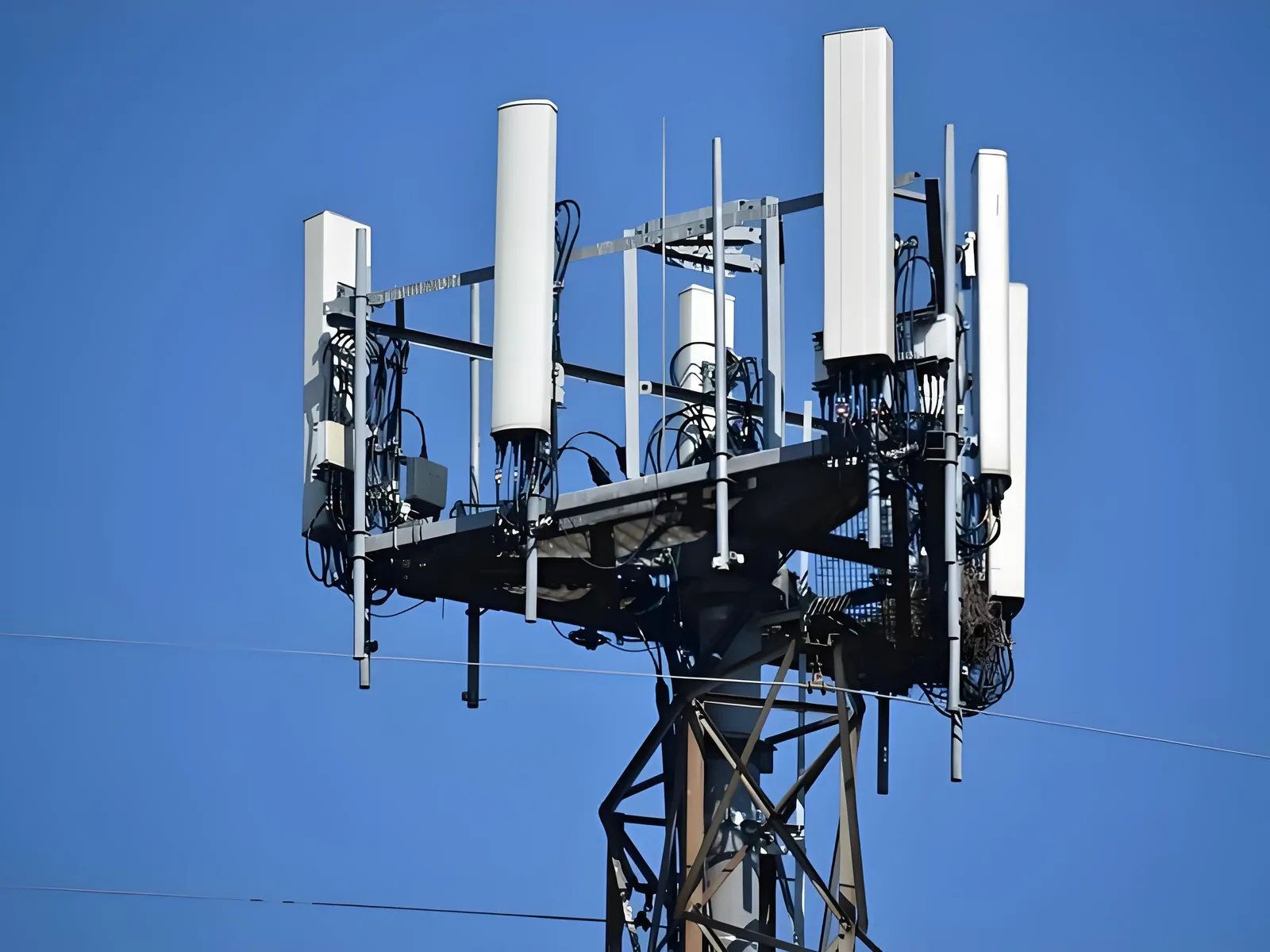
The photo below shows where that run ends: the RRUs bracket the antennas, and every one of them needs a weatherproof fiber drop.
The cable construction. This is where fronthaul diverges most from a data-center run. The cable lives on steel, in weather, with wind loading and temperature cycling, and it has to be pulled through tower cable-bundle limits. What that means in practice: aramid yarn strength members instead of metallic reinforcement (so the cable carries its own weight without becoming a lightning path), a small outer diameter, and a jacket matched to the exposure — PE or TPU for permanent outdoor use, LSZH where flame behavior matters, and an armored variant where rodents are a known hazard. DYS builds its FTTA indoor/outdoor cable family around exactly those constraints, with 2.0 mm subcables and jacket material specified per site.
The contrast with data-center cabling is deliberate. A data-center run is short, indoor, and often preterminated ribbon or trunk in a controlled environment; a fronthaul run is an outside-plant cable with weather, wind, and UV written into the specification.
The architecture that run belongs to — why the baseband moves to the bottom and the radio moves to the top — is covered in our guide to fiber-to-the-antenna.
The connector. The standard fronthaul jumper interface is the duplex LC per IEC 61754-20. Two details decide whether it survives the site. The first is polish grade: APC gives higher return loss than UPC on single-mode, but both ends of a jumper and the equipment ports must match. The second is the outdoor rating at the radio end, where moisture, UV, and vibration work on the termination year after year. Our CPRI LC outdoor connectors are built to that interface with all-weather, UV-resistant materials and a −20 °C to +70 °C temperature rating; the wider question of how much protection a site actually needs — IP67 or IP68 — is compared in our outdoor connector IP-rating guide.
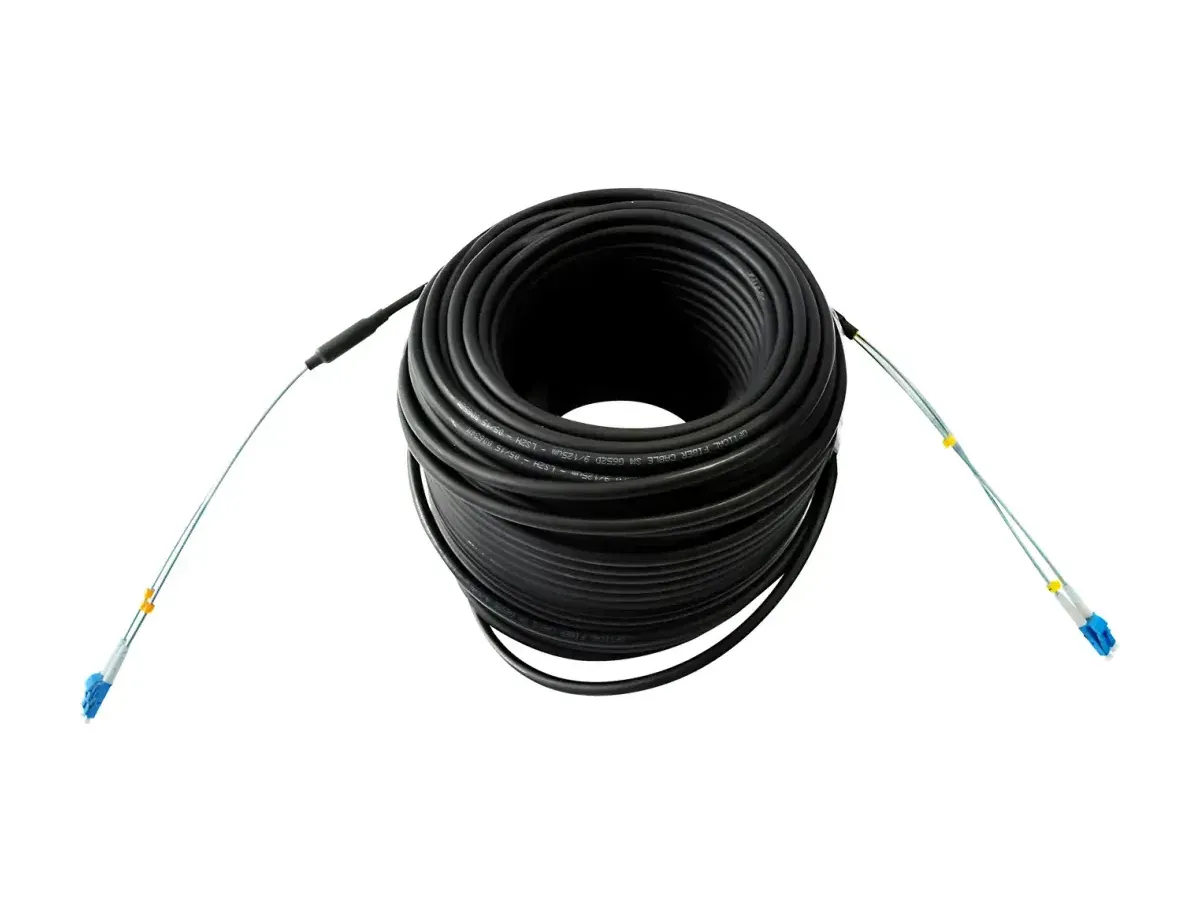
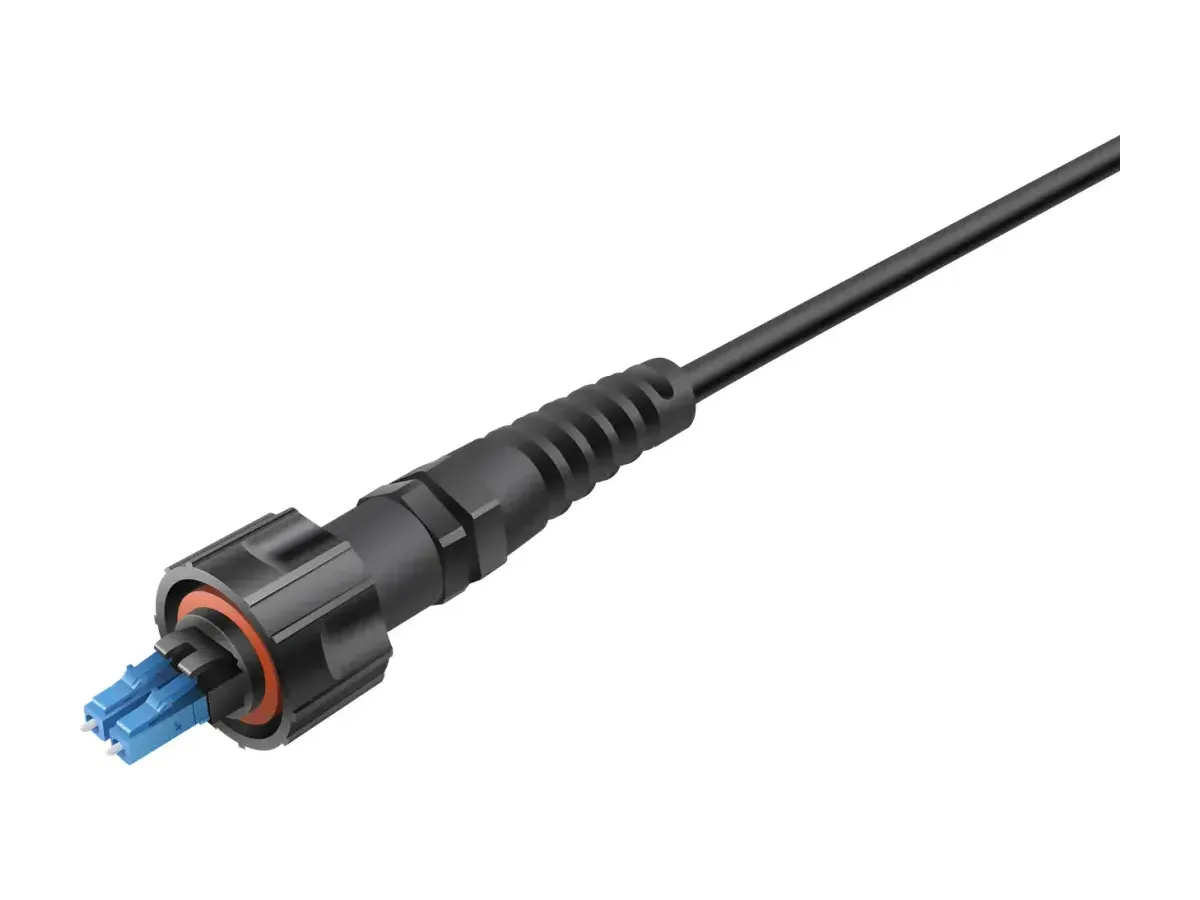
A fronthaul assembly is only as good as its weakest termination, which is usually the one at the top of the tower. A hardened outdoor connection looks like this: an IP68 duplex LC assembly with a sealed shell designed to stay mated through weather rather than be opened for service.
Midhaul Cable Types: The Fiber Between the DU and the CU
Midhaul — 5G midhaul, in most vendor literature — is the link between the distributed unit (DU) and the centralized unit (CU), and it is the least understood of the three links. It carries the F1 interface — packet-based, running over Ethernet and transported across OTN rather than as a dedicated serial bit stream — which changes what the fiber has to do. Capacity is no longer a fixed radio-derived rate; it is a traffic load that grows with the number of DUs aggregated behind one CU.
The reason midhaul exists at all is that it lets a single CU serve many DUs without putting a latency-critical fiber run on every one of them. The CU pools the packet-processing, RRC, and higher-layer functions; the DU keeps the real-time physical-layer work beside the radio. Moving the boundary that way trades a tight, radio-derived fronthaul budget for a looser transport budget on the midhaul — which is why midhaul can use ordinary packet transport, and ordinary metro fiber, instead of a purpose-built serial link.
Distance. Midhaul is metro-scale: tens of kilometers between a DU site and a CU aggregation point, versus the hundreds of meters of a fronthaul run. That distance is what separates the two segments in practice — it is long enough that loss and dispersion budgeting matter, and short enough that coherent long-haul optics are usually overkill.
Fiber. Standard single-mode G.652 again, with one refinement: where the route takes tight bends — inside a street cabinet, around a hand-hole, up a pole — ITU-T G.657 bend-insensitive single-mode is the safer spec, because it tolerates a much tighter bend radius without added loss. Mixing G.652 and G.657 is normal; they are both single-mode and splice to each other cleanly.
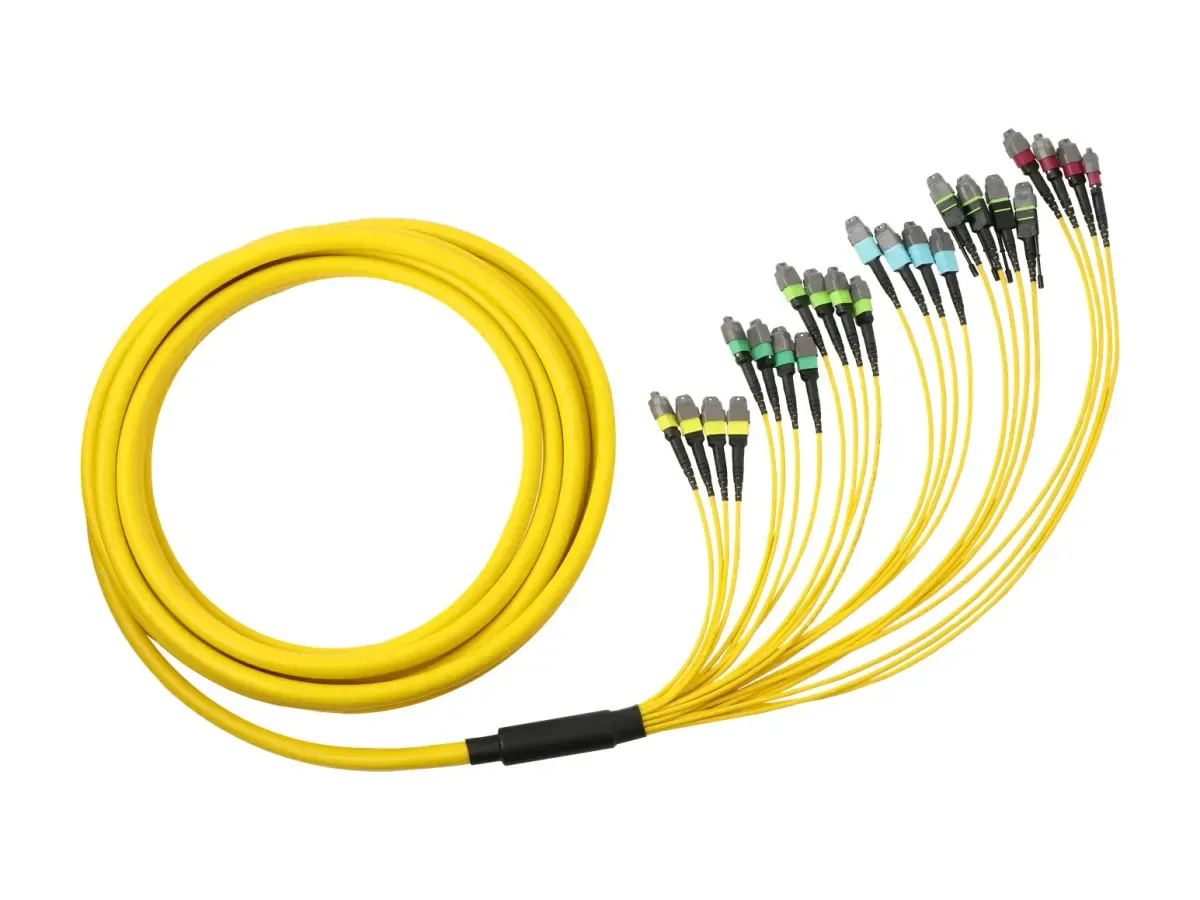
Where one CU aggregates a large number of DUs, the fiber count at the aggregation point climbs quickly, and that is where the MPO/MTP connector family takes over: a single multi-fiber push-on connector terminates 8, 12, or 24 fibers at once and feeds a cassette-based distribution frame instead of a wall of duplex LC pairs. The cable underneath is the same single-mode outside plant; only the termination changes.
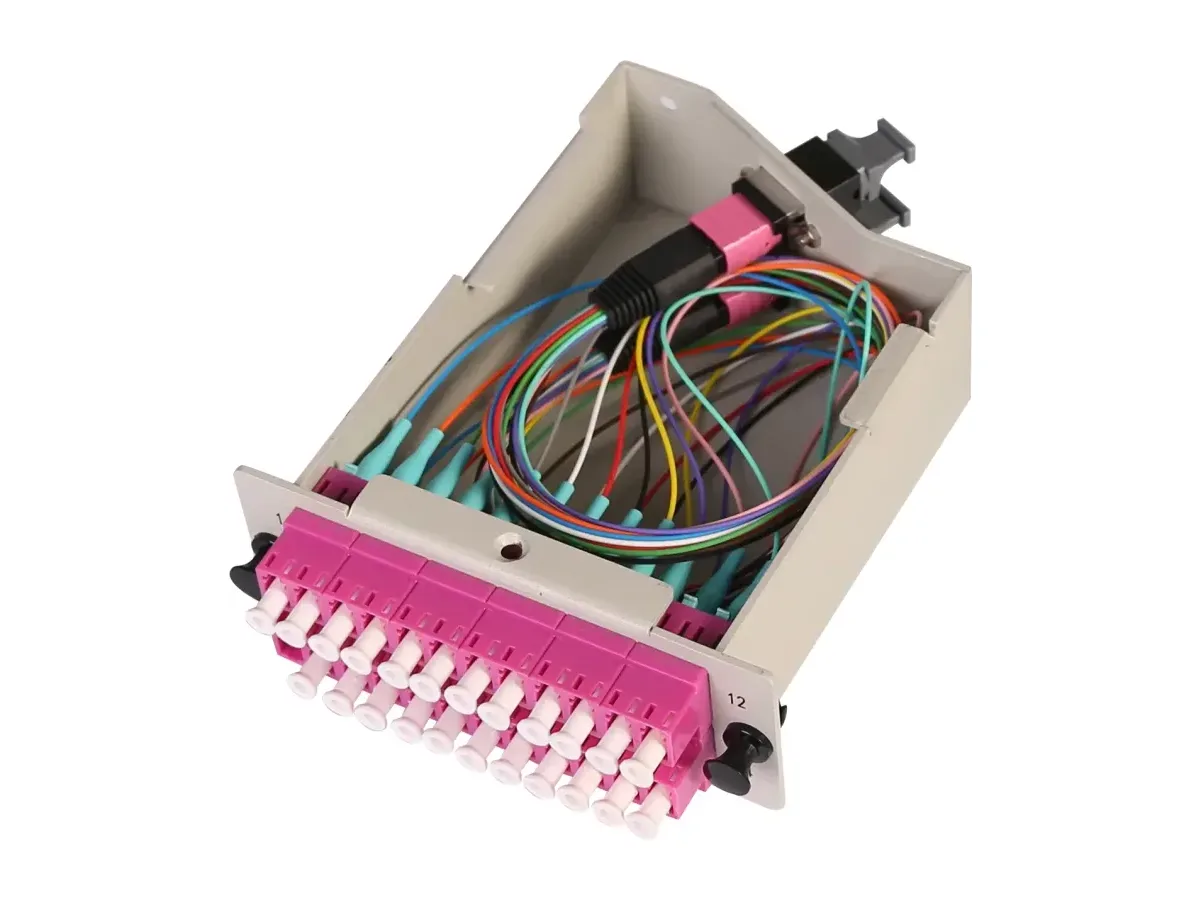
Cable construction. Midhaul almost always runs in outside-plant cable: loose-tube construction for the fiber, a moisture barrier and often a metallic or dielectric strength member, and an armored jacket where the route is in duct or subject to rodent damage. The distinctions that matter — indoor/outdoor versus fully outdoor, duct versus aerial — come from the route, not from the protocol.
Capacity and WDM. A single duplex pair is a lot of capacity, but not always enough for the DUs behind it, and duct space is expensive. Midhaul is where wavelength-division multiplexing earns its place: coarse WDM on the ITU-T G.694.2 20 nm grid for lower channel counts and less demanding optics, or dense WDM on the ITU-T G.694.1 grid where channel count is high. Both ride on the same single-mode fiber. The cable implication is passive but real: a span designed for one pair today, but built with the bend and loss margin to carry a 16- or 40-channel WDM system later, saves a re-pull.
Backhaul Cable Types: The Fiber From the CU to the Core
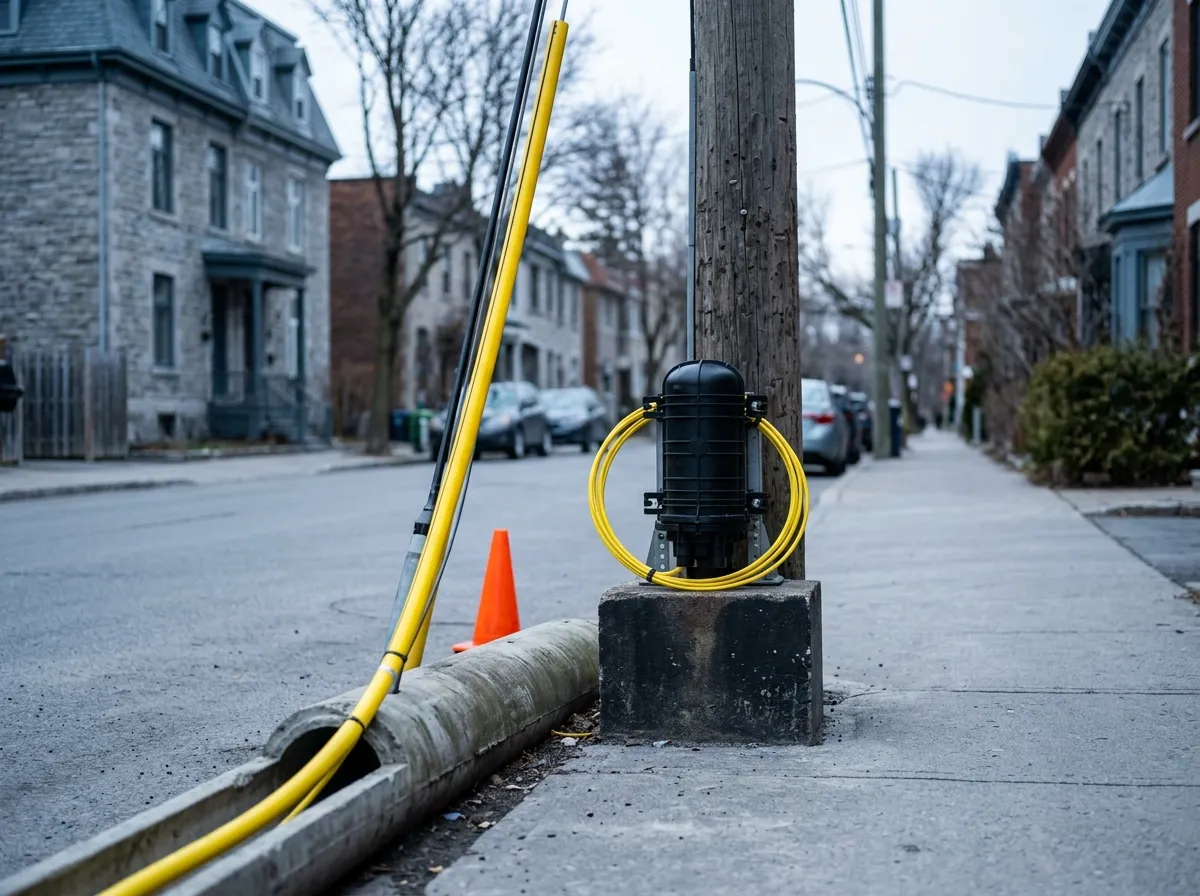
Backhaul connects the centralized unit (CU) to the mobile core network. In operator documentation it is simply 5G backhaul, and it is the segment that looks most like ordinary transport fiber — because it is. The protocols are packet-based, the distances are long-haul, and the capacity per wavelength is measured in hundreds of gigabits.
Fiber. Backhaul fiber is standard single-mode G.652 almost everywhere, with long spans sometimes engineered on low-loss single-mode grades where the reach justifies them. The fiber type is rarely the interesting decision on backhaul; the capacity plan is.
Optics and WDM. Backhaul is where coherent optics and dense WDM are normal rather than optional: 100G, 200G, and 400G per wavelength multiplexed on the ITU-T G.694.1 grid is routine in metro and regional backhaul, and a single fiber pair can therefore carry many terabits. The fiber has to be clean enough for coherent detection — which means low loss, well-controlled splices, and reflection kept under control.
Fiber count and protection. A backhaul route is usually engineered as more than one path. Because a single fiber pair can carry many terabits once it is WDM-loaded, the number of fibers is rarely the limit — route diversity and protected capacity are. That leads to a specific cable-planning habit: every long span is built with the fiber count and splice-loss margin to support a second, diverse path, and the route survey covers duct, aerial, and buried segments with the right construction for each.
Cable construction. Long-haul outside-plant cable: loose-tube or ribbon construction, a water-blocking compound or gel around the fibers, armored where it is ducted, and specified for the aerial, buried, or duct route it takes. Where an operator does not own that fiber, backhaul often rides a leased or access network — and in mobile access that frequently means a passive optical network, most commonly XGS-PON as standardized in ITU-T G.9807.1. Our comparison of GPON, XG-PON, and XGS-PON covers when that is a sensible backhaul choice.
The trade-off on backhaul cable is mechanical rather than optical. A span that will take a long pull through duct wants a high tensile rating and a durable jacket; an aerial span wants a figure-eight or all-dielectric self-supporting construction that survives wind and ice loading; a buried span wants crush resistance and moisture blocking. Those choices usually cost more than the fiber selection, and they are fixed for decades once the cable is in the ground.
How to Choose Fiber Cable Types by 5G Segment
The table below is the whole article in one place. Read it as a design starting point — the exact numbers on your site come from the split, the optics, and the route — but the segment logic holds regardless of vendor.
Segment | Typical distance / latency | Fiber | Typical cable | Typical connector |
|---|---|---|---|---|
Fronthaul (RU ↔ DU) | 0.2–5 km; tightest budget (microseconds) | Single-mode G.652 (G.657 at tight bends) | FTTA indoor/outdoor, small OD, aramid strength members | Duplex LC per IEC 61754-20, IP-rated at the RU |
Midhaul (DU ↔ CU) | 10–40 km; moderate budget | Single-mode G.652 / G.657 | Metro outside-plant, loose-tube, armored in duct | LC duplex or MPO where fiber count is high |
Backhaul (CU ↔ core) | Tens to hundreds of km; loosest budget | Single-mode G.652 | Long-haul outside-plant, loose-tube or ribbon | LC/SC duplex, coherent WDM on the line system |
The single most useful line in that table is the first column: distance is the fastest filter. If a run is under a few kilometers and sits on a tower, it is fronthaul and it needs an outdoor-rated assembly. If it is metro-length, it is midhaul and it needs outside-plant cable with WDM headroom. If it leaves the metro, it is backhaul and the fiber becomes a transport-planning question.
The one-line rule: pick the segment first, then the distance, then the fiber — and only then the connector and the jacket. Reverse that order and you will buy a specification that is right on paper and wrong on the tower.
Mistakes That Add Cost to a 5G Fiber Build
The errors that cost the most in 5G fiber work are made at specification time, not at installation time.
- Specifying multimode on a fronthaul run. It works on the test bench and fails over distance and temperature. Single-mode all the way up the tower.
- Ignoring the tight-bend zones. A G.652 cable bent inside a cramped cabinet or hand-hole adds loss that no one budgeted. Specify bend-insensitive single-mode — or a bend-resistant cable construction — where the route is tight.
- Undersizing duct for the future WDM system. A span built for one pair with no bend or loss margin cannot host the 16-channel CWDM system two years later without a re-pull.
- Treating the connector as a commodity. Polish grade, end-face quality, and the outdoor rating at the radio are what decide whether a tested link stays good. Return loss and insertion loss are the numbers to hold a supplier to, and they are worth measuring rather than assuming — the difference between insertion loss and return loss is the place to start.
- Losing the fiber identity in the field. Splicing crews identify fiber by jacket and buffer color code; a cable whose color code does not match the network plan gets spliced wrong, once, and then costs a truck roll.
- Siting the DU before the latency budget is fixed. On a fronthaul run the constraint that matters is round-trip time, not loss. A DU placed for convenience of power and shelter — and not for fiber distance — can be physically reachable and still outside the split's latency window, and no cable change fixes that after the fact.
- Assuming segment optimization is the whole story. On a brownfield site the duct, the existing spans, and the supplier's stocked cable types are often the real constraint, and the segment argument only decides where you spend the next dollar of new fiber.
FAQ
What fiber cable types are used in 5G networks? Standard single-mode fiber for essentially all of it. G.652 for fronthaul, midhaul, and backhaul runs, with G.657 bend-insensitive single-mode in tight-bend areas. Multimode appears only in short indoor runs; it is not used on tower fronthaul.
Fronthaul vs backhaul — what is the difference? Fronthaul is the short, latency-critical link between the RRU and the distributed unit (hundreds of meters to a few kilometers, microseconds of budget). Backhaul is the long-haul link between the centralized unit and the core (tens to hundreds of kilometers, capacity-driven). Midhaul is the link between the two, DU to CU.
Is OM4 multimode or single-mode, and does it belong in 5G? OM4 is multimode, a 50-micron graded-index fiber optimized for short-reach 850 nm links in buildings and data centers. It has no place in 5G RAN transport, where the distances and optics assume single-mode.
What is the difference between LC and SC connectors on fiber cable? Both are single-fiber connectors; LC is the smaller, higher-density interface and the standard on 5G fronthaul jumpers, while SC is the larger push-pull body common on older equipment and PON access networks. The choice follows the equipment port, not the cable.
How do I tell what type of fiber optic cable I have? Start with the jacket color: yellow is single-mode, while orange and aqua mark multimode grades. Then read the print on the jacket — a designation such as G.652D or G.657A2 confirms single-mode, while OM3 or OM4 confirms multimode — and check the buffer color code, which is what the splicing crew uses to match the network plan.
What are the advantages of fiber optic cable over copper? Capacity and distance come first: one pair of single-mode fiber carries far more than a copper pair and reaches tens of kilometers without the repeaters copper needs. It is also immune to electromagnetic interference, and in an all-dielectric construction it carries no ground current, so a strike on the tower cannot travel down the cable — which matters on a build that connects hundreds of towers.
Can I use the same cable for fronthaul, midhaul, and backhaul? No. The fiber itself is single-mode on all three, but the cable construction is segment-specific: an outdoor-rated tower assembly on the fronthaul, metro outside-plant cable with WDM headroom on the midhaul, and long-haul outside-plant cable on the backhaul. Reusing one construction across all three usually gets you either a cable that cannot survive the tower or one that is over-specified and over-priced for a duct run.
Choosing fiber cable types for a 5G network comes down to one habit: decide the segment first, then let the segment's distance and latency budget pick the fiber, the jacket, and the connector. A catalog of types of fiber optic cable sorted by optical grade will not tell you any of that; the segment will. If your next build needs FTTA cable or outdoor CPRI jumpers — duplex LC, single-mode, IP-rated, built to your length and polish spec — request our FTTA product sheet and samples before you commit to a cable plan. Getting the physical layer right the first time is the difference between a site that commissions once and one that lives in the truck-roll loop.