

FTTA / 5G
CPRI Explained: The Fiber Link Between BBU and RRU
CPRI (Common Public Radio Interface) is a serial interface specification that connects the baseband unit (BBU) of a cellular base station to remote radio units (RRUs) at the antenna site, carrying digitized in-phase and quadrature (IQ) radio samples over fiber optic links. It is defined by an industry cooperation of Ericsson, Huawei, NEC, and Nokia, with version 7.0 as the final release of the classic specification.
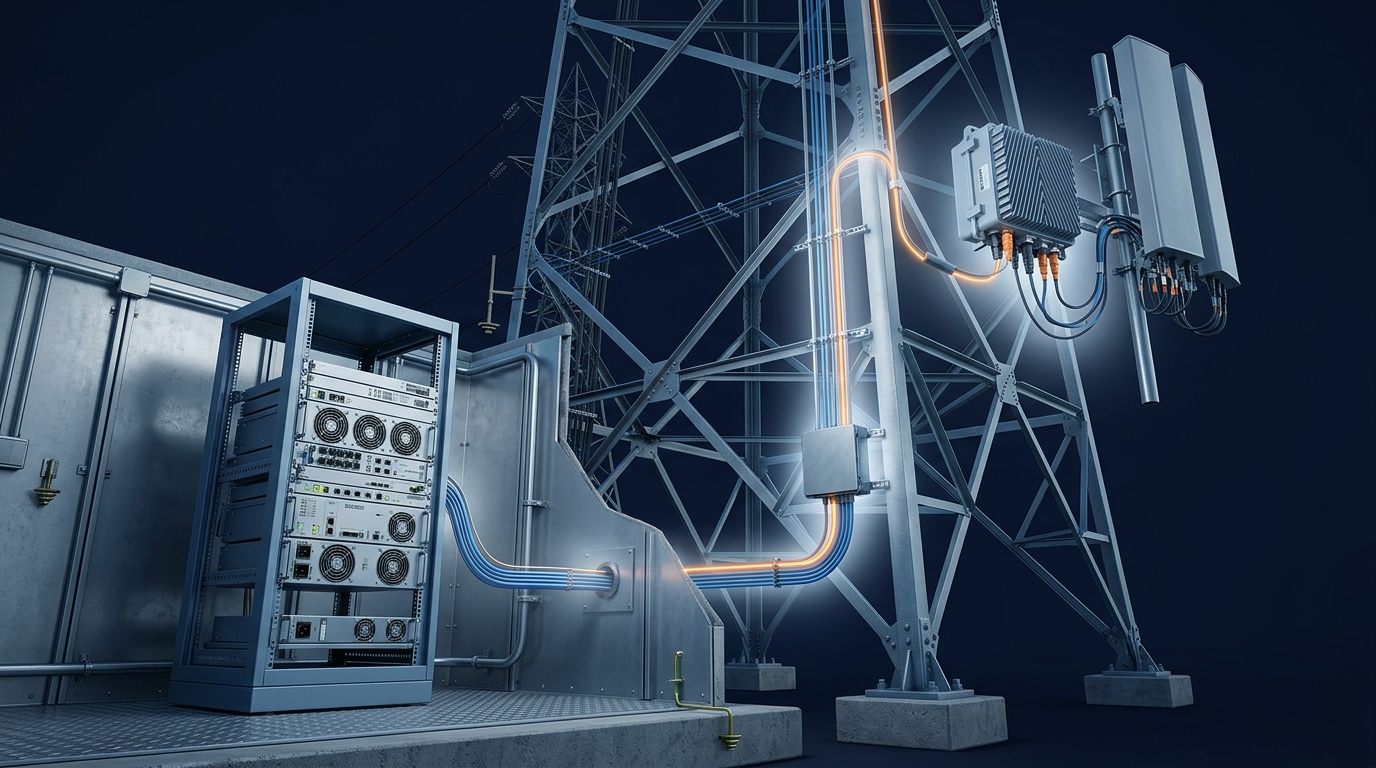
In plain terms: a 4G or 5G base station no longer has to be one box. The signal-processing half (the BBU) sits in a shelter or cabinet at ground level, while the radio half (the RRU) is bolted to the tower near the antennas. CPRI is the standardized link that connects them — and in nearly every real deployment, that link is a pair of single-mode fibers terminated with duplex LC connectors. This guide explains what CPRI actually carries, how fast it runs, what fiber and hardware the link needs, and where eCPRI takes over in 5G.
What Is CPRI? The Interface That Splits the Base Station in Two
Before CPRI, a macro base station was a monolithic cabinet: baseband processing, radios, and power amplifiers all in one enclosure, connected to the antennas by thick coaxial cable. That cable is lossy — signal degrades over distance, and the equipment had to sit within a few tens of meters of the antennas.
Distributed architectures changed the geometry. The BBU (in CPRI terms, the Radio Equipment Control, or REC) stays at the bottom, and the RRU (the Radio Equipment, or RE) moves to the top of the tower. The coax run is replaced by a fiber link that carries the digitized radio signal between the two. Because CPRI transports digitized IQ samples rather than modulated RF, the link is immune to the attenuation and interference problems of RF cable, and the BBU can serve radios that are hundreds of meters — or much farther — away. An overview of how CPRI was applied to C-RAN-based LTE networks is covered in this 2016 IEEE Communications Magazine paper by de la Oliva et al.
CPRI is a specification, not a formal standard from a body like 3GPP — it's published by the CPRI Cooperation and covers the physical and data-link layers (OSI layers 1 and 2) of the interface, including the optical interface parameters. One clarification that comes up in searches: "CPRI certified" equipment is gear that conforms to this published specification, and it should not be confused with a CPR certificate — CPR (Construction Products Regulation) is the EU regulation that classifies cable fire performance. Different acronyms, different industries, easy to mix up.
The specification has been through ten-plus versions since 2003. The cooperation added LTE support in v4.0 (2008), higher line rates through v6.1 and v7.0 (2014–2015), and shifted further development to eCPRI from 2017 onward. Today's installed base of 4G sites runs overwhelmingly on classic CPRI.
What CPRI Carries: IQ Samples, Sync, and Control on One Fiber
A CPRI link is a point-to-point serial connection that multiplexes several information flows onto one fiber pair:
- IQ data (user plane) — the digitized radio signal. Each sample has an in-phase (I) and quadrature (Q) component, interleaved into words and mapped into per-carrier containers called AxCs (antenna-carriers). The bit width varies: typically 8–20 bits per sample in the downlink and 4–20 in the uplink, depending on the air interface and sampling rate.
- Synchronization — frame and time alignment data so the BBU and RRU stay locked to each other, and to network time.
- Control and management (C&M) — the operations channel between the REC and RE.
- L1 inband protocol — link-level signaling used for start-up, maintenance, and time-critical data.
- Vendor-specific data — reserved space for manufacturer extensions.
Because the transport is time-division multiplexed IQ samples, CPRI is deliberately simple but not bandwidth-efficient: it carries raw samples at a fixed rate, whether the cell is busy or idle. Compression techniques exist, but the fundamental trade-off is why the industry moved to a packet-based successor for 5G (more on that below).
CPRI Line Rates: From 614.4 Mbps to 24.3 Gbps
CPRI line rates are standardized as numbered "options," defined in the CPRI Specification v7.0. Each option doubles (roughly) the previous rate, with 8B/10B line coding for the lower options and 64B/66B for the top three:
Option | Line rate | Line coding |
|---|---|---|
1 | 614.4 Mbit/s | 8B/10B |
2 | 1,228.8 Mbit/s | 8B/10B |
3 | 2,457.6 Mbit/s | 8B/10B |
4 | 3,072.0 Mbit/s | 8B/10B |
5 | 4,915.2 Mbit/s | 8B/10B |
6 | 6,144.0 Mbit/s | 8B/10B |
7 | 9,830.4 Mbit/s | 8B/10B |
8 | 10,137.6 Mbit/s | 64B/66B |
9 | 12,165.1 Mbit/s | 64B/66B |
10 | 24,330.2 Mbit/s | 64B/66B |
What drives the option number is the radio configuration: antenna count, carrier bandwidth, and sampling rate. A 20 MHz LTE cell with 2x2 MIMO needs about 2.4576 Gbit/s (option 3); the same bandwidth with 4x4 MIMO needs 4.9152 Gbit/s (option 5); dual 20 MHz carriers at 3.5 GHz push past 9.8 Gbit/s. Anritsu publishes the full mapping of LTE bandwidth and MIMO configurations to CPRI rates in its CPRI and OBSAI technology notes. Version 7.0 (2015) added the 24.3 Gbit/s option 10 for LTE-Advanced, and that is the ceiling of classic CPRI.
This is where 5G hits the wall. A 100 MHz 5G carrier with 64 or more antenna ports needs multiple times the bandwidth of the highest CPRI option. Wide-channel 5G with massive MIMO simply cannot be carried on classic CPRI without aggressive compression — the rates required exceed option 10. That mismatch is the direct reason eCPRI exists.
Also worth knowing: when people say "CPRI cable," they usually mean the fiber jumper or assembly that carries a CPRI link — typically a duplex LC, single-mode, outdoor-rated cable for the run to the RRU. It's shorthand for the physical layer, not a formal cable type.
Why Fiber, and Which Fiber: Single-Mode Is the CPRI Default
Copper was the original medium for CPRI's electrical interface, and it still exists for short, indoor jumps. But the optical interface is what makes distributed base stations practical: fiber has negligible loss over tower distances, is immune to EMI and lightning-induced interference, and carries the high line rates above easily. The CPRI specification's optical interfaces are built around single-mode fiber, standardized as ITU-T G.652 — the same fiber used across telecom transport networks.
For a fiber manufacturer's customers, the practical answers are:
- Single-mode, not multimode. Multimode fiber is fine for short data-center runs at 850 nm, but CPRI's reach and line-rate requirements assume single-mode (G.652) fiber, typically operating at 1310 nm (and 1550 nm for longer or WDM links).
- Distances. A typical macro-site fronthaul run — from the BBU in the shelter to the RRU on the tower — is a few hundred meters to a couple of kilometers. With the right optics, CPRI links are engineered for much longer reaches (tens of kilometers), which is why the fiber choice matters even for short runs: single-mode leaves headroom and is future-proof for higher options.
- Loss budget. Single-mode fiber at 1310 nm attenuates roughly 0.35 dB/km, and connectors and splices add their own loss. A link budget for a tower run is usually a matter of a few dB — but it has to be calculated and measured, not assumed. The whole architecture — why the BBU and RRU are separated, and what the fiber-to-the-antenna run consists of — is covered in our fiber-to-the-antenna architecture guide.
The photorealistic render below shows the physical shape of that architecture: BBU at ground level, a fiber riser up the tower, RRU at the top.
What the Link Is Made Of: FTTA Cables and Outdoor Connectors
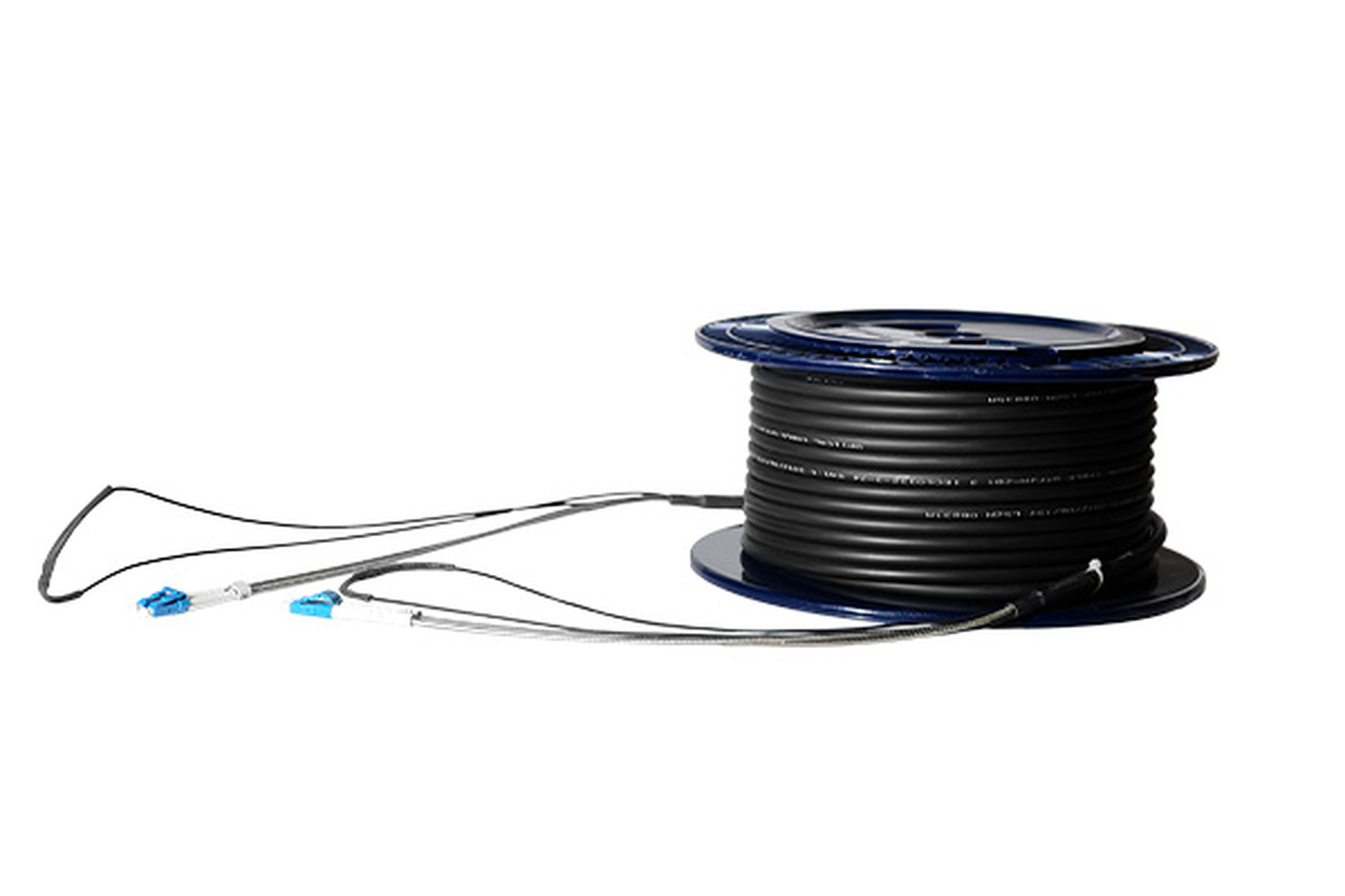
The fiber itself is only half the story — the link lives on a tower, in weather, with wind and temperature swings. Two hardware decisions dominate:
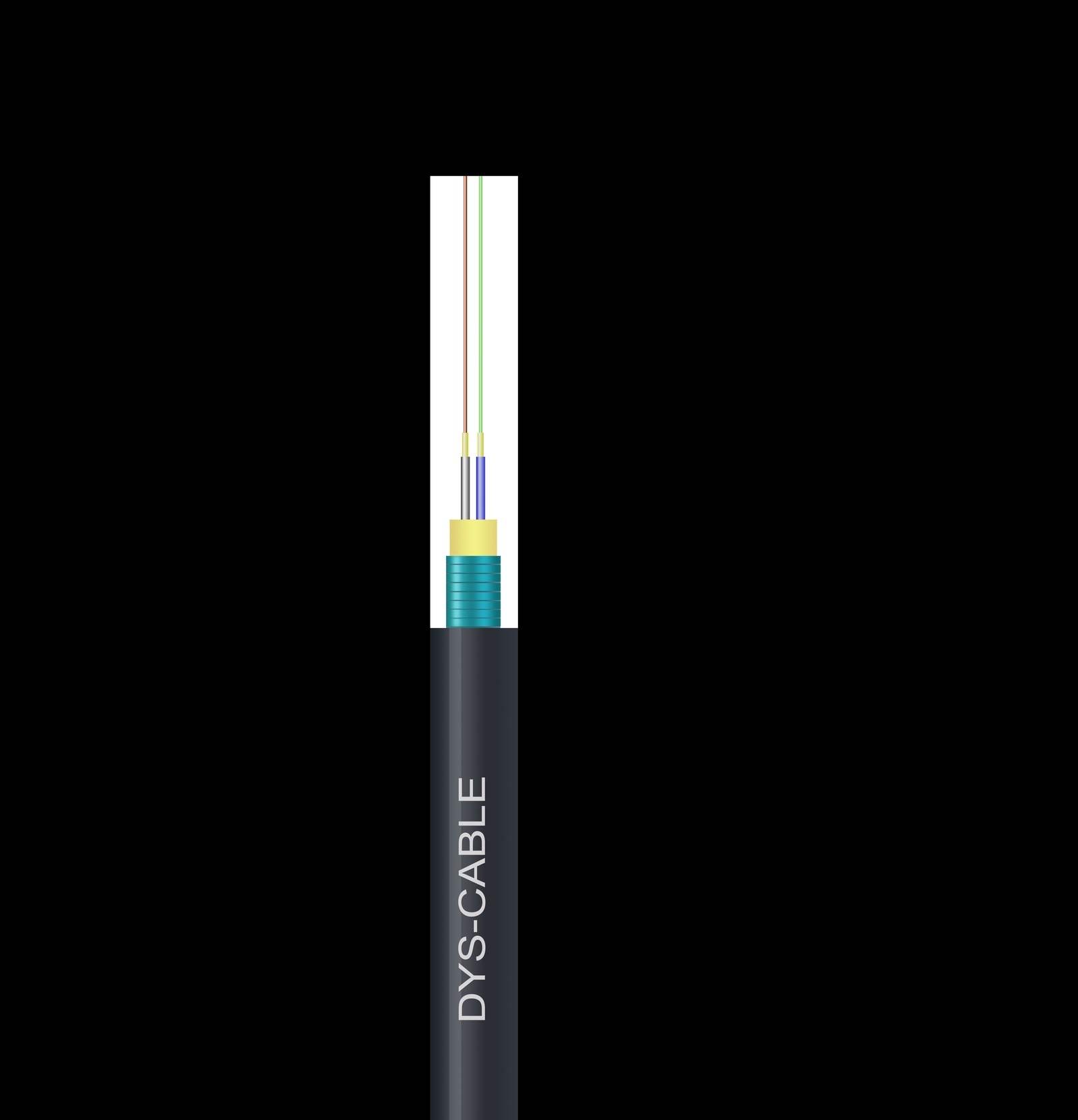
Cables. The run from the distribution point up the tower uses FTTA (fiber-to-the-antenna) cable: a ruggedized indoor/outdoor cable with aramid yarn strength members (so it handles the tensile load of a vertical run without metallic reinforcement), a small-diameter construction that respects tower cable-bundle limits, and a jacket matched to the environment — PE or TPU for outdoor exposure, LSZH where flame retardancy matters, armored variants where rodents are a known hazard. DYS's FTTA indoor/outdoor cable family is built around exactly these constraints, with 2.0 mm subcables and jacket options per site spec.
Connectors. The standard interface for CPRI jumpers is the duplex LC, per IEC 61754-20. Two details matter most:
- Polish grade. APC (green) gives higher return loss than UPC (blue) and is the common choice for single-mode fronthaul. Whatever the network plan specifies, both ends of a jumper must match the equipment ports.
- Outdoor rating. At the RRU end, the connection is exposed — it needs a weatherproof, UV-resistant termination, typically IP-rated, that keeps out moisture over years of outdoor life. A typical specification is an insertion loss of ≤0.30 dB and return loss of ≥60 dB (APC), with end-face quality inspected to IEC 61300-3-35. Our CPRI LC outdoor connectors are built for this exact job: IEC 61754-20 duplex LC, all-weather UV-resistant materials, and a −20 °C to +70 °C storage range.
Buyers comparing assemblies should look past connector brand names and check the cable spec, polish grade, IP rating, and measured insertion/return loss — those are the numbers that determine whether the link survives a tower winter.
CPRI vs eCPRI: What Changes in 5G Fronthaul
eCPRI (enhanced CPRI) was released by the same cooperation in August 2017, with eCPRI 2.0 following in 2019, explicitly to support 5G fronthaul — the full release history is on the CPRI Cooperation's site. The differences are structural, not incremental:
Dimension | Classic CPRI | eCPRI |
|---|---|---|
Transport | TDM serial bit stream | Packet-based, runs over Ethernet |
Bandwidth | Raw IQ at fixed rate | ~10x lower for the same radio config |
Functional split | Radio functions fixed at the RRU | Split moved inside the PHY layer, configurable |
Topologies | Point-to-point, point-to-multipoint | Point-to-point, multipoint-to-multipoint |
Networking | Dedicated link, limited features | Shares Ethernet transport, standard networking features |
Typical use | 4G installed base | New 5G builds |
The practical consequence: a 5G fronthaul link can share Ethernet transport with other traffic instead of consuming a dedicated fiber pair at a fixed high rate, and the same transport network can carry eCPRI alongside legacy CPRI (eCPRI 2.0 explicitly supports carrying CPRI 7.0 over Ethernet for interworking). For the fiber layer, the hardware story is familiar — single-mode fiber, duplex LC, outdoor-rated terminations — which is why the same FTTA cable and connector families serve both protocols. If you're comparing waterproof assemblies for mixed 4G/5G sites, our FTTA cable assemblies comparison walks through the connector options.
A Practical Checklist for CPRI Link Deployment
When you're commissioning a new site or troubleshooting an existing one, run through this list:
- Confirm the line rate — the SFP+ optics and the cable plant must support the option in use (check the RRU and BBU configuration, not the label on the box).
- Verify fiber type — single-mode G.652 for all fronthaul runs; multimode fiber in a CPRI path is a recipe for intermittent failures.
- Match polish grades — APC-to-APC or UPC-to-UPC end to end; an APC/UPC mismatch is a hidden return-loss disaster.
- Check the outdoor terminations — IP-rated, UV-resistant connectors at the RRU; verify the boot and strain relief are seated after installation.
- Measure, don't assume — test insertion loss and return loss on every jumper before install and on the completed span; an OTDR trace confirms the splice and connector points. Our guide to fiber link testing covers the test methods and pass/fail thinking.
- Document the span — fiber pair, connector types, measured loss, and test date. When a tower site fails at 2 a.m., this sheet is what lets the technician isolate the fault fast.
- Respect bend radius — tight wraps in the cabinet or at the RRU are the most common cause of field failures that test fine in the lab.
If your next build needs FTTA cable or outdoor CPRI jumpers — duplex LC, single-mode, IP-rated, built to your length and polish spec — request our FTTA product sheet and samples before you commit to a cable plan. Getting the physical layer right is the difference between a site that commissions once and one that lives in the truck-roll loop.
The full picture of fiber for cell towers — from CPRI links and eCPRI to waterproof connectors and distribution — is in our FTTA and 5G fiber guide, which is the hub for this whole topic cluster.