
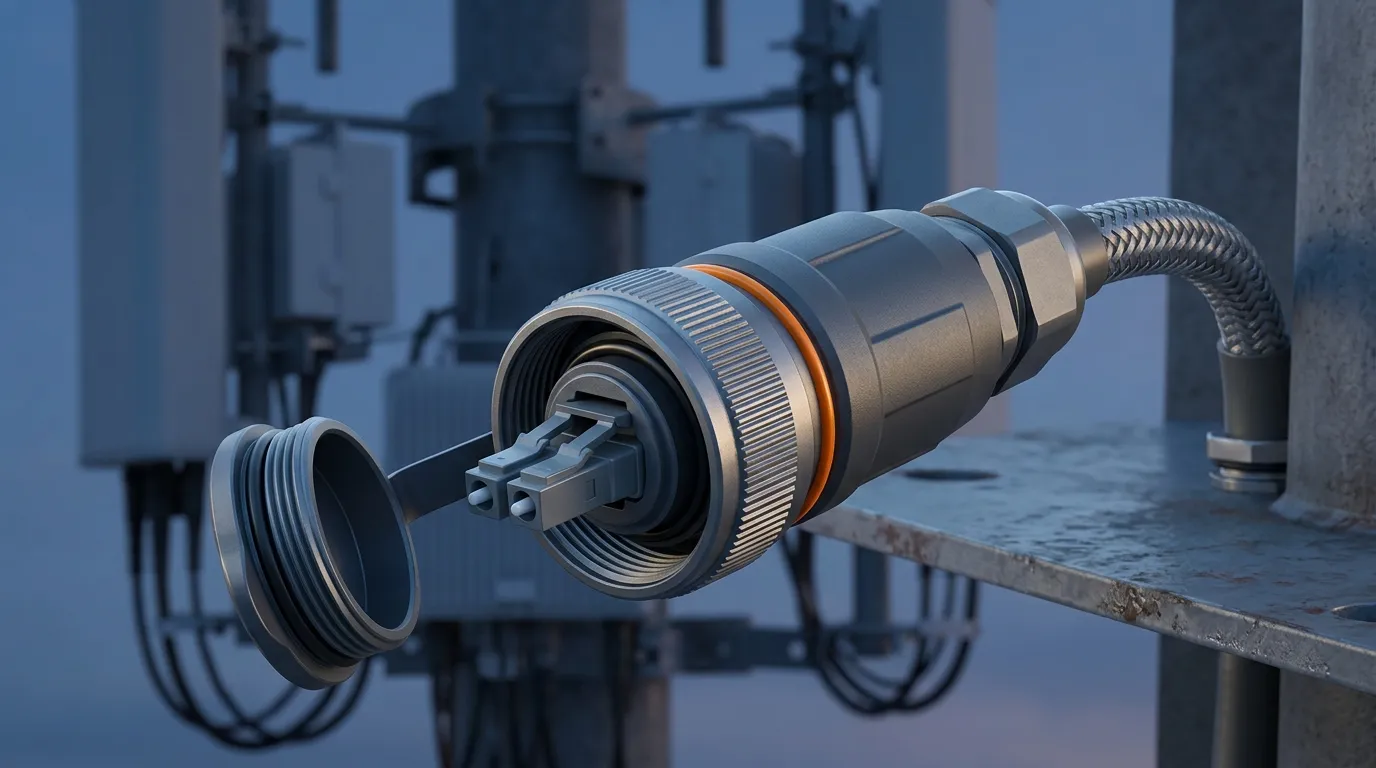
FTTA / 5G
IP67 vs IP68 Fiber Connectors: What Survives on a Tower
IP67 and IP68 outdoor fiber connectors look nearly identical on a datasheet and differ in exactly one test: IP67 survives temporary immersion in 1 meter of water for 30 minutes, while IP68 survives continuous immersion at a depth and duration the manufacturer must specify. Both ratings are dust-tight, both are tested to IEC 60529, and neither says anything about UV, vibration, or how many times the connector can be mated and unmated. On a cell tower, those untested factors usually kill the connection long before water does. This guide explains what the two digits actually test, how to read an IP68 spec that means something, and what survives a season on a tower. If you are new to fiber-to-the-antenna deployments, the FTTA and 5G Fiber guide and our introduction to FTTA cover the wider picture first.
What IP67 and IP68 Actually Mean
An IP rating is two digits defined by IEC 60529. The first digit (0-6) is protection against solid objects — and 6 means dust-tight, the level every outdoor fiber connector should carry. The second digit (0-9) is protection against water, and it is where IP67 and IP68 split. The IEC's own summary of IP ratings is the cleanest statement of the two levels: digit 7 is temporary immersion (1 m, 30 minutes), digit 8 is continuous immersion under conditions the manufacturer specifies.
Rating | Dust | Water | What it means in the field |
|---|---|---|---|
IP65 | Dust-tight (6) | Low-pressure water jets (5) | Heavy rain and hose-downs; not submersible |
IP66 | Dust-tight (6) | Powerful water jets (6) | High-pressure washdowns; not submersible |
IP67 | Dust-tight (6) | Temporary immersion, 1 m / 30 min (7) | Flooding, puddles, accidental submersion |
IP68 | Dust-tight (6) | Continuous immersion, depth and time set by the manufacturer (8) | Standing water, vaults, persistent submersion |
So the entire "IP67 vs IP68" decision reduces to one question: how much submersion risk does this particular connection face? The dust protection is identical, and most outdoor fiber applications never see sustained submersion — which is why IP67 remains the most common waterproof rating in FTTA and outdoor distribution deployments.
The Test Methods Behind the Digits
Understanding the test methods removes most of the marketing fog. For the first digit, the product sits in a dust chamber for eight hours; a dust-tight (6) rating means no dust ingress at all. The water tests are where the two ratings diverge:
- Digit 7 — the product is immersed in a water tank with its lowest point 1 meter below the surface (or, for enclosures under 850 mm in height, fully submerged with the top of the enclosure at least 150 mm below the water surface) for 30 minutes. No water may enter.
- Digit 8 — the product is immersed continuously, at a depth chosen by the manufacturer and for a duration the manufacturer declares. The standard requires only that the test be more severe than digit 7. The IP Code article documents these conditions side by side.
That manufacturer-declared depth and duration is why IP68 written alone is a meaningless claim. One vendor's IP68 may be 1.5 m for 30 minutes; another's may be 10 m for a week. The honest way to write it is in parentheses: IP68 (1 m, 1 h), or IP68 (3 m, 24 h). Whenever you compare two "IP68" connectors, compare the parenthetical specifications — that number is the actual promise.
Three more distinctions worth knowing:
- IPX8 means the dust rating was not declared. For outdoor fiber you need dust-tight, so a connector that only claims IPX8 should raise a question, not inspire confidence.
- IP68 is not "fully waterproof." The test is static and time-limited; it does not cover repeated mating, thermal cycling, or aging of the seal materials.
- The seal is a mechanical system, not a property. O-rings, gaskets, threaded glands, and overmolding hold water out, and they all degrade. The cutaway below shows where those sealing layers actually live in a typical outdoor connector.
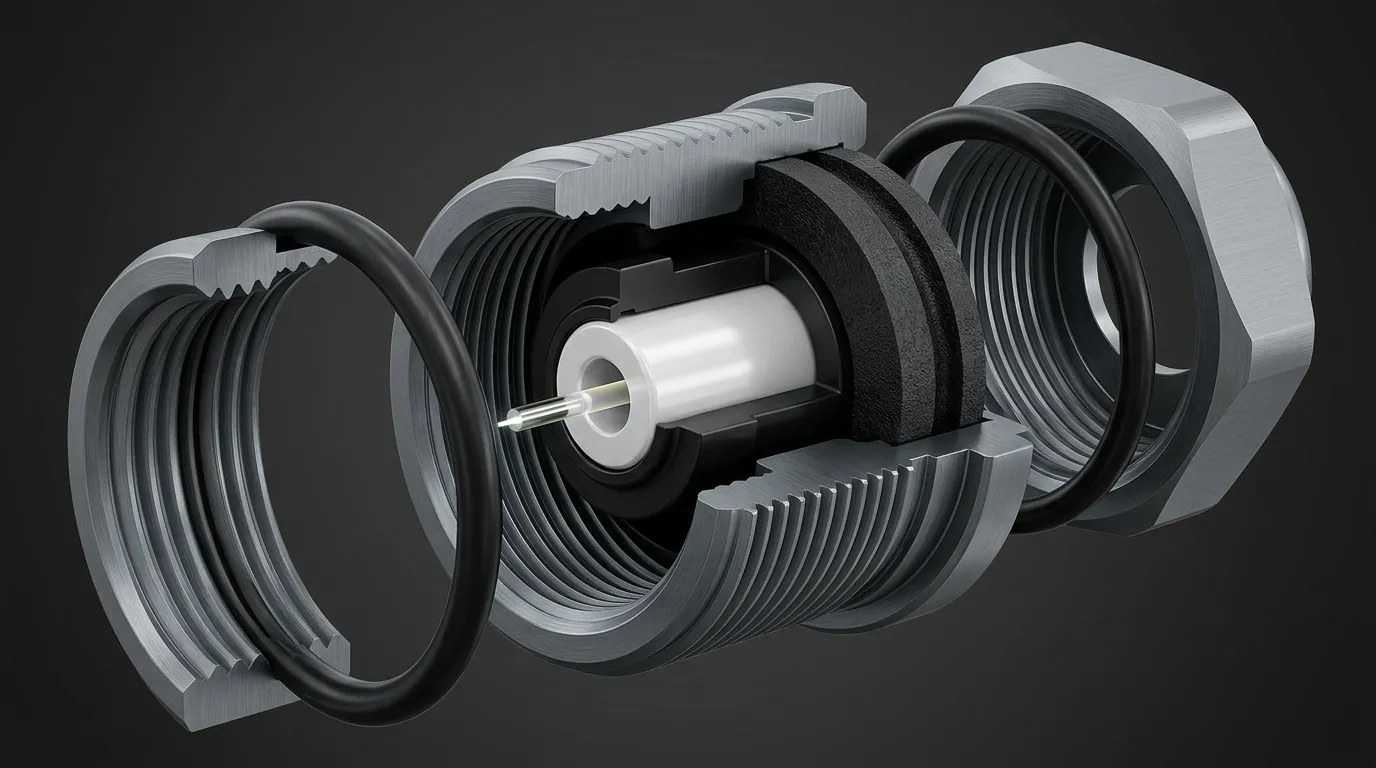
Where the seal lives: O-ring, gasket, and threaded gland isolate the ferrule from the environment.
(IP69K, the high-pressure washdown rating, shows up in comparisons from time to time. It tests hot water jets at close range — relevant for food processing and vehicle washdowns, rarely for cell towers.)
What Actually Kills Outdoor Fiber Connectors on a Tower
The IP digits test dust and water under controlled conditions. Tower hardware fails for reasons those digits never measure:
- UV radiation degrades rubber seals and plastic housings over years of exposure; an indoor-grade connector loses its seal long before it leaks visibly.
- Thermal cycling — tower-top temperature swings of -40 to +70 °C make sealed enclosures "breathe." Condensation forms inside, and the pressure differential can pull moisture past a seal that passed its immersion test at the factory.
- Vibration from antennas and wind loads relaxes threaded couplings and compresses O-rings unevenly, opening micro-gaps.
- Salt spray near coastlines attacks metal coupling rings and accelerates seal hardening.
- Cable entry is the classic weak point: a correctly rated connector mated to an incorrectly torqued gland or an undersized cable boot is no longer IP67 at all.
- Mating cycles — every disconnect and reconnect wears the sealing surfaces. A connector rated for 200 cycles and touched monthly has a very different life than one sealed once at the factory.
- Contamination on unmated ends — an open connector on a tower accumulates dust and grit that then grinds the ferrule when it is finally mated. Sealing caps exist for exactly this reason.
When one of these fails, the symptom is usually intermittent optical loss, not a clean outage — the kind of problem that sends a technician up the tower to find a connection that "looks fine." That truck roll costs far more than the connector it replaces, which is why our FTTA cable assembly comparison spends so much time on sealing and retention rather than just insertion loss.
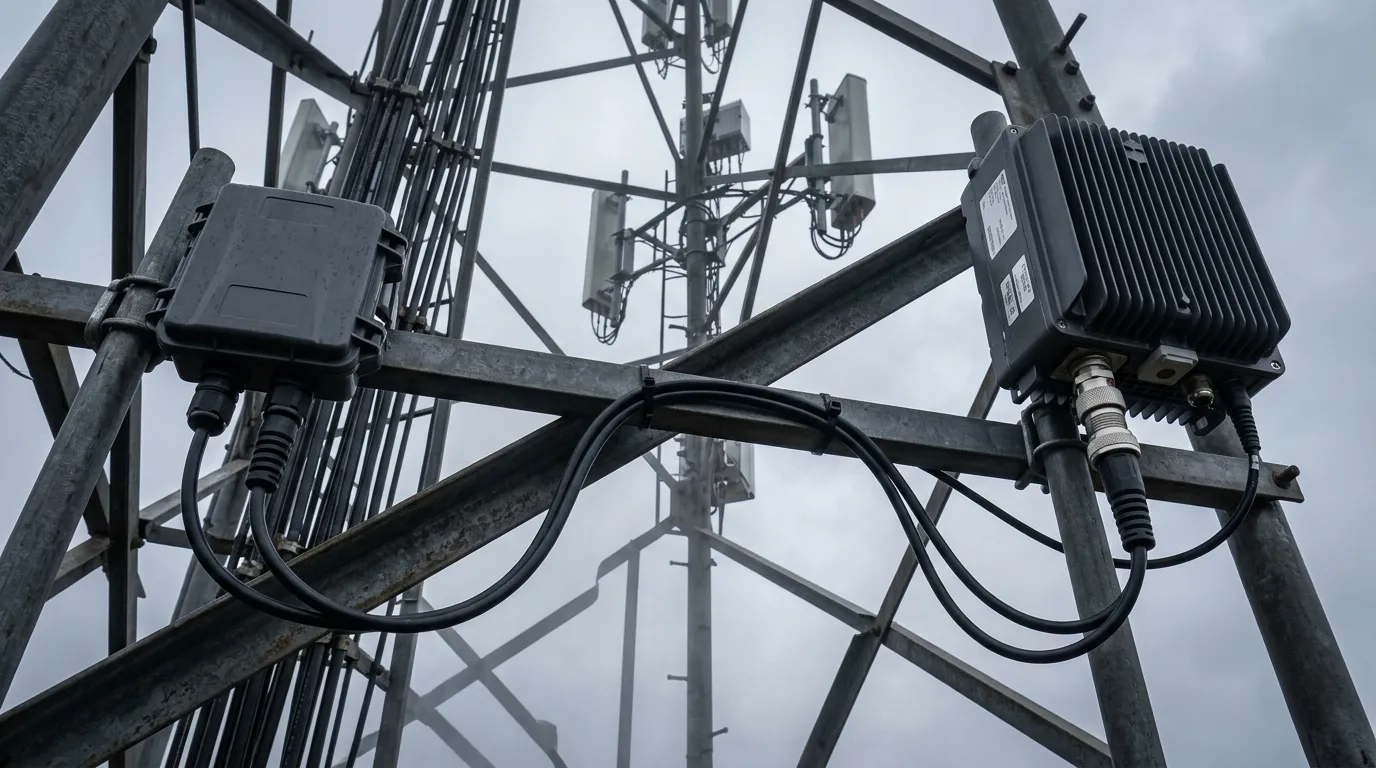
What tower connections face: UV, thermal cycling, vibration, and salt — none of which the IP digits test.
This is also why we test beyond the IP digits at the factory. DYS's in-house reliability lab runs an IPX8 flooding pressure tester, a salt spray chamber, a vibration table, programmable temperature and humidity chambers, and automated insertion and extraction force testing, with methods aligned to GR-326 — the telecom industry's connector reliability standard. An IP rating is the entry ticket; the environmental and mechanical tests are where "survives on a tower" is actually decided.
IP67 vs IP68 for Tower Hardware: When Each Is Enough
Match the rating to the position, not to a default preference for the higher number:
Tower position | Submersion risk | Rating that works | Why |
|---|---|---|---|
Tower-top jumper (BBU to RRU), vertical run | Low — water runs off | IP67 | Dust-tight matters more than submersion at height |
Ground-level connection on an equipment pad | Medium — pooling, seasonal flooding | IP67 minimum; IP68 where standing water persists | Puddles are the classic IP67 scenario |
Vault, manhole, or below-grade enclosure | High — persistent standing water | IP68 with an explicit depth/duration spec | The parenthetical number is the spec |
Coastal or industrial site | Low submersion, high corrosion | IP67 or IP68, plus salt-spray test data | Rating alone does not cover salt exposure |
Two more decisions sit next to the rating. Termination method: a factory pre-terminated assembly is sealed in controlled conditions, while a field-terminated connector depends on the installer's torque and cleanliness — the honest tradeoff is lead time and flexibility against consistency. Access frequency: if technicians reconnect the jumper regularly for maintenance or SFP access, a tool-free quick-connect design with decent retention beats a sealed-for-life coupling that gets damaged by repeated forced unmating.
Concrete examples make the abstract numbers real. Our IP67-rated IPFX assembly (SC, LC, or MPO) is tool-free with 150 N (33 lb) axial cable retention for FTTA and small-cell runs; the ODVA connector is IP68 (1 m, 1 h) with an industrial-LC interface per IEC 61076-3-106 for distribution-box-to-RRH connections; and the IPSCAPC fast connector brings the same IP68 (1 m, 1 h) rating to field-terminated SC/APC drop-cable deployments. Each datasheet states the parenthetical immersion spec, the insertion loss (≤0.15 dB typical for the ODVA and IPFX families, ≤0.2 dB for IPSCAPC), and the operating temperature range — the three numbers that turn "IP68" from a claim into a spec.
How to Verify a "Waterproof" Connector Before You Buy
Before you put any outdoor connector into a bill of materials, ask the supplier for five things and put them in writing:
- The full immersion specification in parentheses — IP68 (1 m, 1 h) or similar. If the datasheet says only "IP68," ask for the depth and duration.
- Optical performance: insertion loss and return loss at the operating wavelengths (typically 1310/1550 nm for single-mode), with typical and maximum values.
- Environmental range: operating and storage temperature, plus salt-spray and UV test data if the site needs them.
- Durability: the rated mating cycles — 200 cycles is a common baseline for outdoor connector families.
- Standards compliance: GR-1320, IEC 61753-1, and IEC 61754-4 are the usual references for connector performance and interfaces — and per-unit test reports if the application is critical.
A useful RFQ line looks like this:
Outdoor FTTA jumper, LC/APC, IP68 (1 m, 1 h) per IEC 60529, insertion loss ≤0.3 dB max, operating temperature -20 to +70 °C, 200 mating cycles, per GR-1320.
Once the assemblies arrive, our fiber optic testing guide walks through verifying insertion loss and continuity on site, because a connector is only as good as the test that proves it.
FAQ: IP67 vs IP68, Answered
Is IP67 ok for heavy rain? Yes. Rain is water jets, not immersion, and IP67's dust-tight first digit plus the immersion-rated second digit covers driving rain comfortably. IP67 fails where water collects, not where it falls.
Does IP68 mean fully waterproof? No. It means the product passed continuous immersion at a manufacturer-specified depth and duration. "Waterproof" is not a defined term, and no rating covers aging seals, repeated mating, or thermal cycling.
What is better, IP68 or IPX8? IPX8 declares water protection only — the dust rating is missing. For outdoor fiber, dust-tight matters (grit destroys ferrules), so prefer a full IP68 with a parenthetical spec over an IPX8 claim.
Is IP65 good enough for outdoor use? For sheltered, drainable positions — yes. For anything that can sit in standing water or flood, step up to IP67 at minimum. IP65 resists jets, not submersion.
The Bottom Line for Tower Specs
The difference between IP67 and IP68 is one test: immersion depth and time. Spec the rating by position — IP67 for tower-top and drained runs, IP68 with an explicit depth and duration for anything that can sit in water — and never accept an IP68 claim without its parenthetical spec. Then verify what the rating does not cover: UV, vibration, salt, mating cycles, and cable entry. If you are specifying waterproof FTTA jumpers for a tower build, the FTTA and 5G Fiber hub on this site ties together the connector families, cable types, and CPRI background you will need — or request datasheets and test data directly from DYS Fiber Optic, a 17-year fiber manufacturer with a reliability lab built for exactly these questions.