
FTTA / 5G
The True Cost of a Tower Top Failure: Truck Rolls
Ask an operations manager what a tower top failure costs and you will usually get the price of the part that failed. That number is close to irrelevant. The true cost of a tower top failure on a cell site is the dispatch — one, often two — plus the crew's exposure while they are up there, plus the traffic the site did not carry while they were driving to it. On a cellular tower the failed jumper or connector is a rounding error next to the truck roll that replaces it, and the roll is the only line item that recurs when the fix does not hold.
This is a cost breakdown, not a security or safety manual and not a substitute for the FTTA groundwork. If the BBU-to-RRU architecture is new to you, the FTTA and 5G Fiber guide and our introduction to FTTA cover it first. What follows is the bill: five line items you can estimate separately, the field failure modes that generate them, and the cable and connector decisions that move the total.
A Tower Top Failure Bills You in Five Places
The reason tower top failure cost is so hard to argue about in a budget meeting is that nobody puts the five line items on one sheet. Unit cost lives in procurement. Dispatch lives in field operations. Risk lives in insurance. Outage lives in the NOC and, in the United States, partly in the FCC's Network Outage Reporting System. Re-failure is not recorded anywhere, because by then it is a new ticket.
Line item | Where the money goes | What a buyer can influence |
|---|---|---|
| Travel, access coordination, a climb-qualified crew, overtime if the window is at night | First-visit completion rate (some benchmarks call it first-time-fix rate); pre-terminated assemblies that arrive sealed and tested |
| The same fault returns, or was never found the first time | Diagnostics on site, and specification of the parts that actually fail |
| Falls, hoisting, weather and structural hazards while on the tower | Fewer climbs per site-year — the only lever that touches every other line |
| Traffic not carried, SLA credits, reporting obligations, churn risk | Detection before customers notice; shorter mean time to repair |
| The replaced part was not the root cause once the route and sealing were examined | Cable construction, sealing, and the environmental evidence on the datasheet |
Read the table top to bottom and the shape of the problem appears: four of the five lines are service costs, and three of them are proportional to how many times someone has to climb. A cheaper connector that sends a crew up twice will always cost more than an expensive one that sends them up once. That arithmetic is usually invisible because the two numbers never appear on the same page — but it is the whole argument for specifying outdoor hardware properly.
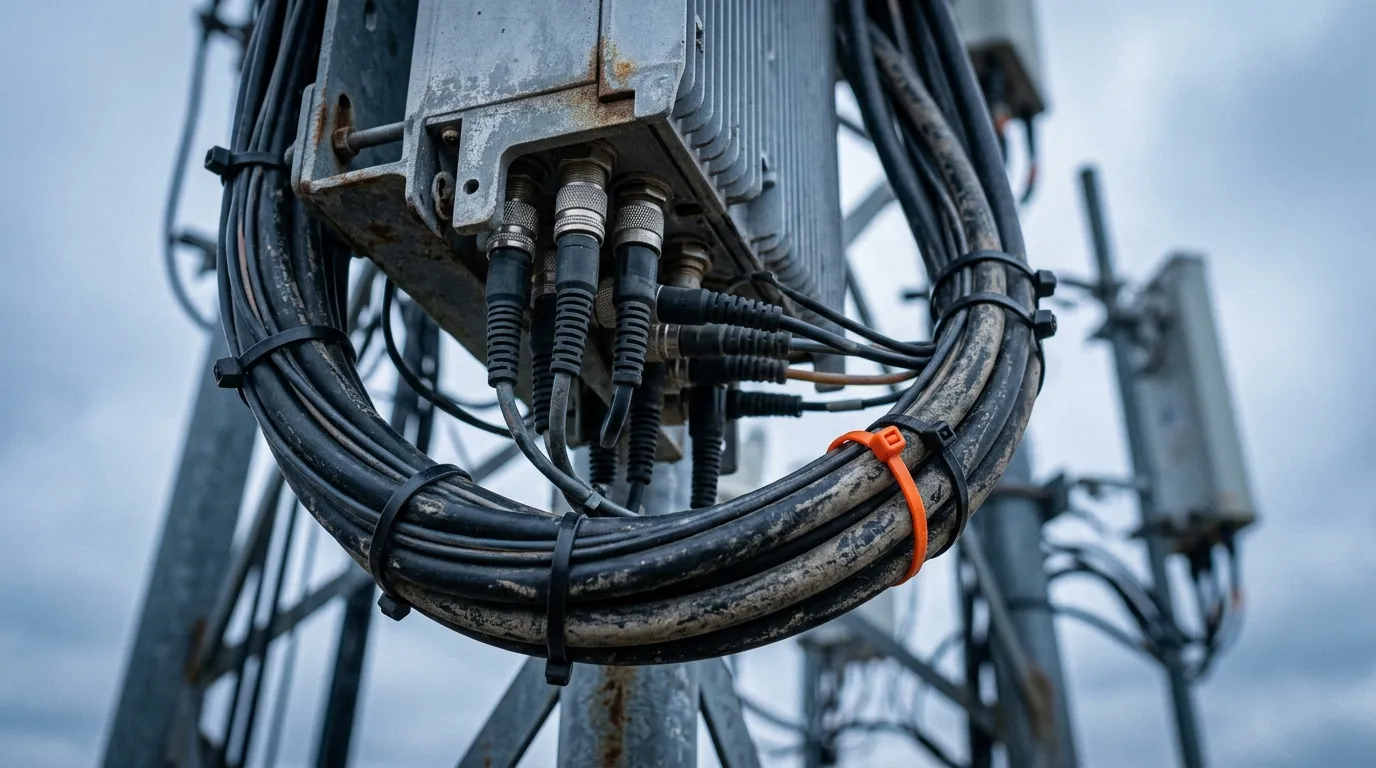
The connection point where four of the five line items originate.
What a Truck Roll to a Cell Site Actually Costs
There is no universal dispatch price, but there is a published range. Field-service benchmarks compiled for fiber operators put a fully loaded truck roll at $150 to $300, split into three bands: $125–$175 for operators running modern dispatch platforms with 90%+ first-visit completion, $175–$250 for partially automated operations, and $250–$350 where dispatch is still handled on spreadsheets and phone calls. Rural routes run 15–25% higher across all three bands because drive time is longer and job density is lower, according to the same truck roll cost benchmarks for fiber operators.
Two adjustments matter before you apply those bands to a tower top failure. First, the benchmarks describe fiber field operations generally — installs and repairs at ground level or in customer premises. A climb-qualified two-person crew with rescue capability and a weather window sits at or above the high band, and we have not seen a public benchmark that isolates tower work; treat the high band as the floor, not the estimate. Second, and more important, the benchmark that counts is not the cost per dispatch. It is the cost per resolved fault.
The arithmetic behind that second point is simple. If a dispatch costs $200 and the first-visit completion rate is 75%, the effective cost of each completed job is about $267, because one job in four needs a second visit. At a 90% completion rate the same $200 dispatch resolves a fault for $222. That 15-point gap is worth $45 per job, and it is why first-visit completion rate is the single most-edited number in field-service budgets.
Now apply that to an intermittent fault. A tower top failure that shows up as fluctuating loss is the worst possible case for first-visit completion, because the fault may not reproduce while the technician is standing in front of it. The crew confirms the link, replaces the most suspicious part because they are already up there, and closes the ticket. If the loss returns in six weeks, line item 2 has already been spent — and nobody records it as a repeat of the first fault.
The Crew Risk Line Item Nobody Models
The cost of sending people up a tower does not appear as a per-site line item, which is exactly why it is easy to under-weight. It appears as insurance load, as the reason a job needs two people rather than one, and as the reason a climb waits for a safe weather window — and that wait is what stretches mean time to repair.
The hazard set is long-established. OSHA's communication tower pages list falls from height, electrical hazards, hoisting personnel and equipment with base-mounted drum hoists, inclement weather, falling objects, equipment failure and structural collapse, and note that crews work at heights from 100 feet to beyond 1,000 or 2,000 feet, year-round, in bad weather. The same page records 13 communication-tower-related fatalities in 2013, 12 in 2014, 3 in 2015 and 6 in 2016. That is historical data — it is the most recent series OSHA publishes on that page, and conditions and reporting have changed since, so read it as a floor on severity rather than a current rate.
For a present-day cost figure, the National Safety Council's injury-cost data gives $48,000 per medically consulted injury in 2024 and $1,540,000 per death, including wage losses, medical costs and administrative expenses. Neither number is specific to tower work, and neither is a number you will ever see on a maintenance plan. They are the reason a single additional climb per site-year is not free even when the labor hours are reimbursed.
The operational consequence is the part worth carrying into a specification discussion: every avoided climb avoids a piece of this line too. That is why the rest of this article is about what makes a tower-top connection fail, not about which connector is cheapest.
Why Tower Top Faults Show Up as Intermittent Loss
A fiber fault at the top of a tower rarely presents as a clean outage. It presents as loss that drifts, a link that passes in the morning and fails at 3 a.m., or an RF problem that keeps pointing back at a jumper. Four mechanisms account for most of it.
Failure mode | How it shows up | Billed as | Specification that limits it |
|---|---|---|---|
Water or vapour ingress at the connector | Drifting insertion loss, worse after rain or a freeze-thaw cycle | Line 2 and line 5 — the fix rarely holds | IP68 with a stated depth and duration, plus salt-mist data |
End-face contamination at mating | Raised insertion loss and degraded return loss | Line 1 and 2 — intermittent, hard to reproduce | Sealing caps, factory-terminated ends, inspected mating |
Thermal cycling and vibration | Enclosures breathe; couplings relax; seals harden | Line 5 — re-failure after a "successful" fix | Operating range, mating cycle rating, retention force |
UV and salt exposure | Slow hardening of seals and boots; corrosion on metal parts | Line 3 and 5 — years later | UV-resistant materials and salt-spray test data |
Water ingress. The IP digits are widely misread. The IEC's public summary of ingress protection ratings covers only what the two digits stand for and points readers to the standard for the testing conditions; in IEC 60529 itself, digit 7 is temporary immersion — 1 metre for 30 minutes — while digit 8 is continuous immersion at a depth and duration the manufacturer specifies. Both are dust-tight at digit 6, and neither tests UV, vibration or repeated mating. A datasheet that says only "IP68" is therefore not a specification; the parenthetical number is. This is the single most useful distinction to carry into a tower-top review, and it has a longer treatment in our breakdown of IP67 versus IP68 on outdoor connectors.
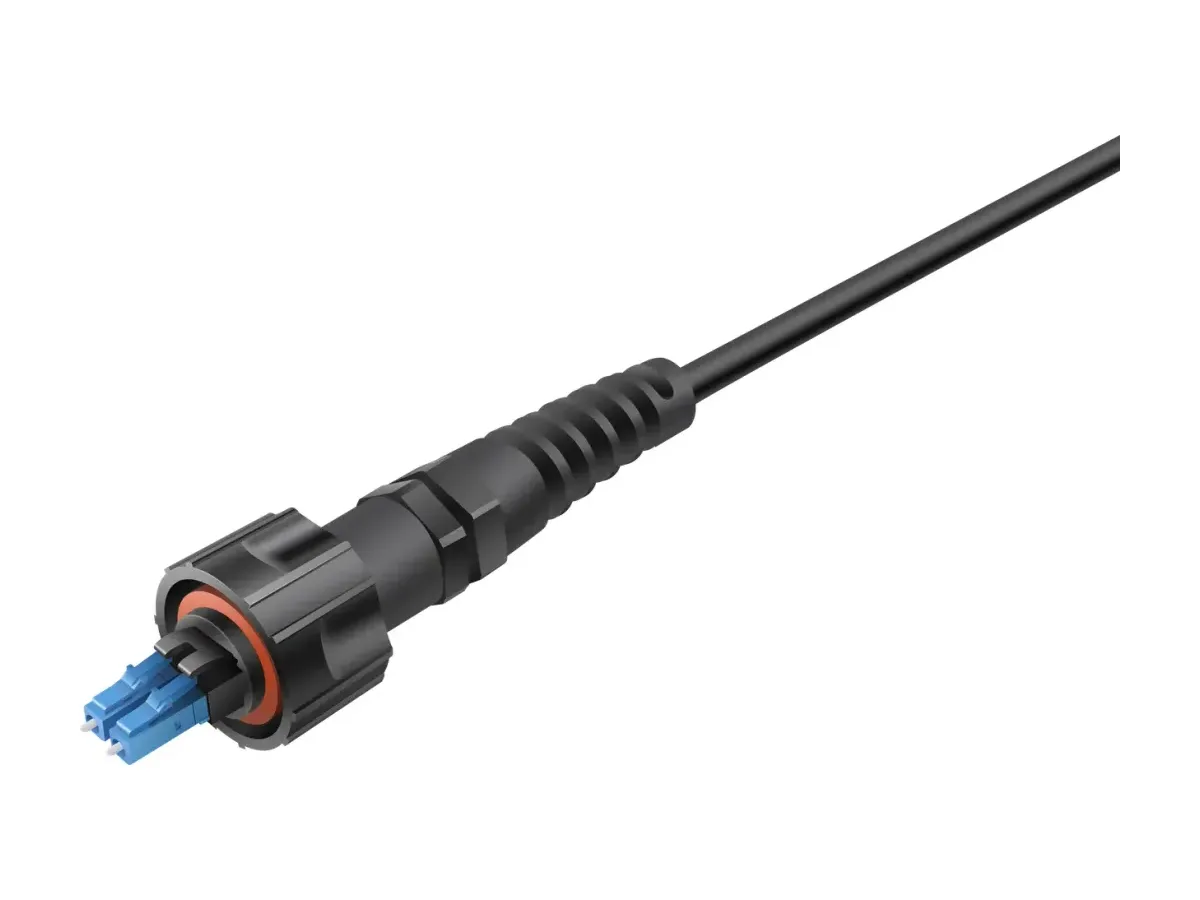
Where the loss usually starts: the face seal and coupling ring, not the ferrule.
Contamination at the mating interface. Every mate and unmate is an opportunity to trap grit on a surface measured in microns, and an open connector left on a tower collects dust before it is mated again. The damage does not announce itself; it appears as insertion loss that has crept up and return loss that has fallen. Because return loss is the metric that degrades first and shows up as reflected power rather than a dead link, a fault can live in the network for months while every test still says "up" — the relationship between the two measurements is covered in our comparison of insertion loss and return loss.
Thermal cycling, vibration and UV. Tower-top temperature ranges of -40 to +70 °C make a sealed enclosure breathe, and the pressure differential can drive moisture past a seal that passed its immersion test at the factory. Vibration from wind loading and antenna movement relaxes threaded couplings unevenly. UV hardens rubber. Salt attacks metal. These are the mechanisms that turn one repair into two, which is why the datasheet numbers that matter are operating temperature range, mating cycle rating and retention force, not just a waterproof claim.
The RF-side analogue. Not every tower top failure is optical, and the crew does not always know which one they are chasing. Anritsu's engineers describe sites where "performance issues for over 12 months" survived several site visits and tower work before testing identified the real cause: a jumper cable with a loose back nut. It is a passive intermodulation case rather than a fiber case, and it is the cleanest published illustration of the pattern that wrecks first-visit completion — an intermittent fault, multiple climbs, and a root cause that was mechanically trivial once found.
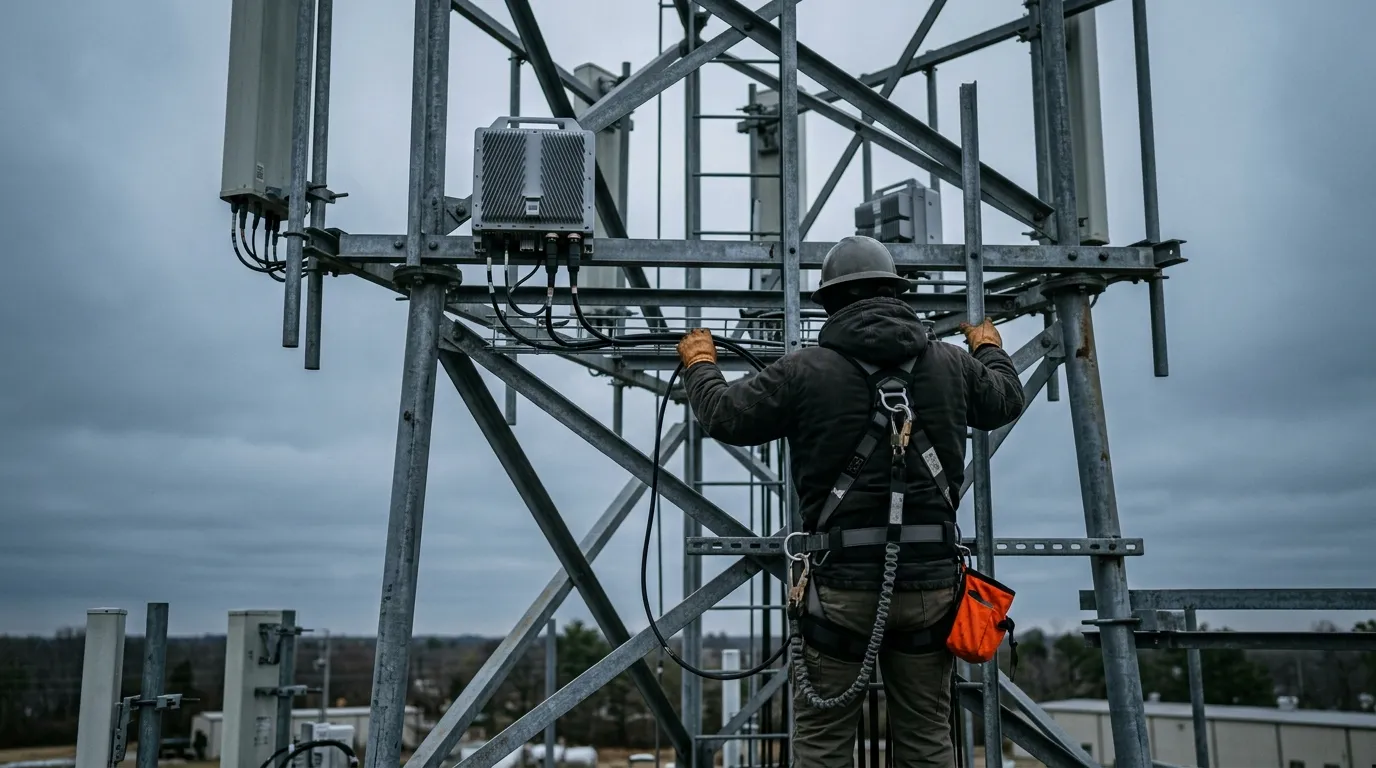
Every one of these climbs re-opens line items 1, 2 and 3 at the same time.
The Cable and Connector Decisions That Move the Number
Specification is where the cost stack becomes a purchasing decision. Five choices do most of the work.
1. Factory pre-terminated or field terminated. A factory-terminated assembly is polished, inspected and tested under controlled conditions, then shipped sealed; a field-terminated end depends on the installer's cleanliness, cleave quality and torque discipline, on a tower, in the weather. Field termination buys flexibility and shorter lead time, and it buys them with variance. If a site's economics are dominated by repeat dispatches, paying for factory termination is paying to remove a variable. The tradeoff between assembly families is worked through in our FTTA cable assembly comparison.
2. Read the IP rating as a specification, not a label. Require the parenthetical immersion figure, and require salt-mist test data and an operating temperature range alongside it. An IP67 part with demonstrated salt-mist durability can outlast an unqualified "IP68" claim on a coastal site, because the digit tests immersion and the site tests corrosion.
3. Demand typical and maximum optical values, at assembly level. A connector's insertion loss is not the assembly's insertion loss. Assembly loss is the mated connection loss plus the fiber attenuation over the length — which is why a competent datasheet writes it as a formula, such as a maximum of 0.3 dB plus 0.35 dB/km times length for single-mode UPC, rather than as one headline number. Compare vendors on the maximum, and check the return loss minimum for the polish grade you are buying.
4. Check durability and retention, not just waterproofing. A rated service life of 200 mating cycles and an axial cable retention figure tell you what happens on the tenth maintenance visit, when the same connection is opened again. Retention is also the number that survives wind loading and thermal movement without the coupling working loose.
5. Look at the cable, not only the connector. Aramid yarn strength members add tensile capability without metal, which keeps the run free of electromagnetic interference and gives lightning no conductive path to follow. A small-diameter subcable matters on towers because bundle limits are usually imposed by the site owner rather than chosen by the installer, and a bend radius the route can actually respect is worth more than a lower part price. Handling and sealing failures are manufacturing decisions as much as they are installation decisions, which is the terrain the FTTA and 5G fiber overview on this site covers at the architecture level.
Concrete examples make the arithmetic easier to argue. An IEC 61754-20 duplex LC outdoor assembly for the distribution-box-to-RRH run carries end-face geometry and quality specified to be tighter than IEC and GR-326 — the telecom connector reliability standard — with UV-resistant jacket materials, so the CPRI LC assembly is a documented reference point for that segment. Where the site sits in standing water, an IP68 (1 m, 1 hour) part such as the ODVA family states the parenthetical figure on the datasheet and rates -20 to +70 °C operating, with -40 to +85 °C storage — so a site whose ambient band drops below -20 °C needs a wider-rated assembly, not a deeper immersion figure. Where repeated maintenance access matters more than submersion, a tool-free IP67 design with 150 N axial retention trades immersion depth for a connection that survives being opened and closed.
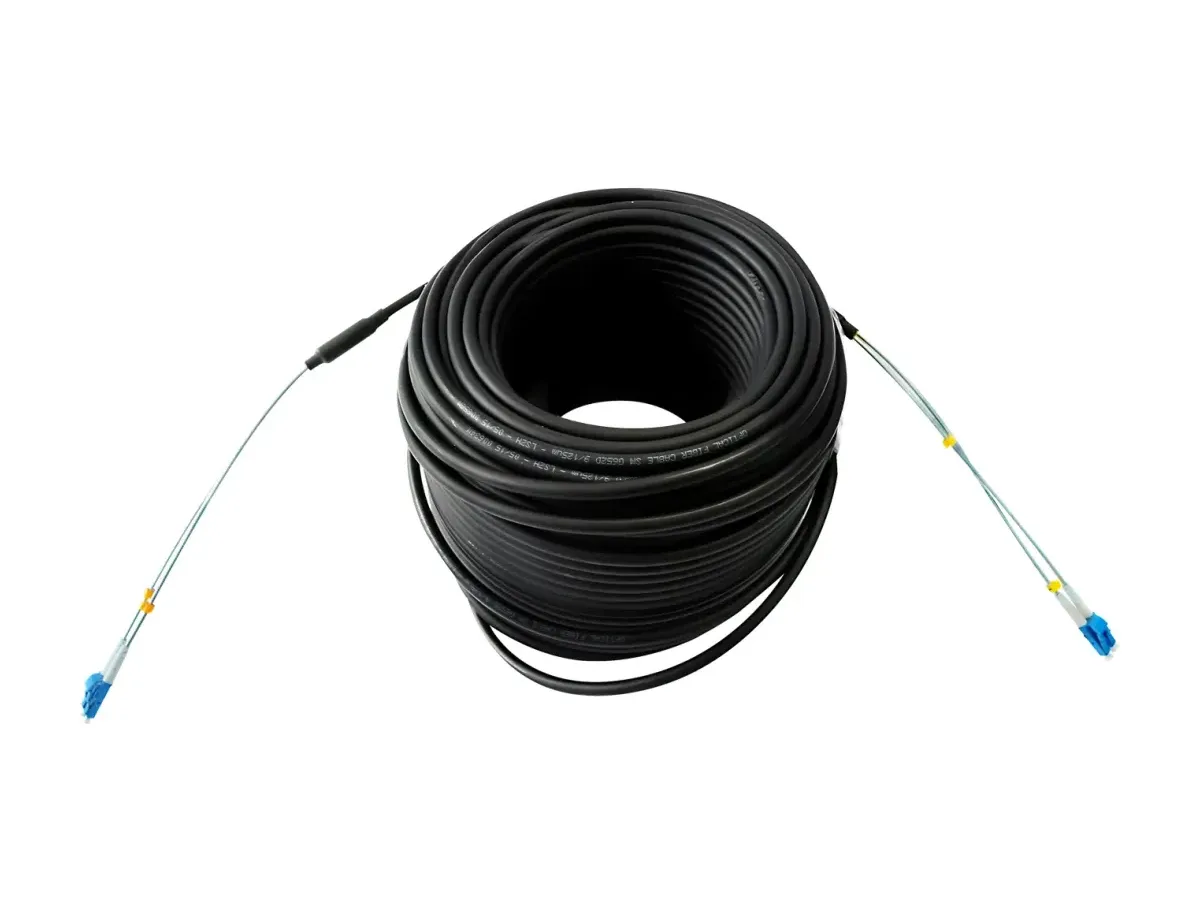
A factory-terminated assembly: polished, inspected and tested before it is sealed and shipped.
Those numbers come from a testing regime rather than from a marketing page. Our reliability laboratory runs an IPX8 flooding pressure tester, a salt spray chamber, a vibration table and programmable temperature and humidity chambers, with insertion and extraction force testing on the connector side, under methods aligned to GR-326 — with roughly 5,000 waterproof ends leaving the assembly lines each day. The point is not that any single test proves a part will survive your site. The point is that a tower-top decision should be made on evidence you can ask a supplier to produce, in the same way you would ask for an insertion loss report.
Pricing One Cell-Site Year: A Worked Example
Every coefficient below is an assumption you should replace with your own numbers. The structure is the reusable part; the figures are placeholders chosen to keep the arithmetic visible.
- Sites in scope: 1,200
- Share of sites seeing at least one tower-top fiber fault per year: 8% (assumption)
- Cost per dispatch, high band: $260
- First-visit completion rate: 75%, so 1.33 dispatches per resolved fault
- Average outage duration per incident: 4 hours (assumption)
Faults per year: 1,200 × 0.08 = 96. Dispatches: 96 × 1.33 ≈ 128. Direct dispatch cost: 128 × $260 ≈ $33,300 a year.
Now change one coefficient. Raise first-visit completion from 75% to 85% and dispatches fall to about 113 — roughly $3,900 a year on this footprint, from diagnosis and preparation rather than from hardware. Alternatively, suppose a specification change eliminates half of the 8% fault incidence by removing the water-ingress and contamination mechanisms: that is 48 faults avoided, about 64 dispatches, and roughly $16,600 a year — before any of the crew-exposure line, and before the outage line, which is where the number usually becomes large.
The outage line is deliberately left as a variable because it is yours to define. Two inputs turn it into a figure: the revenue attributable to the site per hour, and any SLA credit or reporting obligation the operator carries. For scale, note that unplanned downtime is expensive well beyond telecom — Siemens' 2024 study of the true cost of downtime puts an hour of lost production at $36,000 in fast-moving consumer goods and $2.3 million in automotive, or more than $600 a second, with the world's 500 biggest companies losing an estimated $1.4 trillion a year, about 11% of their revenues. That is manufacturing data, not a wireless benchmark, so it is an order-of-magnitude reference for how outage hours get priced elsewhere, not a number to copy into a cell-site model.
Run the same three sums with your own fault rate, dispatch price and completion rate, and you will have the argument that a parts price cannot make: the difference between a $12 connector and a $20 connector, across 1,200 sites, is $9,600 once. Adding one extra dispatch per fault across the same 96 faults is about $25,000 a year (96 × $260), and it recurs for as long as the fault does.
What to Put in the Specification
The checklist below is written to be pasted into a technical agreement or an RFQ, with each line tied to the cost item it protects.
Requirement | What to write | Protects against |
|---|---|---|
Ingress protection | IP67 or IP68 with the parenthetical depth and duration, plus salt-mist test data | Line 5, re-failure |
Operating temperature | The site's real range, typically -40 to +70 °C or wider, stated for the assembly | Line 2, intermittent loss |
Insertion loss | Typical and maximum, at assembly level, as a formula including dB/km and length | Line 1, false pass |
Return loss | Minimum for the polish grade in use (for example 60 dB for SM-APC) | Line 2, undetected drift |
Durability | Mating cycle rating and axial cable retention force | Line 5, maintenance wear |
Standards | GR-326-aligned test methods, plus the interface standard for the connector type | Line 3, avoidable climbs |
Interface and materials | Connector type and polish, jacket material, UV resistance, bend radius | Line 5, route damage |
A usable RFQ line reads like this:
Outdoor FTTA jumper for distribution-box-to-RRH run, duplex LC/APC per IEC 61754-20, IP68 (1 m, 1 h), insertion loss ≤0.3 dB max at assembly level plus 0.35 dB/km, return loss ≥60 dB, operating temperature -40 to +70 °C, 200 mating cycles, UV-resistant jacket, salt-mist test report, per GR-326-aligned methods.
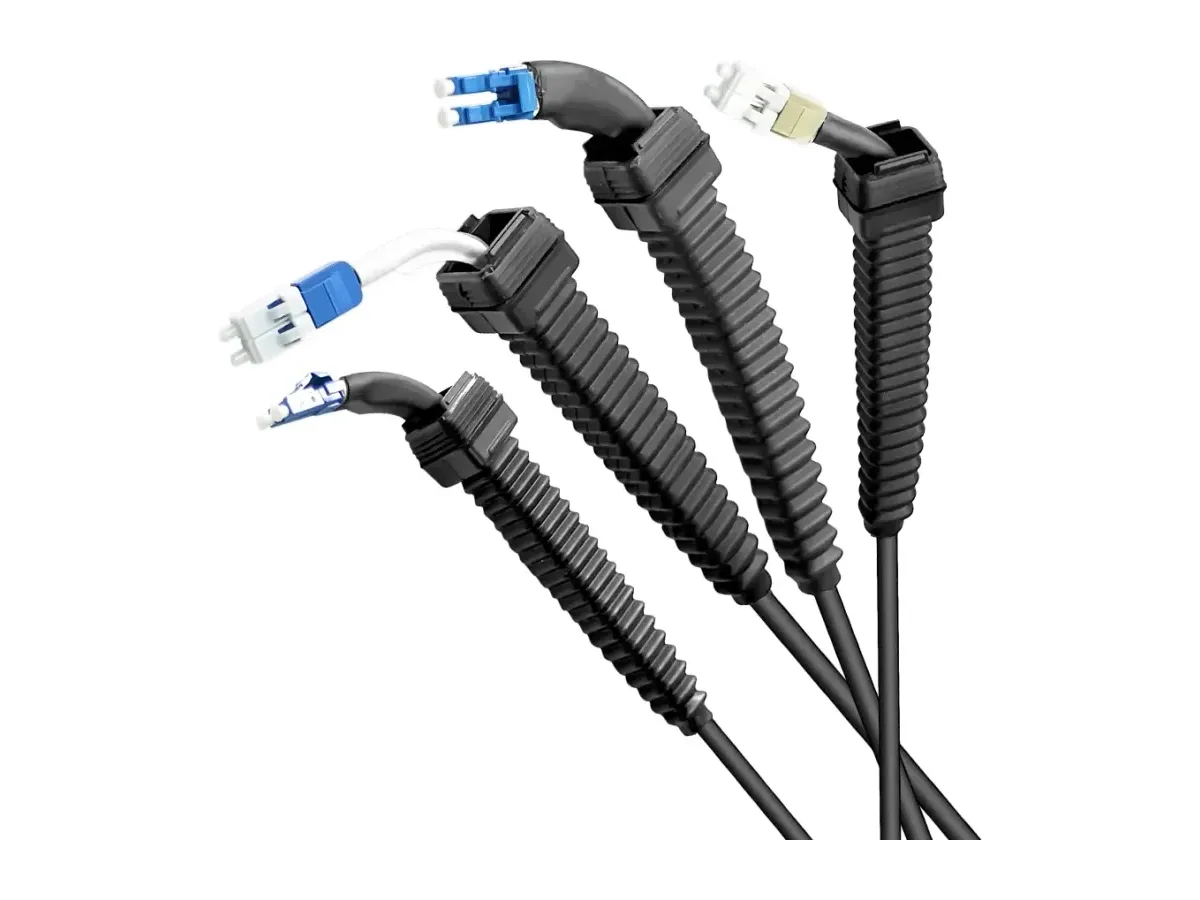
The sealing boot and strain relief are the parts a line item has to name explicitly.
Two habits make the checklist stick. First, require evidence at receipt, not at the factory gate — after the assemblies arrive, verify insertion loss and continuity with a light source, power meter or OTDR following a documented procedure, which is exactly what our fiber optic testing guide walks through. Second, treat every repeat dispatch as data: capture the failure mode, the time since installation, and whether water, contamination or mechanics were involved. Six months of that log is more useful for the next specification than any general benchmark, including this one.
The Line Item You Can Actually Control
By the time a tower top failure is being investigated, every expensive decision has already been made. The dispatch is booked, the crew is climbing, and the outage has happened. The one moment when a buyer can still influence the total is the moment the part is chosen — and the useful question at that moment is not "what does this connector cost" but "how many times will this connector send someone up a tower."
That reframing is what the five line items are for. Put your own fault rate and dispatch price into the worked example, and the comparison between two connector prices stops being an argument about a few dollars per piece. If you are specifying outdoor assemblies for a tower build and want the datasheets, the parenthetical immersion figures and the test reports in one place, our FTTA and 5G Fiber guide collects the connector families and cable types, or you can request the specifications and GR-326-aligned test data directly from DYS Fiber Optic.