
FTTA / 5G
How to Qualify an FTTA Cable Assembly Supplier
Qualifying an FTTA cable assembly supplier is an evidence exercise, not a price comparison. The assembly is one of the cheapest items in a cell-site bill of materials, and it is the item that most reliably sends a technician up a tower when it fails — which is why a jumper that saves a few dollars per piece can cost far more than it saves.
So the qualification has to answer four questions, in this order: can the supplier build the part to your specification, can they prove it, can they repeat it in volume, and can they trace it after the order. Everything below is a way of collecting evidence for those four answers before the purchase order exists. Seven gates, each with a pass condition and a failure signal.
The gates apply to any supplier you are evaluating. This page is the method; the FTTA and 5G Fiber guide is the index of the cable, connector and connector-standard material it draws on.
Why an FTTA Assembly Fails Qualification Before It Fails on the Tower
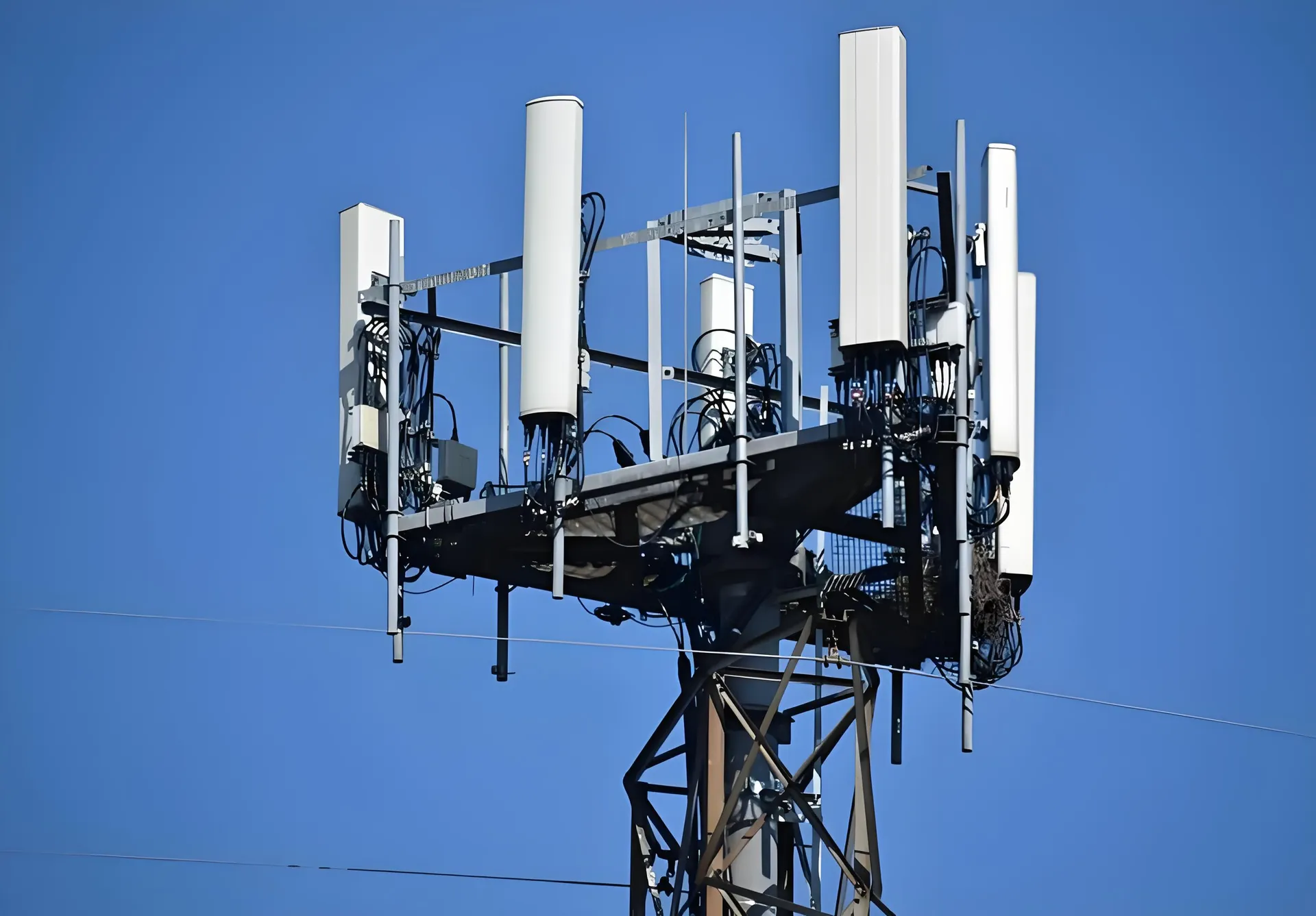
An FTTA run carries fronthaul traffic between the baseband unit or distributed unit (BBU/DU) at the bottom of the site and the remote radio unit, remote radio head or active antenna unit (RRU/RRH/AAU) at the top, usually over CPRI or eCPRI. The assembly is a short outdoor jumper: hardened connectors on both ends, a small-diameter indoor/outdoor cable between them, and a sealing interface at each end that has to survive UV, rain, ice, wind load, vibration and repeated maintenance access.
Every failure mode in that paragraph is decided before the goods ship — in the endface that was inspected or not, in the mating that was measured or not, in the jacket compound and the strength layer that were specified or assumed, in the batch record that was kept or not.
The economics are lopsided in a way that procurement spreadsheets rarely capture. A failed tower-top connection is not replaced by the price difference between two suppliers; it is replaced by a dispatch, sometimes two when the first fix does not hold, plus the crew's exposure while they are up there and the traffic the site did not carry while they were driving. The line-item breakdown of what a tower-top failure costs works through those items; the short version is that the part price is a rounding error and the recovery is not. That asymmetry is the whole reason a qualification process is worth two weeks of someone's time.
The Seven Gates of an FTTA Supplier Qualification
Run the gates in order. Each one is cheap compared with the one after it, and each one can end the evaluation — which is the point. Failing a supplier at Gate 1 costs an email; failing one at Gate 7 costs a volume order.
Gate | What you are testing | Evidence you need | Failure signal |
|---|---|---|---|
1 · Spec | Can they build your part? | Written spec sheet they must answer line by line | Answers that restate marketing copy instead of confirming values |
2 · Test data | Can they prove performance? | Test reports with method, sample size, limits | One typical value, no maximum, no method |
3 · Certificates | Is the claim true for your part? | Certificate + scope + file/registration number | Logo on a slide, no number, "it's the same factory" |
4 · Sample | Does the physical part match the paper? | Measured sample against the spec sheet | Sample that differs from the datasheet |
5 · Line audit | Can they repeat it? | Process control, calibration, in-process tests | Capacity claimed that the equipment cannot produce |
6 · Traceability | Can you find out what happened later? | Lot codes, batch reports, change notification | "We can check with the workshop" |
7 · Commercials | Do the terms protect the technical agreement? | MOQ, lead time, warranty, audit rights, spec freeze | Price agreed before the spec is frozen |
Two rules make the gates work. First, no gate is passed verbally — every one produces a document or a measured value. Second, run all seven on two or three suppliers before negotiating price with any of them, because the scorecard further down this page is only comparable if its inputs are.
Gate 1 — Write the Spec Before You Read Any Datasheet
A datasheet describes what a supplier already makes. A specification describes what you need. If you read datasheets first, your requirements quietly become whatever the first supplier offers — and every later supplier gets judged against that accident.
Write the spec as numbered lines the supplier must answer one by one. For a tower-top assembly it takes about a page:
Line | What to fix | Why it decides cost and risk |
|---|---|---|
Interface | LC, SC or MPO/MTP, duplex or single, and the standard: LC per IEC 61754-20, industrial LC (ODVA) per IEC 61076-3-106 | The interface must match the radio vendor's port and the site's maintenance routine |
Connector family | ODVA, NSN-style boot, FullAXS-style open bulkhead, PDLC | Determines whether a technician can reach the SFP without breaking the seal |
Sealing | IP rating (IP65, IP66, IP67 or IP68) with the parenthetical conditions | "IP68" alone is not a specification |
Cable construction | Fiber count, 900 µm or 2.0 mm subunits, aramid yarn strength member, armour, jacket compound (LSZH, PE, TPU or PVC) | Sets tensile, crush and rodent performance — and the OD that fits the tower bundle |
Optical limits | Insertion loss maximum and return loss minimum, at the polish grade in use | The lines you will actually reject a shipment against |
Mechanical limits | Tensile (short/long term), crush, dynamic and static bend radius, operating and storage temperature | Compare with the real installation route, not with a catalogue average |
Length and marking | Length tolerance, labelling, drum or reel packing | Site-level mistakes are mostly length and label mistakes |
Documentation | Test report per batch, certificate of conformance, lot code | Feeds Gates 2 and 6 |
Four outdoor families dominate tower deployments, and they solve four different problems. ODVA buys intermateability with industrial-LC adapters. The NSN-style boot follows the radio vendor's ecosystem. The FullAXS-style family (listed as FULLX LC in some ranges) opens the bulkhead so a technician can reach the SFP. PDLC stays compact on a standard LC adapter. Our sibling article sets out ODVA, NSN boot, FullAXS and PDLC compared in full; the point here is that the choice belongs in your spec, not in the supplier's standard product list.
The interface line deserves the same treatment as the family line: LC, SC and MPO/MTP footprints are not interchangeable, and the fiber count, the polish grade and the polarity of an MPO/MTP trunk all have to be written down, not left to the supplier's default.
Sealing deserves the same precision. IEC 60529 defines the second digit as an immersion test with different severities: digit 7 is temporary immersion — one metre for 30 minutes — while digit 8 is continuous immersion at a depth and duration the manufacturer specifies. IEC publishes a short explanation of what the two digits cover and sells the standard itself as IEC 60529. Neither digit tests UV, vibration or repeated re-mating, which is why a datasheet that says only "IP68" tells you almost nothing about a tower-top part; the meaningful version is "IP68 (1 m, 1 h)" or "IP68 (2 m, 24 h)". The distinction is worth spelling out in your spec and is covered in more depth in our IP67 versus IP68 breakdown.
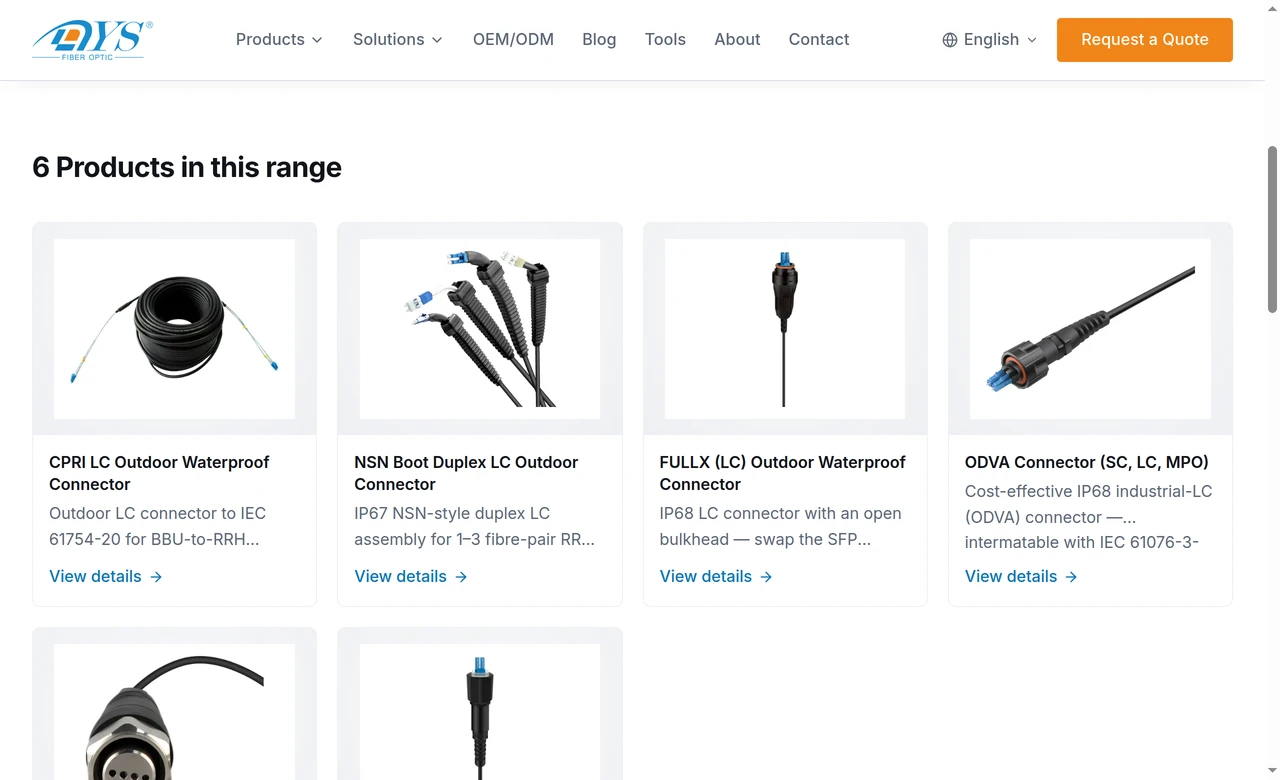
The six outdoor connector families a tower spec has to choose between — each one mates to a different radio-side reality.
Gate 2 — Read Test Data, Not the Datasheet Headline
A performance claim is only usable if you know three things: what value, measured how, on how many pieces. Ask for all three, and read the report rather than the summary line.
Typical versus maximum. "Insertion loss 0.15 dB" with no qualifier is usually a typical value from a good run. What a purchase order needs is the maximum the supplier commits to, because that is the number you reject against. When a supplier can only give you a typical figure, treat the specification as unconfirmed.
Connector level versus assembly level. A connector's insertion loss is not the assembly's. Assembly loss is the mated connection loss plus the attenuation of the fiber over the length, so a competent datasheet writes it as a formula — a maximum at the connector, plus dB/km multiplied by length — rather than one headline number. For a single-mode UPC assembly, a limit shaped like "≤0.3 dB max at the mated pair, plus 0.35 dB/km" is a specification; a bare "≤0.3 dB" is marketing. Return loss is graded differently by polish: UPC and APC interfaces have different minima, and single-mode APC is normally the higher figure.
Which standard defines the test. This is the part that separates a test report from a measurement anecdote. The relevant documents:
Standard | What it settles | Where it applies in this article |
|---|---|---|
Defines the tests and severities that performance standards for passive fiber optic components are drafted around — the category (environment) a product is qualified for | Gate 2 and Gate 4: which tests, how severe | |
Visual inspection of connector endfaces: how debris, scratches and defects are observed and classified | Gate 4: sample and endface inspection | |
Telcordia GR-326 | Generic requirements for single-mode connectors and jumper assemblies: the mechanical and environmental test sequences the telecom industry buys against | Gate 2 and Gate 5: reliability test programme |
IEC 60794 series | Test methods for optical fiber cables (tensile, crush, bend, temperature) | Gate 4: cable-level tests |
Workmanship and acceptance requirements for cable and wire harness assemblies | Gate 5: what an assembly operator is judged against |
A useful detail from IEC 61300-3-35 itself: the standard is explicit that visual inspection is in addition to, and does not replace, measurement of attenuation and return loss. A supplier whose evidence for a sample is a clean endface photo has shown you the weaker half of the evidence. On the field side, the Fiber Optic Association's reference on testing FTTA installations covers the handling, inspection, cleaning and test sequence a crew runs on site — useful for judging whether a supplier's out-of-box condition will survive your installer.
A report is only evidence if the equipment was in calibration when it was used. Ask for the calibration status behind the instrument, and whether that calibration is traceable to an ISO/IEC 17025-accredited laboratory — a certificate that cannot be traced back to an accredited calibration chain is a record of a number, not of a measurement.
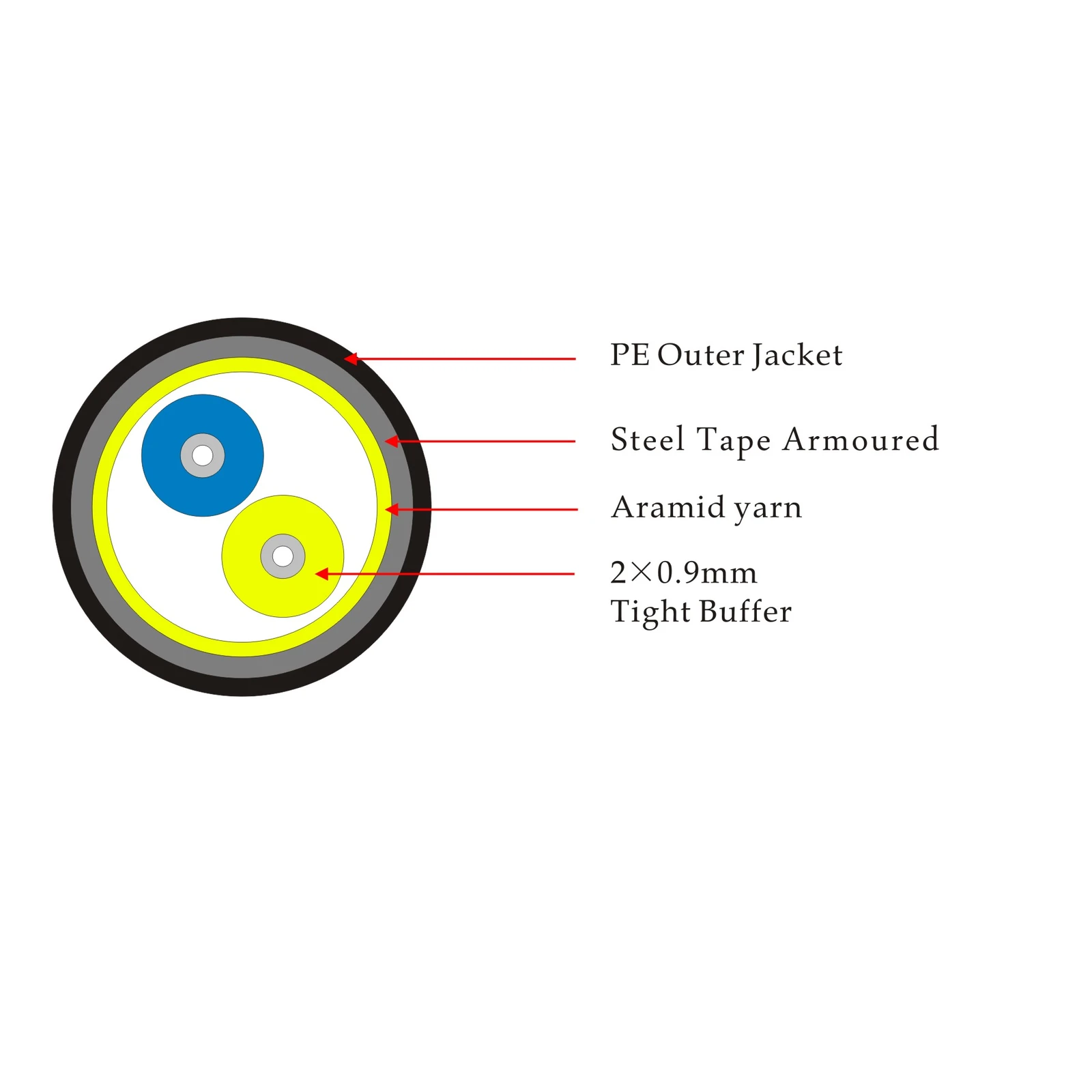
A datasheet's construction claims — armour, strength layer, subunit size — are checkable line by line against a cross-section like this one.
Gate 3 — Match Certificates to the Exact Part and the Site
Certificates are where qualifications are most often decided on the wrong object. A quality-management certificate covers a company. A product certification covers a product or a part number. Your assembly is a third thing, and the question is whether it falls inside the scope of what was certified.
Certificate | What it actually covers | How you verify it |
|---|---|---|
ISO 9001 | The supplier's quality management system | Certificate number, issuing body, scope statement, validity dates — with the legal entity that will be invoiced |
Quality management written for the telecom supply chain, with performance metrics added on top of ISO 9001 | Same check, plus the registration level and the measurement set | |
UL listing (OFNP/OFNR) | The particular cable construction tested to the applicable fire test | Look the file number up in UL Product iQ and match the listing against the exact construction you are buying |
CPR fire classification | EU construction-product reaction-to-fire class — for example B2ca, DCa, ECA under Regulation (EU) No 305/2011; the class your project needs is set by the installation rules, not by the supplier's best certificate (see CPR fire ratings for fiber cable in the EU) | Class letter plus the declaration of performance, matched to the jacket construction |
RoHS and REACH | Substance restrictions and chemical compliance for EU market placement | Declaration against the directive number, per material |
Market access for telecom products sold in Brazil | Homologation record against the product, not the company |
Two habits make this gate fast. First, ask for the certificate in the context of the part you are buying — a listing that covers a different fiber count, jacket compound or diameter is a different product. Second, check one certificate yourself rather than reading the deck: the UL listing is the one that most often fails the check, because listings are tied to a construction and a factory site. Verifying a fiber cable supplier's UL listing walks through the lookup step by step, and the difference between a company system certificate and a telecom-specific one is set out in ISO 9001 versus TL 9000.
If a supplier holds several certificates, ask which one applies to each part number you are buying. A supplier that can answer that question in a table has already passed most of the gate.
Gate 4 — Sample Evaluation: What to Measure, Not Just Look At
A sample evaluation with no plan degenerates into a visual check and a good impression. Give it the same structure as the spec: a fixed sample quantity, a fixed test list, and a pass/fail limit copied from Gate 1.
Check | What to do | Pass condition |
|---|---|---|
Endface | Inspect both ends under magnification and classify per IEC 61300-3-35 | Within zone criteria, no uncleaned debris, and no reliance on the photo alone |
Mated insertion loss | Measure the assembly as a mated pair, at the wavelength you will run | At or below the maximum in your spec (not the typical) |
Return loss | Measure at the polish grade you are buying (UPC or APC) | At or above the minimum for that grade |
Geometry | Interferometry on a sample of ferrules (radius of curvature, apex offset, fiber height) | Within the interface standard's window |
Mechanical | Tensile and crush the cable, and test connector retention in the direction of pull | At or above the short/long-term figures in the spec |
Sealing | Immersion at the depth and duration written into the spec | No ingress, and the same result after re-mating |
Environment | Temperature cycling; salt mist where the site is coastal; vibration for the tower structure | No optical drift past the limit; no cracking or jacket deformation |
Durability | Repeated mating and unmating to the cycle count your maintenance routine implies | Limits still met at the end, not just at the start |
Two practical notes. Measure the mated pair, not the connector in isolation — endface geometry and boot sealing vary between manufacturers, so an intermateable interface does not guarantee an intermateable result. And re-measure after the environmental tests: a sample that passed at hour zero and drifted after temperature cycling has told you something the first report hid.
On instruments: an OTDR is the instrument of record for judging an installed run end to end, but it is a poor judge of a two-metre jumper — for an assembly, the mated insertion-loss and return-loss measurements are the primary numbers, and the OTDR belongs to the acceptance test your installer runs on site. Ask which instrument produced each figure in the report.
The point of the protocol is that it produces numbers you can compare across suppliers, so the delay of waiting for a second sample from a second vendor is paid back by being able to choose on evidence.
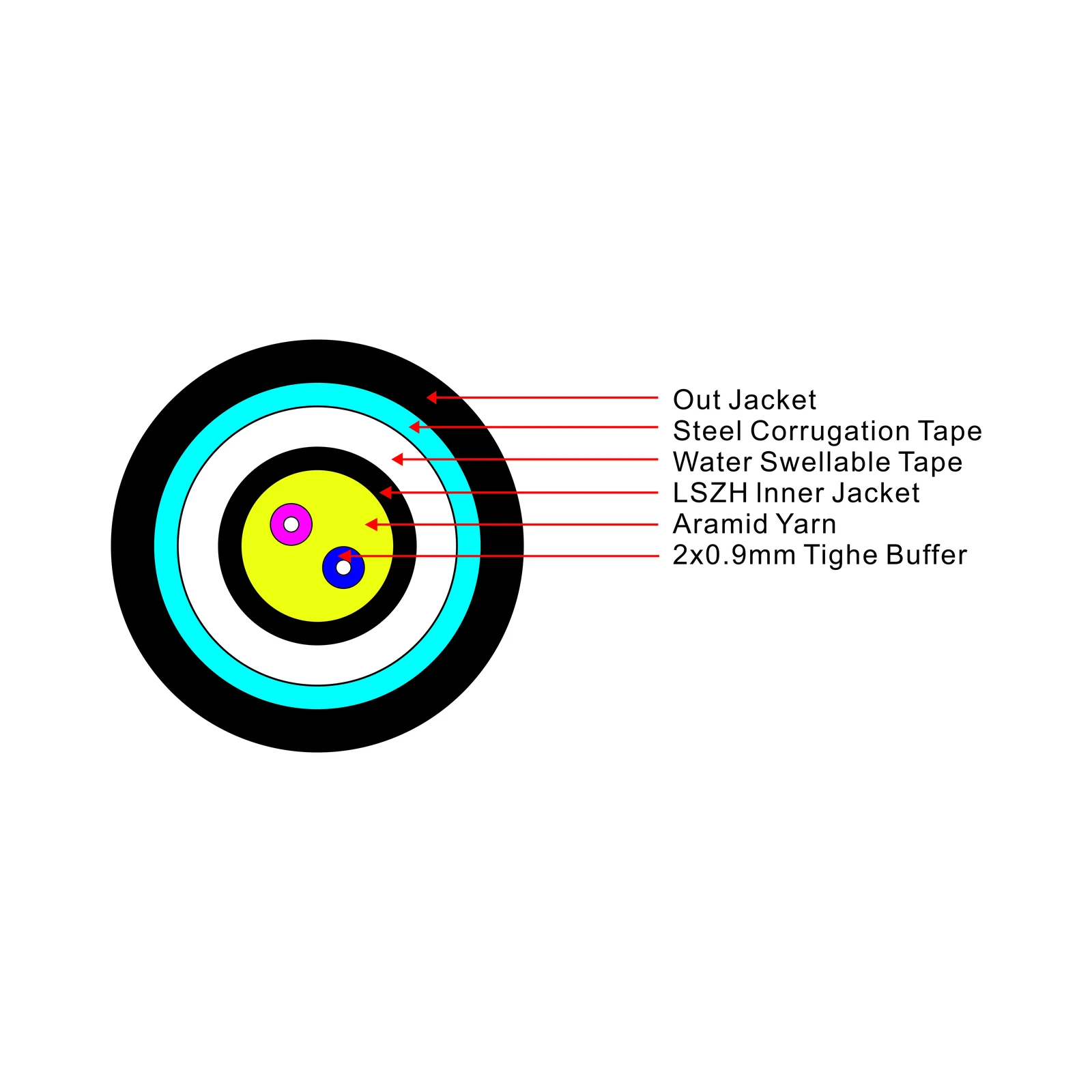
Where a route crosses rodent-prone or crush-prone ground, the answer is a construction decision — corrugated steel tape, water-swellable tape and an LSZH inner jacket — and it is checkable on the sample, not just on the drawing.
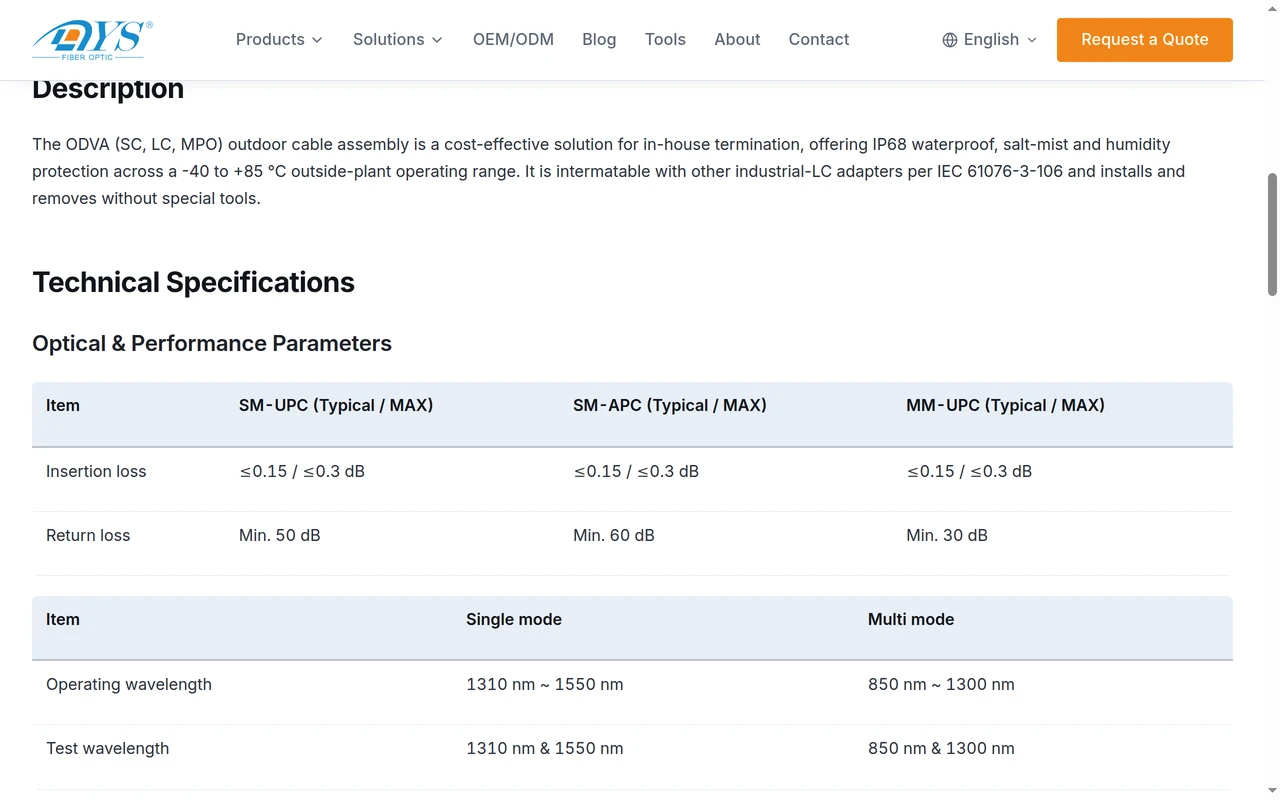
What a spec sheet should look like at the sample gate: typical and maximum insertion loss, a return-loss minimum per polish grade, and the operating range — the four columns this page publishes are the four a sample report has to fill in.
Gate 5 — Audit the Line That Will Make Your Part
Test data proves what a supplier has made. The audit is what tells you whether they can make your part, repeatedly, on the line that is actually going to run it.
Three things decide this gate:
Capacity against equipment. A daily output claim is only meaningful next to the equipment that produces it, the shifts that run it and the other orders in the queue. Walk the assembly line, count the termination and test stations, and ask what share of that capacity is already committed. A supplier who tells you the capacity figure and the utilisation figure has answered the question; one who tells you only the first has not.
Process control at the station. Look for the things that stop a bad part moving to the next step: written work instructions at the bench, a defined inspection point after termination, insertion-loss and return-loss testing on the assembled part rather than on the components, a clean-and-inspect step before packing, and a person accountable for a non-conformance. An assembly line that tests only incoming components and then ships is trusting the process to be perfect — a claim that does not survive a volume order.
Calibration and traceability at the bench. Every instrument used for an acceptance test should carry a calibration label and a record; every batch should leave with a lot code that traces back to the operator, the day and the component lots. This is the bridge to Gate 6, and it is normally the weakest part of an audit at small suppliers.
Our step-by-step method for running this gate is in how to audit a fiber optic cable factory — including how to do it remotely, what to look at station by station, and how to score it before negotiating.
Gate 6 — Traceability, Change Control, and the First Article
This is the gate that decides whether the quality you qualified still exists six months into the order. Nothing about the sample changes; the process, the materials and the people around it do.
Get four things in writing:
Mechanism | What it has to say | Why it matters to an FTTA assembly |
|---|---|---|
Lot code and batch record | Every reel or box carries a code that resolves to the assembly date, line, components and test results | Lets you contain a problem to one shipment instead of condemning a year of stock |
Certificate of conformance per batch | Values reported against the spec limits, not "passes inspection" | Gives your incoming inspection something to sample against |
First-article approval | Before volume, one article measured against every spec line and signed off | Catches the drift between the sample you approved and the process that will run it |
Change notification | The supplier notifies you before changing a material, a component supplier, a machine or a factory site, with re-qualification where the change touches the spec | The most common cause of "it was fine last year" is an unannounced jacket or ferrule change |
Add the two other mechanisms that a mature telecom supplier will already have: a corrective-action process with a written root cause and containment (the 8D shape), and a defined trigger list for re-qualification. Then write them into the purchase agreement, because a gate that is not contractual is a preference.
Gate 7 — Tie the Commercial Terms to the Technical Ones
Commercial terms are qualification criteria, not a separate negotiation. The ones that touch the technical agreement:
- MOQ and the cost of flexibility. A supplier that can take a large single-spec run and a small multi-spec order protects you from a spec change in mid-project. Ask for both prices at the same time — that is where the real flexibility shows.
- Lead time and its basis. Ask whether the quoted lead time is from stock on standard configurations or from material on custom ones, and what the difference is for your part number.
- Sample cost and credit. Free samples are not the goal; a sample process that produces measured data and a written report is.
- Warranty and RMA. What is covered, for how long, and what evidence the supplier needs from the field. A warranty that depends on data no installer captures is decoration.
- Audit rights and spec freeze. The right to re-audit, and a frozen spec version that both sides reference in the purchase order.
- Origin. Manufacturing location is part of the technical offer for tariff-exposed projects. A supplier with multiple sites can often move production without changing the design — but it is a change, so it belongs under the change-notification clause above.
Qualify proportionately. The method above is the full-strength version, and it is the wrong instrument for every purchase. A qualification costs the supplier time as well as you, and a small specialist that makes exactly the assembly you need can be driven away by an audit programme sized for a 50,000-piece programme. Match the effort to the exposure: for a low-volume, low-consequence order, Gates 1 to 3 with a document review and a remote audit may be proportionate; for a tower build where a failure means a climb, run all seven. Decide the depth before you send the RFQ, and say so in it — suppliers respond better to "we will audit the line before the second order" than to an unlimited audit clause.
Six Red Flags That Should Stop a Qualification
- A single typical value with no maximum, and no test method. Gate 2 has no input to work with.
- Certificates offered as logos. If the conversation never reaches a certificate number and a scope, the certificate is decoration.
- "IP68" with no parenthetical. The datasheet write-up is not finished — you do not know what was tested.
- A sample that differs from the datasheet in fiber count, diameter, subunit size or marking. Either the sample was special or the datasheet is aspirational.
- No lot code on the sample's packaging. Traceability starts at the sample; if it is missing there, it will be missing on the volume order.
- Price agreed before the spec is frozen. Every later technical change becomes a negotiation about money rather than an engineering decision.
None of these is fatal on its own with a responsive supplier — the failure is when the answer is a reassurance instead of a document.
A Qualification Scorecard You Can Run in One Meeting
Weight the gates against what actually matters for your deployment and score each candidate 0-3. The weights below suit a macro-tower build where access is expensive; shift them for a small-cell or data-centre-adjacent deployment.
Criterion | Weight | Score 0-3 | What a 3 looks like |
|---|---|---|---|
Spec conformance | 20% | Every line answered with a value, no gaps | |
Test evidence | 18% | Method, sample size, maximum limits, calibrated equipment | |
Certificate scope | 12% | Certificate number matched to the exact part and site | |
Sample results | 15% | Meet the spec at hour zero and after environmental tests | |
Process and capacity | 13% | Line, calibration and in-process test verified on site | |
Traceability and change control | 12% | Lot codes, first article and notification in the contract | |
Commercial terms tied to the spec | 10% | Price, MOQ, lead time and warranty agreed against a frozen spec version |
A candidate that scores below 2 on spec conformance or sample results should not reach price negotiation regardless of the total: those two carry the failure modes that end up on a tower.
What to Send on Your First RFQ
Send the spec, not a request for a catalogue:
- The numbered spec sheet from Gate 1, as an editable file.
- Quantities: first order, and the annual range you actually expect.
- Site conditions: coastal or inland, temperature band, whether the assemblies will be re-mated during maintenance.
- The certification scope your project requires — name the market (US, EU, Brazil) rather than asking for "all certificates".
- A sample request naming the tests in the Gate 4 table, and asking for the measured report with it.
- Your target date and the schedule constraint behind it.
You will get a usable answer from a manufacturer set up for it. Take the gates in order against one example. Gate 1: DYS Fiber Optic publishes its FTTA cabling range with the connector families and their IP figures on the product pages. Gate 2: the reliability tests run in-house — an IPX8 flooding pressure tester, a salt spray chamber, a vibration table, programmable temperature and humidity chambers, a 3D interferometer and insertion/extraction force testing among them — and assemblies are insertion-loss and return-loss tested before shipment. Gate 3: nine international certifications, including ISO 9001, ISO 14001, ISO 45001, TL 9000, UL, CPR, RoHS, REACH and Anatel. Gate 5: three manufacturing sites, and a stated capacity of 5,000 waterproof ends per day — ask for the utilisation figure behind it before counting it as available capacity. You can see the range on the FTTA cabling product page, or ask for the spec sheet, the test reports and the certificate scope together — which is the evidence this whole method is asking for.
FAQ
How long should a qualification take? Fastest realistic path with a responsive supplier is two to four weeks: one week for the spec and the RFQ round, one to two weeks for samples and measurement, and the audit scheduled in parallel so it does not sit on the critical path. If a supplier needs a month to produce a test report, that is itself a finding about their documentation.
Should I qualify one supplier or several? At least two, ideally three, run through Gates 1-4. Single-sourcing a tower-top assembly concentrates a whole class of failure in one place, and having a second qualified source is what lets you walk away from a price increase without re-doing the technical work.
Do I need a factory audit if the test reports look good? The reports tell you what they made. The audit tells you what they will make. If the reports are strong and volumes are low, a remote audit may be proportionate; for a volume programme, the line visit is how you find out whether the capacity claim and the process control are real.
Is an IP68 rating enough for a tower-top assembly? No. IEC 60529 digit 8 is continuous immersion at a manufacturer-specified depth and duration, and neither digit 7 nor digit 8 tests UV, vibration or repeated mating — all of which a tower-top run experiences. Ask for the parenthetical conditions and for the environmental test reports separately.