Compliance
B2ca vs Cca vs Dca: CPR Fire Ratings for Fiber Cable
"CPR compliant" is the cheapest sentence in a fiber cable supplier's pitch. It is also nearly meaningless on its own — because the Construction Products Regulation does not certify cables. It classifies them, on a seven-step ladder from Aca to Fca, and then makes the manufacturer declare the result. The class is what you buy, and the Declaration of Performance (DoP) is the only document that proves it. This guide walks through what the CPR fire ratings actually measure, how B2ca, Cca and Dca differ for fiber optic cable, and how to read a DoP in five minutes instead of trusting a sales sheet.
What the CPR fire ratings are — and what they measure
The CPR (Regulation (EU) No 305/2011) is the EU's framework for construction products — and since the harmonised standard EN 50575 was applied to power, control and communication cables, optical fiber cable counts as one. Since July 2017, cables placed on the EU market have to be CE-marked under the CPR, with the fire performance declared by the manufacturer and verified by a notified body.
The system is built on one idea: a cable's contribution to a developing fire is not a single number. It is a Euroclass (the letter-and-number code such as B2ca or Dca) plus three additional classifications, decided by five measured behaviours:
- Heat release — how much energy the cable adds to the fire (measured as FIGRA, peak heat release rate, and total heat release)
- Flame spread — how far fire travels along the cable
- Smoke production — how much smoke the cable emits, and how much light it blocks (classes s1, s2, s3)
- Flaming droplets — whether burning particles fall and spread the fire (classes d0, d1, d2)
- Acidity — how corrosive the combustion gases are to lungs and equipment (classes a1, a2, a3)
The "ca" in every class name simply stands for cable — B2ca is the cable version of the building-material class B2, and there is no hidden meaning in the suffix. What trips most buyers is that a class code like B2ca,s1,d1,a1 bundles all five answers into one string, and two cables with the same letter class can still differ dramatically in smoke, droplets and acidity.
The Euroclass ladder: from Aca to Fca
The delegated regulation that sets the class thresholds defines seven Euroclasses for cables. The ladder is anchored at the top by Aca (non-combustible, effectively unreachable for a polymer-jacketed cable) and at the bottom by Fca (no performance determined).
Class | Test basis | What it means in practice |
|---|---|---|
Aca | EN ISO 1716 | Non-combustible; not achievable with plastic jackets |
B1ca | EN 50399 + EN 60332-1-2 | Very limited fire growth; premium life-safety grade |
B2ca | EN 50399 + EN 60332-1-2 | Low heat release and flame spread; high-risk buildings |
Cca | EN 50399 + EN 60332-1-2 | Moderate fire contribution; mid-high-risk buildings |
Dca | EN 50399 + EN 60332-1-2 | Acceptable for general use; the common commercial grade |
Eca | EN 60332-1-2 only | Passes the single-cable flame test; no bundling performance |
Fca | — | No performance determined; effectively unclassified |
For fiber optic cable, the realistic territory is Dca and above. Glass carries no fire load — the combustible mass is the jacket and any strength members — so a well-built LSZH (low-smoke, zero-halogen) fiber cable lands in Dca or Cca territory, and some constructions reach B2ca. That is a structural advantage fiber has over copper: the same jacket material often achieves a higher class on a fiber cable because there is simply less flammable material per metre.
B2ca vs Cca vs Dca: what changes between the classes
If you are specifying fiber for a building project, this is the comparison that matters. The three classes share the same test methods (EN 50399 for bundled cables, EN 60332-1-2 for single-cable flame propagation), so the differences are quantitative — and the numbers come straight from the EU's classification table:
Criterion | B2ca | Cca | Dca |
|---|---|---|---|
Flame spread (FS) | ≤ 1.5 m | ≤ 2.0 m | not limited |
Total heat release (THR1200) | ≤ 15 MJ | ≤ 30 MJ | ≤ 70 MJ |
Peak heat release | ≤ 30 kW | ≤ 60 kW | ≤ 400 kW |
Fire growth rate (FIGRA) | ≤ 150 W/s | ≤ 300 W/s | ≤ 1300 W/s |
Read the Dca column and the practical difference jumps out: a Dca cable may still release 70 MJ of heat and burn at up to 400 kW peak, with no limit on how far the flame spreads along the bundle. That is fine for a normal commercial fit-out with a working sprinkler system and short evacuation paths. It is not the cable you want feeding a corridor that is also the escape route of a 20-storey building — which is where specifiers reach for Cca or B2ca, and where national building rules in several Member States (France is a well-known example) set minimum classes above the CPR baseline.
Taking the three pairs in turn, the gaps between them are not even. B2ca vs Cca is essentially a halving of the fire load: THR1200 ≤ 15 MJ against ≤ 30 MJ, and peak heat release ≤ 30 kW against ≤ 60 kW. B2ca vs Dca is the widest of the three — B2ca also limits flame spread (≤ 1.5 m) and FIGRA (≤ 150 W/s), where Dca sets no flame-spread limit at all and tolerates up to 1300 W/s. Dca vs Cca is the smallest step: the same test, but FIGRA falls from ≤ 1300 to ≤ 300 W/s, peak heat release from ≤ 400 to ≤ 60 kW, and THR1200 from ≤ 70 to ≤ 30 MJ — with flame spread becoming limited (≤ 2.0 m instead of unrestricted).
The additional classifications do as much work as the letter. Smoke is the difference between Dca,s1 and Dca,s2: s1 limits total smoke and gives the best light transmittance (s1a ≥ 80%), s2 allows up to 400 m² of total smoke, s3 means no limit. In a fire, smoke kills visibility and people before heat does, which is why escape-route specifications so often demand s1. Flaming droplets matter wherever cables run above other combustibles: d0 means no burning particles within the test window, d1 allows brief burning droplets, d2 is unrestricted. Acidity (a1/a2/a3) is the halogen story — a1 keeps conductivity below 2.5 µS/mm with pH above 4.3, which is what makes the combustion gases less corrosive to lungs and server racks alike.
One sentence to remember:
B2ca, Cca and Dca are the same test, different pass lines — and the smoke, droplet and acidity suffixes are separate decisions you should make explicitly, not inherit by accident.
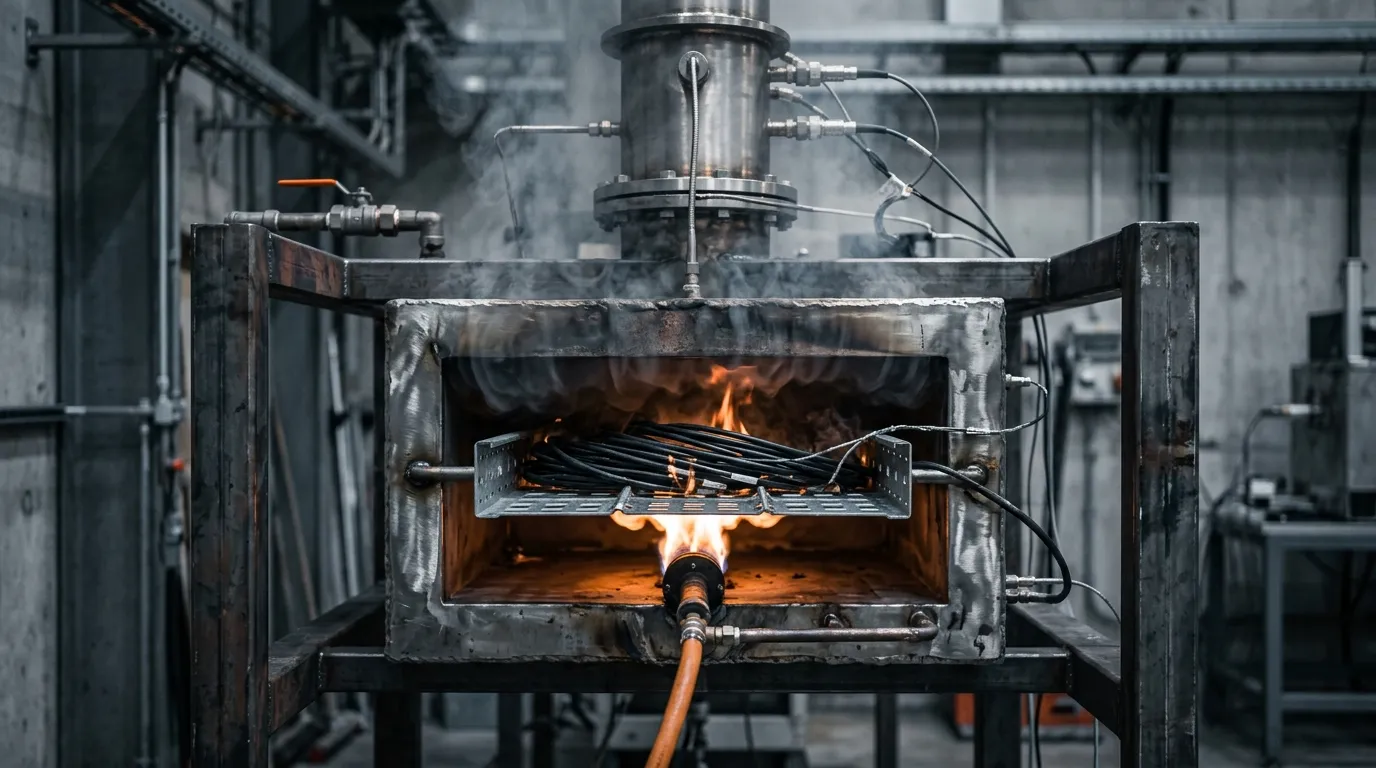
Photo-style rendering of a cable fire test: the tray-mounted sample, the burner, and the instrumented flue are where every Euroclass number above comes from.
The DoP: the one document that proves the class
All of the above is marketing until it lands on paper. Under the CPR, every cable in scope ships with a Declaration of Performance (DoP) — the manufacturer's formal statement of the product's declared performance, drawn up under Article 4 of the regulation itself. The CE mark on the jacket or box is only the visible ticket; the DoP is the record behind it.
Two details matter for anyone buying fiber cable:
- The DoP is the manufacturer's declaration, not a third-party certificate. For reaction-to-fire, the CPR uses AVCP System 3: a notified body performs the initial type testing and issues the test report, while the manufacturer runs factory production control. The DoP states the class on the strength of that system. If a supplier shows you a "CPR certificate" but no DoP, ask where the DoP is — under the CPR the DoP is the operative document.
- A DoP is specific to a product type. Each construction (GJFJV simplex, GJFJBV duplex, distribution cable, breakout cable — different jacket and fibre-count families) has its own DoP with its own declared class. A DoP that names a different cable type does not cover the cable in front of you.
Notified bodies are listed in the EU's NANDO database — if the body number on the DoP does not resolve to a real, current notified body for cable standards, treat the document as suspect.
How to read a Declaration of Performance in five steps
A DoP has a standard structure, laid out in Annex III of the CPR. Once you know where the fields live, reading one takes under a minute:
- Find the unique product identification code at the top. This is the manufacturer's own type name — the field that must match the cable you actually hold. Mismatch here is the most common (and most damning) error to catch.
- Check the intended use. The DoP states the construction works the product is declared for. A cable DoP will reference its general use in buildings; if the intended use doesn't match your application, the class doesn't transfer.
- Read the manufacturer and the AVCP system. The DoP names the manufacturer, the system (System 3 for reaction to fire), and the notified body — with its identification number.
- Look at the declared performance row. This is the line that says something like
EN 50575 — Reaction to fire: Dca, s1, d1, a1. Parse it exactly the way the class is defined: letter class first, then smoke, droplets, acidity. A row that reads "Dca" with no suffixes is a partial declaration — acceptable only if the suffixes are genuinely not determined, which you should question for any cable you plan to install in an escape route. - Check the DoP number, date and signature. A valid DoP is dated, numbered, and signed for the manufacturer. An undated document with no number is a photocopy of a promise.

The DoP travels with the cable. The type code at the top must match the jacket marking on the reel — that single check catches most mismatched paperwork.
The 60-second version: type code matches the cable → intended use fits → notified body number resolves in NANDO → declared performance row parses as class + suffixes → document is dated and numbered. Five checks, one minute.
Verifying a CPR claim when you source from outside the EU
CPR compliance is a property of the product placed on the EU market — which means an overseas manufacturer exporting into the EU is responsible for the same DoP and CE marking as a European factory. When you buy fiber cable from a Chinese manufacturer, the paperwork you should demand is identical, plus one extra layer of diligence:
- DoP for the exact cable type, in a language you can read, with the declared class in full (letter + suffixes).
- Notified body test report behind the declared class — the body's number must appear on the DoP and resolve in NANDO. Ask for the body's name; a European notified body is a hard requirement of AVCP System 3, and there is no legitimate substitute.
- CE marking on the jacket, reel or packaging, paired with the DoP.
- A sample check: request a short length, read the printed jacket markings, and compare them against the DoP's type code. Jackets are printed with the standard and class in exactly the places a compliant factory knows to print them.
The red flags are the same ones that apply to UL claims from fiber suppliers: certificates that don't parse as a class, DoPs for a different cable type, no notified body number, or a "CPR certified" phrase with nothing behind it. Any supplier that has done the work once will hand over the paperwork in the first exchange.
For the record, DYS Fiber Optic holds SGS-issued CPR certification covering B2ca (since 2023), Dca (2019) and Eca (2018) — and the same discipline applies internally: every cable family ships with its own DoP, not a family-level claim. It is also why this guide exists: the class is only useful if the buyer can read the document that carries it.
CPR vs the US system: OFNP, OFNR and LSZH
If your company buys cable for both the EU and North America, one confusion will keep recurring: LSZH is a material, not a rating. LSZH (low-smoke, zero-halogen) describes the jacket compound. The CPR class describes the tested fire behaviour of the finished cable. An LSZH cable still has to be tested to earn its Dca or Cca — and, conversely, a class does not automatically tell you the compound. When a supplier says "LSZH, so it's Dca," they are skipping a step.
The US system works differently: OFNP, OFNR and LSZH are the NFPA-based ratings that govern plenum and riser spaces, with a different test philosophy (UL 910 / UL 1666) and no EU-style performance declaration. A cable can carry both — a US OFNR listing and an EU Cca class, from separate test programs — which is normal for a cable selection covering both markets. What you should never do is treat them as interchangeable: a UL riser rating does not satisfy a European tender that demands Cca, and a DoP does not open plenum spaces in Chicago.
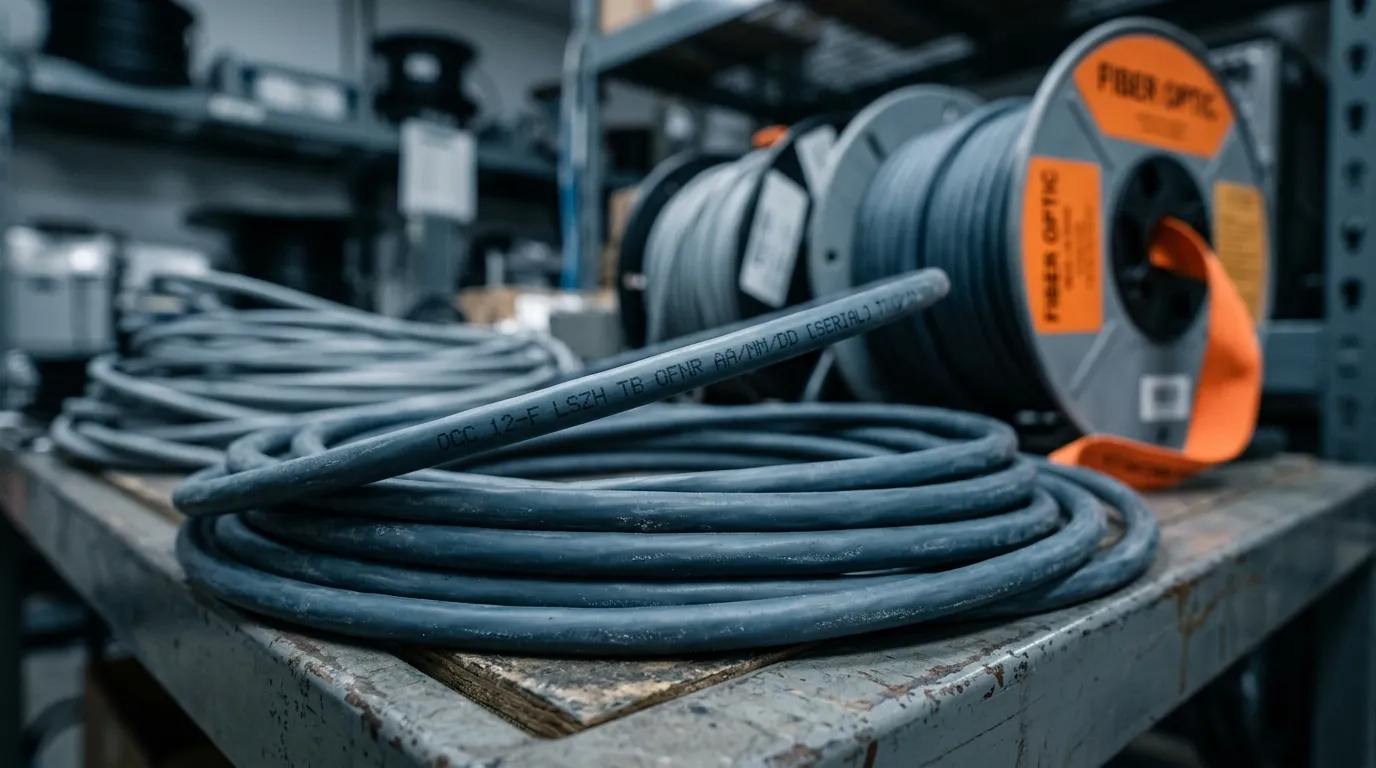
The jacket compound and the printed class marking are two different facts: LSZH is the material, the Euroclass is the tested result.
Frequently asked questions about CPR fire ratings for fiber
What does "CPR compliant" actually mean?
It means the cable is CE-marked under the CPR with a DoP declaring its reaction-to-fire class. Without a class and a DoP, "compliant" is just a phrase.
Is LSZH the same as Dca?
No. LSZH is a jacket material property; Dca is a tested fire-performance class. An LSZH cable is usually a good starting point for a decent class, but the class is only earned in the test chamber.
Which class does fiber optic cable usually get?
Dca is the common commercial grade for indoor fiber, Cca for higher-risk buildings, and B2ca where national rules or the fire strategy demand the most. Eca exists but is rare for fiber in serious projects, because the single-cable test alone tells you nothing about bundled installations.
Does the CPR apply to cable sold outside the EU?
The regulation binds the EU (and, via its own regime, Great Britain — the UK continues to recognise CE marking for construction products under current gov.uk guidance on using the UKCA marking). If your project is in neither market, the CPR is voluntary — but many global contractors spec it anyway as a quality baseline.
What is the difference between Eca and Dca?
Eca only passes the single-cable flame test (EN 60332-1-2). Dca also passes the bundled-cable test (EN 50399) with defined heat-release limits. In a cable tray full of cables, Eca's performance is essentially unknown — always prefer a tested bundle class for real installations.
What to ask your fiber cable supplier (60-second checklist)
Before you sign the RFQ, put these four asks in writing:
- The full class code — letter plus suffixes (for example
Dca,s1,d1,a1), not "CPR certified". - The DoP for the exact cable type on the quote, with a notified body number you can check in NANDO.
- The jacket marking — a photo or sample showing the printed class on the cable itself.
- The test report behind the declared class, from the notified body named in the DoP.
If a supplier hesitates on any of the four, the class is the least of your problems. Run the same discipline on the rest of the certification package with our free fiber certification checker, or dig into the rest of the compliance cluster for the UL, Anatel and TL 9000 angles — the paperwork habit is the same everywhere: the document, not the adjective, is what survives an audit.