
Compliance
ISO 9001 vs TL 9000: What Fiber Buyers Should Check
"ISO 9001 vs TL 9000" reads like a choice between two grades of the same thing. It is not. ISO 9001 is a management-system certificate: an auditor has verified that a plant runs a controlled, documented, repeatable process. TL 9000 is that same process plus a measurement regime — the ICT industry's extension to ISO 9001, in the standards body's own words — which obliges a certified supplier to submit performance data to a central repository every month and be benchmarked against its peers. Both are real. Neither is a product approval. And as of September 2026 there is a third fact worth carrying into a purchase order: ISO 9001:2026 has been published, TL 9000 is still built on the 2015 edition, and TIA QuEST Forum's own status page says no revision is under way. This guide covers what each certificate proves, what it costs the supplier who holds it, and how to verify one in ten minutes.
If you are new to fiber certification schemes, the fiber optic certifications and compliance hub covers the UL, CPR and Anatel side of the same procurement problem.
ISO 9001 vs TL 9000: the one-sentence difference
ISO 9001 certifies the process. TL 9000 certifies the process and measures the results.
That is the whole distinction, and it answers the question most buyers are actually asking. A supplier with ISO 9001 has had its quality management system audited against a general-purpose standard that applies to any industry. A supplier with TL 9000 has had the same system audited against ISO 9001 plus a set of telecommunications-specific requirements and, crucially, has committed to reporting operational performance data every month for as long as it wants to keep the certificate.
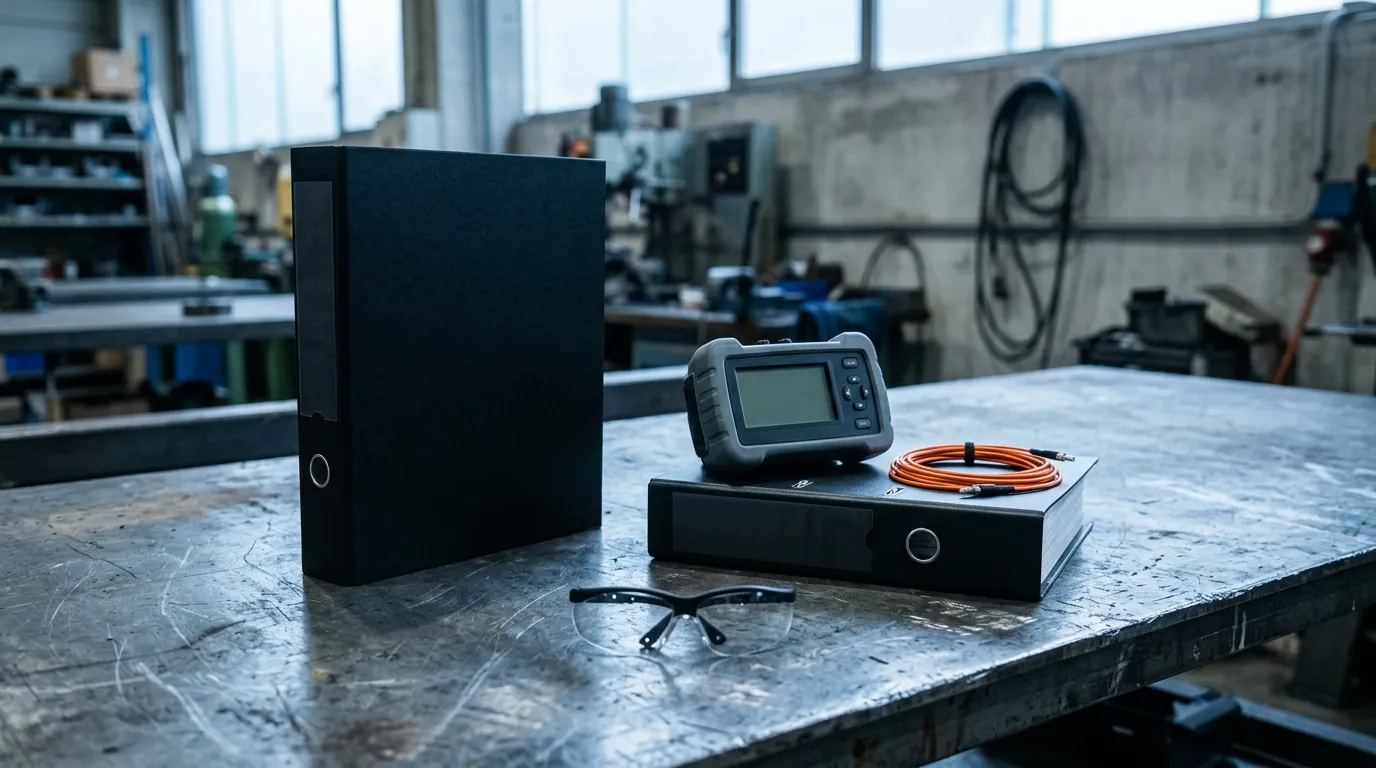
The distinction in one frame: documentation alone on the left, documentation plus continuous measurement on the right.
One piece of vocabulary saves a lot of confusion later. ISO 9000 and ISO 9001 are not two versions of one thing. ISO 9000 is the family's fundamentals-and-vocabulary document — the one that defines what "quality management system" and "nonconformity" mean. ISO 9001 is the requirements standard: the one an organization can be audited against and certified to. A supplier describing itself as "ISO 9000 certified" is using a phrase that does not exist in the certification system. It is a small tell, but a useful one, because it usually means nobody in the sales chain has read the document.
What an ISO 9001 certificate actually covers
The certificate is an opinion about a process, issued after a third-party audit, and it is voluntary. ISO's own explainer on the 2026 edition states it plainly: "ISO 9001 certification is voluntary," and the value comes from implementation rather than the paperwork. An ISO 9001 certificate is therefore evidence that a supplier chose to be audited and passed — not evidence that a regulator checked them.
What makes it worth more than the supplier's word is the chain behind it. The audit is performed by a certification body, and that body is itself accredited by a national accreditation body operating in an international mutual-recognition arrangement. Accreditation is the only reason a certificate signed in one country carries weight for an importer in another; the International Accreditation Forum documents the arrangement and lists the member bodies by economy. A certificate from an unaccredited body is a document, not a credential.
Then there is the part almost nobody reads: the scope statement. Every ISO 9001 certificate names the activities, products and sites it covers. "Manufacture of indoor and outdoor optical fiber cable at Huizhou" is a scope. A certificate issued to a trading company for "distribution of cable products" is not a factory audit at all, even though both are honest ISO 9001 certificates with the same logo. When you ask for a certificate, ask for the page with the scope on it.
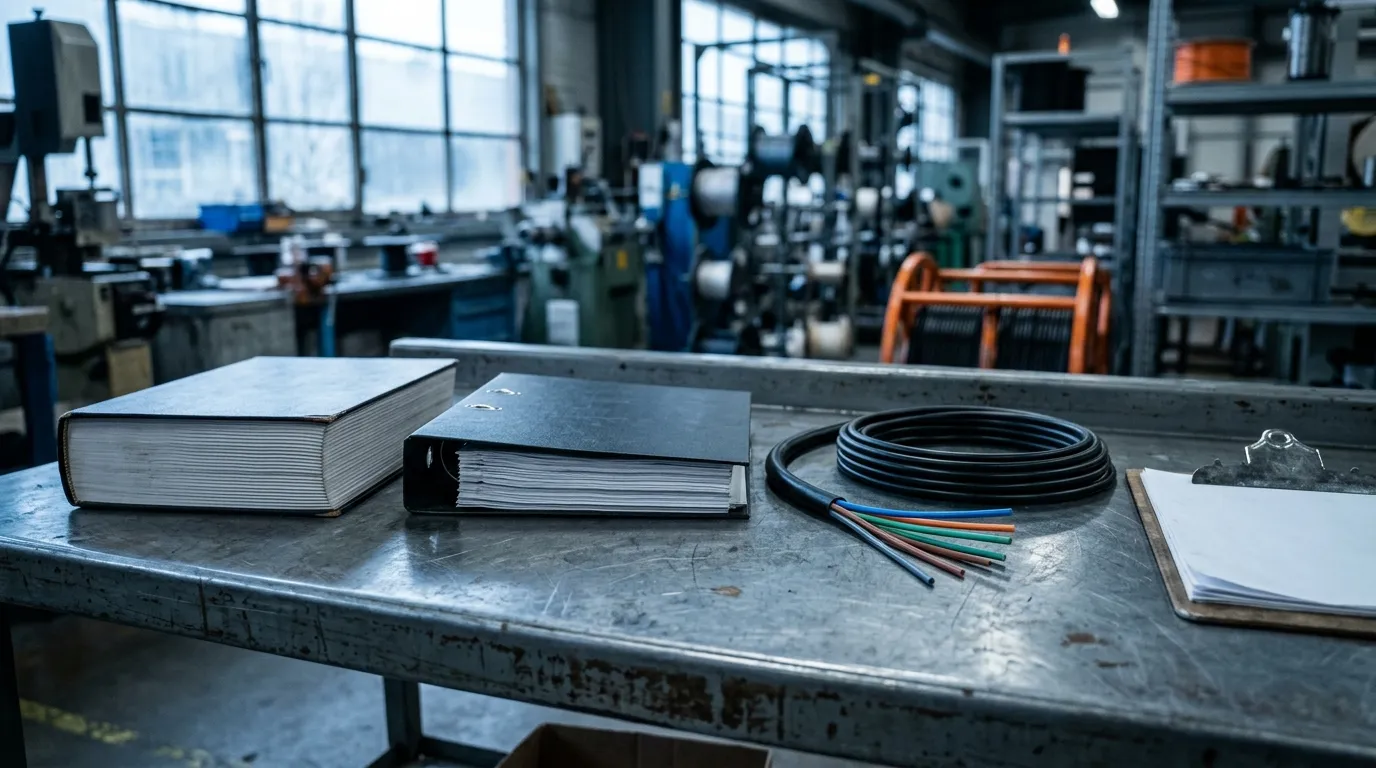
What an ISO 9001 audit examines: the documentation and records trail behind the cable, not the cable itself.
A certificate also carries an edition year. ISO published ISO 9001:2026 in September 2026, replacing ISO 9001:2015, with a stronger leadership clause covering quality culture and ethical behavior, a quality policy tied more explicitly to business strategy, a clearer separation of risk from opportunity, and new awareness requirements. According to ISO's own summary of the new edition, certified organizations "will have three years to move to ISO 9001:2026" and "will not need to start the certification process again."
For a buyer, the edition year tells you which base the supplier's system was last audited against — and, in the case of TL 9000, which base the whole certificate is built on. That is where this comparison gets interesting.
You can see the same process discipline from the other direction in how fiber optic cable is actually made: the drawing tower, the jacketing line and the inline diameter gauges are exactly what the standard asks to have controlled, measured and recorded.
What is TL 9000 — and what does it add on top of ISO 9001?
TL 9000 was developed in 1998 by QuEST Forum — now TIA QuEST Forum, after the forum merged into the Telecommunications Industry Association, a combination announced in 2017 — to meet the supply-chain quality requirements of the worldwide information and communication technologies industry. It is not a competing standard. The standards body's own overview page describes it as "the ICT industry's unique extension to ISO 9001:2015", and the five areas it adds are:
- performance measurements based on the reliability of the product
- software development and life-cycle management
- requirements for specialized service functions such as installation and engineering
- requirements covering communications between customers and suppliers
- reporting of quality measurement data to a central repository
That last bullet is what changes a supplier's workload. The result, again in the standards body's words, is "a two-part quality system with significant management and measurement components" — a Requirements Handbook and a Measurements Handbook, with category tables mapping a company's products to the measurements that apply. A TL 9000 certified organization must comply with all the requirements clauses of ISO 9001:2015, the ICT-specific requirements that apply to every registration, the ICT-specific requirements for hardware, software and service registrations respectively, and the ICT industry measurements for its categories. The TL 9000 overview sets all of this out; the reasons the scheme exists go back to the 1998 origin story and the goal of defining cost- and performance-based measurements rather than more paperwork.
The measurement loop produces the only artifact in this comparison that a buyer can actually use:
- A certified supplier must report its TL 9000 measurements every month to a central repository.
- Those submissions are administered by the University of Texas at Dallas, which manages the database and guarantees contributor anonymity.
- TIA QuEST Forum calculates industry averages by category and publishes Performance Data Reports monthly and annually, showing best-in-class, worst-in-class and industry-average values.
- The annual benchmark reports are free to any certified registration, member or not; the monthly reports are free to TIA QuEST Forum supplier and service-provider members and can be purchased by everyone else.
Two consequences follow. The benchmarks are built from mandatory submissions rather than suppliers volunteering their good numbers, the anonymity guarantee is what makes that credible, and the annual reports reach any certified registration rather than only paying members. And, the honest limit, the data reflects a supplier's registered categories: if your product sits in a category the supplier has not registered, the benchmark that matters to you does not exist. The PDR overview explains how the reports are compiled.
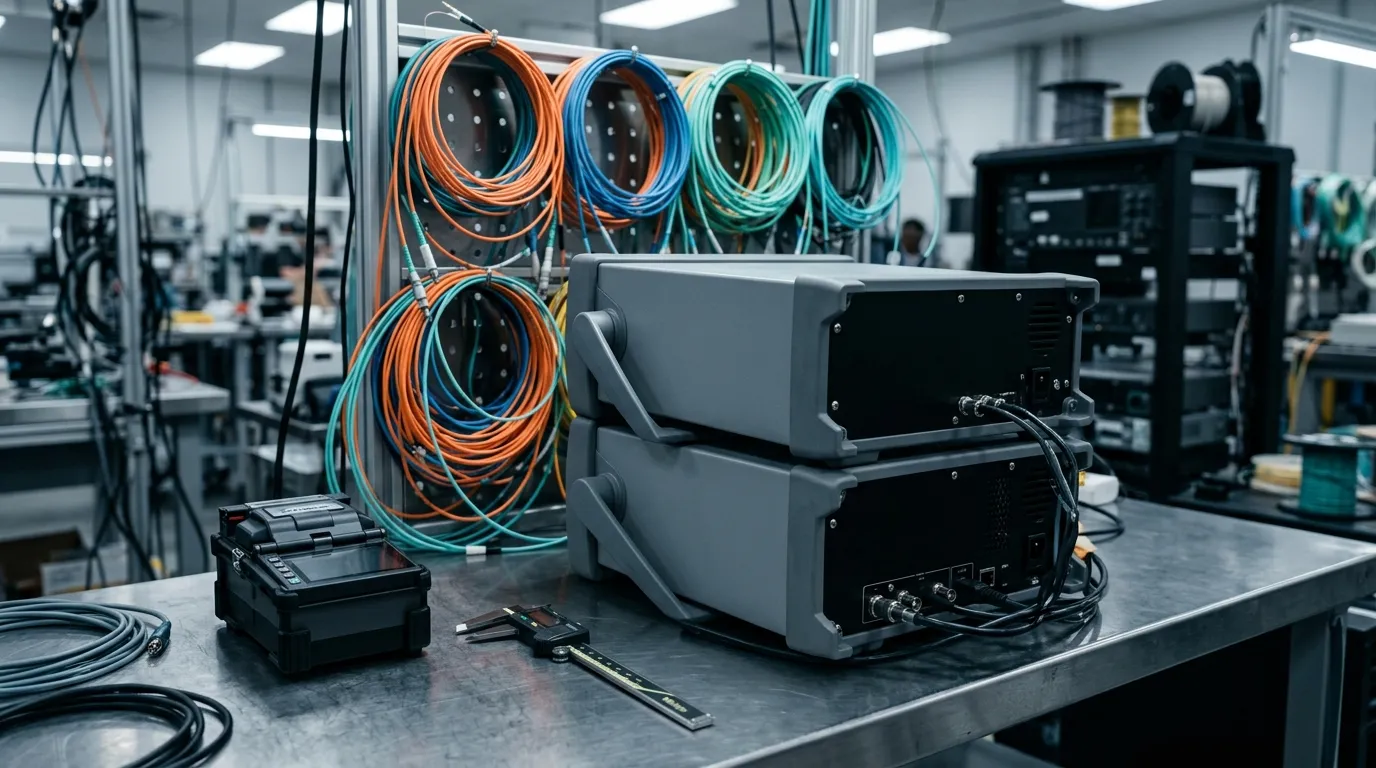
TL 9000's measurement component turns test-bench readings into monthly data submissions and industry benchmarks.
ISO 9001 vs TL 9000: side by side
Dimension | ISO 9001 | TL 9000 |
|---|---|---|
What it is | The certifiable requirements standard for a quality management system | The ICT industry's extension to ISO 9001: same system plus mandatory industry measurements |
Who owns it | ISO | TIA QuEST Forum |
Current document set | One standard, ISO 9001:2026 (published September 2026, replacing ISO 9001:2015) | Two handbooks: Requirements R6.3 and Measurements R5.7, plus category tables R5.9 — built on ISO 9001:2015 |
Applies to | Any organization, any sector | Hardware, software and service registrations within ICT, mapped to over a hundred product categories |
What it proves | A controlled, auditable process exists and is maintained | A controlled process exists, and field performance is measured and benchmarked every month |
Evidence a buyer can ask for | Certificate, scope statement, accreditation of the issuing body | All of the above, plus registered categories and benchmark reports |
Ongoing obligation | Surveillance audits and three-year reassessment | All of the above, plus three consecutive months of measurements before certification and monthly submissions afterwards |
Marginal cost over ISO 9001 | — | Half a day to several extra audit days, plus permanent measurement reporting labor |
Is it a product approval? | No | No |
The last row is the one to remember, and it is the subject of the section after next. Everything above it is a distinction between two kinds of system certificate.
What TL 9000 costs a supplier
TL 9000 is often described as "ISO 9001 plus" as though the plus were a document. It is closer to an operating commitment, and the cost shows up in three places.
TL 9000 certification cost: what actually drives it
Two suppliers can be quoted very different totals for the same standard, because the number that moves is not the certificate fee but the time: audit days, the three months of measurement history that must exist before certification, and the monthly reporting that never stops.
Audit time. TIA QuEST Forum's own guidance states the effect on the audit itself: TL 9000 adds half a day to several days to the audit days required for ISO 9001 certification, and the organization publishes a separate page setting out those requirements. Half a day is the floor for a small single-site registration; a multi-site manufacturer with hardware and service scopes sits at the upper end.
Measurement history you cannot buy. Before an organization is considered fully conforming, three consecutive months of TL 9000 measurements must be collected and reported to the Measurement Repository System, within the scope of certification. There is no fast path through this. A supplier that decides in January to pursue TL 9000 cannot hold the certificate in March, because the data has to exist, be validated and be submitted in the categories it registered. The certification process page sets out the sequence: gap closure, then measurement reporting, then certification, then continuing surveillance audits and three-year reassessments.
Permanent reporting labor. Once certified, monthly data submission is not optional; it runs through a web interface, a template upload or machine-to-machine transmission, and the certification body verifies that measurements are actually reported and actually used by the organization.
What the certificate obliges a supplier to keep doing: a measurement submission every month, indefinitely.
There is a fee structure for repository access and registration, and TIA QuEST Forum publishes it — with one structural detail worth knowing: TL 9000 certification is separate and independent of membership in TIA QuEST Forum. Membership is not what makes a certificate valid.
When you are holding a quote, this narrows to two practical notes. A supplier with a live TL 9000 certificate has already spent years building measurement infrastructure, which is a genuine signal about the organization. It also explains slower movement on a category the supplier has not registered, and reluctance to restructure a production line, because changes ripple into numbers it reports every month. Neither is a defect.
The 2026 problem: ISO 9001:2026 vs TL 9000 R6.3
Here is the fact this comparison turns on, and it is the one most supplier answer sheets leave out.
ISO published ISO 9001:2026 in September 2026. The standards body describes it as now being "the current edition of the standard, replacing ISO 9001:2015," and gives certified organizations three years to move.
Now look at the other side. TIA QuEST Forum's TL 9000 handbook status page lists the Requirements Handbook at R6.3 and the Measurements Handbook at R5.7, and states for each that no revision work is under way: "There is currently no work under way on a revision to the TL Requirements Handbook," with the same statement for the Measurements Handbook. The overview page still describes TL 9000 as the ICT industry's unique extension to ISO 9001:2015.
Put the two together and the picture changes. A current, valid TL 9000 certificate is a superset of a base standard that has just been superseded, with no published re-basing date. That is not a scandal and it is not new — TL 9000 has followed ISO 9001 revisions historically, and the previous major release tracked the 2015 edition. It is a real timing gap, and it produces a question a buyer can use:
If ISO 9001:2026 has been published with a three-year transition, and the TL 9000 handbooks are still built on the 2015 edition, which edition will your quality management system be audited against on my next order — and what is your plan for the gap?
Most suppliers will not have an answer ready. That is fine. The answer you want is not a date; it is evidence that somebody at the company is tracking the question, because a supplier that is not tracking its own certification's base standard is not tracking much else about compliance either.
A superset of an older base: TL 9000's handbooks still sit on ISO 9001:2015 while ISO 9001:2026 begins its transition clock.
Where each certificate fits in a fiber cable RFQ
Most certification conversations go wrong here, so it is worth being blunt: ISO 9001 and TL 9000 are the same category of document, and the documents that decide whether your order is legal to install are in a different category entirely.
- Management-system certificates describe how a company operates — ISO 9001 for quality, TL 9000 for telecom quality and metrics, ISO 14001 for environmental management, ISO 45001 for occupational health and safety.
- Product approvals and market-access certificates describe a specific product — a UL listing for plenum or riser performance, a CPR Declaration of Performance with a Euroclass, an Anatel homologation number, a RoHS or REACH declaration.
What you are actually buying | Document that proves it | Class |
|---|---|---|
Confidence that the supplier runs a controlled, auditable process | ISO 9001 certificate with its scope statement | Management system |
Telecom field-performance accountability and industry benchmarking | TL 9000 certificate plus benchmark reports for your categories | Management system |
A cable that may legally be installed in a US plenum or riser space | UL listing for that construction, with the file number | Product |
A cable that may legally be placed on the EU market | CPR Declaration of Performance stating the Euroclass | Product |
A cable that may legally be sold and used in Brazil | Anatel homologation for the product family | Product |
Evidence that the cable is not a restricted-substance problem | RoHS and REACH declarations for the materials | Product |
Read the table across, not down. Asking a supplier for "ISO 9001 certified cable" gets you a company certificate, and the document that keeps your install legal is the one in the third row. A supplier can hold both management-system certificates and still have no approval for the exact construction you are buying, because approvals attach to product families and manufacturing sites rather than to companies. The reverse holds too: a small assembler with no TL 9000 at all can ship a fully listed, CPR-declared drop cable.
Speaking from the supplier side of this table: DYS has held ISO 9001 since 2016, certified by SGS, and added TL 9000 in 2025. Both are system certificates. The product approvals — UL OFNP and OFNR listings, CPR declarations, Anatel homologation — are separate files, held per product family and covering the manufacturing sites that make them. That separation is not a quirk of one company's paperwork; it is how the two classes of evidence are issued. The product side gets its own coverage: CPR fire ratings and how to read a Declaration of Performance covers the European route, and Anatel certification for fiber products covers why the same cable needs a separate homologation to enter Brazil.
Product approvals attach to constructions like these, one product family at a time — not to the company that makes them.
What neither certificate tells you
Two genuine management-system certificates create more confidence than the documents support, so it is worth saying out loud what they are silent about.
Capacity and lead time are out of scope — a quality system can be flawless on a plant running at full capacity. Price is out of scope; a certified supplier is not a cheap supplier. Optical performance is out of scope: insertion loss, return loss, bend radius, fiber grade and temperature range are product properties, evidenced by type-approval test reports and batch test data. An ISO 9001 audit confirms the manufacturer has a working process for testing and recording those values. It does not confirm any particular value. Contractual protection is out of scope too: a certificate is a statement about a management system at a point in time, not a warranty.
What the certificates leave out: mechanical and optical performance is proved by test data, not by the logo.
Scope is where the silent failure lives. Both certificates are issued for a defined scope, and a genuine certificate whose scope excludes your product tells you nothing about your order. Before treating either one as reassurance, find the scope and check that your product, your site and your process are inside it.
How to check a supplier's certificate in 10 minutes
Six checks, in order. The first four apply to either certificate; the last two split by what you are actually buying.
- Read the scope statement, not the logo. Find the page naming the activities, products and sites covered. If your product is not named, the certificate is decoration for your purposes.
- Identify who issued it and whether that body is accredited. The issuing organization should be a certification body accredited by a national accreditation body in the international recognition arrangement — the requirements that accreditation has to meet are set out in ISO/IEC 17021-1. That arrangement is documented by the International Accreditation Forum, which lists the member bodies by economy.
- For an ISO 9001 certificate, check the edition year and ask about the transition. A 2015-edition certificate is still valid, but the owner should be able to describe how it plans to move to ISO 9001:2026 within the three-year window.
- For a TL 9000 certificate, look the company up in the register. TIA QuEST Forum maintains a public search of certified organizations and notes that organizations which are not yet certified are not displayed; the same site publishes counts by category, by country and by certification body. Ask for the benchmark report covering your product categories.
- If you need a product approval, check the product, not the company. A UL file number can be looked up in UL's own database against the specific construction; a CPR Declaration of Performance must state the Euroclass; an Anatel homologation carries a number tied to the product family. The four-check method for the UL side is in how to verify a fiber cable supplier's UL listing.
- Use the supplier's own tools before you ask them anything. Naming the exact document you want — a scope statement, a benchmark report, a file number — turns a pitch into a document exchange.
Ten minutes with the scope statement, the issuing body and the register settles more than a week of email assurances.
The same checks work in the other direction. Run them on ours before you take any of this on trust — the fiber certification checker is a faster start than asking.
Is TL 9000 still relevant? The honest case against caring
The strongest argument against caring about TL 9000 is the top result for this query, so it is worth stating properly rather than ignoring.
The critique, published in 2022 by a quality-management consultant who had been invited onto the TL 9000 committee two decades earlier, argues that the scheme failed: that in 22 years only 597 companies had been certified, a figure it attributes to TIA QuEST Forum's own published statistics, against a US population of telecom-related firms numbering in the hundreds of thousands. Its conclusion is blunt — that a standard this large produced adoption this thin. You can read the full argument in the original essay, and you should, because a supplier pitching TL 9000 will not show it to you.
That count is a snapshot from 2022, and the live numbers belong to the register rather than to any article, including this one. TIA QuEST Forum publishes the register of TL 9000 certified companies along with growth-trend, by-category, by-country and by-certification-body statistics. Check them yourself.
What is not in dispute on either side of that argument: TL 9000 is not universal. It is a specialist scheme with a genuine adoption ceiling. So the useful question is not whether it "matters" in the abstract, but which side of a contract you are on.
- Buying through a tier-1 carrier or a major OEM supplier program. Their supplier requirements will name the standard if they want it, and TL 9000 appears in telecom supply contracts as a stated requirement rather than a bonus. Here it is not optional, and the measurement history behind a live certificate is exactly what those buyers are paying for.
- Buying cable directly as an ISP, distributor or network contractor. The operative set is normally ISO 9001 plus the correct product approvals for your market. TL 9000 is a differentiator worth noticing; it is rarely the gate. If you operate across several regulatory systems at once, the one-supplier three-markets checklist is the more useful framework.
- Choosing between two suppliers that both hold ISO 9001. This is where a TL 9000 certificate earns its place in the decision — not because the scheme is universal, which it plainly is not, but because holding it requires monthly customer-reported performance data. That is a heavier ongoing commitment than an annual audit, and it is the closest thing to a public track record that exists in this industry.
And the limit again, because it is easy to forget once a benchmark report looks impressive: TL 9000 measures a supplier's performance in the categories it registered. A strong benchmark is evidence about a company's operations in that category. It is not a statement about the specific cable you are ordering.
Does TL 9000 replace ISO 9001? No, and it cannot. It contains ISO 9001 — all of its requirement clauses, plus the telecom additions. Replacing one with the other is not a trade-off a supplier can make, and a supplier presenting it as one has told you something about how carefully it reads standards.
FAQ: ISO 9000, ISO 9001 and TL 9000
Are ISO 9000 and ISO 9001 the same thing?
No. ISO 9000 is the family's fundamentals-and-vocabulary document, defining the terms used across quality management standards. ISO 9001 is the requirements standard an organization is audited against and certified to. You can be certified to ISO 9001; you cannot be certified to ISO 9000.
What are the ISO 9000 standards?
Usually the family rather than one standard: ISO 9000 for fundamentals and vocabulary, ISO 9001 for requirements (the certifiable one), ISO 9004 for guidance on sustained success, and ISO 19011 for guidance on auditing management systems. Only ISO 9001 is a certification standard.
Is ISO 9000 still relevant?
The family is current and actively maintained — ISO 9001:2026 is the live edition, published in September 2026, and the vocabulary document underpins it. It remains the shared language that makes an audit report from one country readable by an importer in another.
What are the TL 9000 standards?
Two handbooks plus supporting tables: the TL 9000 Requirements Handbook, currently at release R6.3, and the TL 9000 Measurements Handbook, currently at R5.7, with category tables at R5.9 mapping product categories to the measurements that apply. Together they form a two-part quality system — management requirements plus measurement requirements — layered on ISO 9001.
What are the TL 9000 certification requirements?
A registered company must comply with every requirements clause of ISO 9001:2015, the ICT-specific requirements that apply to all registrations, the requirements specific to its own hardware, software or service registration, and the ICT industry measurements for the categories it registers — then report those measurements every month, having collected three consecutive months of data before certification.
Is TL 9000 still relevant?
For telecom suppliers selling into carrier and OEM supply chains, yes, and it is usually written into the contract. For direct buyers of fiber cable it is a meaningful differentiator rather than a gate. Treat a live TL 9000 certificate as evidence of organizational commitment, and verify the product approvals separately.
TL 9000 vs ISO 9001: is the reversed order a different question?
No. It is the same comparison written from the other end, and it usually comes from a supplier or buyer that already holds ISO 9001 and is weighing whether to add the telecom layer. The one-sentence distinction does not change: ISO 9001 certifies the process, TL 9000 certifies the process and measures the results. ISO 9001 sets the requirement; TL 9000 builds on ISO 9001:2015 and adds the measurement obligation.
ISO 9001 certificate verification: the short version
Ask for the scope statement and for the accreditation of the issuing certification body, then check the edition year in the certificate against the three-year transition window from ISO 9001:2015 to ISO 9001:2026. The clause the certificate was issued against is the part buyers skip, and it is the part that changes in 2026.
What to ask your supplier
Six lines to drop into your supplier questionnaire. If you run a supplier quality management system, three of these are the questions most buyers never ask — which is why those three produce the useful answers.
- Which certification body issued your ISO 9001 certificate, which accreditation body accredits that certification body, and what does the scope statement cover?
- Which edition of ISO 9001 is the certificate based on, and what is your transition plan for ISO 9001:2026?
- Do you hold TL 9000, and if so, which categories are registered and can you share the benchmark reports for ours?
- For each product we buy, which product approvals apply — UL file number, CPR Euroclass, Anatel homologation, RoHS and REACH declarations?
- Can you provide type-approval test reports and batch test data for the optical and mechanical performance we specified?
- Which manufacturing site will produce our order, and is that site inside the scope of the certificates you have sent us?
A supplier who answers all six with documents rather than paragraphs is telling you something no certificate logo can. That set of expectations is the same one we work to as a manufacturer: management-system certificates for the process, product approvals and test data for the cable, and the scope statements in between. For a specific product family, tell us which cable you are buying and we will send the set that applies.