

Compliance
One Supplier, Three Markets: UL+CPR+Anatel Checklist
Your fiber rollout spans three markets: a data center in Chicago, a municipal FTTH build in Portugal, a network expansion in São Paulo. Sourcing all three jobs from one manufacturer is the efficient move — one purchase order, one quality system, one freight lane. The catch is that compliance does not travel with the cable. A UL Listed jacket proves nothing at the Brazilian border, and a European DoP says nothing about US fire codes. UL, CPR and Anatel are three separate, product-level certifications, and yes — fiber optic cable can be UL Listed, just as it can carry a CPR Euroclass and an Anatel homologation. One supplier can hold all three. Only you can verify that yours actually does. Here is the checklist to run before you commit.
Why one supplier across three markets needs three separate checks
Certifications are product-level, not company-level. A UL listing, a CPR Declaration of Performance, and an Anatel homologation are each issued to a specific legal entity, for specific product families, against specific standards, and each one is valid in exactly one regulatory system. The US market asks how the cable behaves in plenum and riser spaces under the National Electrical Code. The EU asks which reaction-to-fire class it declares under the Construction Products Regulation. Brazil asks whether the product is homologated for use in telecom networks. These questions have separate answers, kept in separate registries, evidenced by separate documents — and "the supplier said so" is not one of them.
If you are building a multi-region buying process for the first time, the global procurement guide to fiber optic certifications walks through the whole landscape, including TL 9000. This article is the focused version: one supplier, three markets, one verification method.
UL, CPR and Anatel at a glance: three systems, one goal
Market | Certification | Standard / scheme | What it proves | Key document |
|---|---|---|---|---|
US | UL Listing (OFNP / OFNR) | UL 1651 | Fire performance in plenum / riser spaces per US building codes | UL file number + Product iQ record |
EU | CPR declaration | EN 50575 (Euroclass B2ca to Fca) | Reaction-to-fire class of the cable in construction works | Declaration of Performance (DoP) |
Brazil | Anatel homologation | Anatel technical requirements | Approved for use in Brazil's telecom networks | Homologation certificate |
Read the table as one row at a time. The left column is the same supplier in all three rows; the right column is three paper trails that never touch. The EU framework is defined by Regulation (EU) No 305/2011, the US fire ratings sit on the UL 1651 standard, and Anatel runs its own homologation regime. Nothing in any of those documents references the other two.
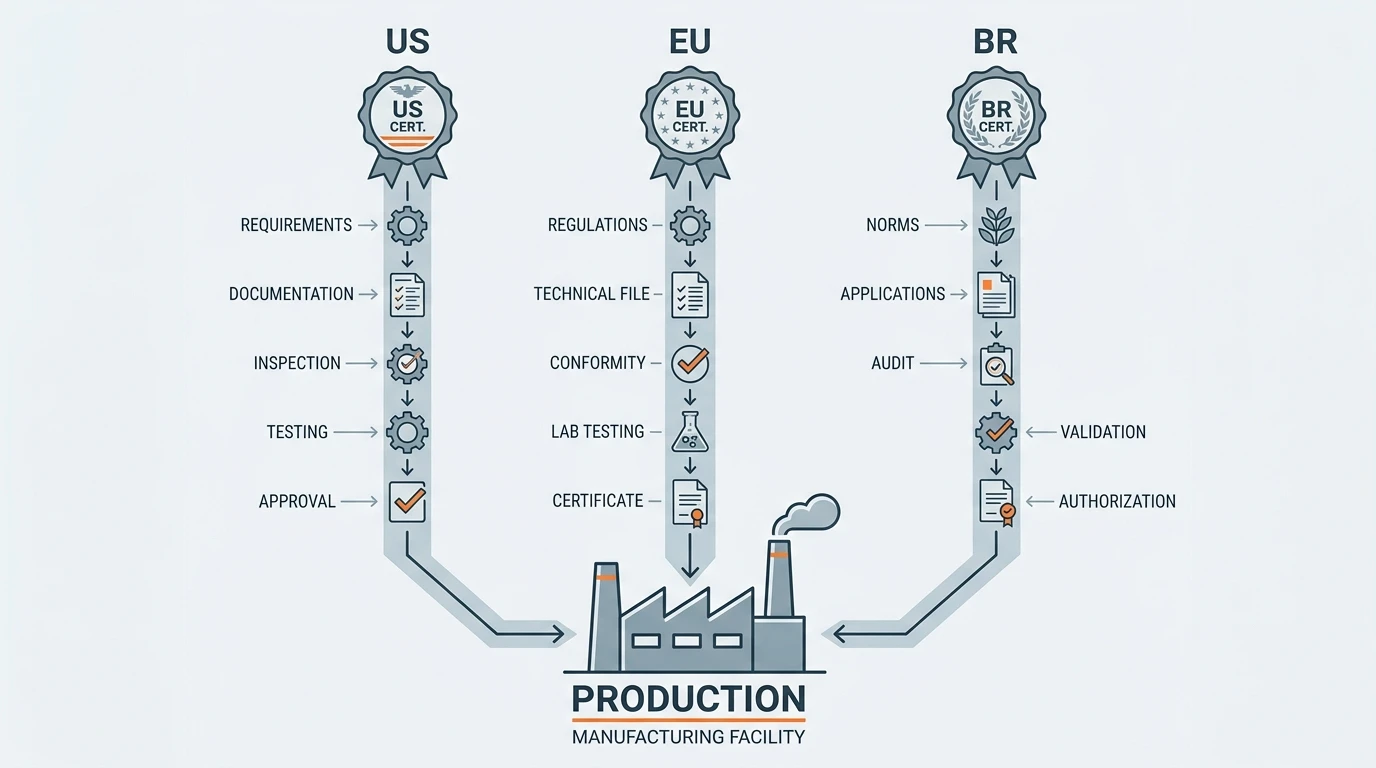
Three regional certification systems, each fed by the same factory — the verification burden is on the buyer, not the badge.
The five-point check every certificate must pass
Rather than learning three different verification workflows, run the same five checks against each certificate:
- The right document. Each scheme has one authoritative document: the UL file record, the DoP, the homologation certificate. If the supplier hands you a photo of a badge instead of the document, that is the first check failing.
- The right SKU. The document must name the exact product family and part number you are buying. "We have UL for our cable range" is not a match.
- The right holder. The certificate holder must be your supplier's legal entity — or, for Anatel, its authorized Brazilian representative. A certificate issued to someone else is a borrowed certificate, no matter how convincing the scan looks.
- The right imprint. The certification mark must actually appear on the cable jacket or coil: the UL mark with fire rating, the Euroclass, the Anatel identification. Imprints are the cheapest forgery check in the industry, and the one most buyers skip.
- Current validity. Active status, current standard version, unexpired certificate. A certificate that was true in 2019 is a fact about 2019.
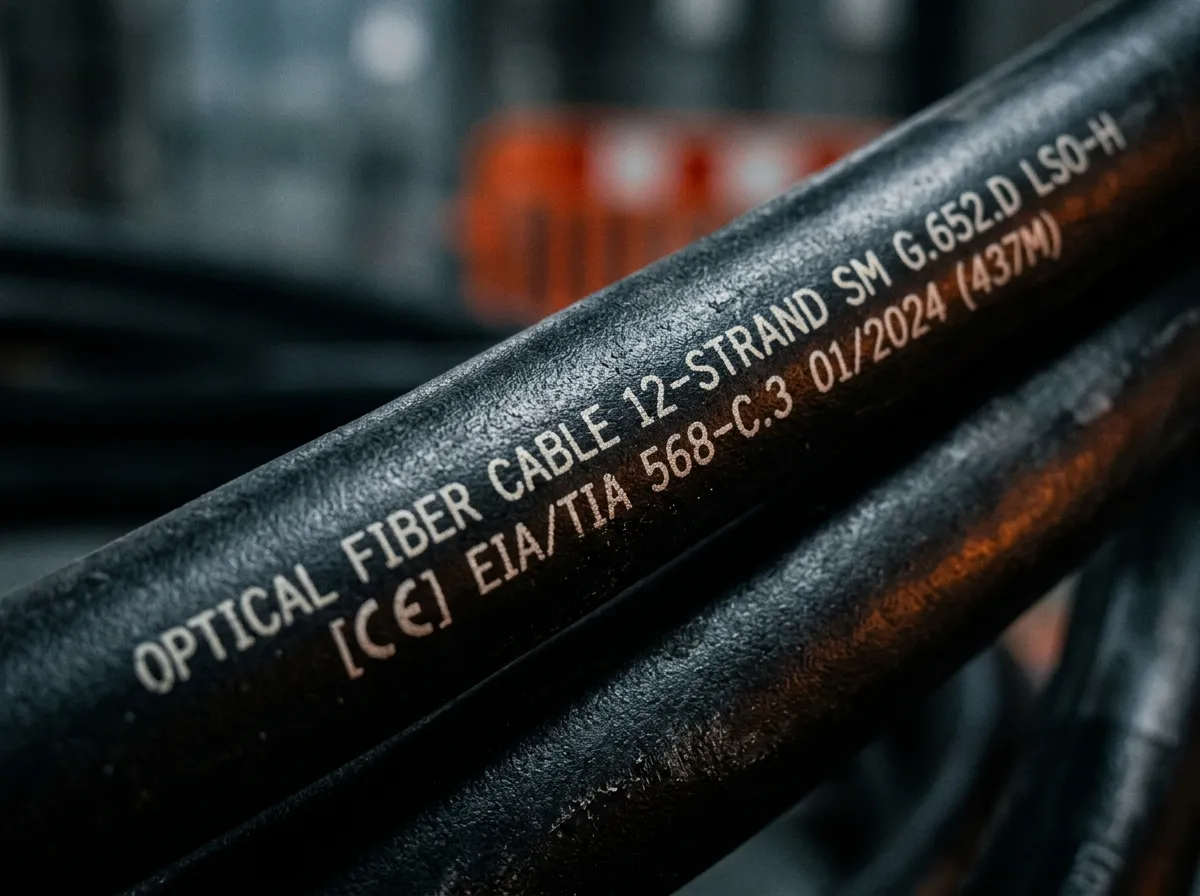
The jacket imprint is check four: a mark on the reel label is not the same as a mark on the cable.
Checking UL for the US market
Ask for the UL file number — the E-number printed on the cable or its packaging. Look it up in UL Product iQ, UL's public database of listed products. Four things must line up: the status is Active (not "Terminated" or expired), the listed product description matches your exact SKU, the company name matches your supplier, and the fire rating matches where the cable runs — OFNR for riser shafts, OFNP for plenum air-handling spaces. Then walk to the spool and confirm the imprint: the UL mark and rating should be printed on the jacket itself, not just on a label.
The step-by-step mechanics of the Product iQ lookup — including what an expired file looks like and how to read the fine print — are in our full guide to verifying a fiber cable supplier's UL listing. If the difference between OFNR and OFNP matters for your project, the OFNP vs OFNR vs LSZH fire-rating explainer covers the code requirements behind each rating.
Checking CPR for the EU market
The one document that proves a CPR claim is the Declaration of Performance (DoP) — the EU framework is explained on the European Commission's CPR page. A DoP is issued per product type, and it must name the manufacturer, identify the product, and state the declared Euroclass: B2ca, Cca, Dca or Eca for communication cables. Three checks matter: the manufacturer name on the DoP matches your supplier; the product identification matches the SKU you are quoting; and the declared class matches the requirement for the building where the cable will run — B2ca is the demanding class for high-rise and high-risk buildings, while Dca covers many general installations. The DoP must also reference the current version of EN 50575; an outdated standard reference means a re-declaration is due.
For a plain-English walk through what each Euroclass actually measures — B2ca vs Cca vs Dca on flame spread, heat release and smoke — our CPR fire ratings guide goes section by section.
Checking Anatel for Brazil
Anatel homologation is the approval required to sell and operate telecom products in Brazil's networks, and the program is documented on Anatel's product certification page. The homologation certificate is issued per product, the holder must be the manufacturer or an authorized Brazilian representative, and the certificate carries a number you can check in Anatel's official systems. Homologated products carry Anatel identification, so the imprint check applies here too.
There is a customs angle that most English-language articles miss. Since November 2025, imports of products subject to homologation are processed under the operational procedure in Anatel Ato 18086/2025, which runs through Brazil's foreign-trade system (SISCOMEX). In practice: a homologation gap does not surface at the sales desk, it surfaces at the border — where it stops the shipment.
One caution on sources. Anatel publishes its technical requirements as acts on its legislation portal, and it revokes and replaces them regularly; older English-language guides frequently cite act numbers that have since been revoked — or that never covered cables at all. Treat any act number you read in a blog post (including this one — we deliberately cite the current import procedure and no product-category act) as a prompt to check the current version on Anatel's official channels before you rely on it.
The one-page multi-market checklist
Check | US (UL) | EU (CPR) | Brazil (Anatel) |
|---|---|---|---|
| UL file number | DoP per product type | Homologation certificate number |
| Product iQ record = your part number | DoP product ID = your SKU | Certificate model = your SKU |
| Your supplier | Your supplier | Supplier or authorized BR representative |
| UL mark + OFNR / OFNP on jacket | Euroclass on jacket or coil | Anatel identification on product |
| Active status | Current EN 50575 version | Current act, certificate unexpired |
Print this, put the three documents next to it, and work left to right. If any cell comes back empty, that market is not covered — regardless of what the other eight cells say.
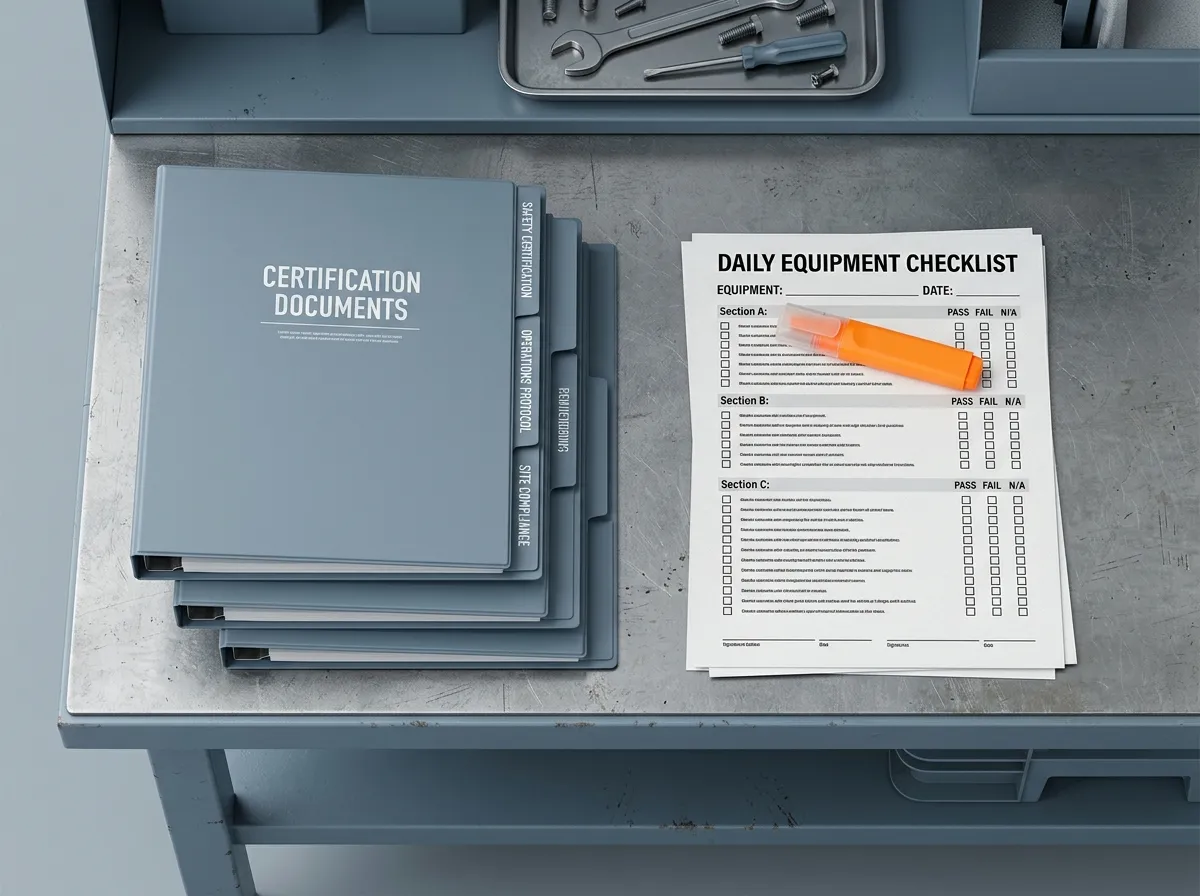
The final checklist sits next to the documents, not in the sales conversation.
Red flags when one supplier claims all three
Some warning signs matter more than others, and a few are near-conclusive:
- Holder mismatch. The certificate names another company. This is the most common way a "certified" supplier is not — the certificate is borrowed from a partner or a former factory.
- SKU mismatch. The certificate covers a similar cable, but not the one in your quote. Similar is not certified.
- Revoked or expired status. A revoked UL file or a replaced Anatel act ends the conversation until the supplier re-certifies.
- No imprint. The documents are beautiful; the cable jacket says nothing. Either the cable is not the certified cable, or the certificate is not the cable's.
- "Certification is in progress." For a rollout with a deadline, a certificate that does not exist yet is a schedule risk, not a discount.
- Factory mismatch. The certificate names one site, your order ships from another. If origin matters to you — tariffs, trade policy, audit history — the certificate must name the site you are actually buying from. The China vs Vietnam sourcing comparison is worth reading in that context, because the factory named on the certificate is the factory that has to pass your own audit.
What to ask your supplier before the purchase order
Send this list with the RFQ, and ask for the documents in the same email:
- The UL file number for each quoted SKU, plus a Product iQ screenshot showing Active status.
- The DoP for each quoted SKU, with the declared Euroclass and the EN 50575 version it references.
- The Anatel homologation certificate number and the official verification link for each quoted model.
- The registered address of the certificate holder, and confirmation it is the entity invoicing you.
- A photo of the jacket imprint on the production sample, not the marketing sample.
- The certificate validity dates, and the renewal procedure when they lapse.
If a supplier hesitates on any of these, that hesitation is the finding. At DYS Fiber Optic, we share the UL (OFNP/OFNR), CPR (B2ca) and Anatel documentation for our indoor and outdoor cable families with any buyer who asks — and we expect buyers to verify it, because a checkable document is the only kind worth having.
Frequently asked questions about UL, CPR and Anatel for fiber cable
Can fiber optic cables be UL Listed? Yes. Optical fiber cable is covered by UL 1651, with fire ratings OFN, OFNR and OFNP. The listing is per product and per factory site, and the file can be verified in UL Product iQ.
Does a UL listing count for Europe or Brazil? No. Each market runs its own scheme: the EU requires a CPR declaration (DoP) with a Euroclass, and Brazil requires Anatel homologation. There is no mutual recognition between them.
Do these certifications expire? UL listings must stay Active, and file status changes over time. CPR DoPs stay valid only while the declared standard version is current. Anatel certificates have defined validity periods, and the underlying acts are replaced as requirements evolve.
Why do blog posts disagree about the Anatel regulation? Because Anatel revokes and replaces technical requirement acts, and many older articles (and AI-generated summaries) repeat act numbers that are no longer current — sometimes for entirely different product categories. Always verify against Anatel's official certification and legislation channels.
The single-supplier strategy is sound: one factory, one quality system, one document set, three markets. It works when the documents prove it — run the five checks against the three registries, and your rollout keeps moving instead of stopping at a customs desk or a building inspector.