
Sourcing
China vs Vietnam Fiber Sourcing: Tariffs, Lead Times
This is from DYS Fiber Optic, a 17-year fiber optic cable manufacturer with plants in Huizhou, Mianyang, and Hanoi — so this comparison is written from inside the trade, not from a brochure. The short answer to "China vs Vietnam fiber" is that you should probably buy from both. China still owns the supply chain that makes fiber cable possible; Vietnam currently buys access to that supply chain and trades it for tariff and origin advantages. Which one wins your order depends on the SKU, the destination, and how much risk you are willing to carry. This guide breaks both origins down across tariffs, lead times, cost, supply chain depth, certifications, and customization — and then shows you how to run the dual-origin play instead of picking a side.
China vs Vietnam at a glance
Dimension | China | Vietnam |
|---|---|---|
Fiber supply chain depth | Full vertical stack: preforms, fiber drawing, jacketing compounds, connectors | Assembly-focused; most plants import preforms, fiber, and compounds |
Tariffs into the US | Section 301 tariffs + UFLPA compliance burden on Chinese-origin goods | No Section 301 exposure; origin paperwork still required |
Tariffs into the EU | Standard MFN duties | EVFTA preferential rates if rules of origin are met |
Production lead time | Shortest: everything is in-house or a short drive away | Longer: dependent on imported inputs and a thinner component ecosystem |
Unit cost | Lowest at scale; material-intensive products still cheapest | Competitive labor, but material costs erode the advantage |
Engineering & customization | Deep OEM/ODM base, fast tooling, mature quality systems | Growing fast; custom projects slower and pricier |
Certifications | UL, CPR, Anatel all obtainable; audit distance is the question | Same certification bodies; factory audits are easier for some buyers |
Best suited for | Custom, certified, engineered, or high-volume SKUs | Standard, tariff-sensitive, or origin-constrained SKUs |
Why "China or Vietnam" is the wrong question for fiber optic cable sourcing
Almost every article about China vs Vietnam manufacturing starts from garments, footwear, or electronics. Fiber optic cable is a different animal, and the difference breaks the usual advice.
Cable is a material-heavy, supply-chain-deep product. A single outdoor cable needs optical fiber (drawn from a preform), strength members, water-blocking materials, jacketing compounds, and often a steel or dielectric armor — then termination hardware if you buy assemblies. China has every step of that stack at home. Vietnam, as of 2026, has a growing cable assembly industry that mostly imports the expensive heart of the product — the optical fiber and preforms — from China, Korea, and Japan, then extrudes jackets and terminates.
That single fact explains everything else in this article: why Vietnamese cable is not dramatically cheaper, why production lead times in Vietnam are not shorter, and why "move sourcing to Vietnam" is not the clean solution it appears to be. It also explains the most useful strategy: a fiber optic cable manufacturer sourcing guide that treats origin as a portfolio decision rather than a yes-or-no.
The tariffs pressure that pushed buyers to ask about Vietnam in the first place is real — Section 301 duties and UFLPA supply-chain scrutiny have made Chinese origin expensive and administratively heavier for US buyers since 2018-2019, and European buyers are weighing similar diversification. But "anywhere but China" is not the same as "Vietnam works." What actually works is knowing which origin wins for which part of your order.
Tariffs and trade policy: where the two origins actually differ
Trade policy is the reason this question exists, so it gets the first deep cut.
US tariffs on Chinese-origin fiber cable. The US Section 301 investigation of Chinese trade practices has layered tariffs onto hundreds of billions of dollars of Chinese imports, including most telecom hardware. Fiber optic cable, patch cords, connectors, and related components are in scope of that program — at rates that have ranged from 7.5% to 25% (as of August 2026) depending on the product and the tariff tranche, on top of normal MFN duties. The USTR Section 301 enforcement page is the authoritative tracker for which tranches are in force and what has been modified. For a specific cable you are importing, your customs broker should confirm the exact HTS classification — optical fiber cables sit under HTS 8544.70, and classification disputes are common — before you trust any cost model.
UFLPA, the compliance layer China-origin buyers cannot ignore. Since 2022, the Uyghur Forced Labor Prevention Act creates a rebuttable presumption that goods linked to Xinjiang or to listed entities are made with forced labor, and US Customs can detain shipments while importers prove otherwise. The DHS UFLPA guidance is the operational reference: importers need supply-chain documentation tracing where components were produced, not just a certificate of origin. This matters for fiber cable because the component chain is long — a Chinese supplier who cannot document preform, fiber, and jacketing sources is a compliance risk regardless of price.
Vietnam's tariff position. Vietnamese-origin cable carries no Section 301 exposure, which is the whole point of the "non-China" conversation. Into the EU, Vietnam adds the EU–Vietnam Free Trade Agreement (in force since 2020), which removes duties on the vast majority of tariff lines — provided the goods meet the agreement's rules of origin. This is the catch most sourcing articles skip: under EVFTA's origin rules, simple assembly of Chinese components in Vietnam does not automatically make a cable "Vietnamese." The substantial-transformation test applies, and origin paperwork must trace the processing steps. A "Made in Vietnam" cable assembled from Chinese fiber may qualify for no preference at all — get the origin ruling in writing before you price on it.
Cost: unit price vs landed cost
The naive comparison — Chinese labor is getting expensive, Vietnamese labor is cheap — misses what cable actually costs. Cable is roughly 60-80% material by cost for most constructions. Labor is a rounding error next to optical fiber, jacketing compounds, and armoring. So the honest cost picture looks like this:
- China unit cost: the cheapest possible bill of materials, because every input is produced domestically at scale, plus the cheapest labor for the assembly that does exist.
- Vietnam unit cost: cheaper labor, but materials mostly imported — paying freight, import duty, and thinner-supplier margins on the same fiber and compounds a Chinese factory buys locally.
The World Bank's Vietnam overview documents rapid growth; in practice, the labor-cost gap between the two origins has narrowed — the "cheap Vietnam" window closed years ago for manufacturing generally, and cable is not labor-intensive enough to live on the labor gap anyway.
What you should actually compare is landed cost: unit price, plus freight, plus duty, plus compliance administration, plus the cost of the risk you are not pricing. A Chinese cable at 10% higher unit price can still win on landed cost when Vietnam-origin alternatives carry import-duty-on-materials, thinner order volume, or origin-rule risk. And a Vietnam-origin cable can win on landed cost even at a higher unit price when Section 301 and UFLPA administration would otherwise eat the difference. Model both, per SKU, per destination.
Lead time: production and shipping, separately
Lead time has two halves, and the sourcing articles that blur them are the ones that burn buyers.
Production lead time favors China for almost every fiber cable type. The raw fiber, compounds, and tooling are all onshore; a factory can spin up a production run without waiting on imports. In Vietnam, the assembly model means waiting on imported fiber and components first — which means Chinese suppliers can often deliver a finished cable in less time than a Vietnamese plant can even source the inputs. This is counterintuitive to everyone who assumes "closer to home = faster," and it is the single most common miscalculation in Vietnam-sourcing projects.
Shipping lead time is where Vietnam sometimes wins. Sea freight from Chinese ports to US West Coast ports is typically 12-20 days; from Vietnamese ports to the US West Coast it is comparable or slightly shorter, and into the EU, Vietnamese sailings are competitive with Chinese ones. But note the honest caveat from sourcing agencies that run both supply chains: importivity's China vs Vietnam comparison concludes that Vietnam often matches China on lead times for the products its factories actually make — and, as the production half above shows, fiber cable is often not one of them, because the inputs still travel from China.
Net: for a standard cable family already proven in Vietnam, transit-time savings are real but measured in days, not weeks. For a custom or first-run cable, production lead time in Vietnam can wipe out any shipping advantage and add weeks on top.
Supply chain depth: the difference nobody talks about
This is the dimension every other comparison article skips, and it is the one that decides everything else.
Figure: the difference is upstream — China owns the stack, Vietnam assembles it.
A complete fiber cable value chain looks like this:
- Preform manufacturing (the glass rods fiber is drawn from — the most capital-intensive step, dominated by a handful of global players plus Chinese producers)
- Fiber drawing (preform → optical fiber, with coating)
- Coloring and stranding (loose tubes, ribbons)
- Jacketing (LSZH, PE, and fire-rated compounds — UL OFNP/OFNR in the US, CPR classes in the EU)
- Armoring and strength members (steel tape, aramid yarn)
- Testing and termination (IL/RL testing, connectorization, assemblies)
China has steps 1-6 in-country at scale. Vietnam, for the most part, has steps 4-6 with 2-3 imported. Every cable "made in Vietnam" therefore contains a Chinese (or Korean, or Japanese) preform and fiber inside it — which is fine commercially, but it means three things for buyers:
- You are still exposed to Chinese supply chain risk — just one layer removed, through your Vietnamese supplier's import contracts.
- You are paying twice for logistics — materials into Vietnam, finished cable out.
- Vietnam's origin advantage can be hollow — if the rules-of-origin test is failed (see the EVFTA section), you get the Vietnam label without the Vietnam tariff benefit.
None of this means Vietnam is a bad choice. It means "Made in Vietnam" is an assembly statement, not a supply-chain statement, and your sourcing decision should be made on the latter.
Quality, certifications, and the workforce
Certifications transfer between origins more cleanly than supply chains do. UL, CPR, and Anatel are global programs, and a Vietnamese factory can hold the same listings as a Chinese one — with two buyer-side caveats.
First, check the listing, not the label. A UL OFNP listing (US), a CPR B2ca classification (EU), or an Anatel approval (Brazil) is tied to a specific factory site and file number, not to a brand. The same supplier's Chinese and Vietnamese plants are two separate audit sites, and a certificate for one does not cover the other. If you are about to buy from a new factory, the verification workflow in our guide to UL fire ratings applies identically to a Vietnamese one — look up the file number, match the company and plant code, check the status.
Second, audit distance cuts both ways. US and EU buyers sometimes find a Vietnamese plant easier to visit than a Chinese one, which is a real due-diligence argument for Vietnam. But it is worth remembering that the deepest pool of fiber cable process engineers on earth is in China — the people who can solve a stranding problem or re-qualify a jacketing compound in a day. Vietnamese plants are importing not just fiber but, in many cases, the engineering talent to run advanced lines. For standard constructions this is invisible. For complex or failing products, it is the whole game.
OEM/ODM, MOQ, and how easy it is to work with each origin
Customization is where China's advantage is widest and where Vietnam's is narrowest.
China. The OEM/ODM ecosystem around fiber cable is mature: in-house tooling for molds, fast sample cycles, flexible MOQs that let you start small, and a workforce that has done private-label and custom runs for two decades. If your project involves a custom jacket color, a bespoke print, a new connector combo, or a private-label drum, a Chinese factory can usually engineer it faster and cheaper than any alternative — this is precisely the OEM/ODM manufacturing capability DYS Fiber Optic runs from its Huizhou and Mianyang plants. The indoor fiber cable lineup built at those plants is a good example of the customization depth available: custom fire ratings, jacket colors, and print legends as standard practice, not special order.
Vietnam. Vietnamese plants are increasingly capable of standard assemblies — drop cables, patch cords, terminated assemblies — and several are doing OEM work for Japanese and Korean brands. But custom engineering in Vietnam is slower, tooling is less available locally, and MOQs for custom runs tend to be higher because the supplier is carrying imported-material risk. Communication is workable (many plants run English-speaking sales teams) but the engineering conversation — the one about tolerances, test data, and failure analysis — is thinner than in China.
The practical rule: standard SKUs can migrate to Vietnam; custom SKUs should not, until a Vietnamese supplier proves the engineering depth on a paid trial run. If you are an OEM/ODM buyer, keep the custom work in China and use Vietnam for the commodity half of the same order — that split is the dual-origin play in miniature.
When to pick China, when to pick Vietnam — and how to run the dual-origin play
SKU profile | Preferred origin | Why |
|---|---|---|
Custom/private-label cables, bespoke tooling | China | OEM/ODM depth, fast samples, flexible MOQ |
Certified fire-rated cable (UL OFNP/OFNR, CPR) | Either — verify listing per plant | Certifications are plant-specific; audit both sites |
Standard drop/patch/trunk SKUs for US buyers | Vietnam, if price is close | No Section 301/UFLPA administration, origin diversification |
Standard SKUs for EU buyers | Vietnam, if EVFTA origin rules are met | Preferential duty, origin diversification |
High-volume commodity cable, cost-critical | China | Lowest unit cost at scale, full-stack supply chain |
First-run or complex constructions | China | Production lead time and engineering depth |
The dual-origin play is not "move everything to Vietnam." It is: identify the 20% of your SKUs that are origin-sensitive, qualify them in a second factory, and keep the other 80% where they are already proven.
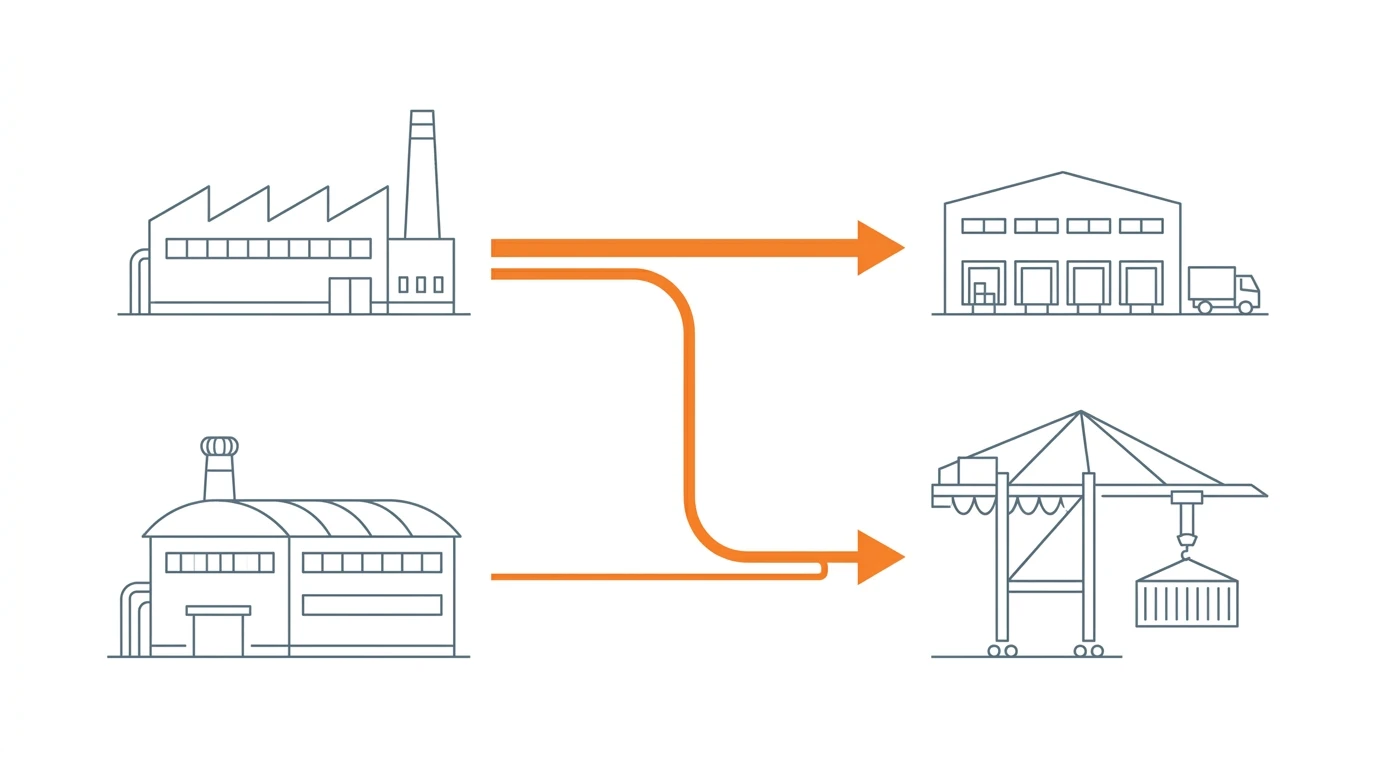
Figure: one catalog, two origins — SKUs split by tariff sensitivity, certification, and customization needs.
Concretely, it works like this:
- List your SKUs and score each one on tariff exposure, certification requirements, customization level, and volume.
- Pick the origin-sensitive slice — typically standard cables going to the US or EU where origin or duty changes the landed cost.
- Qualify a second factory for that slice: sample runs, per-plant certification verification, and a paid trial order before any commitment. For standard drop cables, that means qualifying the UL-listed FTTH drop cable range at the second site and re-testing per the destination market's certification.
- Keep the engineering-heavy slice in China, where speed and depth still rule.
- Re-qualify annually — tariff policy, factory capacity, and your own volume mix all shift faster than sourcing plans do.
This is not a theoretical structure. DYS Fiber Optic runs exactly this model: our China factories in Huizhou (headquarters) and Mianyang handle the full custom and volume range, and our Hanoi, Vietnam plant — commissioned in 2024 specifically as a non-China origin option for tariff-sensitive buyers — covers eligible cable families with Vietnam origin. If you are evaluating a dual-origin supply base, the concrete next step is a per-SKU origin matrix from a supplier that can actually quote both sides — not a one-country pitch.
Bottom line
China and Vietnam are not competing answers to the same question; they are answers to different questions. China answers "who can engineer and deliver this custom cable fastest and cheapest"; Vietnam answers "who can ship this standard cable without the tariff and compliance baggage." For most buyers the correct procurement strategy is not "China vs Vietnam" — it is a split: custom and complex work stays in China, origin-sensitive standard work qualifies in Vietnam, and the whole catalog is re-checked against tariff policy every year. Start with the at-a-glance table above, score your SKUs, and ask your suppliers for origin options on both sides before you let a tariff cycle make the decision for you.