

Sourcing
How Fiber Optic Cable Is Made: From Preform to Jacket Inside a Real Factory
A datasheet is a promise, not evidence. It tells you the attenuation a supplier is willing to put in writing. It does not tell you whether that number still holds on reel four thousand, nine months from now, when the color sequence has changed twice and the jacket line has run three different compounds that week.
That gap — between a manufacturer who can make your cable once and one who makes it the same way every time — is not visible in a catalog. It is visible in how fiber optic cable is made. Which is why buyers who have been burned stop asking "what are your specs" and start asking "walk me through your line."
What follows is that walk-through. Seven stages, from a cylinder of ultra-pure glass to a reel that carries a test certificate, written for people who have to decide whether a factory is real. We will spend most of the words where almost nobody else does: the cable-level steps, where cost, lead time and failure modes are actually decided.
Most explainers of this topic stop at the fiber. But you are buying cable.
How fiber optic cable is made: seven stages from silica to a tested reel
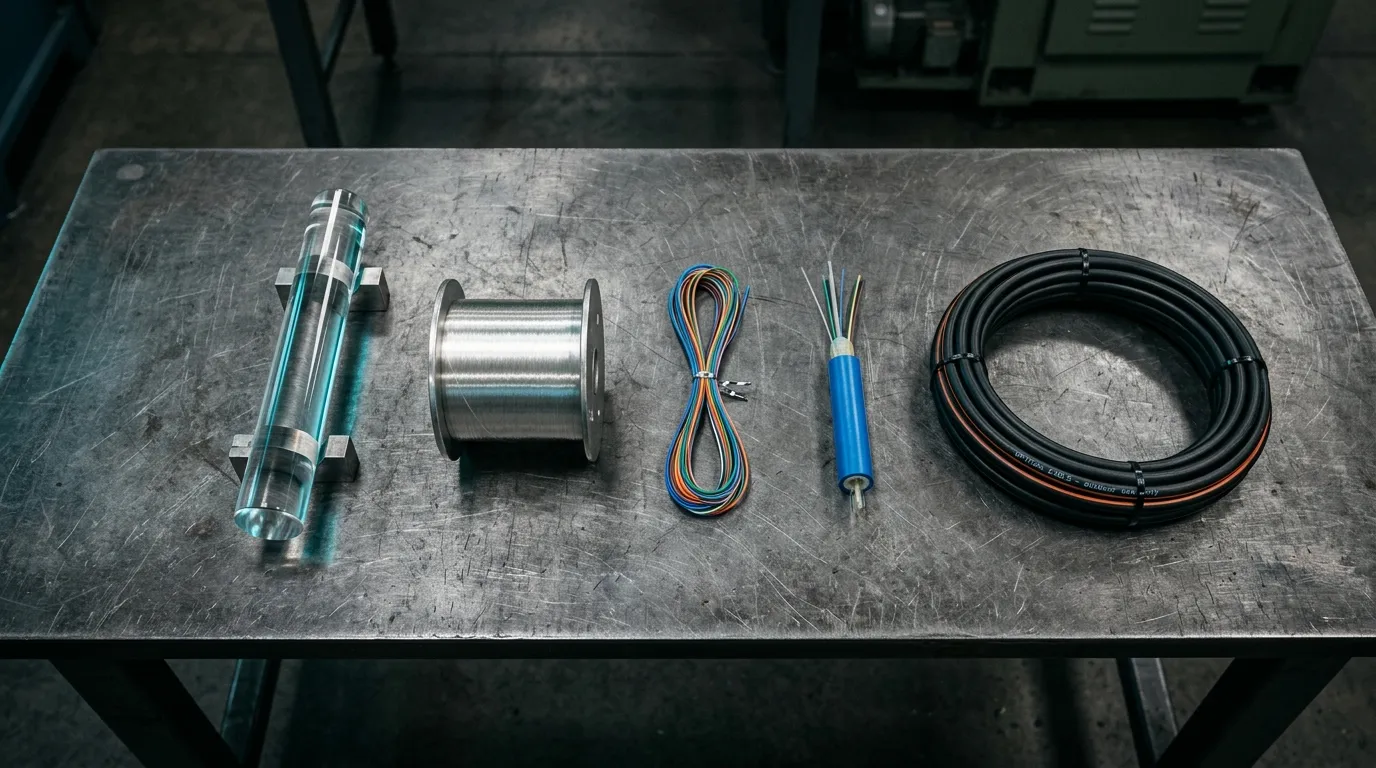
The images in this article illustrate the process; they are not photographs of a specific factory's production line.
The whole process divides into two halves with completely different economics, and knowing where the line falls is the single most useful thing you can carry into a supplier conversation.
Stage | What happens | What it decides | Kind of investment |
|---|---|---|---|
1 · Preform | Ultra-pure glass is deposited into a rod with the finished fiber's optical cross-section | Purity ceiling — everything downstream inherits it | Heavy asset, clean-room |
2 · Drawing | The rod is heated and pulled into hair-thin fiber, coated and proof-tested | Diameter, strength, coating integrity | Heavy asset, high throughput |
3 · Coloring | Fibers are colored to a fixed 12-color sequence; ribbons are bonded | Traceability inside the cable | Process-dense |
4 · Unit build | Fibers are packed into loose tubes, tight buffers or ribbons | Micro-bend protection, splice strategy | Process-dense |
5 · Stranding | Units are stranded around a strength member with water blocking | Tensile rating, moisture path | Process-dense |
6 · Jacketing | A polymer jacket is extruded over the core | UV, abrasion, fire rating | Process-dense |
7 · Testing | Attenuation, geometry, mechanical and environmental tests per reel | Whether it ships | Lab, per-reel cost |
Stages 1 and 2 need a furnace, a tower, a clean room and a technology relationship that takes years and serious capital to stand up. Stages 3 through 6 need three or four lines, a lab, and disciplined operators. Both are real manufacturing. They are not the same thing, and the price difference between two quotes for the "same" cable usually lives in that distinction.
Stage 1 — Preform: the fiber is decided before it exists
The preform is a glass rod that already contains the finished product's design. It is, in the Fiber Optic Association's reference guide, "a large diameter glass rod which has the exact same optical cross section as a fiber but is hundreds of times larger." The core that will guide the light, the cladding around it, the index profile between them — all of it is built into the rod.
The rod is grown rather than cast. In the vapor-deposition processes used commercially, silicon tetrachloride and germanium tetrachloride are carried in a gas stream through a hot zone, where they oxidize into soot that is deposited layer by layer and then consolidated into glass. Germanium dopes the core so its refractive index sits slightly above the cladding's — and that difference is the entire mechanism of a fiber: light launched at a shallow enough angle to the axis reflects at the core-cladding boundary and stays trapped in the core. That is total internal reflection, and it is designed in at this stage, not later.
Purity is the constraint that makes this stage expensive. Contamination is measured in parts per billion. Residual hydroxyl groups in particular create absorption bands that ruin the transmission window around 1383 nm, which is why low-water-peak fiber exists as a product category at all. You cannot fix an impure preform downstream. You can only reject the fiber it produces, at a cost several stages later.
A finished preform is roughly a meter long and 100–200 mm in diameter. Drawing it down to a 125 µm cladding means the glass thins by a factor of about a thousand across, which is why one rod carries the equivalent of hundreds of kilometers of fiber. That ratio is also why preform capacity is the true bottleneck in the fiber trade — the tower can only draw as much as the rods allow.
What to ask: Do you draw your own fiber, buy fiber from a major glass maker, or both? Both answers are legitimate. "Both" usually means the supplier can pick the fiber grade that suits your application instead of relabeling whatever is in stock.
Stage 2 — Drawing: a preform becomes kilometers of glass thread
The preform is lowered into the top of a draw tower, into a graphite resistance furnace running at roughly 2,000 °C. The tip softens and a strand is pulled away, then accelerated down the tower while a laser gauge watches the diameter continuously and feeds speed control. Telecom fiber is drawn at a nominal 125 µm cladding; the tolerance is tight enough to be measured in fractions of a micron, because a variation there changes the fiber's mode field and how it splices.
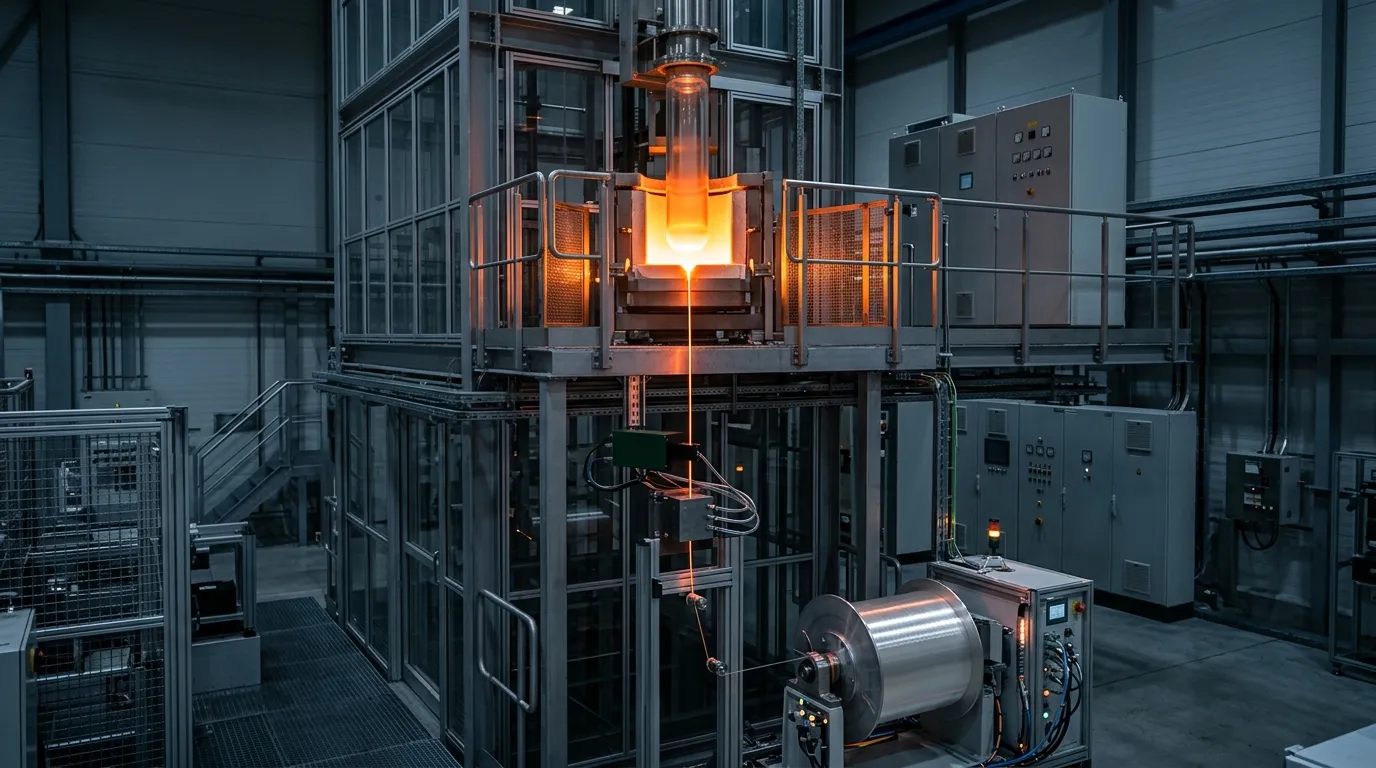
Three things happen during the short fall down the tower, and each one shows up in the cable's behavior later.
The freshly formed glass is coated before it touches anything. An acrylate coating is applied in-line and cured with ultraviolet light, building the bare 125 µm glass up to a 242–250 µm strand. This is not packaging; an uncoated fiber loses most of its strength within hours because surface flaws become crack initiators in the presence of moisture. The coating is the fiber's mechanical life.
The fiber is proof-tested. Each strand is pulled over a series of capstans under a controlled load, so that any section weaker than the screening level breaks and is spooled away instead of being sold. That screening level is what sets the minimum tensile figures on the fiber datasheet — a proof test is a promise about the worst fiber in the spool, not the average. Bend limits are a separate specification with a different origin: they come from the fiber's macrobend-loss performance and its fatigue behavior under sustained stress, which is why a bend-insensitive G.657 design carries a tighter minimum radius than standard G.652.
And it is spooled. Take-up tension, traverse pitch and spool geometry are all set here, because a fiber package that was wound badly will micro-bend in the coloring line and show up as scatter in a customer's OTDR trace months later.
Wavelength and fiber type get chosen at the same time: single-mode versus multimode is a decision about what the link needs, not about what the factory prefers to run.
Stage 3 — Coloring and ribbon: making 12 fibers tell themselves apart
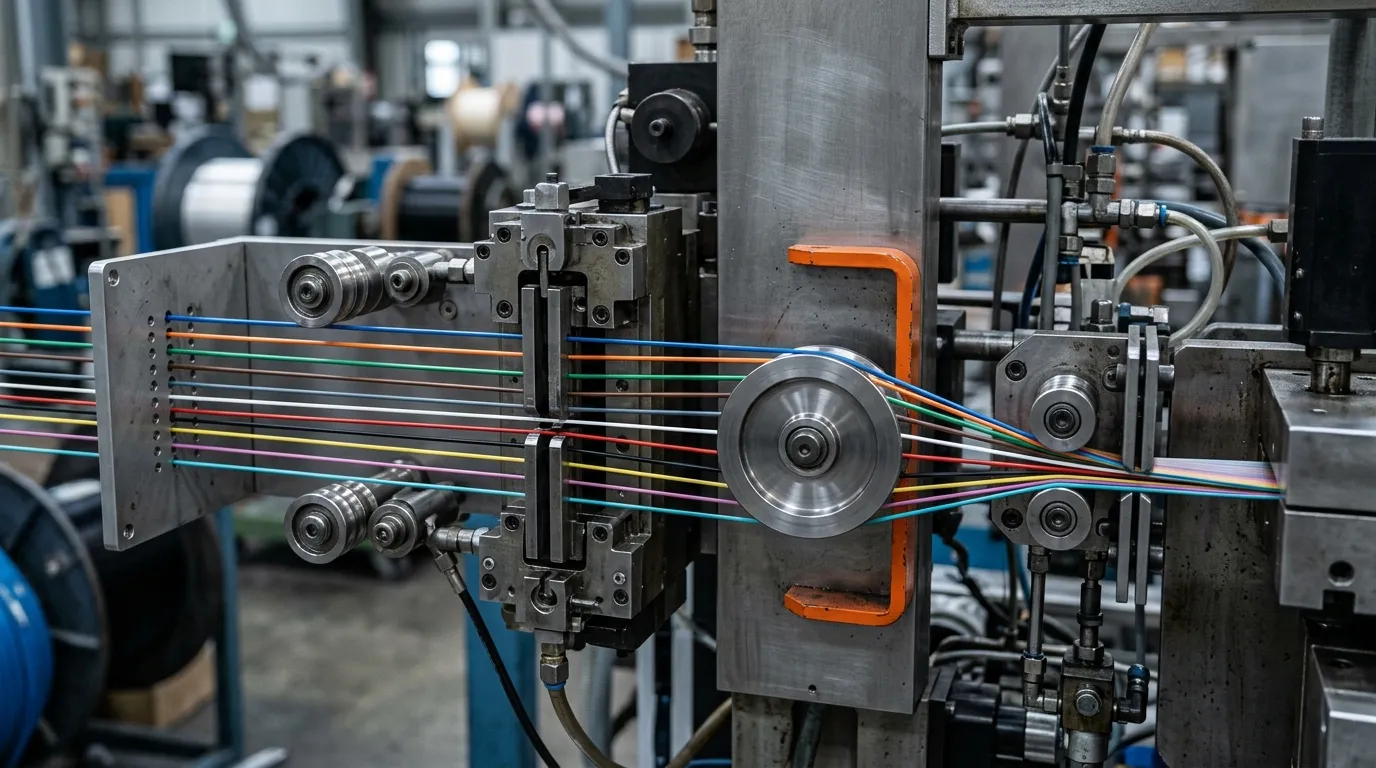
A fiber with no color is untraceable the moment it enters a cable. Inline coloring runs the coated fiber through a thin layer of UV-cured ink and re-reels it, and the sequence is fixed by standard rather than by taste.
Per the FOA's color-code reference, TIA-598 specifies twelve colors in this order: blue, orange, green, brown, slate, white, red, black, yellow, violet, rose, aqua. Tubes and ribbons use the same twelve in the same order, so a technician can find fiber 7 in tube 3 without a schematic. Sixteen-fiber MPO connectors extend the sequence with olive, magenta, tan and lime for positions 13 to 16.
Ribbonizing is the other half of this stage. Four, eight or twelve colored fibers are bonded side by side into a flat ribbon with a thin matrix material that can be peeled apart. The payoff is at splicing: one mass-fusion splice joins twelve fibers at once instead of twelve separate splices, which is why high-count data center and access cables are built from ribbons. The formal structure of those cable families is covered in our guide to fiber color codes in cable construction.
An inline coloring line is a modest investment compared with a draw tower, which is why color consistency is a fair test of a cable factory's discipline — mismatched or drifting ink shows up immediately on a customer's splice tray.
Stage 4 — Loose tube, tight buffer, or ribbon: choosing the cable's core unit
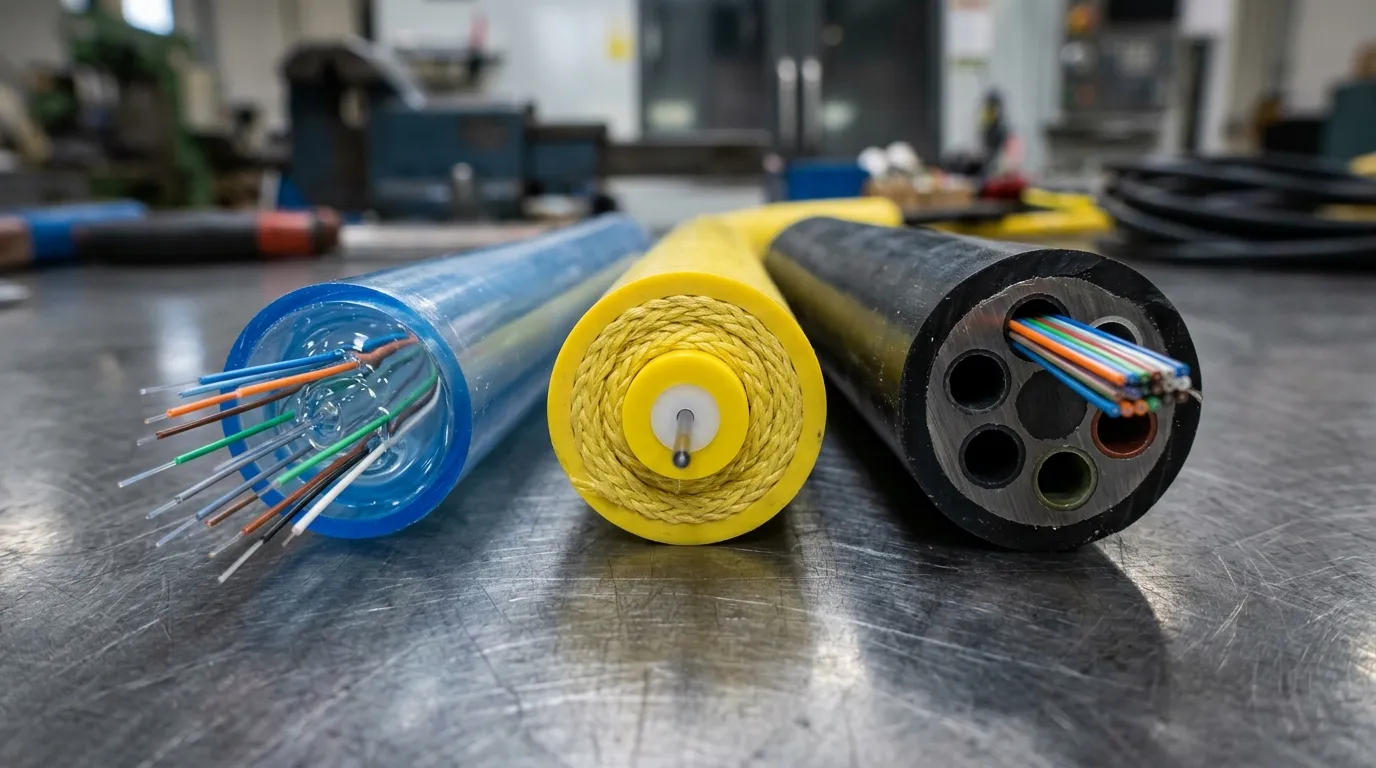
This is the fork in the road. Three unit designs dominate, and each one exists because it solves a different problem.
Loose tube is the outdoor default. Bare 250 µm fibers sit inside a small plastic tube — typically six to twelve per tube, sometimes twenty-four — with the free space filled by a thixotropic gel or a dry water-blocking yarn. The fibers float. That slack is deliberate: it isolates the glass from the strain and thermal contraction of everything around it, and it is why loose-tube cable survives being pulled through a duct in January and hanging on a pole in August. The standard a buyer should expect to see named on a single-mode fiber datasheet is ITU-T G.652, with G.657 as the bend-insensitive variant used for drop cables and tight indoor routing.
Tight buffer wraps each fiber individually to a 900 µm diameter. The fiber is fully supported, so there is no gel to manage and no gel to clean. It is more expensive per fiber, and it is the right answer for patch cords, indoor risers and anywhere a human will handle the fiber directly.
Ribbon in a slotted core pushes fiber count up while keeping the cable compact. The trade-off is handling: ribbons reward mass-fusion splicing and punish hand-termination.
Which one you should buy depends on where the cable will live, not on which is technically superior — a comparison our cable types guide works through by application.
Stage 5 — Stranding: strength members, water blocking, and rip cords
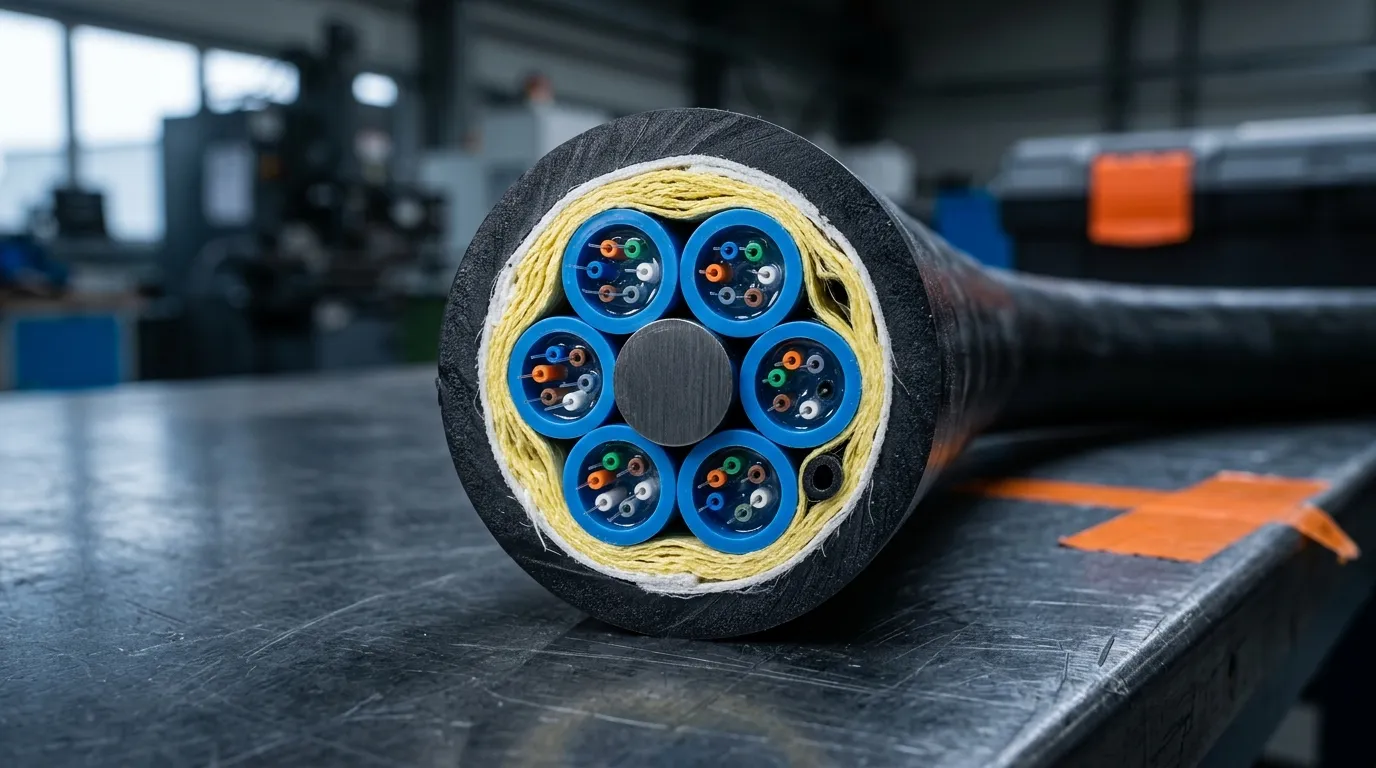
Fibers carry light. They do not carry load, and they are the most fragile thing in the cable, so everything else in the core exists to protect them.
A central strength member — steel wire, or a fiber-reinforced plastic rod where dielectric construction matters — anchors the cable's tensile rating. Around it, the loose tubes are cabled in a helix. The important distinction here is between a unidirectional lay and an SZ lay, where the helix reverses direction at intervals. SZ stranding lets an installer open the cable mid-span and pull out the tubes they need without cutting the whole cable, which is why it dominates access-network and distribution cables. If a supplier cannot tell you which lay pattern they run, they are not close to their own line.
Aramid yarn is layered over the tubes as additional tensile strength. Water blocking is handled either wet or dry: gel-filled tubes and a flooding compound, or water-swellable tape and yarn that expand on contact and choke the water path. Both work. Dry constructions are easier to prepare in the field and increasingly preferred for that reason, but they demand tighter process control on the line, so the choice tells you something about the manufacturer's equipment.
Finally, rip cords are laid in — a small detail that decides whether a technician opens the cable in ninety seconds or an hour. Designs that skip the rip cord, or bed it too deeply, save cents at the factory and cost hours in the field. For aerial routes where a dielectric, all-plastic construction is required, the whole strength-member decision changes, as this all-dielectric aerial cable explainer sets out.
Stage 6 — Jacketing: the extrusion line that decides your fire rating
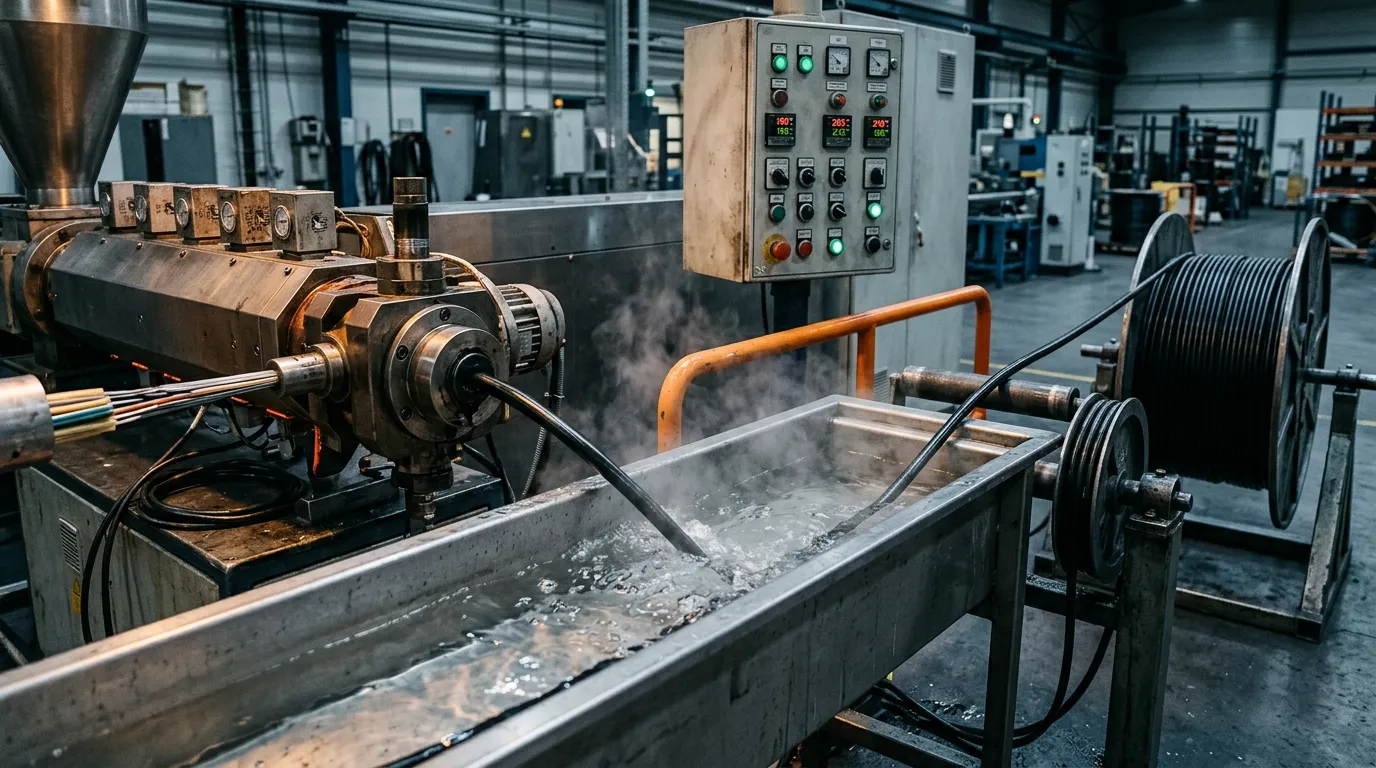
The stranding is pulled through a crosshead die while an extruder feeds molten polymer around it, then the freshly jacketed cable runs through a cooling trough with the jacket sizing itself as it sets. Along the line, an inkjet printer writes meter marks, fiber count and batch codes onto the jacket — the reason you can measure a span without opening a reel.
The compound choice is where this stage becomes a commercial decision rather than a technical one. Medium- and high-density polyethylene gives outdoor cable its UV resistance and abrasion tolerance, and it is cheap. Low-smoke zero-halogen compounds cost materially more and give up some mechanical toughness, but they emit far less smoke and no corrosive halogen acid when they burn, which matters in a duct, tunnel or riser.
That is why an indoor cable cannot simply be "the outdoor one in a different color." The reaction-to-fire class marked on a European cable — Aca, B1ca, B2ca, Cca, Dca, Eca or Fca — comes from the CPR classification table carried in Delegated Regulation 2016/364, and the class is a property of the finished assembly, not of the polymer alone. Change the jacket thickness, the filler, or the core construction and the class has to be re-established. In North America the same question is asked as a plenum or riser rating, which is where the UL OFNP and OFNR designations come from.
For a buyer, the practical test is whether the factory can tell you which class a given construction achieves and who signed the declaration. Our fire-rating comparison covers the differences between those systems; the point here is that the answer is decided on this extrusion line.
Stage 7 — Testing: what a factory measures before it signs off a reel
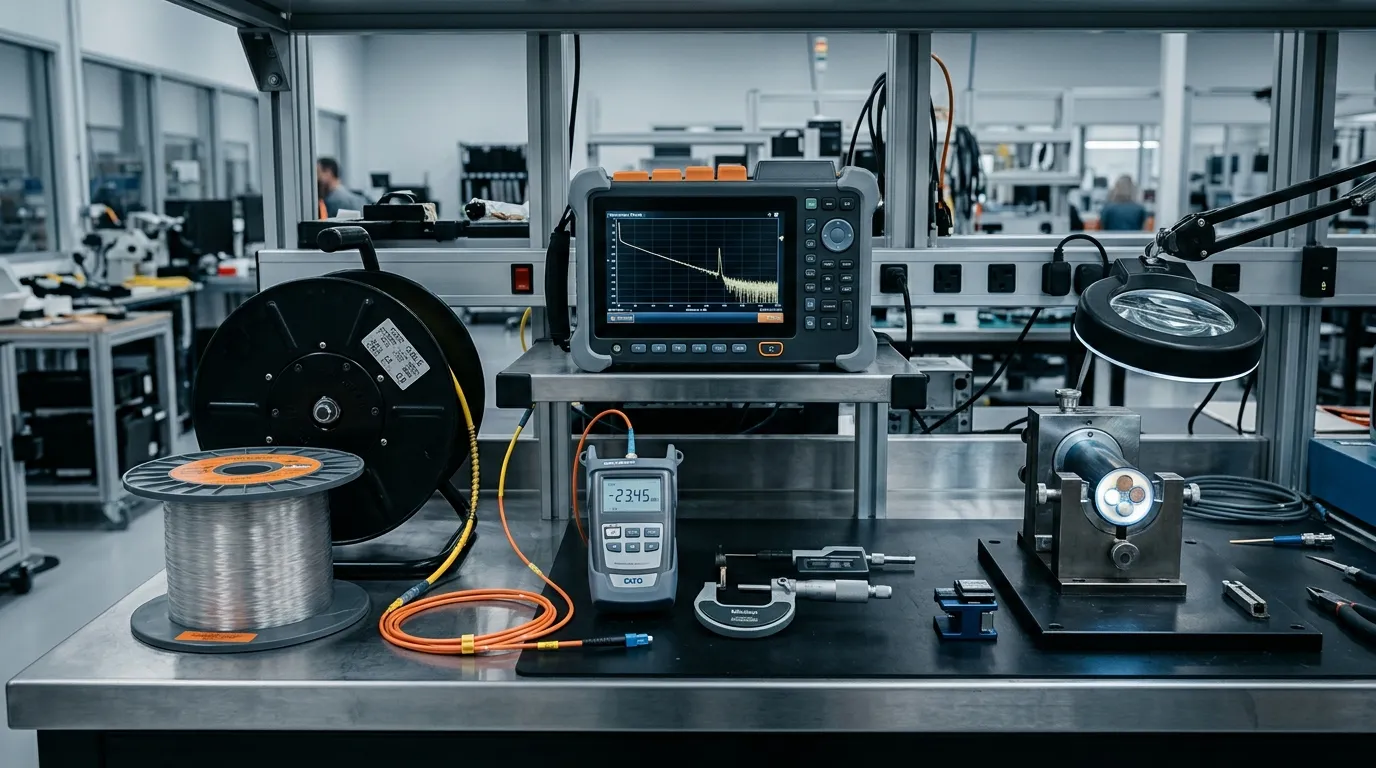
A reel leaves a good factory with data, not just a label.
Attenuation comes first, measured at the operating wavelengths — nominally 1310 nm and 1550 nm for single-mode. As a typical reference point, the Fiber Optic Association's fiber reference (the page linked in Stage 1) gives around 0.4 dB/km at 1310 nm and 0.25 dB/km at 1550 nm for standard single-mode, with the fiber standard itself setting the limits rather than the average. The physics behind those numbers is two mechanisms: absorption, driven by residual hydroxyl and the dopants used to shape the index, and scattering, which falls off with the fourth power of wavelength — the reason 1550 nm is quieter than 1310 nm and 1310 nm is quieter than 850.
An OTDR trace goes further than a single number. By sending a pulse and reading the backscattered light against distance, it shows whether loss is uniform along the reel or concentrated at a point, and it localizes breaks and poor bends. On a factory reel, a clean, flat trace is the evidence that the drawing, coating and cabling stages did not introduce localized damage. On an installed span, the same instrument is how a technician finds the fault, which is the subject of our field testing walkthrough.
Geometry is checked too: cladding diameter, core concentricity and, for single-mode, mode field diameter — the effective core size, specified in the 8–10 µm range for standard single-mode rather than as a physical core edge. Mechanical and environmental tests follow: tensile and crush loading, impact, repeated bending, and temperature cycling across the operating range. These are the tests that catch a design error in the cable rather than in the fiber, and they are the ones most likely to be skipped by a manufacturer treating testing as paperwork.
The output that matters to you is a per-reel attenuation record and a certificate of conformity keyed to the batch printed on the jacket. If a supplier cannot produce one for an arbitrary reel, the earlier six stages are academic.
How to tell a real drawing plant from a cable assembly shop
Here is the payoff. Take everything above and reduce it to one question: which stages are inside the wall?
Drawing fiber from your own preform requires a furnace, a tower, a clean room and either a long-developed process or a licensed one. A very small number of factories worldwide do it. Building cable from purchased fiber — coloring, unit assembly, stranding, jacketing, testing — requires three or four lines and a lab, and a much larger number of factories do that. Neither is automatically better. It depends entirely on what you are buying and how much control over the fiber you need.
What is not acceptable is a supplier who cannot tell you which category they are in. That ambiguity is where the unexplained quote comes from.
The questions below are worth carrying into a video audit or a site visit. They are ordered by how quickly they separate the two categories, and none of them requires you to be an engineer to interpret the answer.
Ask | A factory that knows its line answers with | A reseller answers with |
|---|---|---|
Do you draw fiber from your own preform, or buy fiber? | A named position, plus the fiber maker's reel label on request | "We use the best fiber" |
Which lay do you run on distribution cable — unidirectional or SZ? | The lay pattern and why | A blank silence |
Is coloring inline or do you only buy pre-colored fiber? | Either, described concretely | Confusion about the question |
Which tests does every reel get, and can I see an OTDR trace? | A list, plus a sample trace and the per-reel record | "All our products are tested" |
Where is the jacket line, and who signs the CPR or UL declaration? | A site, a name, a document | A certificate PDF with no traceable author |
What is your nameplate throughput? | A per-day figure by product line | A marketing number with no unit |
Verify the certification half of that table independently rather than accepting the PDF — the method is set out in our guide to verifying a fiber cable supplier's UL listing.
For transparency about where we sit on that spectrum: DYS Fiber Optic has made optical cable since commissioning our first cable line in 2013, across three sites — the Huizhou headquarters in Guangdong, the Mianyang plant in Sichuan, and the Hanoi plant in Vietnam — with more than 50 production lines and a nameplate optical cable capacity of 800 km per day. Our 2026 build-out is MES and WDS systems on the floor, which is the unglamorous part of "consistent": being able to trace a batch back to its line, its compound lot and its operator.
If you want the selection framework rather than the process — rankings, audit structure, and how OEM and ODM engagements differ — the sourcing cluster hub is the right next stop — the link is at the end of this article.
What the process tells you about lead time, MOQ, and where to buy
Once you can see the line, lead time stops being a mystery number.
The long pole is fiber supply, because drawing capacity is finite and shared across every cable the factory runs. The flexible part is downstream: coloring, stranding and jacketing can be reordered around your delivery date with relatively little pain, provided the fiber is in the building.
That is why two things move your quote more than volume does. Color and print are the setup-driven costs — a non-standard color sequence, or custom jacket printing, means a line stoppage that a manufacturer will recover somewhere in the price. And construction changes that touch the jacket or the core will reset the fire-rating declaration, which is a documentation cycle as well as a production one.
That setup framing is also the honest answer to the MOQ question. A cable factory's minimum order is rarely a fixed number printed in a catalog; it is a run-length decision that falls out of two things — the smallest fiber package the fiber supplier will break for this construction, and how much line time a color change or a compound change is worth absorbing. So ask for MOQ by construction, not for one headline figure, and ask which of those two constraints is doing the driving. A number quoted without a construction attached to it is a number that will move the moment your jacket compound or core design changes.
Origin is the third lever, and it is worth planning rather than discovering. One supplier running multiple plants can serve the same drawing from different origins, which is a supply-chain conversation rather than a manufacturing one — the trade-offs are the subject of China versus Vietnam fiber cable sourcing.
Three questions buyers ask after a plant tour
Who is the largest producer of fiber optic cable?
There is no single answer, because "largest" splits into two lists. The largest fiber makers are a small group of glass and materials companies that sell drawn fiber worldwide. The largest cable makers — the ones who turn that fiber into finished cable — number in the thousands, and our ranking of the world's largest fiber cable manufacturers works through who they actually are. Your supplier's real position is which list they buy from and how much of the second list they actually operate.
What is the downside to fiber optic?
It is fragile in ways copper is not, and it punishes handling errors. Bend it too tightly during installation, pull it past its tensile rating, or leave it unsupported and it will fail — often not immediately but as slowly rising loss. Splicing needs skill and calibration. And every passive fiber link still needs powered electronics at both ends.
Is fiber optic plastic or glass?
Almost all telecom fiber is ultra-pure silica glass with a doped core; "plastic" refers to the protective acrylate coating around it. True plastic optical fiber exists with a roughly 1 mm core, but it is used for short, low-speed links, not for access or transport networks. When someone says glass, they mean the light-guiding material.
Where to go next
If you are still choosing a supplier, work from the hub: our guide to selecting a fiber optic cable manufacturer covers rankings, factory audits and how to read an audit report. If you already have a shortlist, the next most useful distinction is contractual rather than technical — OEM versus ODM in fiber optics explains which party owns the design, the tooling and the liability.
And if you have a spec sheet in front of you right now and want a straight answer on which stages we run in-house and what your reel's test record will contain, send it over — that conversation is faster than another round of reading.