

Sourcing
OEM vs ODM in Fiber Optics: Which Model Fits You?
In fiber optics, the difference between OEM and ODM comes down to who owns the design: an OEM builds to your drawings and specification, while an ODM designs the product and lets you brand its existing catalog. Most buyers comparing OEM vs ODM in fiber optics discover the real decision is not the acronym — it is three ownership questions (design, tooling, certification listings) plus which products in your line can tolerate standard designs. This guide is written from inside the trade: DYS Fiber Optic has manufactured fiber optic cables, FTTX assemblies, and MPO/MTP products on an OEM/ODM basis for 17 years, with 90% of output shipping to Europe and the US. It walks through both models with fiber-specific examples so you can carry a clear answer into your next RFQ.
OEM vs ODM in fiber optics at a glance
Dimension | OEM | ODM |
|---|---|---|
Who owns the design | You do — the factory builds to your drawing | The factory does — you customize an existing design |
Who owns the tooling (molds) | You typically pay for and own the molds | The factory owns the molds, amortized across customers |
Certification listing | Your brand can carry its own listing, per plant | The factory's listing covers its standard designs |
Customization ceiling | Nearly unlimited: fiber count, jacket, print, packaging | Mostly cosmetic: logo, label, packaging, minor tweaks |
MOQ | Higher — tooling and setup amortize over your order | Lower — designs and tooling are shared |
Best for | Differentiating SKUs, premium brand, proprietary specs | Standard SKUs, speed to market, tight budgets |
The short version: if the product only exists in your spec, that is OEM; if a proven design from a supplier's catalog is good enough, that is ODM. Most fiber buyers end up running both — the full decision framework in our guide to choosing a fiber optic cable manufacturer treats the model choice as part of the overall supplier selection, not a separate one.
What OEM means when you buy fiber optic cable
An original equipment manufacturer (OEM) builds a product to another company's design and specification. In fiber optics, that means you hand the factory a spec sheet or drawing — fiber count and type, jacket material, fire rating, print legend, connector and polish type, packaging — and it manufactures to exactly that. You set the quality bar, you define the tests, and your brand goes on the drum.
What you control is the entire product definition. Want an MPO/MTP cassette with a non-standard fiber count, a proprietary color-coding scheme, and your logo molded into the housing? That is an OEM project. Want an FTTH drop cable with a custom jacket color and your print legend on 2,000-meter reels? Also OEM. The factory's role is execution.
The price of that control is visible in three places:
- NRE and tooling. Someone pays for the mold design, connector tooling, and process qualification before the first cable ships. In OEM, that someone is usually you — either as a one-time fee or as an amortized cost in the unit price.
- Longer lead times. First-article qualification, testing, and approval cycles add weeks compared with pulling a standard design off a shelf.
- Your own engineering responsibility. You own the spec, so you own the design reviews, tolerance decisions, and failure analysis when something does not perform in the field.
What ODM means when you buy fiber optic cable
An original design manufacturer (ODM) designs and produces the product itself; you select it from the catalog, apply your branding, and sell it as your own. The factory has already engineered, tested, and in many cases field-proven the design — your input is usually cosmetic: logo, labels, packaging, and occasionally a length or connector variant.
This is where standard fiber products live. FTTH drop cables in G.657A2, LC and SC patch cords, 12- and 24-fiber MPO/MTP trunks, and standard distribution boxes all exist as proven ODM designs at any serious factory. You get three things OEM rarely gives you:
- Speed. The design is qualified; samples ship in days rather than after a development cycle.
- Lower cost. Tooling and development are shared across many customers, so unit prices and MOQs stay low.
- Less risk. The design has manufacturing history. Test data and failure modes are known quantities.
The trade-offs are the mirror image, and they are worth stating plainly because they are the most-asked question about ODM: customization is capped at cosmetics, the design and tooling stay with the factory, and your competitor can buy the same product from the same catalog. If differentiation is your strategy, ODM alone will not carry it.
The difference that actually matters: who owns the design
Every solid explainer of OEM vs ODM lands on the same line: the difference is who owns the design. For fiber optic buyers, that line has three concrete consequences — three things you should be able to name before you sign anything.
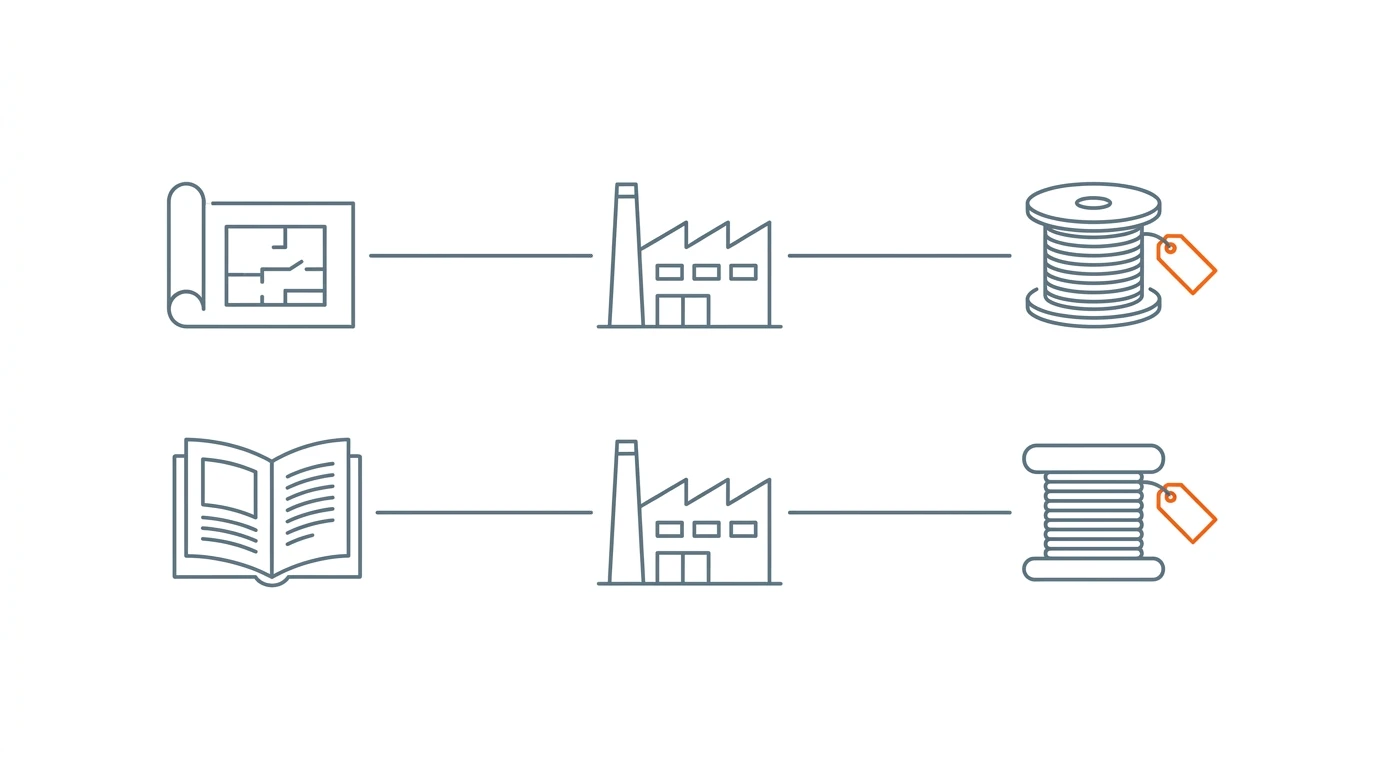
Figure: both models end with your brand on the product — the lanes differ in where the design comes from.
Design and IP. The design ownership defines the intellectual property. Under OEM, your drawings, your fiber and connector choices, and your print legends belong to you; the factory signs an NDA and builds to order. Under ODM, the design belongs to the factory, which is free to sell it to other brands — including your direct competitor.
Tooling and molds. Fiber products are full of molded parts: connector housings, box enclosures, splice trays, strain-relief boots. Mold ownership is a contract question, not a marketing one — the party that paid for the mold generally owns it, and mold transfer is a real negotiation point when you switch suppliers. A factory with an in-house precision mold and injection workshop can build and own custom tooling fast; a factory that outsources molds adds a middleman to that conversation.
Certification listings. UL, CPR, and Anatel approvals attach to a factory site and a file number — not to a brand name. If you OEM your own product, your brand can hold its own listing at that plant. If you buy an ODM design, you are typically riding the factory's listing for the standard construction. That distinction matters for US and EU buyers because fire-rated cables (UL OFNP/OFNR, CPR classes) are regulated products, and the UL mark is tied to the listing, not to the label on the box.
Three adjacent terms keep showing up in this conversation, and they blur into OEM/ODM in most articles:
Term | Who designs | Who brands | Typical use |
|---|---|---|---|
OEM | Buyer | Buyer | Custom products built to your spec |
ODM | Factory | Buyer | Catalog products with your branding |
Private label | Factory | Buyer | Finished standard goods, minimal factory customization |
White label | Factory | Distributor/retailer | Unbranded goods any channel can brand |
JDM (joint design) | Both, co-developed | Buyer | Shared engineering on complex products |
Contract manufacturing (CM) | Buyer | Buyer | You design fully; factory manufactures |
That last boundary explains questions like "Is Cisco an OEM or an ODM?" — the answer is both. Cisco designs routers and has them manufactured (an OEM customer), and it builds products to other companies' specifications (an ODM supplier). Most mid-size fiber brands sit in the same place: OEM customers for their differentiating SKUs, ODM customers for their standard ones.
Which fiber optic products fit which model
The fiber-specific question no generic guide answers is: which of your SKUs actually need OEM, and which are fine as ODM?
Product family | Typical model | Why |
|---|---|---|
FTTH drop cable | ODM base + OEM variants | G.657A2 constructions are standard; custom lengths, jacket colors, and print legends are cheap OEM additions |
Patch cords and jumpers | ODM, or OEM for combos | LC/SC/MPO combos at custom lengths are standard OEM work; plain cords are pure ODM |
MPO/MTP trunks and cassettes | OEM for custom; ODM for standard | Fiber count, polarity, and length are the differentiation levers at 400G/800G |
Distribution and terminal boxes | ODM + mold customization | Enclosure design changes need molds, which makes this the most tooling-heavy category |
Connectors and injection parts | OEM/ODM via mold workshop | Custom housings and boots are mold projects, not assembly tweaks |
The pattern behind the table: standard constructions migrate toward ODM; anything with a specification that differentiates you migrates toward OEM. A useful rule of thumb is the 80/20 split — roughly 80% of a typical fiber catalog is standard and ODM-friendly, while the 20% that wins you accounts is built OEM, often as custom fiber optic cable assemblies with your branding on the drum. Cabling standards such as the TIA-568 series from TIA define the performance baselines that standard designs are built to, which is exactly why those baselines are safe to buy as ODM.
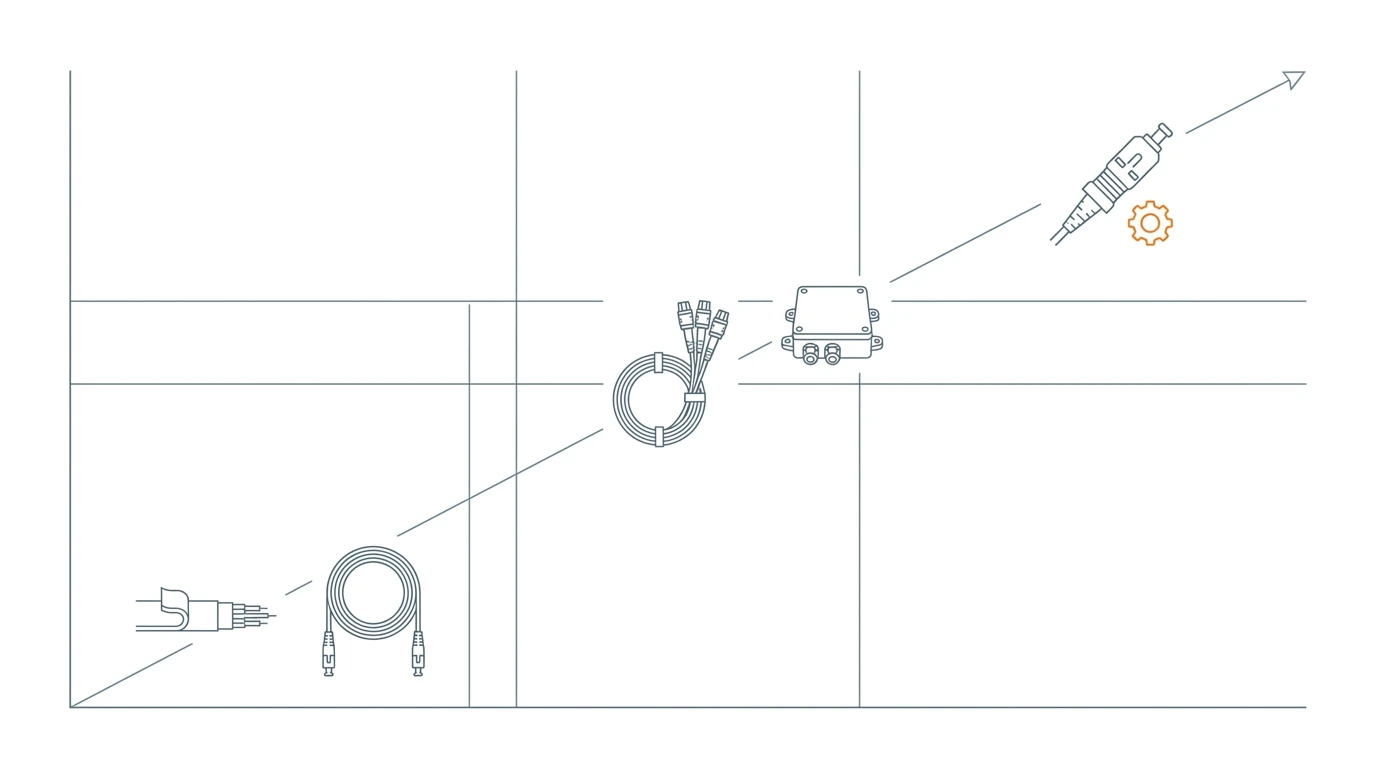
Figure: the more custom the specification, the further a product sits toward the OEM end of the matrix.
When OEM is the right call
Choose OEM when the product is the strategy:
- Your network or product has a specification that does not exist off the shelf — a non-standard fiber count, a mixed connector configuration, a proprietary enclosure.
- Your brand competes on features, and a catalog product would hand your differentiator to the factory's other customers.
- You need your own certification listing or your own test documentation for a regulated market.
- You have the volume horizon to amortize tooling and NRE — mold costs make sense when the SKU will run for years, not once.
The honest cost is the one-time development burden plus longer first-article cycles. If a custom MPO/MTP trunk takes six weeks to qualify and a standard one ships in two, the OEM decision is a bet that the custom spec earns that month back in margin or performance.
When ODM is the right call
Choose ODM when the product is a utility:
- You need to reach a market fast — a new region, a new customer, a trial deployment — and speed beats uniqueness.
- Your spec is standard: G.657A2 drop cable, LC/SC patch cords, 12-fiber MPO trunks. Someone has already engineered and field-tested them.
- Budget is tight and tooling is not in this year's plan.
- Volumes are too small to amortize custom tooling.
Third-party sourcing advisors reach the same conclusion from the other side: importivity's OEM vs ODM breakdown notes that the ODM route wins for standard products and short timelines, and that the cost gap between the models narrows as volumes grow — the shared-tooling advantage fades exactly when the OEM tooling has been paid off. The practical reading: start standard, and let proven SKUs fund the custom ones.
How to run an OEM/ODM sourcing project
Whichever model you choose, the process looks the same — and the verification steps are where fiber buyers get burned.
- RFQ. Send the spec sheet, target price, and forecast volumes. A serious factory answers with a cost breakdown: materials, tooling/NRE if any, unit price by volume band, and lead time. If the RFQ is for an ODM product, ask which catalog items match and what the customization limits are.
- Samples. Standard ODM samples ship in days; OEM first articles take longer and must be tested against your spec — fiber count, insertion loss, return loss, jacket dimensions, print legibility. Ask for the test reports, not just the samples.
- Factory audit. This is the step generic guides skip. Walk the production lines and the test lab, check the mold shop if tooling matters to you, and confirm the certifications are real — the process for verifying a fiber cable supplier's UL listing applies to every certificate you are relying on.
- Pilot run. Qualify the first production batch against the sample's test data. Confirm 100% pre-shipment testing is real — insertion-loss and return-loss data per cable, not a sampling policy.
- Scale with the paperwork. Three things belong in writing: mold ownership and transfer terms, MOQ and lead-time commitments per volume band, and which certification listings cover which products.
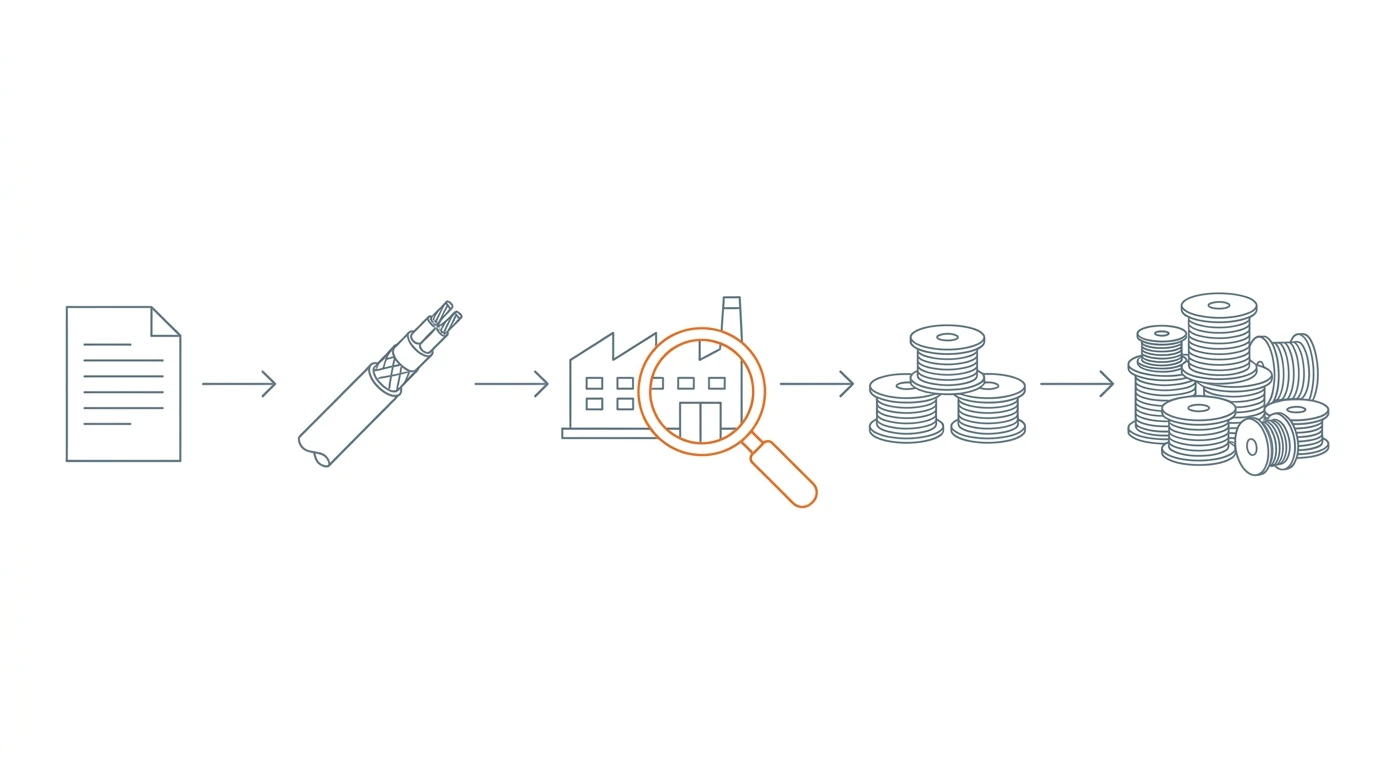
Figure: the verification checkpoints — samples, audit, pilot — are where the model decision gets tested against reality.
Two contract points deserve emphasis. First, mold ownership: if you pay for tooling, the contract should say you own it and what happens at separation. Second, origin: for tariff-sensitive buyers, the OEM/ODM relationship does not change the China vs Vietnam sourcing decision — a Vietnam factory offers non-China origin for the same models, and origin is verified per plant, not per brand.
What a capable partner looks like in practice: DYS runs five in-house workshops (cable extrusion, jumper assembly, mold design, injection molding, FTTX waterproof assembly) — the mold and injection division was commissioned in 2025 — under ISO 9001/14001/45001 and TL 9000, with UL, CPR, and Anatel listings and 100% pre-shipment testing. That is the shape of the checklist above made concrete: the design conversation, the tooling conversation, and the certification conversation all happen inside one factory instead of across three vendors.
Bottom line: decide the model, then vet the supplier
Three questions settle the OEM vs ODM decision for any product in your line: Is the design yours? Do you need to own the tooling? Does your brand need its own certification listing? Three yeses points to OEM. Three noes points to ODM. Anything in between — which is most fiber product lines — points to a supplier that can do both, with the contract points above handled in writing.
If you are evaluating an OEM/ODM partner for fiber optic cable, FTTX assemblies, or MPO/MTP products, send your spec sheet and target volumes to DYS Fiber Optic — our engineering team will tell you which items belong in each model before you commit to either.