
Cable Selection
Fiber Optic Cable Types Explained: A 2026 Selection Guide
Fiber optic cable types are usually described in three layers: the fiber inside (single-mode or multimode, graded OS1/OS2 or OM1–OM5), the cable construction that protects it (loose-tube, tight-buffered, breakout, ribbon, and more), and the jacket with its fire rating for the environment it lives in. Choosing the right type means making all three decisions together, not picking a name off a list.
Most "fiber optic cable types" guides stop at single-mode vs multimode, then hand you a shopping page. That misses the two decisions that determine whether a cable survives its environment and installs cheaply: construction and jacket. This guide walks the three axes in order, gives you comparison tables instead of adjectives, and finishes with a map that turns your application into a concrete cable type. If you already know your application and just want the short path, jump ahead to the application table — the rest is context you will need the moment a supplier asks for a spec.
Why "type" is really three decisions, not one
Ask "what are the types of fiber optic cable?" and you will get two different answers depending on who you ask, because the word type is overloaded:
- A fiber manufacturer means fiber grade: single-mode vs multimode, then OS1/OS2 or OM1–OM5.
- A cable plant engineer means construction: loose-tube, tight-buffered, breakout, ribbon.
- A project manager means jacket and rating: indoor, outdoor, plenum, riser, LSZH, armored.
All three answers are correct, and they are three separate axes. The popular answer "there are three main types — single-mode, multimode, and plastic optical fiber" is true only at the coarsest level of the first axis, and plastic optical fiber (POF) rarely appears in telecom or data-center networks, so it will not be the type you order. A useful way to think about it: the fiber decides how far and how fast light can travel; the construction decides how well the fiber survives pulling, water, rodents, and temperature; the jacket decides whether the cable is legal and safe in the building or trench where it runs.
For a structured view of how these axes interact when you are actually selecting a product, the cable selection guide on the DYS blog walks the full choose-by-application workflow. What follows here is the types layer that guide builds on.
Single-mode vs multimode: the fiber-grade axis
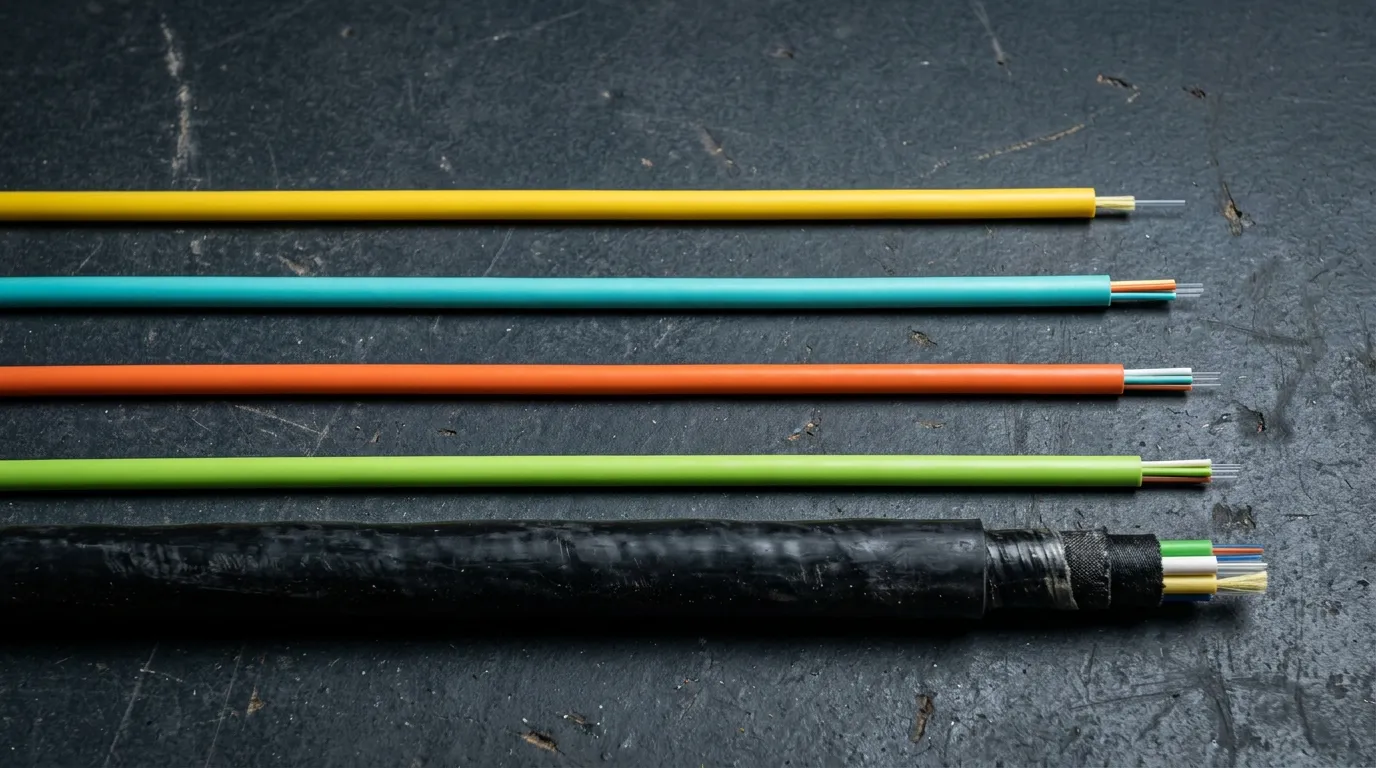
The fiber grade is the first and most consequential decision because it locks in the transceivers you can use. Single-mode fiber (SMF) has a 9 µm core and guides one light path, which lets it run for kilometers with cheap-to-run laser optics and no dispersion penalty. Multimode fiber (MMF) has a 50 µm or 62.5 µm core and guides many light paths at once, which makes connectors and transceivers cheaper over short runs but limits reach as the modes smear the signal. Jacket colors encode this at a glance: single-mode cables are yellow, multimode cables are orange or aqua.
The standard grades are defined in ISO/IEC 11801 and the TIA-568 family — the FOA fiber reference explains the same taxonomy from the fiber side — and they map directly to applications:
Grade | Core | Where it is used | Typical reach (10 Gb/s class optics) | Jacket color |
|---|---|---|---|---|
OS1 | 9/125 µm SM | Indoor backbone runs between floors and buildings on a campus | Up to ~10 km | Yellow |
OS2 | 9/125 µm SM | Outdoor trunk, metro and long-haul, FTTH feeder | 10 km+; hundreds of km with DWDM | Yellow (black when outdoor-jacketed) |
OM1 | 62.5/125 µm MM | Legacy LAN risers, older installs | ~33 m at 10 Gb/s | Orange |
OM2 | 50/125 µm MM | Older LANs, now mostly grandfathered | ~82 m at 10 Gb/s | Orange |
OM3 | 50/125 µm MM | New enterprise LAN, laser-optimized | 300 m at 10 Gb/s | Aqua |
OM4 | 50/125 µm MM | Data center and storage links | 400 m at 10 Gb/s (550 m under engineering rules) | Aqua (violet in some vendors) |
OM5 | 50/125 µm MM | Wideband multimode for SWDM links | 100–150 m duplex at 100 Gb/s using multiple wavelengths | Lime green |
A few notes that the tables usually omit. OM1 and OM2 are considered obsolete in the current ISO/IEC 11801 and TIA-568 main texts and are only kept as "grandfathered" types for extending legacy plants — new installations should use OM3, OM4, or OM5, per the TIA Fiber Optics Technology Consortium. OM3 was the first multimode fiber designed for 850 nm laser sources rather than LEDs; OM4 extends its reach; OM5 (introduced in 2017) adds wideband support so four wavelengths between 850 nm and 950 nm can ride one duplex link. Distances above are reach at a given speed — buy on the distance your optics need, not on the highest grade your budget allows. A deep comparison of OM1–OM5 bandwidth, reach, and migration is in our dedicated OM-grade guide.
On the single-mode side, the OS1/OS2 split matters less than most buyers think and the fiber category matters more. OS1 and OS2 are cable-level designations in ISO/IEC 11801: OS1 covers indoor, tighter-buffered constructions; OS2 covers outdoor loose-tube cables designed for longer spans. The underlying fiber, however, is where the real specification happens — and this is the layer almost every guide skips:
- ITU-T G.652D is the default single-mode fiber for outside-plant and metro use. It is optimized for low water-peak attenuation around 1383 nm, which matters for CWDM systems.
- ITU-T G.657.A1 and G.657.A2 are bend-insensitive versions of G.652D. They meet the same transmission requirements but tolerate far tighter bend radii, which is why they are the standard choice for FTTH drop cables that must turn corners inside homes and MDU risers.
If a supplier quotes "OS2, G.657.A1" on an FTTH drop cable, they are telling you it is an outdoor-capable, bend-insensitive single-mode cable — the two standards answer different questions and are often printed together. The ITU-T G.652 and ITU-T G.657 recommendations define these categories and their attenuation and bend requirements.
Which grade should you default to? For anything that crosses a property boundary, leaves a building, or needs to last through a technology upgrade cycle, single-mode (G.652D or G.657) is the safer call: the fiber itself is cheaper than multimode at equal length, and the optics premium that used to make multimode attractive for short runs is shrinking. Multimode OM4/OM5 still wins inside a data center or a floor where transceiver cost and density dominate and every run is under a few hundred meters.
Cable construction: loose-tube, tight-buffered, breakout, and ribbon
The second axis is the physical cable — the layers of protection around the fiber. This is where "fiber optic cable types" becomes a list of constructions, and the FOA reference on fiber optic cables remains the cleanest explanation of the family. The constructions that matter for selection:
Construction | How it is built | Typical use | Trade-off |
|---|---|---|---|
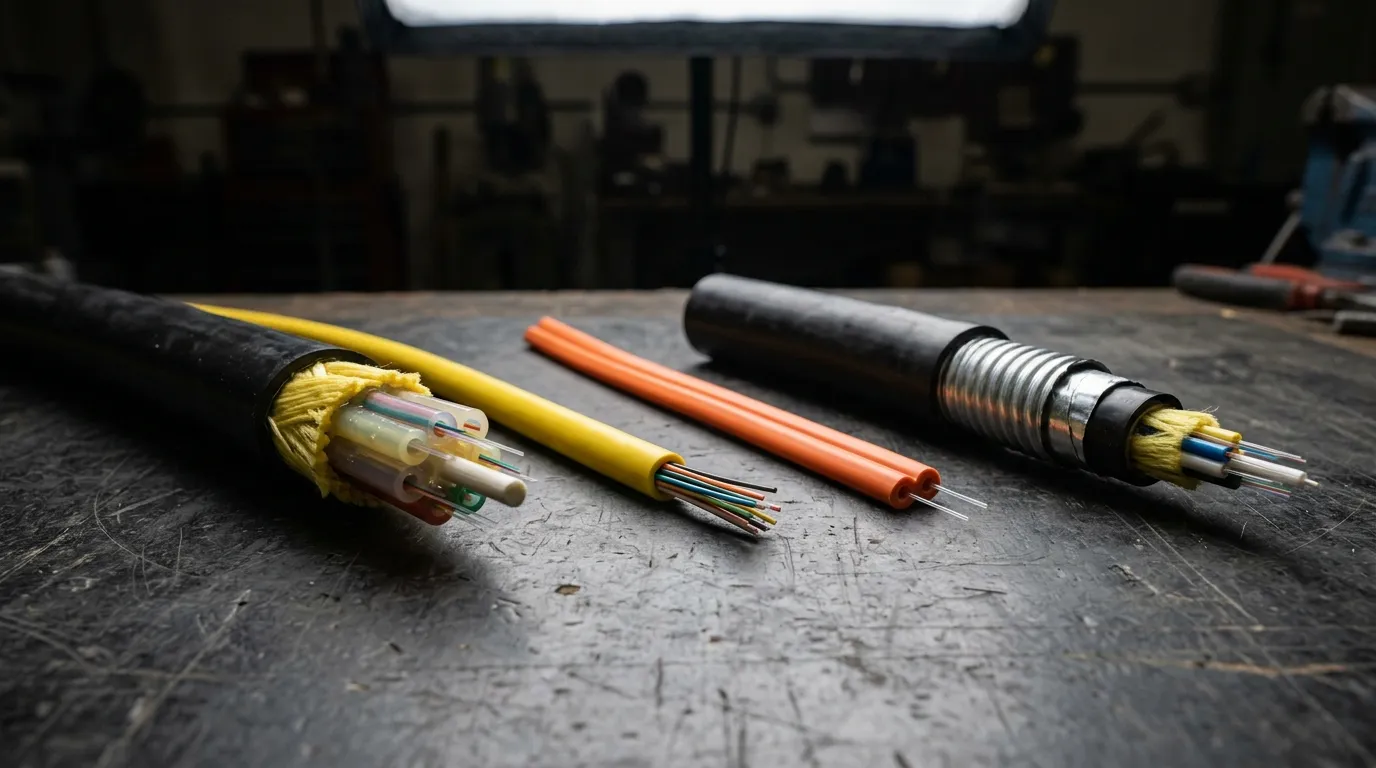
Loose-tube | Fibers sit loosely inside gel-filled or dry water-blocked tubes, stranded around a central strength member | Outdoor duct, direct burial, aerial — the default outside plant | Best water and temperature performance; needs termination hardware, harder to terminate directly |
Tight-buffered | A 900 µm buffer coating is applied directly over each fiber | Indoor riser and plenum runs, patch panels, equipment rooms | Terminates directly to connectors without a splice tray; less water protection |
Distribution | Multiple tight-buffered fibers under one jacket | Indoor backbone between telecom rooms | Compact and cheap per fiber indoors |
Breakout | Each tight-buffered fiber has its own sub-jacket under the main jacket | Short indoor runs to devices that need rugged individual legs | Easy to terminate, bulky and pricier |
Zipcord / simplex / duplex | One or two tight-buffered fibers, flat or paired | Patch cords and pigtails, short jumper runs | Not for long or outdoor runs |
Ribbon | Fibers laid flat in 12-fiber ribbons, stacked in the cable | High-count trunk (144–3456 fibers), fast mass splicing | Highest density; needs ribbon-capable splicing |
Micro / air-blown | Small-diameter cables (down to a few mm) blown into pre-installed microduct | Duct networks where future re-cabling matters | Fast install and upgrade; needs microduct plant |
Armored | Steel tape or wire armor layer under the jacket (loose-tube or tight-buffered) | Direct burial, rodent-prone ducts, industrial sites | Crush and rodent resistance; heavier, costlier to handle |
Two practical rules cut through most of this. First, outdoor equals loose-tube in the vast majority of cases: the buffer tubes decouple the fibers from cable strain and the jacket, water-blocking (gel or dry), and strength members are engineered for trench and aerial life. Second, indoor equals tight-buffered (or a tight-buffered family like distribution or breakout), because indoor cable must terminate at patch panels and meet fire codes — and a 900 µm buffer can be connectorized directly, saving a splice tray at every end.
Fiber count lives on this axis too. Counts follow the fibers-per-tube math: outdoor loose-tube cables commonly come in 4, 8, 12, 24, 48, 72, 96, 144 and beyond — 12-fiber units dominate because a 12-fiber tube or ribbon maps neatly onto splicing trays and MPO connector architecture. If you are not sure how many fibers to order, it is cheaper to over-specify count at purchase time than to re-pull or re-blow later, because the labor and pathway cost dwarfs the fiber cost. For typical size and diameter ranges per construction, our fiber optic cable size chart has the numbers.
Jacket and environment: fire ratings, indoor vs outdoor
The third axis is the jacket, and it is the one that gets people into compliance trouble. The same loose-tube cable logic can ship in a dozen jacket variants, and the jacket — not the fiber — is what a building inspector or a fire code checks.
For indoor cable, the governing question is fire rating, and the answer depends on where the cable runs:
Rating | Where it is allowed | Behavior |
|---|---|---|
OFNP / CMP (plenum) | Air-handling plenums and other spaces where flame can travel | Lowest smoke and flame spread — the strictest indoor rating |
OFNR / CMR (riser) | Vertical risers between floors | Flame-retardant for vertical runs |
LSZH / LS0H | General indoor use, EU projects, public buildings | Low smoke, halogen-free — common in Europe and Asia |
General purpose (CM/OFN) | Ordinary indoor pathways | Basic flame retardance |
For outdoor cable, the questions shift to water, UV, temperature, and mechanical threats rather than flame. Outdoor jackets are typically black polyethylene (PE) for UV resistance, with gel or dry water-blocking inside, and the installation method picks the subtype: cable pulled into duct or conduit, cable buried directly (needs armor or at least a robust sheath and often a warning tape), or cable strung aerially (figure-8 or self-supporting designs that integrate a messenger). The two most common mistakes are running indoor-rated cable outdoors (UV and water destroy the jacket in a few seasons) and running a non-armored cable in a direct-burial or rodent-heavy path.
Because indoor and outdoor requirements are so different, the family splits into three practical buying buckets: indoor (tight-buffered, fire-rated), outdoor (loose-tube, PE-jacketed, water-blocked), and indoor/outdoor hybrids that carry a fire-rated but UV/water-tolerant jacket so one cable can cross a building boundary without a splice. If your project ships into both the US and the EU, note that you will be asked for UL OFNP/OFNR on one side and CPR Euroclass (B2ca/Cca/Dca) on the other; we break down the US and EU fire-rating systems side by side in OFNP vs OFNR vs LSZH, and the direct-bury vs conduit trade-off in our installation method guide. Aerial spans have their own logic — figure-8 and all-dielectric self-supporting cables carry the messenger in the sheath, which matters for pole loading and ice and wind ratings.
Match the cable type to your application
Putting the three axes together: an application implies a fiber grade, a construction, and a jacket. The table below is the short path — find your row, then read across. "Specify as" gives the concrete shorthand to put on an RFQ.
Application | Fiber grade | Construction · jacket / install | Typical count | Specify as |
|---|---|---|---|---|
Long-haul / metro trunk, ISP backbone | OS2 (G.652D) | Loose-tube, gel or dry · PE, duct or direct burial | 12–144 | OS2 loose-tube armored GYTA53-class |
Aerial between poles (FTTH feeder, rural) | OS2 (G.652D / G.657) | Loose-tube figure-8 self-support · PE, aerial | 4–48 | Figure-8 aerial, GYTC8S-class |
FTTH drop to the home | OS2, G.657.A1/A2 | Flat or round drop, tight or semi-tight · indoor/outdoor or self-support flat | 1–4 | G.657.A2 drop cable (flat or round) |
Building riser / backbone (indoor) | OS1/OS2 or OM3/OM4 | Tight-buffered distribution · riser (OFNR) or plenum (OFNP) | 6–24 | OFNR tight-buffered distribution |
Horizontal LAN to the desk | OM3/OM4 (or SM) | Tight-buffered / breakout · plenum or LSZH | 2–12 | OM4 plenum distribution |
Data center: spine-leaf, storage | OM4/OM5 or OS2 | Ribbon or high-count trunk / pre-terminated · indoor plenum/LSZH | 12–3456 | OM4 ribbon trunk or MPO pre-terminated |
FTTA: tower to RRU fronthaul | OS2, outdoor-tolerant | Rugged indoor/outdoor, often armored · direct burial or aerial on tower | 2–24 | Indoor/outdoor ruggedized, IP-rated where exposed |
Duct network with future upgrades | OS2 (G.652D) | Micro / air-blown cable · blown into microduct | 12–144 | Air-blown micro cable |
Legacy LAN extension | Match installed OM1/OM2 | Tight-buffered · match existing rating | 2–6 | OM1/OM2 patch and riser (grandfathered) |
Read the columns in order. The fiber grade row answers "how far and what optics"; the construction row answers "what will this cable survive"; the jacket row answers "is it legal here." If a row surprises you — for example "why is the drop cable G.657 and not plain G.652D?" — that is the bend-insensitive single-mode story from the grade section doing its job: the drop must pass through tight corners inside a home.
Two cross-cutting rules for the whole table. First, do not mix OM grades in one link if you can avoid it, and never mix single-mode and multimode in a plant: the core sizes are incompatible and mismatches create silent, intermittent failures. Second, buy cable with the connector and termination plan in mind: a loose-tube outdoor cable terminates into a splice tray or a factory pre-terminated assembly, while a tight-buffered indoor cable can be connectorized in the field. If your team does not splice, a pre-terminated outdoor assembly or a factory-terminated FTTH drop cable removes an entire failure mode — which is exactly the kind of decision the cable selection guide linked at the top of this article walks through step by step.
How to tell which cable type you're looking at
Sooner or later you will stand in front of an unlabeled cable and need to know what it is. Read the sheath print first — it is the ground truth, and it is printed every meter or two along the jacket. A typical print looks like this:
DYS 24F SM G657A1 LSZH 2026 ...
The fields, in order: fiber count, fiber type (SM for single-mode, or the OM grade for multimode), the fiber category (G.652D / G.657.A1 / G.657.A2 on single-mode), jacket material, and year. The G.652/G.657 code is the single most informative field because it tells you the transmission class and the bend performance in one token.
On outdoor cables you will often see a construction code instead of a full sentence: the Chinese GB/IEC-style system used by most Asian manufacturers prefixes codes with GY for outdoor and GJ for indoor — so GYTA53 is an outdoor (GY) steel-tape-armored (A=aluminum/steel tape, 53=armored) loose-tube cable, while GJFJV is an indoor non-metallic tight-buffered cable. The letters vary slightly between manufacturers, so treat the code as a family identifier and confirm the datasheet before you order.
Jacket color is a hint, not a verdict. Yellow says single-mode, orange or aqua says multimode, lime green says OM5 — but outdoor jackets are almost always black regardless of fiber type, and some manufacturers use custom colors. Never spec from color alone. The full color-code tables for fibers, tubes, and ribbons are in our fiber optic color code guide. One safety note that belongs in any cable-handling routine: once a cable is terminated or under test, never look into a fiber endface, connector ferrule, or adapter port while a source could be active — infrared light is invisible and can damage your eyes before you notice anything.
Turn the table into a spec
You now have everything needed to write a one-line cable specification instead of a vague request. Before you send it, check the list:
- Fiber grade — single-mode (G.652D for long haul, G.657.A1/A2 for anything with bends) or multimode (OM4/OM5 for short high-speed links)?
- Construction — loose-tube for outdoor, tight-buffered for indoor, ribbon or pre-terminated for high count?
- Jacket and rating — OFNP/OFNR/LSZH for indoor; PE with water-blocking for outdoor; armored if buried or rodent-exposed; and the CPR class if the project ships to the EU?
- Count and future-proofing — current demand plus one growth step; remember re-pull costs more than fiber.
- Compliance evidence — ask for the datasheet, the fire-rating certificate, and a test report on the delivered drums.
Most fiber optic cable types become easy to choose once you stop treating them as a flat list. Decide the distance and optics first, the environment second, and the fire code third — the type names then follow from the table above. When you are ready to turn the spec into part numbers, a manufacturer that builds indoor, outdoor, and drop cables in one plant can quote the whole path consistently: DYS tests every cable 100% before shipment and supplies test reports with the order, so the type on the datasheet is the type that arrives. Send your application and target markets to our contact page and the engineering team will confirm the grade, construction, and rating before you commit to a drum.