
Compliance
Anatel Certification for Fiber in Brazil: Buyer Guide
Anatel certification is the kind of requirement that never shows up in a quote — until a container is held at customs or an ISP's quality team rejects the delivery because the cable has no Brazilian homologation. Anatel, Brazil's National Telecommunications Agency, homologates telecom products before they can be legally sold or used in the country, and fiber optic cables, drop cables, connectors and related components are on the regulated list. If you are buying fiber for Brazil as an importer, distributor or ISP, you do not need to become a certification expert — but you do need to know which products are affected, what a valid certificate looks like, and how to verify one in minutes. This guide covers exactly that, and it is about product certification only, not installer or technician credentials such as FOA's CFOT. For the wider picture of UL, CPR and other market certifications alongside Anatel, start from our compliance hub.
Anatel Certification for Fiber: Does Your Product Need It?
Brazil's General Telecommunications Law (Law 9.472/1997) created Anatel and gave it the job of certifying telecom equipment, and today the framework sits on Anatel's Regulamento de Avaliação da Conformidade e de Homologação — the conformity-assessment and homologation regulation approved by Resolução 715/2019. Under that regulation, the homologation document is a mandatory prerequisite for commercializing and using telecom products in Brazil. "Telecom product" is defined broadly: any equipment, device or element that forms part of a telecommunications link, including its accessories. If a product is on Anatel's list, selling or installing it without homologation is not an option, no matter how good the cable is.
For fiber networks, the affected families include:
- Optical fiber cables, indoor and outdoor
- FTTH drop cables, including self-supporting aerial flat drop and round self-supporting designs
- Optical fiber, connectors and cable assemblies
- Passive network hardware such as splitters, terminal boxes and splice closures
Exactly which types are covered, and under which evaluation model, is defined in Anatel's reference product list (LRPT) and the technical requirements issued for each product type — the official regulamentação page collects all of them. If you are unsure whether one specific SKU needs approval, that page plus a quick conversation with a designated certification body is the reliable way to settle it; do not rely on a supplier's guess.
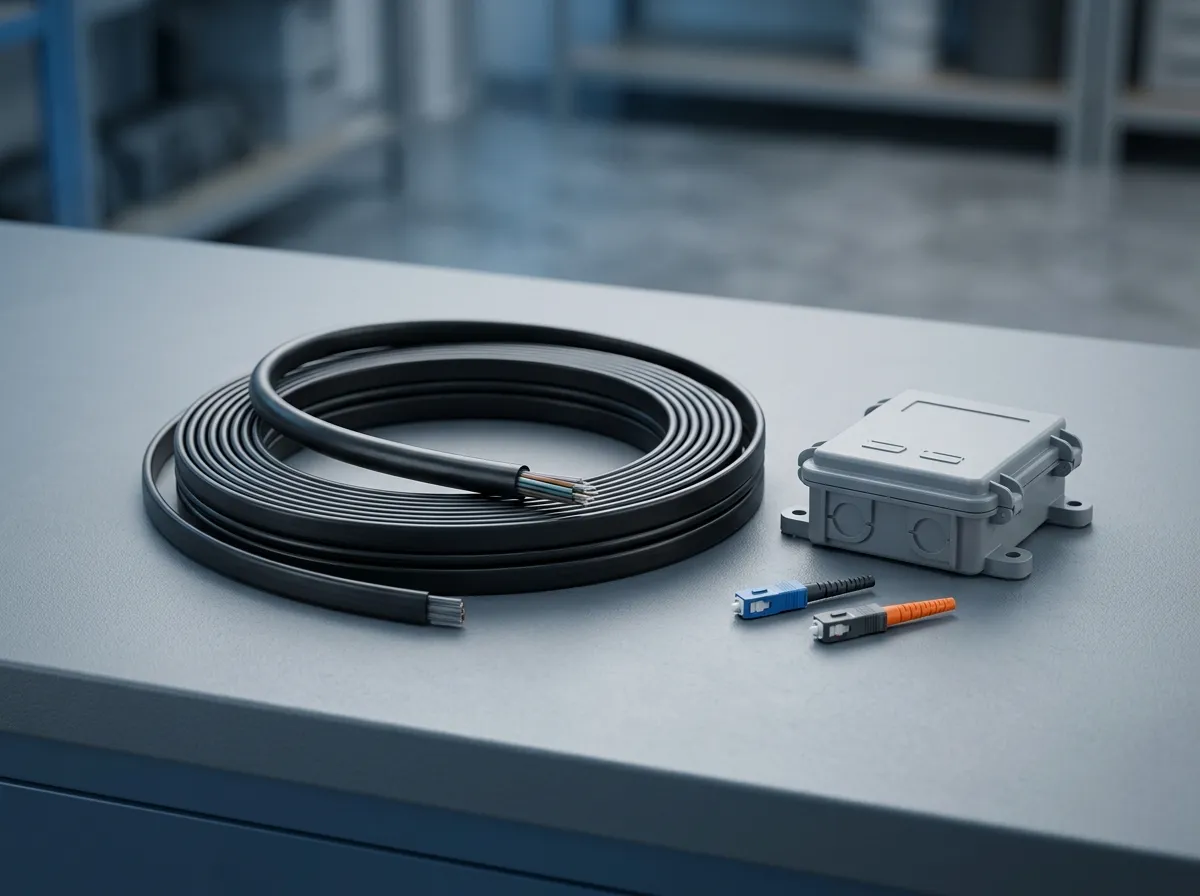
The fiber product families that commonly require Anatel homologation: drop cable, distribution cable, terminal boxes and connectors.
What "Anatel Certified" Actually Means: CoC and Homologation
Two different documents sit behind the phrase "Anatel certified," and knowing the difference tells you who did what:
Document | Issued by | What it proves |
|---|---|---|
Certificado de Conformidade (CoC) | A designated certification body (OCD) | The product passed conformity assessment — testing against Anatel's technical requirements |
Certificado de Homologação | Anatel | The product is registered and authorized for commercialization and use in Brazil |
The legal basis runs from the LGT itself — Law 9.472/1997 — down to Resolução 715/2019 and the operating procedures that Anatel issues as Atos, summarized on the base legal page. The OCD (Organismo de Certificação Designado) is a body designated by Anatel to run the certification process and issue the CoC; Anatel then issues the homologation certificate itself. In practice, the homologation is held by a legal entity established in Brazil — usually the importer or a Brazilian company in the supply chain — because registration and import clearance run through Brazilian systems. A foreign factory does not "hold" the certificate; it is certified through its Brazilian certificate holder and OCD. When a supplier tells you they are "Anatel certified," the useful follow-up question is: which homologation number, for which model, held by whom?
Portuguese terms you will see on certificates: homologação (the approval), certificado de homologação (the certificate), OCD, avaliação da conformidade (conformity assessment), and marca/identificação Anatel (the Anatel mark). If you buy for several markets at once, note that Anatel sits alongside UL and CPR as one of the region-specific approvals — see how a single certified supplier can cover UL, CPR and Anatel together, and check any product mix against DYS's fiber certification checker for the US, EU and Brazil.
How Anatel Certification Works for Fiber Products
As a buyer you will rarely run this process yourself, but you need enough of the skeleton to evaluate suppliers and lead times. The conformity-assessment process for a fiber product looks like this:
- Confirm the product type and evaluation model. Anatel's reference list and the applicable technical requirement tell you whether the product is assessed by certification (type testing, often with factory audits) or by registration through a declaration of conformity. The regulamentação page referenced above links the resolution, the product reference list (LRPT) and the technical-requirement acts.
- Engage an OCD. The OCD defines the tests, selects suitable laboratories, and manages the process on behalf of the requester. Testing is done by accredited labs — Anatel's rules direct that tests be performed preferably in Brazil, though the OCD decides the appropriate laboratory depending on the technology.
- Type testing against technical requirements. Fiber products are tested against international standards (IEC 60793/60794 families, ITU-T recommendations) as adopted in Anatel's technical requirements, covering geometry, attenuation, mechanical and environmental performance.
- Certificate of Conformity. The OCD issues the CoC once the test reports and documentation are approved. Typical documentation includes product photos, technical specifications, the test report and supporting quality certificates.
- Homologation and marking. The OCD registers the product and Anatel issues the homologation certificate. The product then carries the Anatel identification mark and homologation number.
Two things worth knowing as a buyer. First, homologations are not forever: certified products are subject to manutenção (maintenance of the conformity assessment) on cycles defined in the operating procedure — commonly reported as every two or three years for type-test certifications — so a certificate printed last decade may no longer be valid. Second, this is a moving regulatory target: the consolidated text of Resolução 715 shows amendments since 2019, most recently by Resolução 780 of August 2025, and re-evaluating the whole regulation sits on Anatel's 2025–2026 regulatory agenda. Any sourcing decision should be checked against the current official text.
Type testing in an accredited laboratory is the technical core of every Anatel conformity assessment.
Where Importers and ISPs Actually Get Caught
The failure modes are almost never about a supplier who refuses to certify. They are about mismatches discovered too late:
- Customs. Non-homologated telecom products are not cleared for import into Brazil. The container sits, demurrage accrues, and the importer pays either way.
- Operator acceptance. Brazilian ISPs and operators will not accept fiber materials without the homologation document matching the delivered model — an installer cannot put non-homologated cabling into a network that itself operates under Anatel rules.
- Bids and tenders. Network build tenders increasingly require evidence of homologation at the qualification stage. Missing it can disqualify a bid before pricing is even discussed.
- Fake or mismatched certificates. The most common trap in the fiber import business is a supplier waving a certificate that covers a different model, an expired homologation, or a document that was never issued. Anatel itself advises that users should only acquire and use telecom products homologated by the agency — which is why verification belongs in your buying process, not after the shipment lands.
You do not need to master the certification system. For most fiber buyers, Anatel certification in Brazil is not something you administer — it is something you verify. You need your supplier to produce, before you order, a valid homologation that matches the exact model you are buying. Everything else is paperwork the supplier and its OCD handle.
How to Verify a Supplier's Anatel Certificate
Verification takes about two minutes, using Anatel's own public system. Ask the supplier for their homologation number (and, ideally, the CoC), then check it in the official consultation system — Mosaico, Anatel's public register of homologated products. If you need to verify an Anatel certificate quickly, this is the only official database you should trust — it is the same register Anatel publishes for customs, operators and consumers, and a certificate that does not appear here is not a valid Anatel homologation.
When the record comes up, check four things:
- Model match. The product described in the record must be the exact model and construction you are buying. A homologation for a different cable type or jacket does not cover your SKU.
- Validity and maintenance. Confirm the homologation is current. Look for the validity/maintenance status — many certifications run on two- or three-year maintenance cycles, so an old number may be expired.
- Certificate holder. The holder should be a Brazilian legal entity that your supplier can explain — typically their importer, affiliate or the OCD that handled the process. If the supplier cannot explain who holds it and how their product is covered, that is a red flag.
- Marking. The homologation number should appear on the product itself or its packaging (the Anatel identification mark). For fiber cable, this is normally printed on the jacket or on the reel/box label.
A certificate image in a PDF or a photo on a website is not evidence — it costs nothing to edit a model number. The record in Mosaico is the evidence. If you source from several countries, the same verification logic applies to other market certifications; we wrote the parallel guide for verifying a fiber cable supplier's UL listing. Non-Portuguese readers can navigate Anatel's official English portal for agency-level information, though the Mosaico consultation and the regulatory texts are in Portuguese.

Sixty seconds in Anatel's public Mosaico system is the fastest way to check whether a homologation is real and current.
Supplier Checklist Before You Order Fiber for Brazil
Run through this list before committing to a PO, and put the requirements in your RFQ so suppliers quote you compliant material from the start:
Ask specifically about the Anatel certification requirements for your model — any supplier who has done this before will answer with a homologation number and a model list, not a generic "yes, we are certified."
Bottom Line: Make Anatel a Sourcing Criterion, Not a Surprise
Anatel certification does not need to be complicated for buyers, but it does need to be checked early: confirm the product is on the regulated list, verify the supplier's homologation in Anatel's public system, and make compliant supply a contractual condition. Do that and the customs hold-up, the operator rejection and the expired certificate all become problems the supplier solves before shipping — not problems you discover at the border.
If you are sourcing fiber for Brazil and want a supplier that already holds Anatel certification, DYS Fiber Optic carries it alongside UL, CPR and TL 9000 — ask our team for the certificate and confirm the exact model coverage for your order before you commit. Whatever you buy, verify first. A two-minute check in Mosaico is cheaper than a container stuck in Santos.