
Cable Selection
Indoor vs Outdoor Fiber Cable: Jackets & Transitions
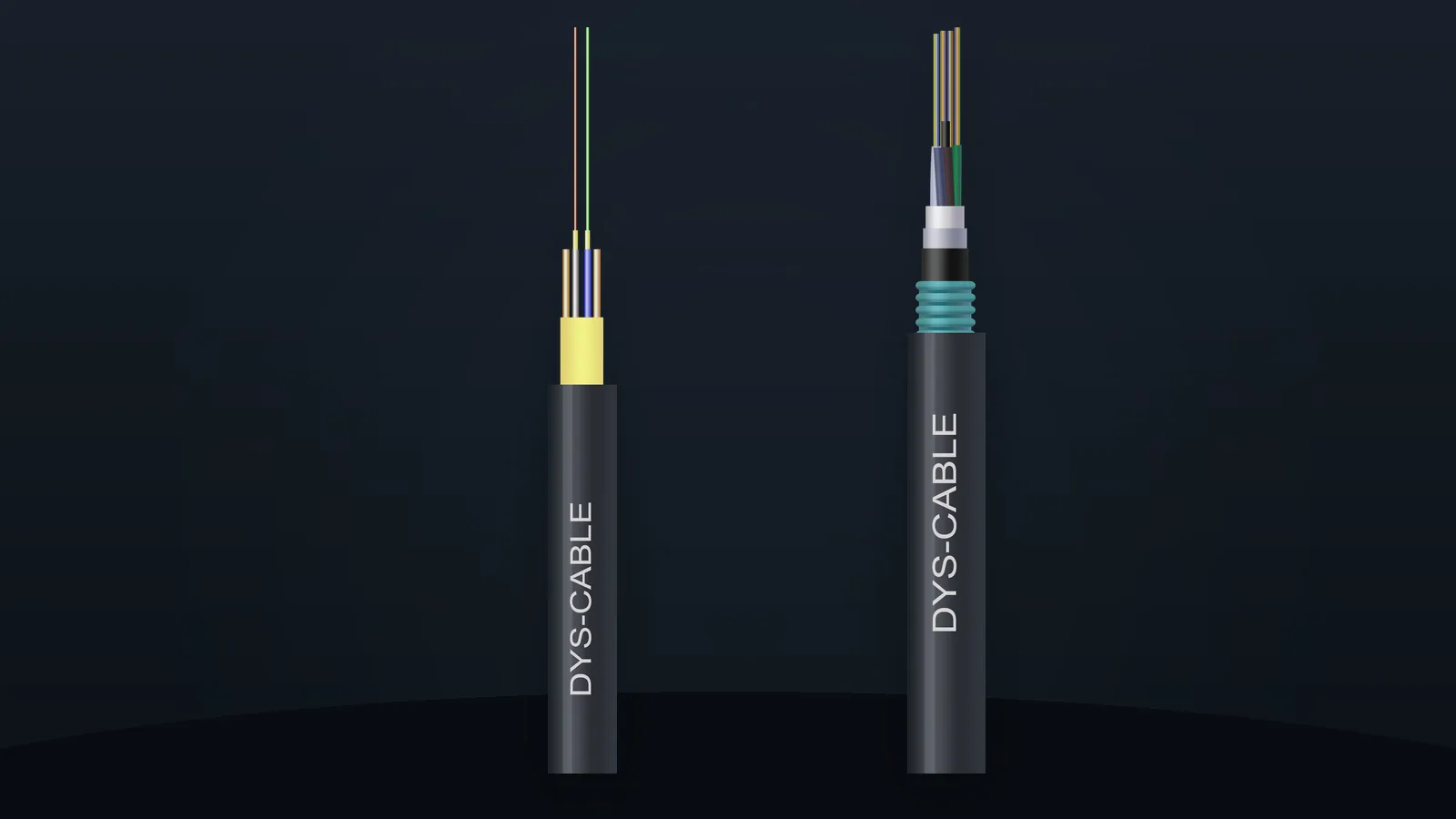
The question usually arrives as a jacket question: can I run this one cable from the pole, through the wall, and up to the ONT? It is not a jacket question. Indoor and outdoor fiber optic cable carry the same glass, the same attenuation and the same bandwidth. What changes is the protection system wrapped around that glass, and which of the two systems the electrical code will accept on the side of the wall you are standing on.
That distinction costs money in one direction only. A cable that is too light for its route fills with water or fails in a duct; a cable that is too heavy for its route fails an inspection, or gets ripped out and replaced. Both failures happen at the crossing, not in the middle of either run.
Indoor vs Outdoor Fiber: Same Glass, Two Different Jobs
Strip the jackets off a premises cable and a duct cable and you find the same 250 µm coated fiber, the same single-mode or multimode core, often from the same fiber supplier. Attenuation is a property of the glass and the wavelength. It does not care what surrounds it.
The jacket, the strength member and the water blocking do care. They are sized for two different load cases, and those load cases pull in opposite directions.
An indoor cable has one non-negotiable job: it must not spread fire through a building, and it must be legal in the space it occupies. Small diameter, tight bend radius, easy connectorization and low smoke all follow from that, plus the fact that premises routes are short, supported and pulled by hand.
An outdoor cable's job is survival in an uncontrolled environment: water, ultraviolet light, rodents, crush from soil and rock, pulling tension from hundreds to thousands of newtons, across a range that can span 110 °C between a winter installation and a summer attic.
Dimension | Indoor cable | Outdoor cable | Dual-rated (indoor/outdoor) |
|---|---|---|---|
Jacket compound | PVC, LSZH, plenum-grade fluoropolymer | Black polyethylene (UV-stabilized) | PE oversheath over a rated inner jacket |
Fire listing | Required — OFN / OFNR / OFNP per NEC 770 | None on its own | Inner cable carries the listing |
Water blocking | Usually none | Gel-filled tubes and/or dry swellable tape and yarn | Depends on design — specify it |
Strength member | Aramid yarn, sized for handling | Central steel or FRP rod, plus aramid | Both, for the outer and inner cable |
Armor | Optional (interlocked or steel tape on armored premises cable) | Steel tape, corrugated steel, or none for all-dielectric | Varies |
Operating temperature | Typically −20 to +60 °C | Typically −40 to +70 °C | Product-specific |
Typical OD | 1.8–7 mm | 8–23 mm | 4–8 mm |
Termination | Direct connectorization of the tight buffer | Splice or fan-out; rarely direct | Direct on the inner cable |
The table also settles a claim that shows up in every forum thread on this topic: that outdoor cable is simply the better product, so you should use it everywhere. Outdoors, that is true. Indoors it is a code violation. A polyethylene jacket has no premises fire listing, and NEC Article 770 does not care that the cable is mechanically superior — it cares whether the jacket is listed for the space. For the selection sequence this decision sits inside, start from the cable selection hub.
Tight Buffer vs Loose Tube: The Construction Behind Every Difference
Almost every other difference in that table traces back to one decision: whether the fiber is bonded into its own buffer or left free inside a tube.
In a tight-buffered cable, each fiber is coated to 900 µm and that buffer is in contact with the glass. The fiber is protected individually, which makes it directly connectorizable — strip, cleave, crimp — and it holds a tight bend without the buffer collapsing. The cost is mechanical: bend or pull the cable and the strain reaches the glass through the buffer, because there is nothing between them to absorb it.
In a loose-tube cable, 250 µm fibers sit loosely inside a tube 2–3 mm across, with enough slack that the fiber can move when the tube stretches. The tube takes the installation strain and the fiber does not. That is why outdoor cables are loose-tube: a duct pull can impose 1,500 N on a cable that must still deliver an intact fiber at the far end. The trade is that you cannot put a connector straight on a loose tube. You splice, or you fan out to 900 µm pigtails.
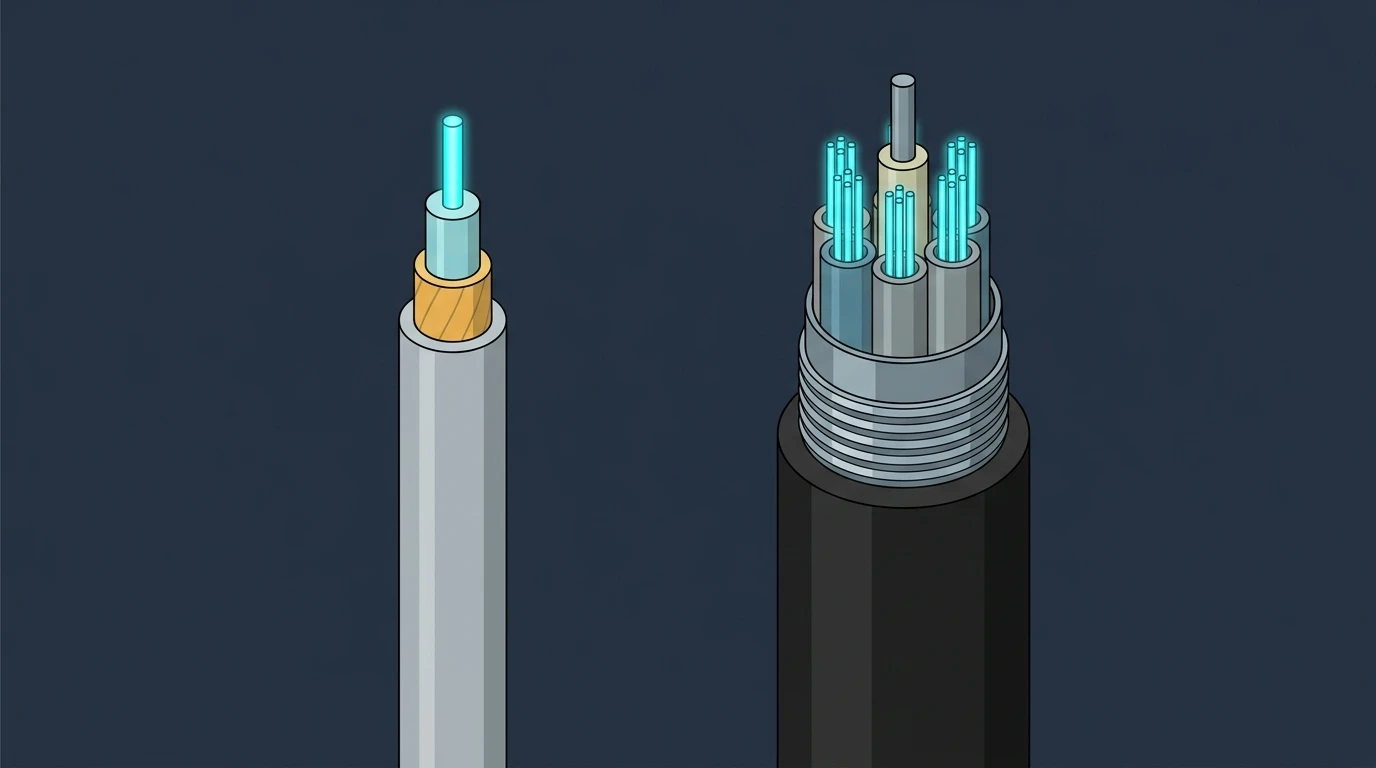
Around those cores sit three more layers, and each answers a specific outdoor threat. The central strength member — steel wire or a fiberglass rod — carries pulling tension and stops the cable shrinking and stretching with temperature. Aramid yarn under the jacket carries short-term handling loads and, in an indoor cable, is often the only strength member there is. Armor, usually corrugated steel tape, converts a point load from a rock or a rodent's teeth into a distributed load the jacket can survive.
The full family tree — simplex, duplex, distribution, breakout, ribbon, figure-8 — is a selection question rather than an indoor-versus-outdoor one, and the fiber optic cable types guide works through it. Here the takeaway is narrower: the buffer type sets the application, the strength member sets the installation, and the jacket sets what the code allows.
The Numbers That Actually Differ
Most comparisons stop at "outdoor is stronger". Here is what stronger means in millimeters and newtons, taken from published DYS datasheets for cables in current production (retrieved October 2026).
Cable | OD (mm) | Weight (kg/km) | Tensile short / long (N) | Crush short / long (N/100 mm) | Bend radius dyn. / stat. | Temp (°C) |
|---|---|---|---|---|---|---|
GJFJV simplex, indoor | 2.8 | 3.5 | 100 / 60 | 500 / 100 | 20D / 15D | −20 to +60 |
GJPFJV-12 distribution, indoor | 6.8 | 31.5 | 660 / 200 | 1,000 / 300 | 20D / 15D | −20 to +60 |
GYTS loose tube, duct | 10.5 | 88.0 | 1,500 / 600 | 1,000 / 300 | 20D / 15D | −40 to +70 |
GYTA53 double-armored, buried | 14.5 | 228.0 | 3,000 / 1,000 | 3,000 / 1,000 | 20D / 15D | −40 to +70 |
GJYFJH indoor/outdoor | 7.0 | 42.5 | 800 / 400 | 1,000 / 500 | 20D / 15D | −20 to +60 |
FTTP tight-buffered indoor/outdoor | 4.0 × 7.0 | 44.0 | 1,350 / 400 | 2,200 / 1,000 | 20D / 15D | −40 to +70 |
Two rows tell the story. The 2.8 mm indoor simplex cable is rated for 100 N of short-term tension; the 10.5 mm duct cable is rated for 1,500 N, and the buried double-armored cable for 3,000 N. That is a factor of 15 to 30, and it is not a quality difference — it is a statement about how each cable is expected to be installed. One is pulled by a technician's hand through a tray; the other is pulled by a winch through a duct, or plowed into the ground.
Crush tells the same story in the other direction: 500 N/100 mm for the indoor simplex, 3,000 N/100 mm for the buried cable. The temperature range moves 20 °C at each end, and that matters at installation as much as in service.
The full specifications are on the individual product pages, for example the GJFJV simplex cable and the GYTA53 buried cable. Read them as load cases, not as a ranking: a 100 N cable is not a worse cable, it is a cable for a route that never sees 100 N.
One number that does not change between the two: attenuation. Single-mode and multimode selection is a reach-and-bandwidth decision, independent of which jacket you end up with.
Fire Rating Is a Permission, Not a Grade
The letters on an indoor cable jacket — OFN, OFNR, OFNP, and their conductive OFC variants — answer one question: where may this cable be installed? They are not a quality score, and they are not interchangeable with European classes.
Two tests sit behind the two ratings that matter most in a building. OFNR (riser) is earned in a vertical shaft test, UL 1666, which asks how far flame travels up a cable in a chimney-like void. OFNP (plenum) is earned in the NFPA 262 Steiner tunnel, a horizontal test that measures flame travel and smoke optical density, because a plenum is a space whose air is returned to occupied areas — the standard's own scope is flame travel and smoke in air-handling spaces. UL describes both as part of its wire and cable certification work.
Because the plenum test is the stricter one, substitution runs one way only: OFNP may be used where OFNR is required, never the reverse. That single rule settles a large share of real installations under Article 770.
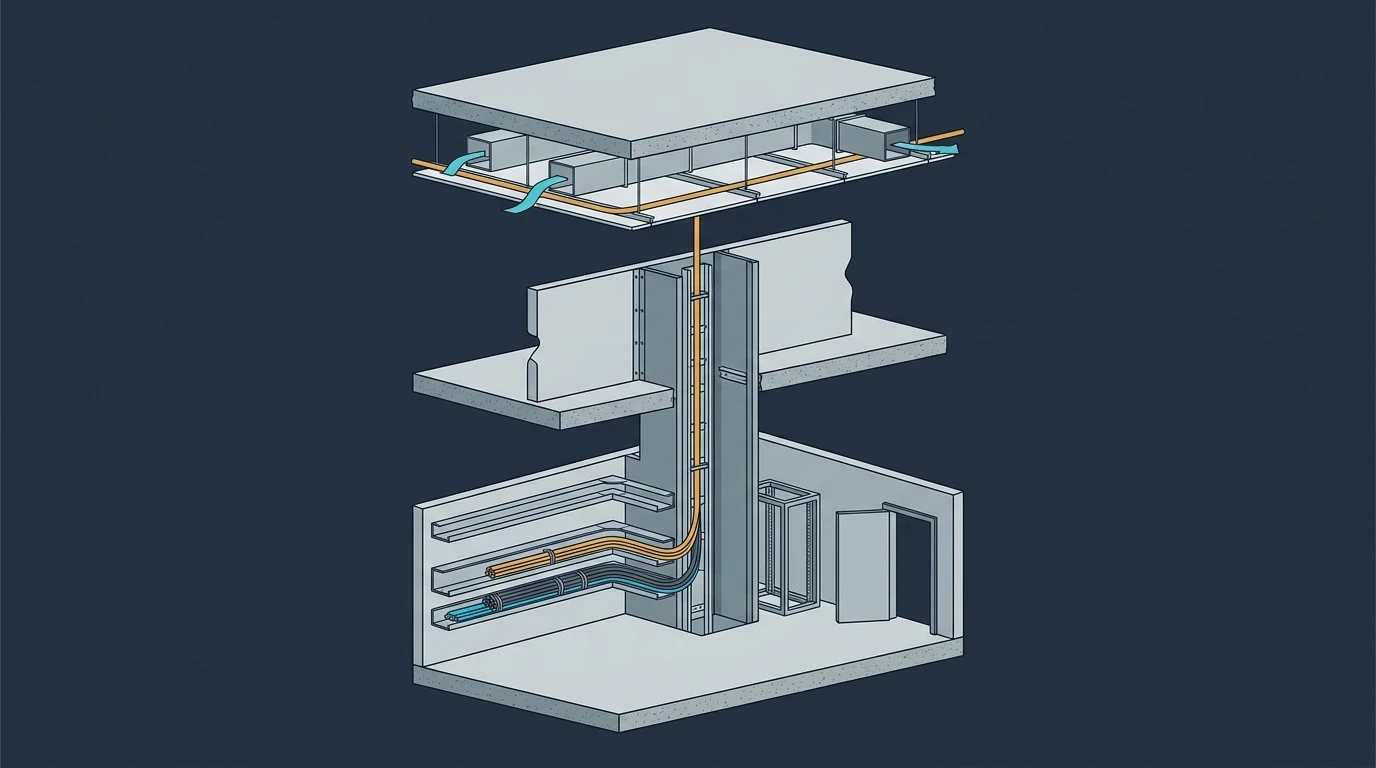
Europe answers the same question differently. A cable permanently installed in a building is a construction product and needs a Declaration of Performance against EN 50575, declaring a Euroclass from Aca to Fca. Corning's CPR explainer for fiber and data cables states the scope point that matters here: cables that are not permanently installed in buildings — including all outdoor duct, aerial and direct-buried cable — fall outside the regulation and are not tested against it. LSZH, meanwhile, is a jacket chemistry, not a location rating; a cable can be LSZH and still be illegal in a plenum.
The code-level detail — every designation, both test methods, and how the US and EU systems fail to convert into each other — is in the fire rating guide for US and EU projects, and the Euroclass side is covered in the CPR guide for fiber cable. For the indoor/outdoor decision, one consequence is enough: the moment a cable goes beyond the point-of-entrance allowance, it has to be a listed type — including the outdoor cable you just pulled through the wall.
Water Blocking: The Layer You Cannot See
Water does not need a flood. It needs an open tube end, a jacket nick, or an armor interstice, and a temperature cycle to pump it along. Once inside, it travels longitudinally — toward the splice closure, the cabinet, the connector — and the damage shows up months later as a loss spike that no one attributes to the cable.
Outdoor cables block that path in one of two ways. Gel-filled designs fill the tube and the core interstices with a thixotropic compound, so there is no void for water to occupy. Dry designs wrap the core in water-swellable tape and run superabsorbent polymer (SAP) yarns inside the tubes; on contact with water the polymer swells into a plug that stops the front. Sterlite's comparison of dry and gel-filled cables is written from the dry side and argues that dry compares favorably, on faster splice preparation, lower weight and fewer consumables. Take the mechanism from it, not the ranking. Our own reading of the two constructions: gel fills every void and so excludes water most completely in sustained immersion, at the cost of weight, mess and preparation time; dry cable is lighter and cleaner, but it only blocks after the SAP has been wetted.
Either way, the performance claim should be a test result, not an adjective. The relevant method is F5B, in IEC 60794-1-22, the environmental test-methods part of the 60794-1 series: a 3 m sample, a 1 m head of water, 24 hours, no water permitted at the far end. If a supplier says "water-blocked" and cannot name that test, the claim is unverified.
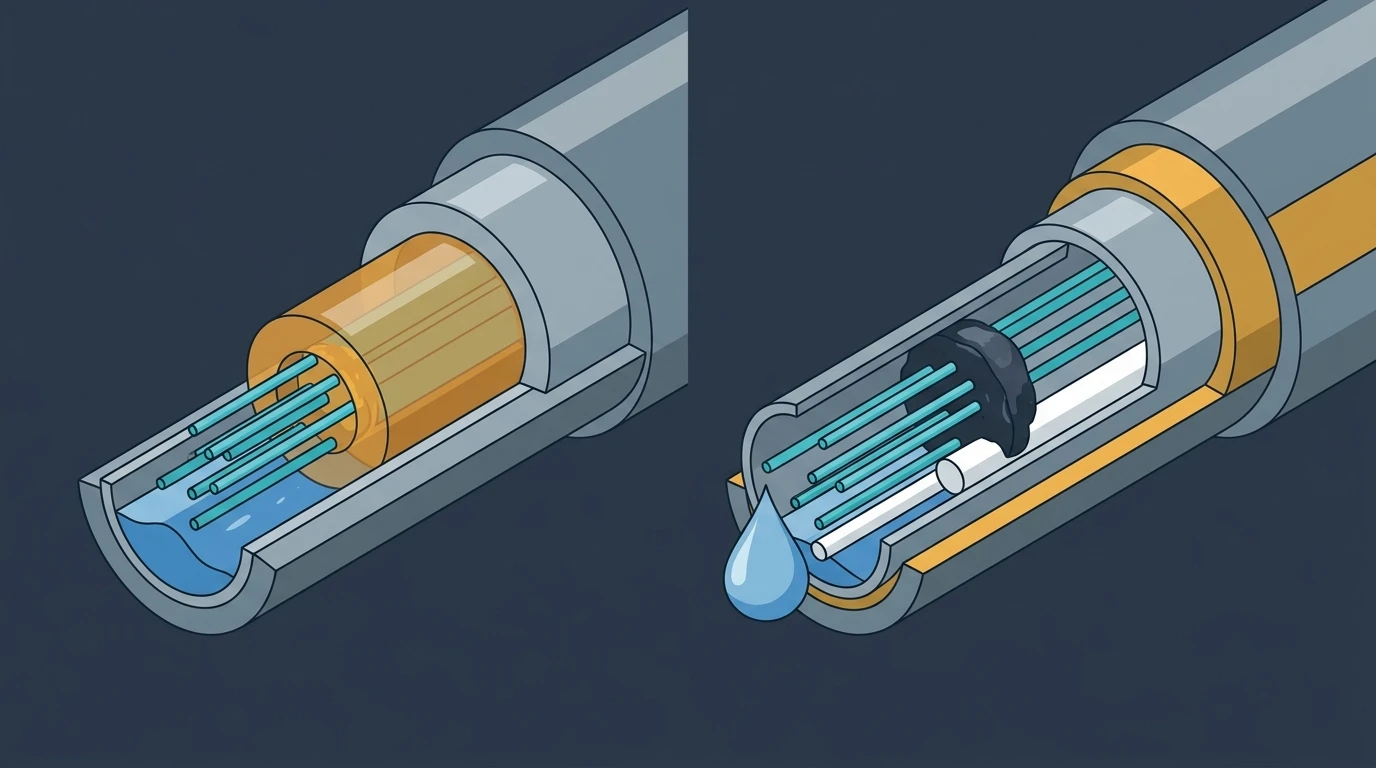
Three failure modes are worth knowing by name. Gel pumping: thermal cycling pushes gel along the cable until a closure fills and a splice tray floods. Hydrogen ageing: moisture inside the tube releases hydrogen that reacts at defect sites in the glass and raises attenuation at the 1383 nm water peak, permanently. Contamination at the transition: a wet outdoor cable meets a dry indoor one, and the connector is most likely assembled in the rain.
Indoor cables usually carry no longitudinal water blocking at all, because they are not expected to be wet. That assumption holds inside a conditioned building. It does not hold for an indoor-rated cable pulled through an outdoor conduit "just for the last 30 meters", which is where most of the misapplications we see in this decision start.
Crossing the Wall: The Transition Rules
Everything above converges on one detail: the point where the route leaves the outside plant and enters the building. In the NEC this has a name and a distance.
The point of entrance is where the cable emerges from an external wall, roof or floor slab. Article 770 of NFPA 70 permits unlisted outside-plant cable to be installed inside the building only where three conditions hold: the length inside, measured from the point of entrance, does not exceed 15 m (50 ft); the cable enters from outside; and it terminates in an enclosure. The same section excludes risers, plenum and other air-handling spaces outright, and allows the point of entrance to be extended only by continuously enclosing the cable in rigid or intermediate metal conduit to the point of emergence.
Three patterns comply, and the choice between them is commercial as much as technical.
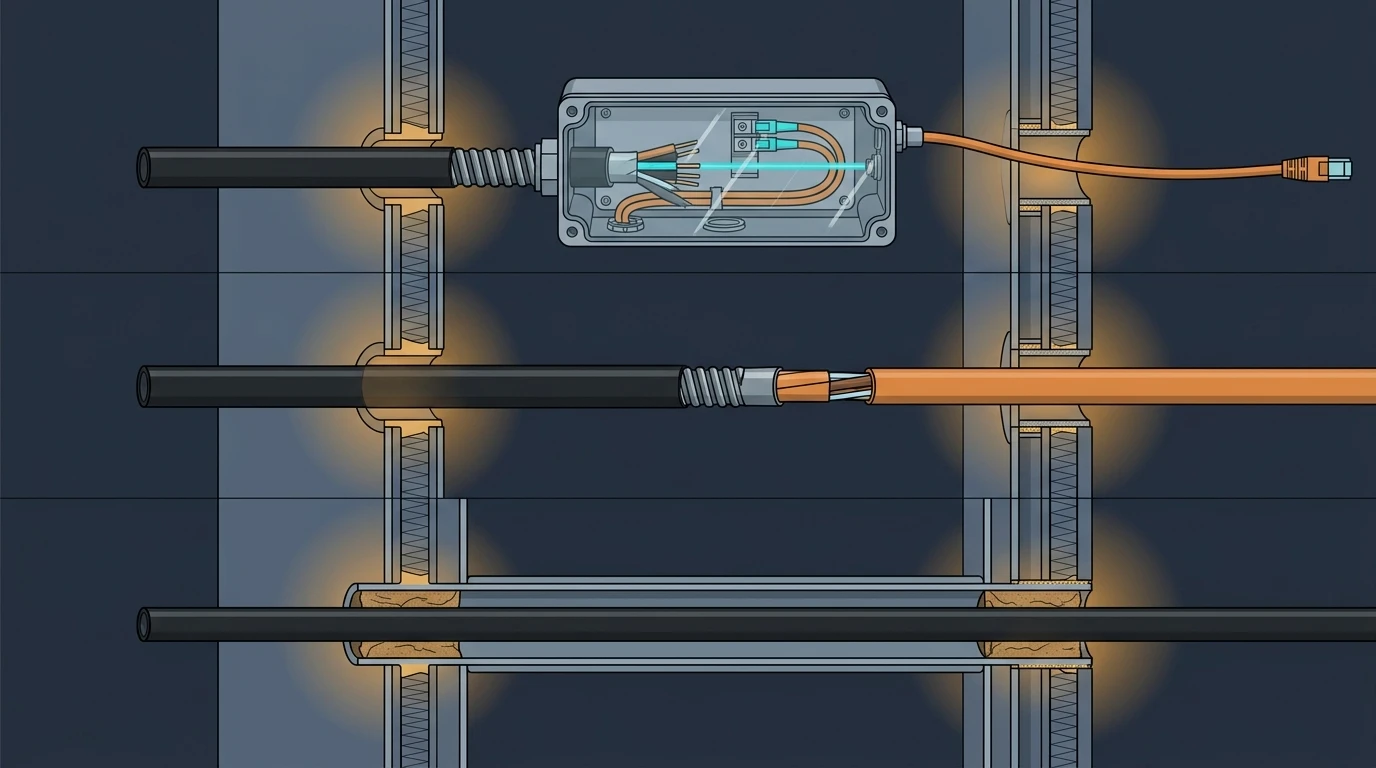
- Terminate at entry. The OSP cable stops in a sealed enclosure on or just inside the wall; a listed premises cable leaves it. This is the default for high fiber counts and for anything that will be re-spliced later. It costs one closure and two terminations.
- One dual-rated cable, outer jacket stripped. A cable built as a rated inner cable inside a PE oversheath crosses the wall intact; the oversheath is removed inside the building, exposing the listed inner jacket. No splice, no closure, one pull. This is what the FOA's outside-plant cable reference means by a double-jacketed cable whose outdoor jacket is simply removed at the entry.
- OSP cable in a metal sleeve. The outdoor cable continues through a rigid metal conduit that extends the point of entrance to a rated transition point. Legitimate, but the 15 m then runs from the point of emergence, and the sleeve must be continuous.
What an inspector actually looks at is unglamorous: the print legend on the jacket at the point where the cable is inside the building, the listing mark for that legend, the firestop at the penetration, and — for cables with metallic members — the bonding of those members as close as practicable to the point of entrance.
Three errors account for most failures. Running PE-jacketed cable 30 m into a ceiling void because "it is only low voltage". Stripping the outdoor jacket and calling the result indoor cable, when the inner construction was never listed. And putting the transition inside a plenum, where the enclosure itself needs to be rated for the space.
The pull itself has its own rules, and the fiber optic cable installation guide covers tension, bend limits and firestop detail without repeating them here.
When One Cable Has to Do Both
The dual-rated cable in pattern two is a real product class, not a workaround, and it is a common answer for last-mile routes where a splice at the wall is expensive.
The construction is a cable inside a cable: a fully rated indoor cable forms the core, and an outdoor sheath is applied over it. DYS builds the FTTP drop this way — a 2.9 mm OFNR-rated tight-buffered cable inside a GR-20 outside-plant-rated flat jacket. The published datasheet gives 4.0 × 7.0 mm, 44 kg/km, 1,350 N short-term tension, 2,200 N/100 mm crush and a −40 to +70 °C range: outdoor numbers around an indoor-rated core. Its purpose is to eliminate the splice at the premises wall, and the standard to name if you are writing the requirement is ICEA S-104-696, the industry standard written specifically for indoor/outdoor optical fiber cable — Corning's application note on indoor/outdoor cables describes it as the first standard to give the class its own requirements.
The FTTA version, GJYFJH indoor/outdoor cable, makes the same trade at 7.0 mm and 800 N, with a −20 to +60 °C range that reflects its tighter indoor/outdoor duty rather than a full OSP route.
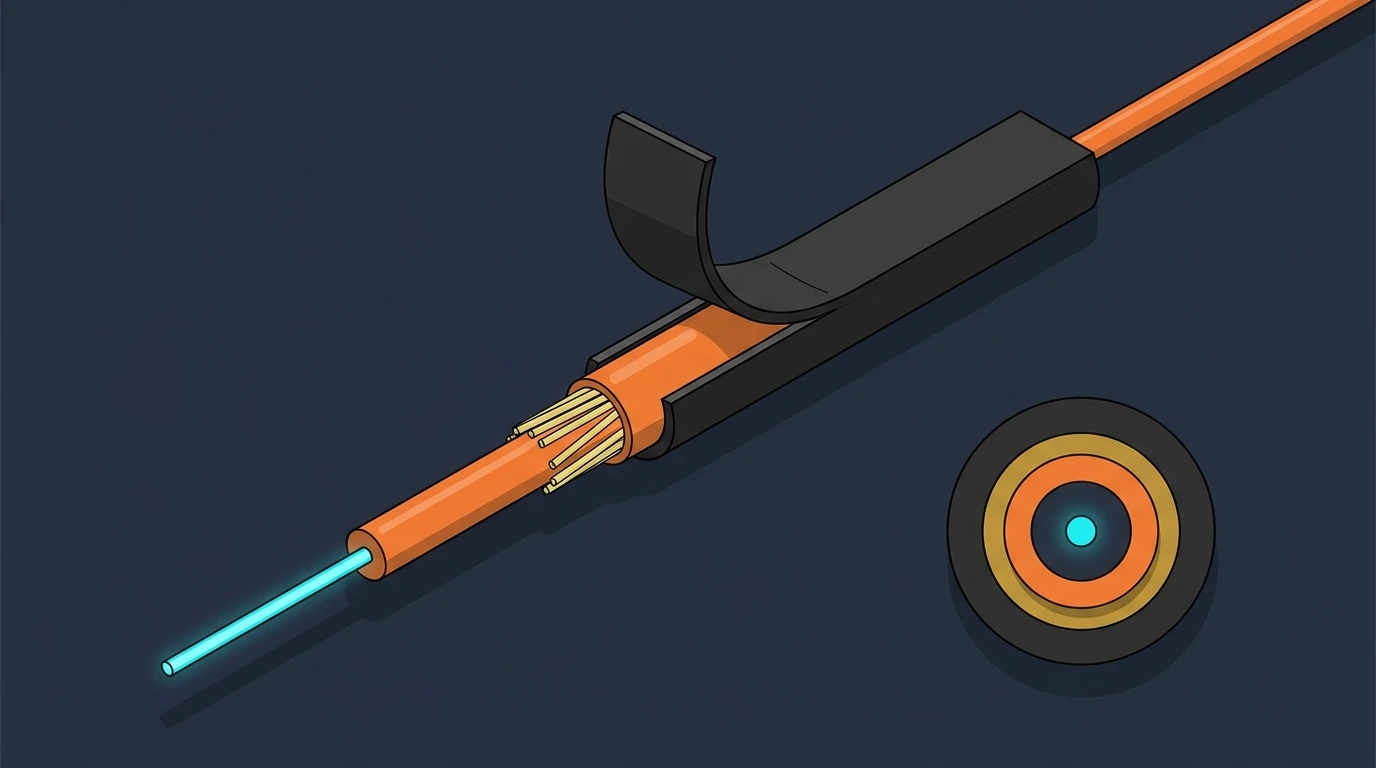
Whether it wins is an installed-cost question, quoted per project rather than per meter, because four variables move it: the PE oversheath, the second jacketing pass, the lower volume against standard OSP cable, and the fiber count. The oversheath and the second jacketing pass dominate; fiber count moves the number most at the high end. Against that premium you set two terminations, one splice, one enclosure, the labor for all three, and the failure you delete: a wet splice at the wall in year five.
The two-cable route still wins in three situations. When the indoor run is long and the outdoor run is short, because you are paying the dual-rated premium over hundreds of meters to save one splice. When the route enters a plenum, because the inner listing has to match the space — an OFNR core cannot enter a plenum, and a plenum-rated indoor/outdoor construction is a different product. And when the fiber count is high enough that a closure at the entry is cheaper than the oversheath on 48 fibers.
What Goes in the Specification
The specification that prevents the argument is a segment table, not a cable list. Write it by location, then let each location pick the cable.
Segment | Environment | Required listing | Water blocking | Tension / bend | Transition hardware |
|---|---|---|---|---|---|
Pole to wall | Aerial, UV, wind | None (OSP) | F5B, dry or gel | Per span sag | Anchor, slack coil |
Wall penetration | Through masonry | Per inner cable | — | — | Sealed sleeve, firestop |
Entry to telecom room | Indoors, non-plenum | OFNR minimum | Not required | Hand pull | Enclosure if spliced |
Riser to floor 3 | Vertical shaft | OFNR | Not required | Support per floor | — |
Ceiling void | Plenum (check) | OFNP | Not required | Hand pull | Rated enclosure |
Five lines do most of the work. List segments by location, never by cable type — the location is what the code regulates. Put the required listing on every indoor segment beyond the point-of-entrance allowance — and if you are relying on that allowance for the first 15 m, say so in the spec, because it covers only an unlisted OSP cable that enters from outside and terminates in an enclosure. Require F5B water blocking by test method for any segment that can get wet, and say whether gel or dry is acceptable. State short-term tension and minimum bend radius so the pulling crew has a limit rather than a habit. Name the transition hardware — enclosure, sleeve, firestop — because it is the item most often left to the installer's van.
Drawn as a flow, the route ends up in one of four shapes: a bare wall penetration, an aerial run into a wall-mounted box and down into a duct, an indoor tray run, or a crossing where the black jacket is stripped back to the rated inner cable.
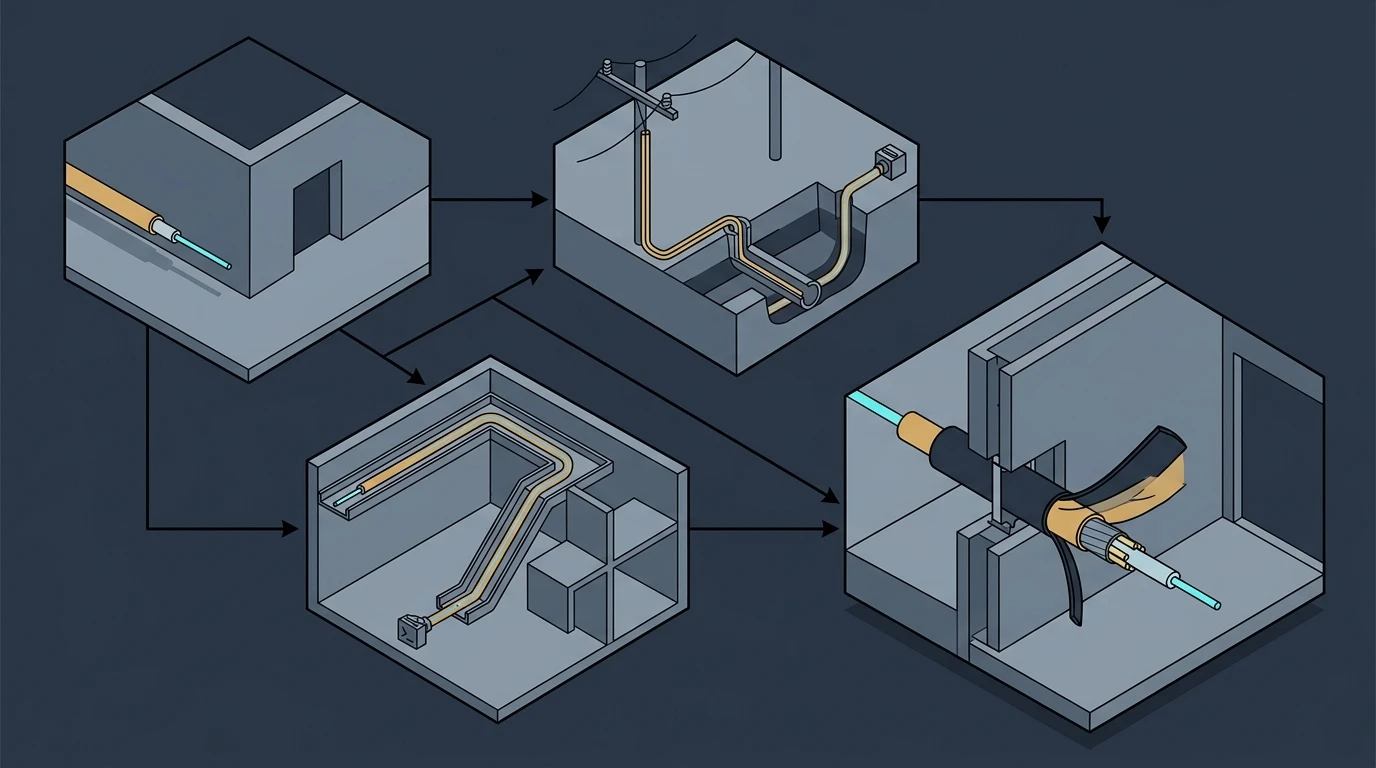
For the outdoor side of the table, depth and bedding belong to a different decision — the burial depth guide covers that, and the aerial cable options guide covers the routes that never bury at all.
The decision rule is short enough to remember. If the route never leaves the building, buy by listing and bend radius. If it never enters one, buy by water blocking, armor and tension. If it crosses the wall, decide where the crossing is before you decide which cable to buy — because that 15 m is the only part of the route where both codes apply at once.