
Cable Selection
Aerial Fiber Cable: ADSS vs Figure-8 vs Lashed
Aerial fiber cable is built three ways: ADSS (all-dielectric self-supporting, no messenger at all), figure-8 (the optical unit and a steel messenger molded into one jacket), and lashed (a standard outdoor cable lashed to a messenger, or to the strand already on the poles). Which one your route can take is settled by three conditions in a fixed order — whether a messenger already exists, whether metal is allowed on the poles, and how much tension the spans will demand.
Get those three answers and the cable choice mostly makes itself. Skip them and you end up sizing a cable for a route that is already limited by someone else's strand, or ordering an all-dielectric build where a figure-8 would have halved the installation work.
That is the order this article follows: what separates the three constructions, how each performs against those three conditions, the span and tension numbers that turn the conditions into arithmetic, and the sequence a network planner can walk through. Two details first: the glass is ordinary single-mode or multimode cable in all three cases — what changes is the structure around it and what carries the load — and what follows is a summary of published specifications and practice, not a span design for your route. Pole loading, clearance and hardware selection belong to the pole owner and a licensed engineer, and the manufacturer's span recommendations override any table on a blog.
The three aerial fiber cable options at a glance
Strip away the marketing and there are four questions that separate ADSS from figure-8 from lashed cable:
- What carries the tension of the span? The cable's own strength members, a steel messenger molded alongside the fibers, or a messenger that already exists on the pole line.
- Is there conductive metal on the route? Figure-8 and lashed builds both put a steel messenger in the air; ADSS puts none.
- How does the cable get up there? One pull that installs cable and support together, or a cable run followed by a separate lashing pass.
- What has to be designed before you order? A span-by-span tension design, a messenger size, or somebody else's strand capacity.
ADSS | Figure-8 | Lashed | |
|---|---|---|---|
Load path | the cable's own dielectric strength members | a steel messenger molded into the same jacket | the messenger or strand already on the poles |
Metal in the air | none | steel messenger and steel tape armor | steel messenger and steel lashing wire |
Placement | pulled over pulleys, then supported with suspension fittings and dead-ends | installed like a messenger wire, in a single pull | cable run first, then helically lashed to the messenger |
Designed before purchase | the span, pole by pole: tension, sag, hardware | the messenger size, fixed at the factory | the existing strand's remaining load capacity |
Best fit | power corridors, long or awkward spans, lightning and EMI exposure | new routes on standard poles with no strand to reuse | pole lines that already carry a strand |
One clarification before the details, because it trips up purchase orders: construction is not grade. Construction is what hangs the cable in the air; grade is whether the glass is single-mode or multimode, and the jacket is a third, separate choice. A figure-8 cable is not "better" than an all-dielectric one — it is a different answer to the load-path question. If the three axes are blurring together, how fiber cable types break into grade, construction and jacket separates them.
ADSS cable: no messenger, no metal, engineered spans
ADSS — all-dielectric self-supporting, also written out as all dielectric self supporting cable — is the build for routes where you cannot hang a steel messenger and cannot tolerate a conductive path. The cable is strong enough to span between structures on its own, with no support wire, and it contains no metal: the strength comes from aramid yarns, or from fiber-reinforced plastic rods on shorter spans, wound around a loose-tube or ribbon core.
The reason utilities adopted ADSS is not aesthetics. As the Fiber Optic Association's aerial installation reference puts it, ADSS cables can be erected in close proximity to power transmission lines, which allows pole sharing — and pole sharing reduces installation cost while speeding up deployment. On a transmission corridor, that is often the difference between a route that gets approved and a route that does not. The absence of metal also removes two work items from the job: no grounding and bonding of a messenger, and no electromagnetic interference or lightning concern to design around.
Span capability is where published sources diverge, and averaging them would be a mistake. Wikipedia's summary of the BICC handbook describes ADSS designs strong enough for spans up to about 700 m between support towers; the FOA notes ADSS can run without a messenger on long spans of up to 6 km in some cases. Both describe the same trade: span is bought with strength members, weight and hardware, so the span number is a design output, not a catalog property. The catalog property is the rated tensile strength — 1500 N short-term and 600 N long-term across 12 to 144 fibers for the all-dielectric non-metallic construction this manufacturer builds for aerial and duct use.
The hardware is where ADSS differs most. With no messenger to clamp to, the fittings grip the cable itself: dead-ends where the span is tensioned, suspension fittings at intermediate poles, and reinforcing rods that take the clamp pressure so the jacket is never squeezed directly — the accessories sit over the rods, not on the sheath. Because the cable is light, carries high tension and has little self-damping, wind-induced aeolian vibration can degrade the support hardware on long spans, and the FOA's advice is to fit vibration dampers. Above about 220 kV, an ADSS cable also has to be chosen for dry-band arcing resistance, or moved to a lower field position on the structure.
Where ADSS loses is worth stating plainly: it is the most demanding of the three to specify, the cable carries a premium over a standard outdoor cable of the same fiber count, and if a usable strand is already on the poles, you are paying for strength you did not need. The FOA's own guidance is that designers should work with the manufacturer so span lengths suit the cable and the mounting hardware is matched to it — this is not a build you swap in at the last minute.
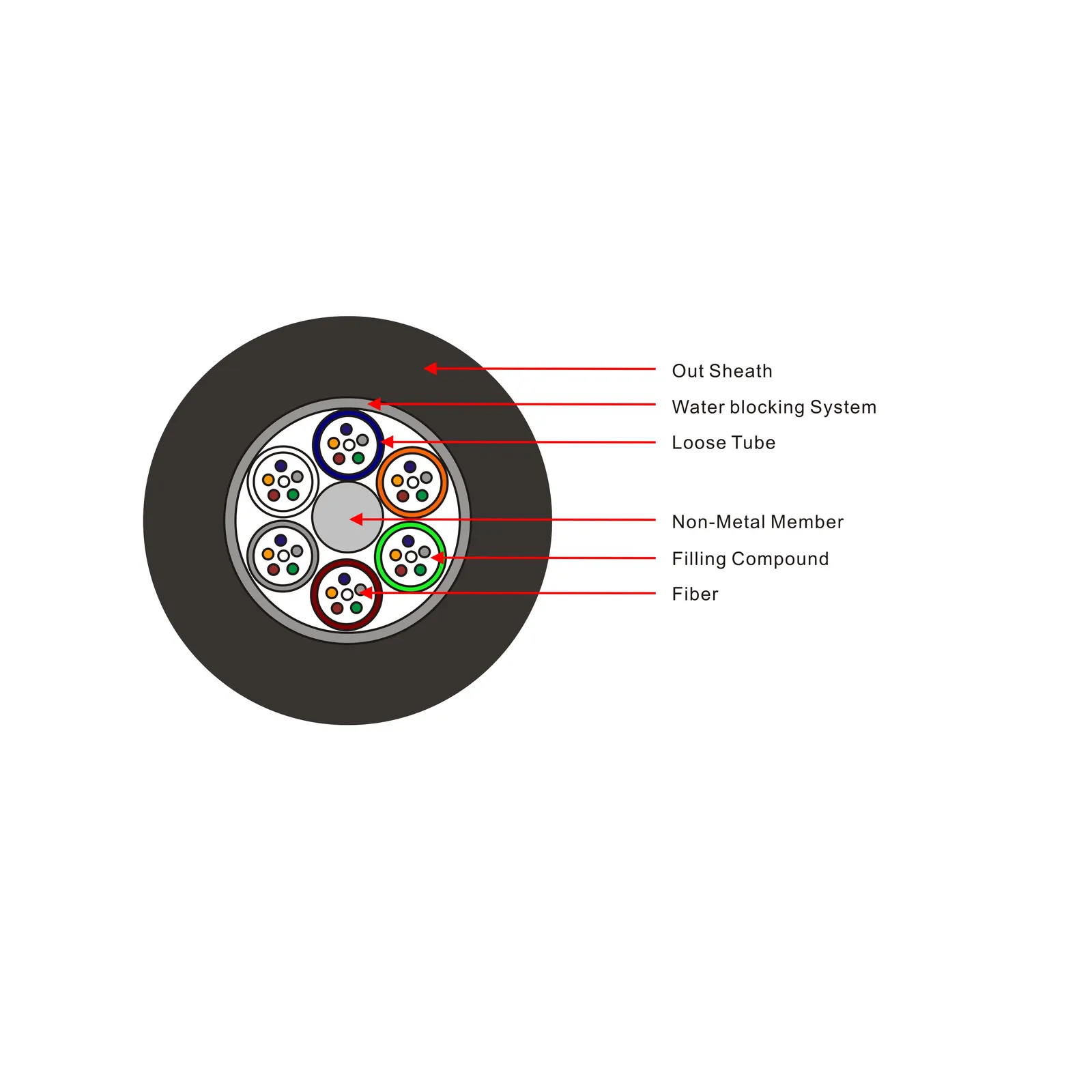
An all-dielectric build like this one — non-metallic central member, no armor, no messenger — is what makes an aerial route immune to the interference and lightning problems that come with a steel support wire. For a closer look at how that construction is put together, see the all-dielectric aerial cable breakdown.
Figure-8 aerial fiber cable: optical unit and messenger in one jacket
Figure-8 aerial fiber cable is exactly what the name describes: an outdoor cable with a steel messenger wire molded to the side of it, so the cross-section looks like an 8. The FOA defines it in one sentence — "an OSP cable with a messenger wire molded on the side of the cable" — and adds two observations that matter more than the definition: it is less commonly used for aerial installations, but it may be useful where no messenger is available, and it is installed like a messenger wire, with care taken to protect the fiber cable from damage.
The build has two lobes with different jobs. The optical lobe holds the loose tubes or the central tube, water-blocking material, corrugated steel tape armor and the polyethylene sheath; the messenger lobe is a galvanized steel wire. Both are extruded into one jacket, so a single pull puts the load path and the optical path in place at the same time. Typical published ratings for the two variants this manufacturer builds:
Model | Fiber count | Dimensions (mm) | Weight (kg/km) | Tensile strength (short / long term) | Crush resistance (N/100 mm) |
|---|---|---|---|---|---|
GYTC8S (loose tube) | 2–144 | 11.0 × 20.8 (±) | 212–397 | 4950 N / 2500 N | 2000 / 1000 |
GYXTC8S (central tube) | 2–24 | 7.0 × 13.5 (±) | 270 | 4800 N / 2500 N | 1000 / 300 |
Fiber count is the cable's build range. For the loose-tube GYTC8S the tensile rating is specified from 12 fibers up; the central-tube GYXTC8S carries a single 4800 N / 2500 N rating across its whole 2–24 core range.
Both are rated for −40 to +70 °C working and storage, with a minimum bend radius of 20× the cable diameter under tension and 15× when static. Note what does not change with fiber count: the tensile rating holds at 4950 N to 144 fibers, while the weight climbs from 212 to 397 kg/km. The messenger is sized for the span, not for the fiber count, and the extra weight of a high-count cable is what the messenger and the poles have to carry.
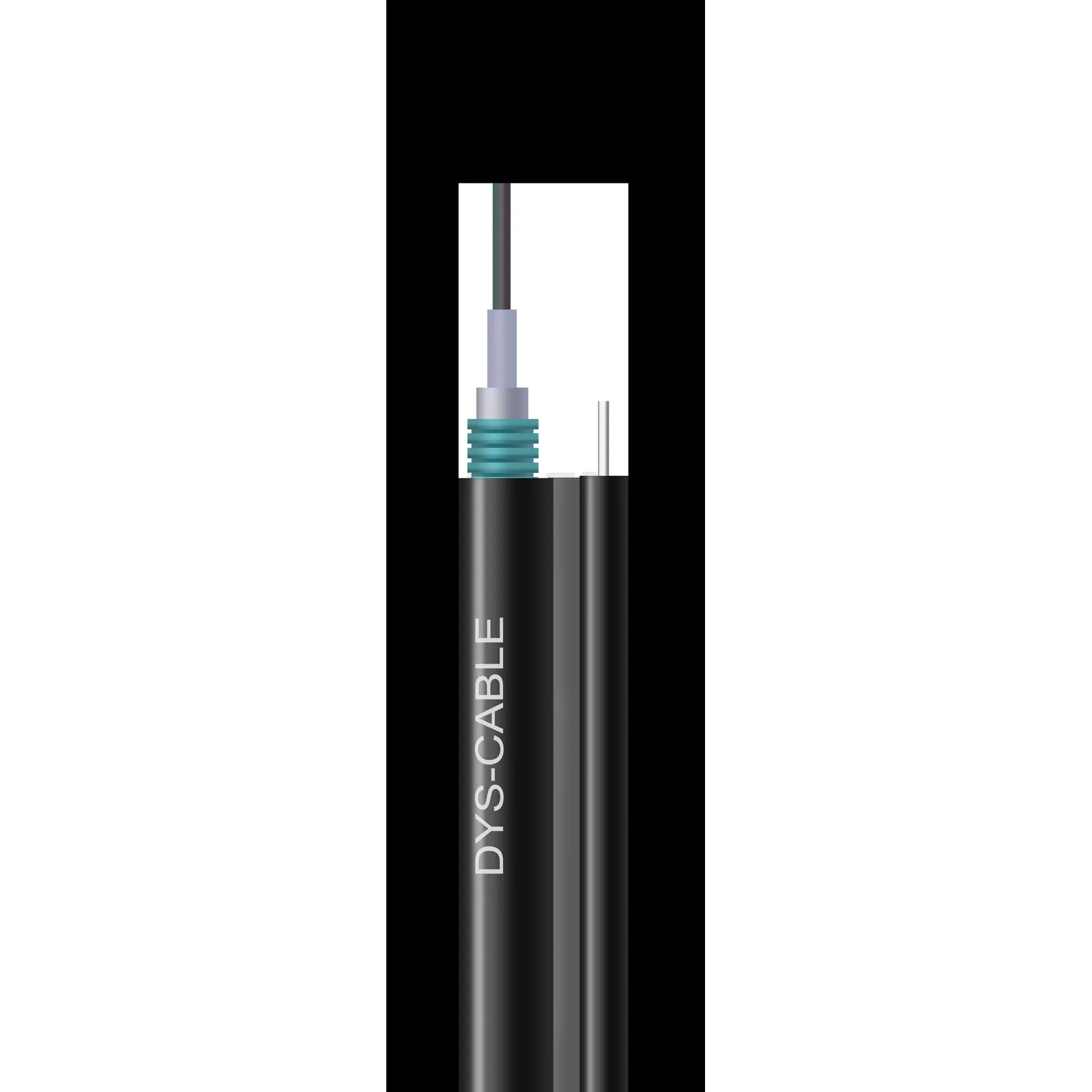
The central-tube variant of the same idea: one blue central tube holding the fibers, steel tape armor around it, and the thinner steel messenger lobe alongside — 2 to 24 fibers with a 4800 N short-term rating.
That factory-fitted messenger is the whole argument for figure-8. There is no separate messenger to design, tension or ground at its own dead-ends: the crew installs one assembly the way they would install a messenger wire. On a new rural distribution route with no strand to reuse and standard pole spans, it is the least complicated of the three builds to procure.
Its limits are equally structural, and there are three.
Metal. A steel messenger plus steel tape armor means the route needs grounding and bonding, and it is the wrong cable for a transmission corridor, an EMI-sensitive site or a lightning-prone ridge. That case belongs to an all-dielectric build.
A fixed messenger. The support is chosen when the cable is ordered, which means the span capacity arrives frozen. Adding capacity later on the same structure means overlashing another cable onto this messenger — a load and clearance calculation that the original design either anticipated or did not. You cannot upsize the messenger without replacing the cable.
Handling. The tension of the pull runs in the messenger lobe and the fiber side is along for the ride, which is why the FOA warns about protecting it: pushed around a tight pole radius, the optical lobe is the part that gets damaged. Drum weights of 212 to 397 kg/km also decide which poles the reel trailer can reach.
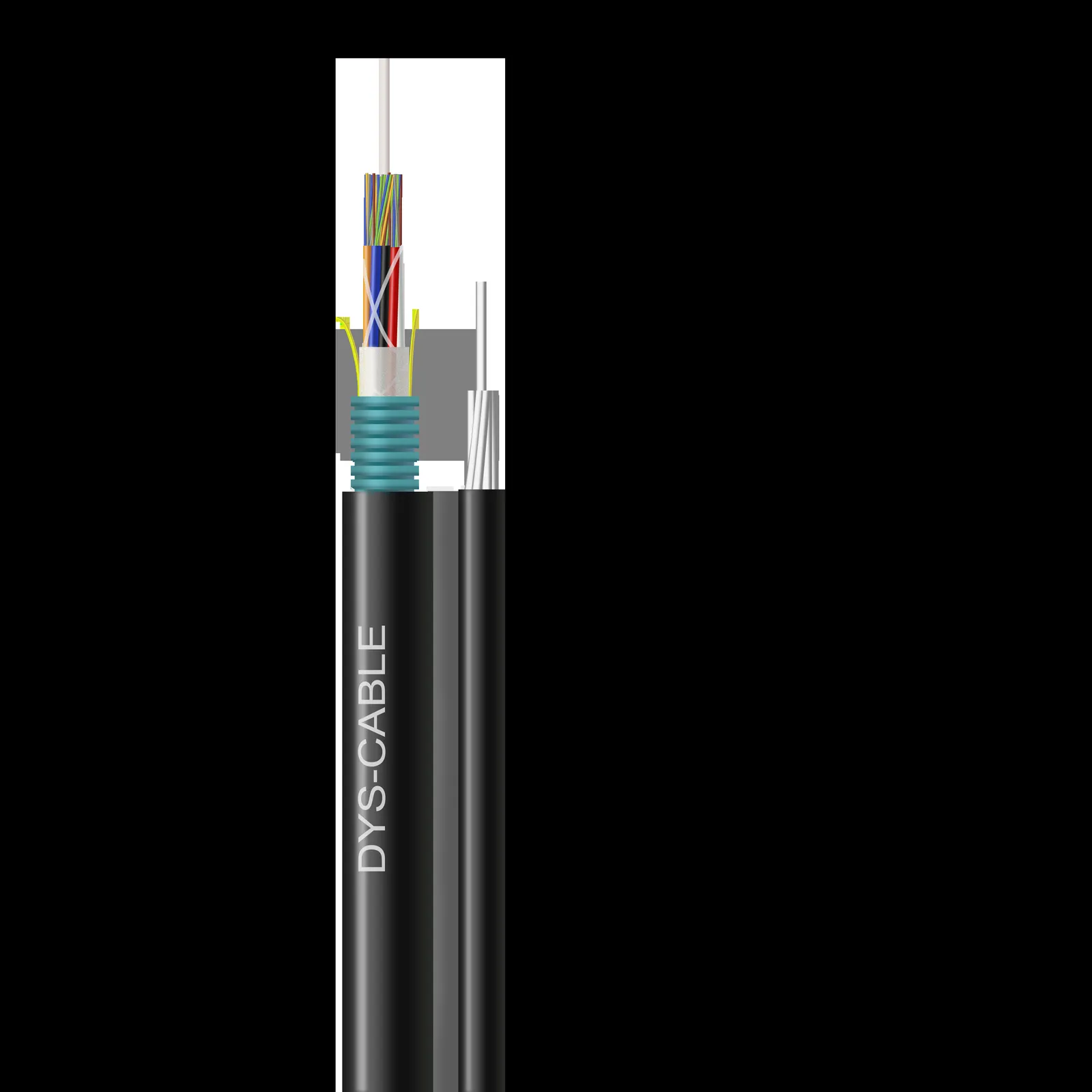
The two lobes of a figure-8 build: an armor-protected optical unit on one side, a steel messenger on the other, both in one jacket. This is our GYTC8S figure-8 cable — 2 to 144 fibers with a 4950 N short-term tensile rating.
Lashed aerial fiber cable: reuse the strand you already have
Lasher, lashing wire, messenger: this build turns an existing support wire into a fiber route. The cable itself is an ordinary outdoor cable — loose-tube armored, or a central-tube aerial-and-duct cable — and the work is the lashing: a wire wound helically around both the cable and the messenger by a lasher, driven along the pole line. The FOA's description of the process is blunt about the equipment: a lashed installation generally needs one or more bucket trucks so crews can reach the lashing, guide cables around poles and through trees, and move the lasher from pole to pole.
There are two ways to place the cable before lashing, and the choice is a site condition rather than a preference. In the moving reel method the reel travels along the route and the cable is paid off as the lasher is pulled forward — a single pass, no blocks. In the stationary reel method the reel stays put, the cable is pulled and held against the messenger with cable blocks, and the lasher follows, pushing the blocks ahead of it for removal at the next pole. Lashing wire and messenger selection is not improvised: the FOA points to the ANSI/ICEA P-79-561-2020 Guide for Selecting Aerial Cable Messengers and Lashing Wires, and recommends sizing the messenger with future overlashing already in the load case, because larger wires weigh more and collect more ice and wind.
Overlashing is where this build earns its place. Lashing additional cables to an existing messenger and cable is often allowed, and it is how a great deal of aerial capacity gets added — but the FOA requires an analysis of the added stress and the resulting sag or ground clearance before construction, with the current loading, the weight of the new cable and the effect on span tension all in the calculation. An overloaded strand does not fail politely; it sags into the clearance envelope first.
Two more items belong to the lashed build rather than to the cable. The first is electrical: a steel messenger and the lashing wire are conductors, so they are grounded — the National Electrical Safety Code, Chapter 9, recommends grounding at four locations in each mile (1.6 km), and a messenger that terminates at a building is bonded and grounded there. The second is administrative: permits are still required to add communications cables to existing poles, and the poles must be made ready by their owner or authorized parties — which the FOA notes can take considerable time.
Where lashed cable wins: the cable is the cheapest of the three per meter, no messenger has to be designed or procured, capacity can be added in increments later, and the plant can be built with equipment and skills crews already own. Where it loses: you inherit the strand, including its age, its corrosion and whatever else is already lashed to it; the span limit is set by that strand rather than by the cable you bought; the lashing wire and hardware are extra parts to specify and inspect; and the route depends on permissions you do not control.
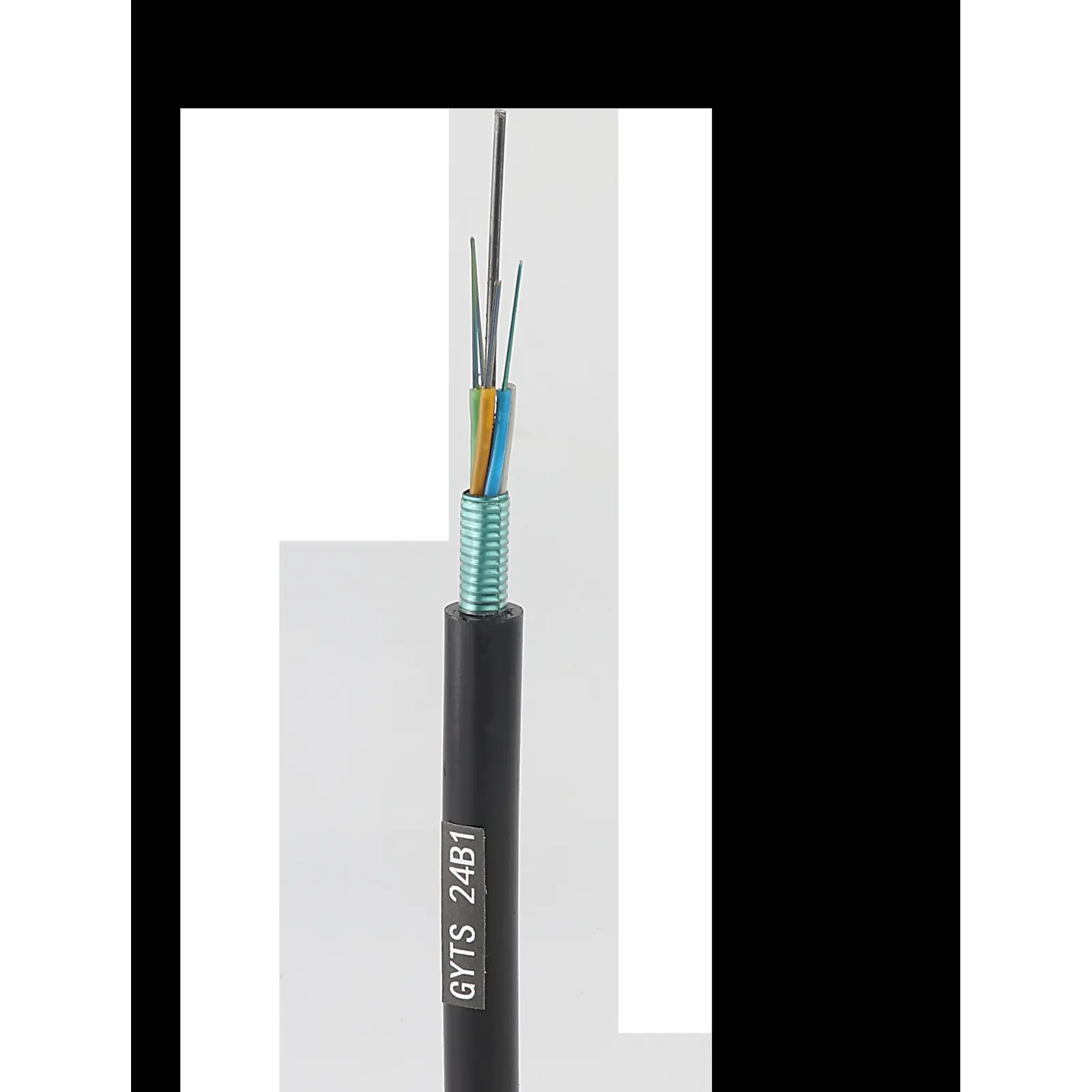
A conventional loose-tube armored cable is the usual payload of a lashed route — its own strength members only have to survive handling, because the messenger above it carries the span. Field work like this also has its own rules, including the bend radius limits that apply at every fitting.
Span, sag, and tension: the numbers that decide the construction
Three terms carry every aerial design, and the FOA defines them cleanly. Span length is the distance between two poles. Sag is the vertical drop of the messenger at midspan, and it depends on the weight of everything hanging on it — the cables, any splice closures or service loops, plus the added load of ice and wind — with sag often set at 1 % of span. Tension is the force holding the assembly between the poles, and tension is what determines sag.
The rule that turns those definitions into a specification is short enough to quote:
Every span must be analyzed for the size of messenger, the tension required for the span length and cable weight to meet sag requirements. Sag is generally limited to <2% of span length and maximum tension <30% of cable minimum breaking strength.
That is the Fiber Optic Association's workmanship rule, from the aerial installation reference linked above, and it explains a mismatch that shows up in a lot of aerial purchase orders: a cable's rated tensile strength is not the tension you string it at. The rating describes what the cable survives; the design tension is what keeps sag inside the limit, and it should stay under 30 % of the breaking strength. A 4950 N figure-8 cable is not strung at 4950 N — it is strung at whatever tension holds the span at the right sag, with the rating as the ceiling.
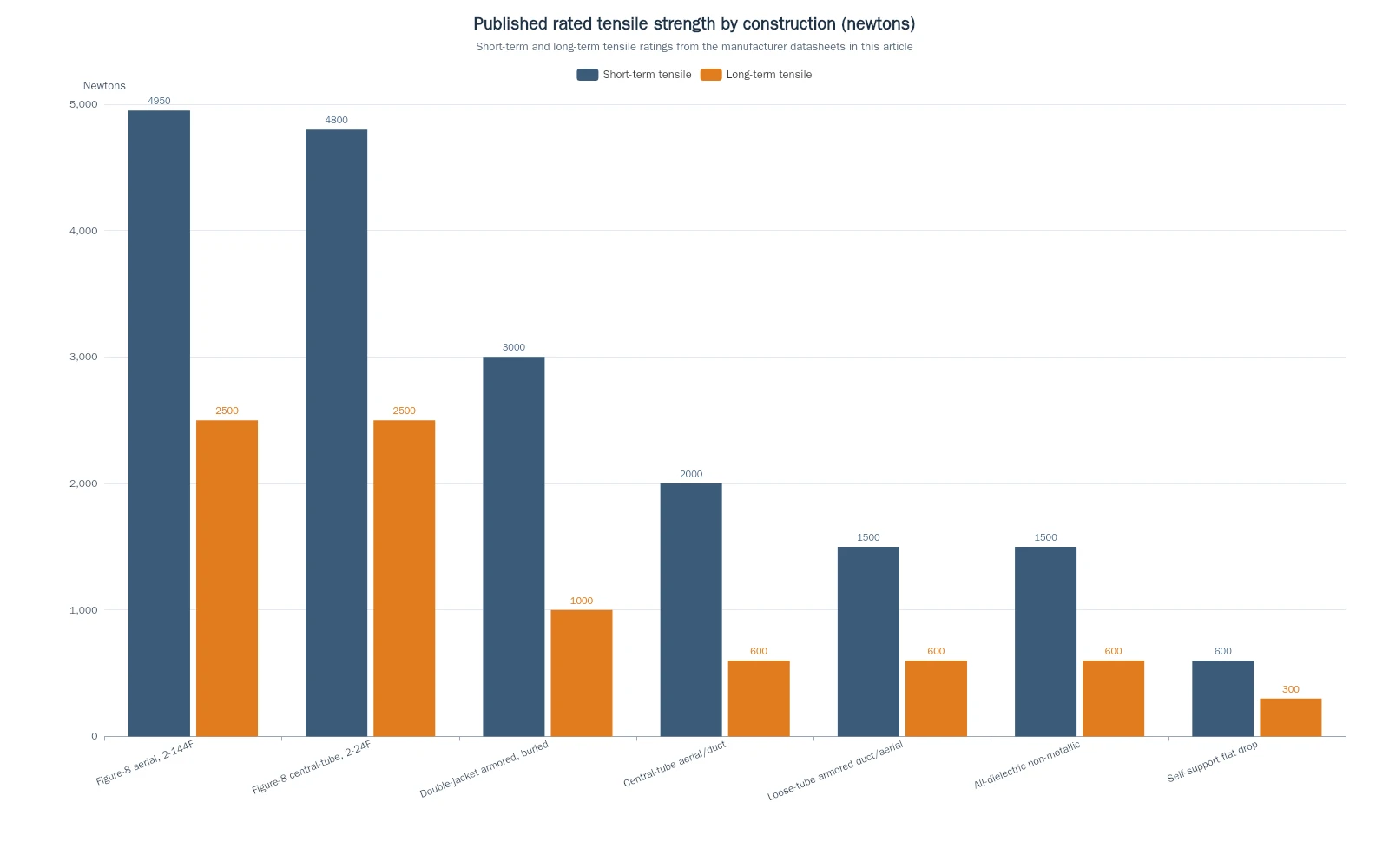
The chart above puts the published ratings of the constructions in this article side by side, with two others for scale: the buried double-jacket armored cable at 3000 N, and the self-supporting drop cable at the far right. Two things to read from it. First, the long-term figure is the one that governs a permanent installation — 2500 N for figure-8, 600 N for a loose-tube armored cable, 300 N for a drop. Second, the spread across these constructions is not about glass or fiber count; it is about structure and how much span the build is expected to hold.
What loads the span is next. The environmental checks behind an aerial design are wind load, ice load, galloping and vibration — all four belong in the design case before a pole line is built, rather than being treated as a fair-weather span. On a lashed or figure-8 route the messenger absorbs that case; on an ADSS route the cable does.
One further number belongs to the installation rather than to the design. While cable is being pulled in, the winch should be calibrated to stop when the installation tension exceeds the maximum rated cable load (MRCL), with a dynamometer as the fallback — a separate limit from the design tension, and the one that protects the cable during the pull itself.
So how long can an aerial span be? Never a fixed number. Distribution pole lines usually work in tens of meters between structures; standard ADSS designs are published for spans up to about 700 m, with long spans of up to 6 km in some cases; a figure-8 or lashed span is limited by its messenger and by the 2 % sag limit. The span you get is the span the design supports.
Which aerial fiber cable to choose
The decision path is short once the three route conditions are known, and it goes in one direction.
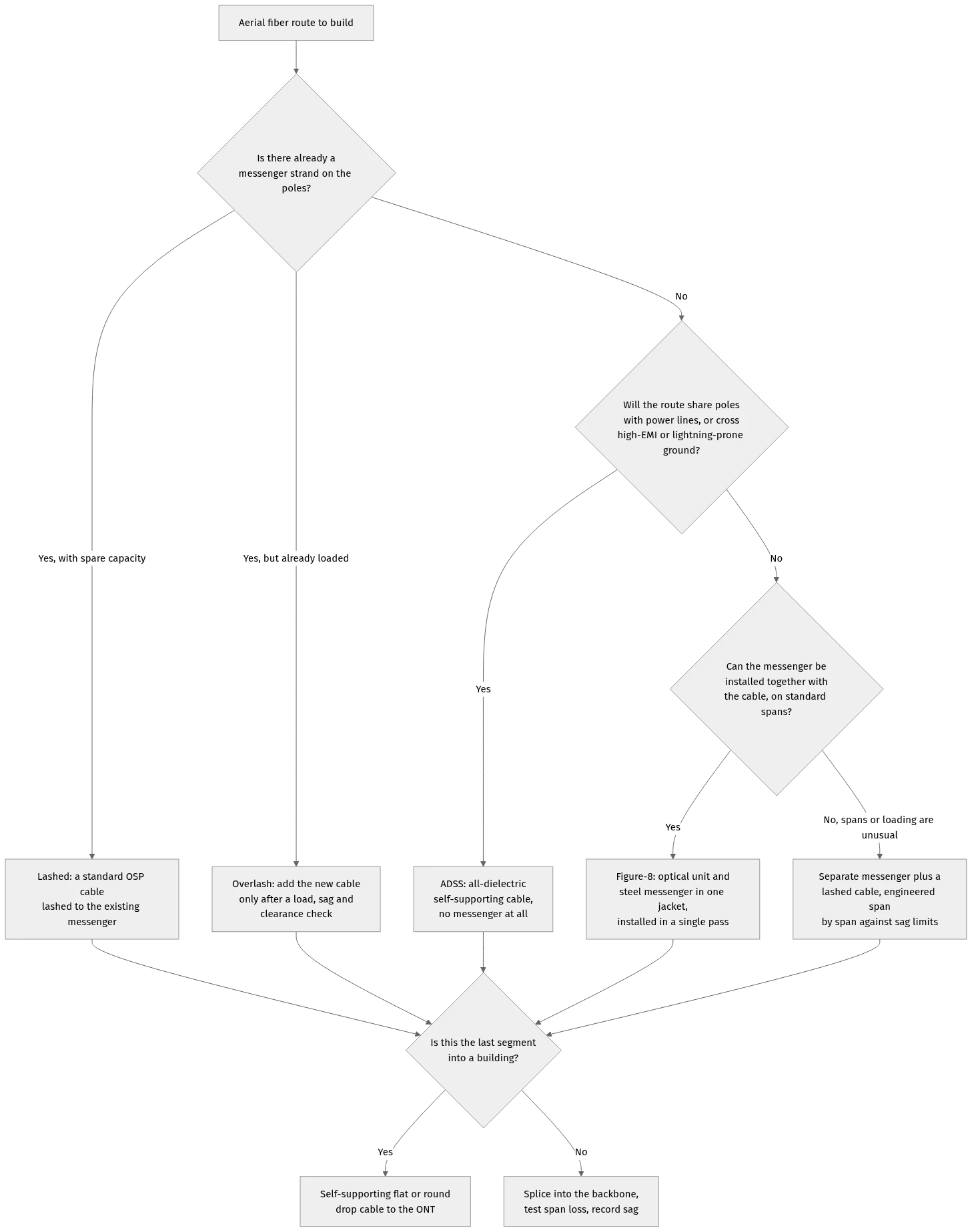
- Is there already a strand on the poles? If yes, start with lashed cable and check the strand's remaining capacity and clearance for the extra load — including an overlash if you may add cables later. Reusing a strand is almost always cheaper than erecting a new support.
- If there is no strand, is metal allowed on the pole line? On a transmission corridor with dry-band and arcing constraints, near sensitive electronics, or on a lightning-prone route, the answer is no: choose an all-dielectric build. ADSS exists for exactly this case, and pole sharing with the utility is its commercial argument.
- If metal is allowed and no strand exists, can the route take an integrated messenger? On standard pole spans with no obstruction over the line, figure-8 puts the support and the cable up in one pull and removes a separate messenger job from the schedule.
- If the spans are unusual, the messenger has to be sized separately, or you expect to add cables later on the same support, buy a messenger and a cable as two items and lash: more work up front, easier to extend afterwards.
- Then the last segment. Whatever happens on the pole line, the run into the building is a different job — a self-supporting drop cable sized for a short span and a lighter load.
Before any of that, though, there is a fork that outranks the cable: aerial or buried. Digging is removed from the project, which is why aerial deployment is generally much less costly than underground construction and typically much faster — a gap that widens on uneven or rocky ground. Underground duct has the advantages of being invisible once installed and less affected by high winds or freezing rain, though it can be flooded. If that fork is still open, direct-buried and conduit alternatives covers what changes on the other side of it.
There is no “best” aerial fiber cable. There is a correct answer per route, decided by an existing strand, the metal rule on that pole line and the span design — not by a tensile rating quoted out of context.
Aerial fiber optic cable installation: what changes on site
Aerial fiber optic cable installation splits into two placing methods, and most projects use both.
The stationary reel method pulls the cable along the route from a fixed reel. It is the method of choice when the cable has to pass above existing lateral cable and other obstructions, and it depends on instrumentation: the pulling winch should be calibrated to stop when tension exceeds the maximum rated cable load, or a dynamometer with an alarm must monitor the pull. Once the cable is in position with slack for building access or splicing, it is tensioned until the correct sag level is reached and terminated at each dead-end pole along the route.
The moving reel method carries the reel along the pole line, pays cable off as the vehicle advances, and supports it with hardware as it goes. It is a single-pass operation with no cable blocks or pull lines, and it is generally quicker — but it needs a drivable route, no obstructions, and a reel truck that can stay a safe distance ahead of the first pole. It is rarely possible for a whole route, which is why hybrid deployments are normal: moving reel along the open stretches, stationary reel where the line is congested.
Hardware follows the same logic. As PPC's installation guide sets out, dead-end attachments are the most widely used items on an aerial route, in two families: formed wire dead-ends that grip the cable uniformly over two to four feet and are often treated as the strongest solution for long spans, and wedge anchor clamps that grip six to twelve inches. Where the cable is spliced, the closure is mounted on the pole or supported on the messenger, and both it and its service loops are secured — the FOA is explicit that no loop of cable may be left hanging from a span.
Then there is the paperwork. Permits from local authorities, coordination with agencies such as traffic and police for road crossings, and the pole make-ready process with the pole owner all sit on the critical path before a single cable is pulled — and working at height on ladders, bucket trucks and poles near electrical wires is a trained, equipped job rather than a general one.
The final segment is its own discipline. A self-supporting flat drop cable is built for the short aerial run into a building: the DYS GJYXFCH is 2.0 × 6.2 mm and 23.6 kg/km, rated 600 N short-term and 300 N long-term, with a dielectric strength member and one or two G.657A single-mode fibers. Compare that with the 4950 N of a figure-8 distribution cable: drop cable is not scaled-down distribution cable, it is a different duty, and the drop segment of an access network has its own rules. Where the drop is pre-terminated the fusion splicing disappears, at the cost of leftover cable on the drum.
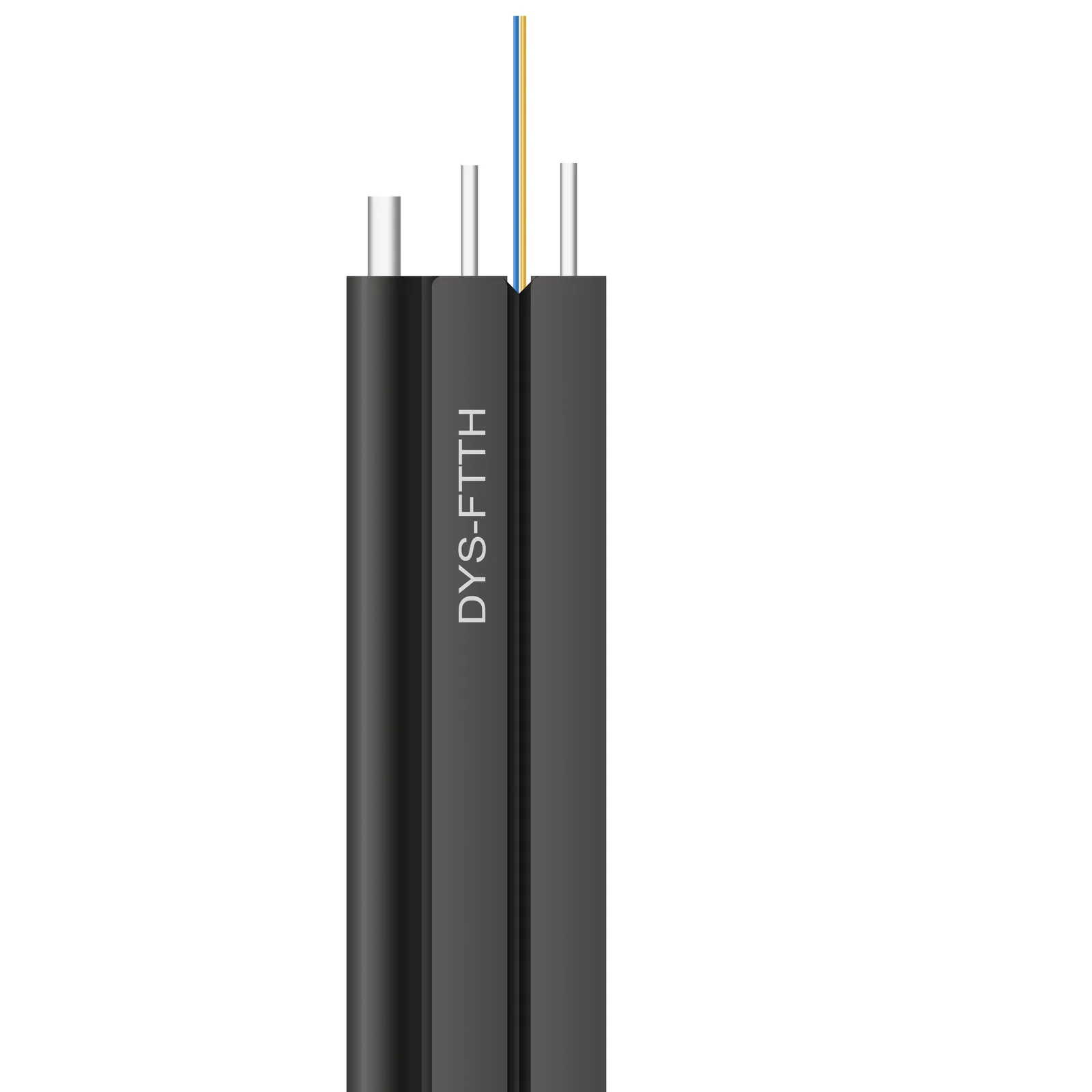
A self-supporting flat drop cable, the aerial segment that reaches the building: 600 N short-term tensile strength, a dielectric strength member and a bend-tolerant single-mode fiber.
FAQ
Can fiber optic cable be installed aerially? Yes, in three constructions. ADSS needs no messenger because the cable supports itself; figure-8 has a steel messenger molded into the same jacket; lashed cable is a standard outdoor cable wound onto a messenger or an existing strand with lashing wire. Two constraints follow the choice — span loading, where sag is generally limited to under 2 % of span and design tension to under 30 % of the cable's breaking strength, and grounding, which applies to any build with metal in the air.
What is the difference between ADSS, figure-8 and lashed aerial fiber cable? ADSS is all-dielectric and self-supporting, with no messenger and no conductive path, which is why utilities use it in power corridors and on lightning-prone routes. Figure-8 carries its own steel messenger in the same jacket, so one pull installs cable and support together. Lashed cable reuses a messenger or strand that is already on the poles, and is limited by that strand's capacity rather than by the cable's own rating.
Is aerial fiber cable cheaper than underground? As a construction method, aerial deployment removes the digging, which is why it is generally much less costly than underground construction and typically much faster; on uneven or rocky ground the gap widens. Underground duct disappears from the landscape and is less affected by high winds or freezing rain, but it can be vulnerable to flooding.
How long can an aerial fiber span be? Longer than most people expect, and not a single number. Standard ADSS designs are published for spans up to roughly 700 m between structures, and the FOA notes ADSS installed on long spans of up to 6 km in some cases. Figure-8 and lashed spans are limited by their messenger and by the sag limit, and distribution pole lines usually run in tens of meters. The span length is a design output — it should come from the manufacturer's recommendations for the specific cable, not from a generic table.
Does aerial fiber cable need a messenger? Not always. ADSS does not need one, figure-8 carries its own, and only a lashed installation requires a separate messenger — either one you erect or the strand already on the poles.
The bottom line
Aerial fiber cable decisions go in one order: the strand that already exists, the metal rule on that pole line, the span the design has to hold — and the cable comes last, as the answer rather than the question. Decided in that order, ADSS, figure-8 and lashed cable stop competing and start describing three different routes. If you are still weighing the whole route against buried construction, the cable selection guide sets out how construction, grade, jacket and application are chosen together.
DYS manufactures the outdoor cables this decision lands on: figure-8 aerial cable with the messenger molded in, all-dielectric non-metallic cable for interference and lightning-prone routes, and the loose-tube and central-tube constructions a lashed route carries — each with its short-term and long-term tensile rating published, so the span design has real numbers to work with. Tell us the route and the span, and we will confirm which construction carries it.