
Cable Selection
How to Spec Fiber Optic Cable in an RFQ: A Checklist
A short RFQ — "10,000 m single-mode fiber optic cable, LSZH, delivered to site" — usually comes back as six quotes that cannot be compared line by line, and where the cheapest and the most expensive are not even the same product. Nobody is cheating. Each bidder is filling the same blanks with a different assumption: one prices 12-fiber loose tube, another assumes 48-fiber ribbon; one includes per-drum test reports, another bills them separately; one quotes FOB Shenzhen, another DDP Rotterdam.
The gap between a comparable RFQ and an incomparable one is not length. It is whether every field carries a number, a unit, a test method and a stated default — because a field with no default silently receives a different default from every supplier who reads it.
This is the checklist we hand to procurement teams who are about to learn how to spec fiber optic cable in an RFQ: seven blocks, roughly thirty fields, the clause wording that closes each one, and a one-page sheet you can paste into your tender package. It is written from the supplier's side of the table — DYS Fiber Optic has been building cable against other people's RFQs since 2009, from plants in Huizhou, Mianyang and Hanoi — because the fields that cause the most damage are the ones a buyer never notices are missing.
How to spec fiber optic cable in an RFQ in one page
The seven blocks are cut by what a supplier has to price, not by catalog category. Four blocks describe the cable itself; three describe how the cable gets proven and paid for. Everything else in a cable datasheet — the marketing copy, the certificates page, the company history — is supporting material a bidder will attach anyway.
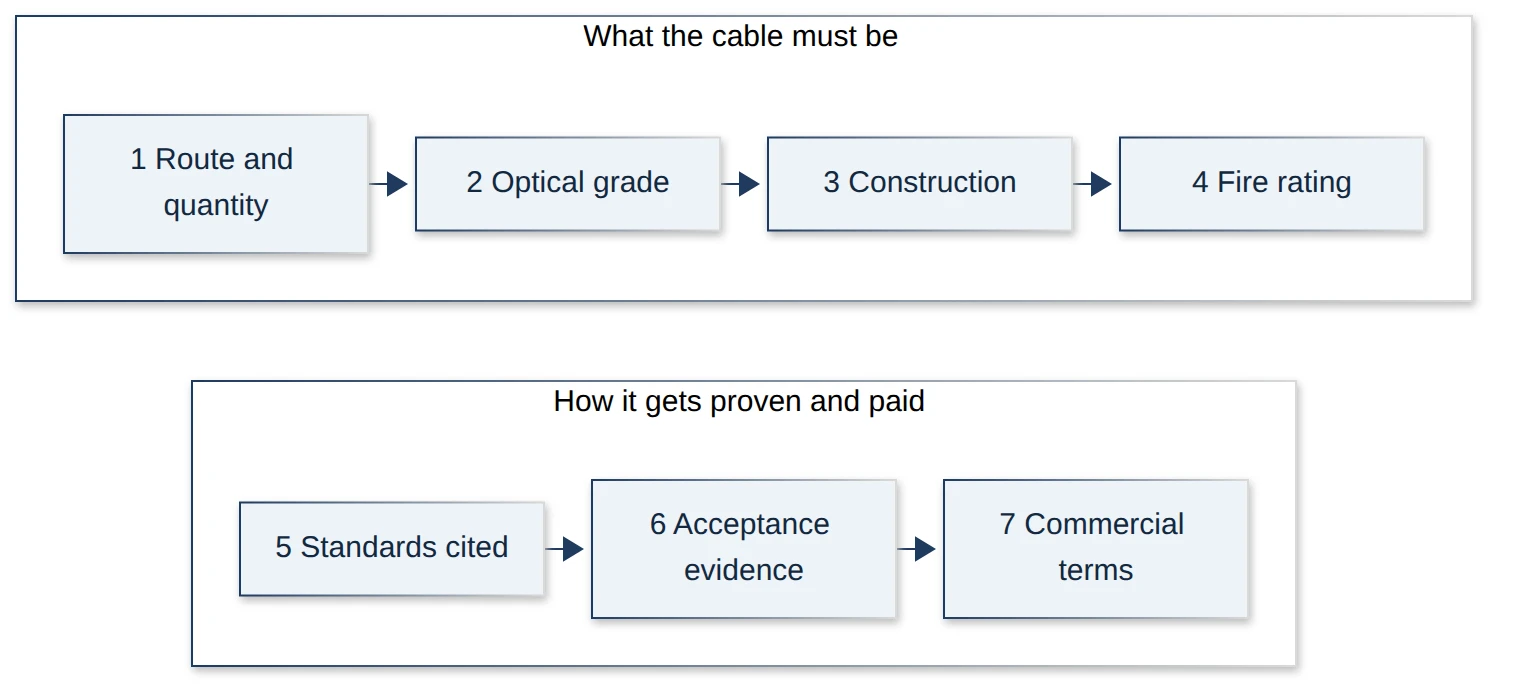
Figure: blocks 1 to 4 define the product; blocks 5 to 7 define the evidence and the commercial envelope.
One page is not a stylistic preference. Bidders price what they can find. When a specification is spread across a 12-page narrative, the estimator reads the drawings and the bill of quantities, prices the fields that are unambiguous, and applies a risk allowance to everything you left vague — which is exactly the margin you were trying to squeeze. The short version of the whole exercise fits on one page and is also the version your own buying committee can actually check; the deeper construction choices live in the complete guide to choosing fiber optic cable if you need them.
Block 1: route, quantity, and drum lengths
Write the route, not the adjective. "Outdoor cable" is not a specification; "direct-buried, 0.9 m depth, agricultural land, rodent history along 2 km, 24-strand, single jacket" is. Installation method decides construction before any other field does: aerial needs a messenger or a figure-8 design and a strength member; duct needs a smaller OD and lower friction; direct burial needs armor and crush resistance; indoor riser or plenum work overrides everything with a fire class.
Strand count comes next, with a spare policy attached. Say "48 strands, of which all 48 are live at handover" or "48 strands plus 25% spare capacity," because "48" alone leaves the supplier free to sell you a 48-fiber cable in 6 tubes of 8 with no spare anywhere. Sparing also changes the tube layout, which changes the diameter, which changes the drum length you can fit on the truck.
Then quantity — and quantity means meters per drum, with the drum schedule as an item. Standard reels run 2,000 or 3,000 m; anything unusual is a tooling and handling decision at the factory rather than a rounding error at the depot. A 10 km order delivered as five 2 km drums costs materially more to splice than the same order in three 3,333 m drums, and if you never state the drum length, you are letting your installer's splicing budget be set by your supplier's convenience.
Finally, the delivery schedule by drum number, not by total tonnage. Phased rollouts need drum 1–2 in week 3 and the rest released against site progress; a single "30 days" line invites a bidder to promise 30 days for everything and then ship when the line has capacity.
Block 2: the fiber optic cable specification clause — grade and attenuation
The fiber optic cable specification most often fails at the most basic field: grade. "Single-mode" is a mode, not a grade. Single-mode OS2 in most tenders means ITU-T G.652.D, the low-water-peak grade that keeps the 1310–1625 nm range usable for future wavelengths; ITU-T G.652 defines the grade, its geometrical tolerances and its attenuation ceiling. Bending-insensitive grades (ITU-T G.657, A1 and A2) are the right answer for FTTH drops, wall boxes and any route where the cable will be coiled into a tight enclosure: A1 holds its mechanical and optical performance down to a 10 mm bend radius, A2 down to 7.5 mm, which is the difference between a drop cable that survives a carelessly stapled corner and one that does not.
If the grade choice is still open, our G.652.D versus G.657.A1 and A2 comparison maps which of the three survives which installation.
Then put the number on the page. For a G.652.D cable the standard ceiling is 0.40 dB/km anywhere from 1310 to 1625 nm and 0.30 dB/km across 1530–1565 nm (ITU-T G.652, Table 2); if your RFQ only says "G.652.D compliant," a bidder can legitimately quote fiber at that ceiling while another quotes premium fiber at 0.32 dB/km — a 0.08 dB/km gap that compounds over every kilometer — and the two prices are not for the same product. State the ceiling you will accept, and state the measurement method in Block 5. If the route is multimode instead — a short data-center link, an in-building run — the equivalent fields are the fiber type (OM4 or OM5, per IEC 60793-2-10 and the TIA-492AAAF series) and the attenuation ceiling expressed at 850 nm and 1300 nm, which are entirely different numbers from the single-mode pair above.
Two fields people forget in this block:
- Connector and polish, if the RFQ includes assemblies. LC vs SC, UPC vs APC, and the insertion-loss and return-loss limits per mated pair. Polish is not cosmetic at 1550 nm — a single-mode APC endface typically holds return loss at −60 dB or better where UPC sits around −50 dB, and if you did not ask for it you will not get it.
- Attenuation per kilometer, not per drum. The 0.40 dB/km limit is a rate; a 2 km drum is allowed roughly twice the loss of a 1 km drum. If your acceptance test measures whole drums, say so and give the per-drum limit in dB, or you will reject good cable and accept bad cable in the same shipment.
Block 3: construction, from loose tube to jacket
Construction is where a cable stops being a commodity. The loose tube vs tight buffer decision is the first fork: loose tube puts each bundle of fibers in a gel- or dry-filled plastic tube with excess length, so the fiber sits stress-free while the cable is pulled and the tube carries the strain; tight buffer puts a 900 µm coating directly on the fiber, which makes the cable smaller and easier to terminate indoors but much less forgiving of installation tension. Outdoor routes and long pulls want loose tube. Indoor patch and riser work, and short pre-terminated assemblies, want tight buffer. If the RFQ mixes both, split it into two line items instead of asking one construction to do two jobs — the comparison of fiber cable constructions is worth reading before you write this block.
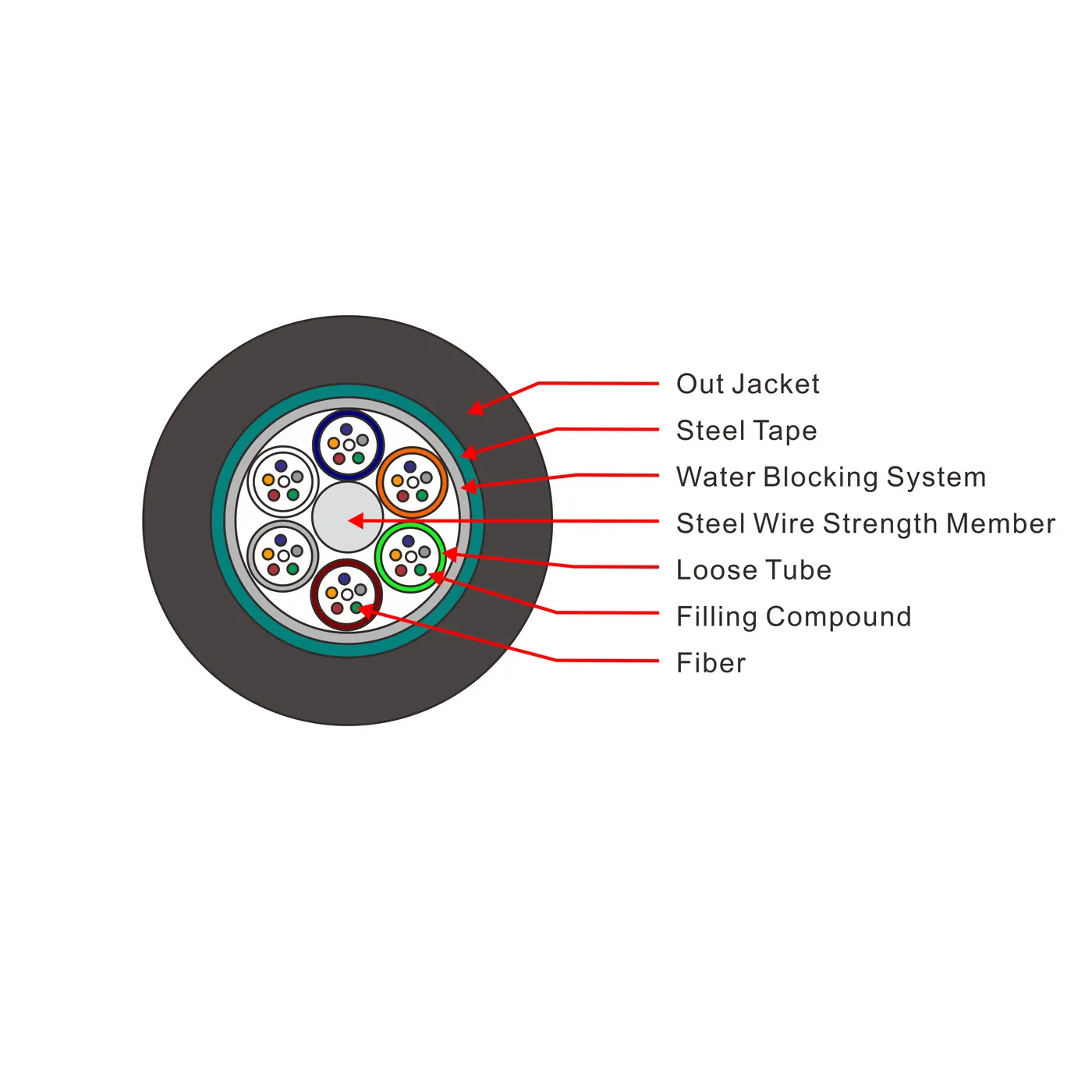
Figure: every labeled layer in this cross-section is a field in block 3 — and every one of them has a cost and a failure mode.
After the tube type, the fields that actually move price and reliability:
Field | What to require | What it prevents |
|---|---|---|
Water blocking | Gel-filled tubes or dry water-swellable tape, stated | Water tracking along the cable after a sheath nick |
Strength member | Central steel wire, or aramid yarn for all-dielectric routes | Conductor-borne surge on aerial plant; stretch on long pulls |
Armor | Corrugated steel tape, single or double jacket, stated | Rodent damage on buried routes, crush in duct bends |
Jacket material | PE or HDPE outdoors; LSZH or PVC indoors, stated per SKU | UV cracking outside; the wrong fire class inside |
Outer diameter | Nominal mm with a tolerance, e.g. 10.5 ± 0.5 mm | Duct fill and bend-radius calculations going wrong on site |
Weight | kg/km, nominal | Drum, transport and pole-loading assumptions |
None of this is exotic; it is simply the difference between a bill of materials and a wish. A supplier who is asked for all six will quote a construction. A supplier asked for "outdoor cable" will quote the cheapest construction that fits the phrase.
Block 4: fire rating is a bid disqualifier
Fire rating is the one field where a wrong answer does not cost money later — it stops the shipment at the loading dock or fails the building inspection. Two regimes dominate, and they are not interchangeable.
In the United States, the requirement comes from the National Electrical Code and the test that proves it comes from two different standards. Plenum-rated cable (OFNP) is tested to NFPA 262 in the Steiner tunnel; riser-rated cable (OFNR) is tested to UL 1666. The distinction that gets written wrong most often is where each applies — and the error that costs more is the belief that the two ratings exclude each other. OFNP is a fire-and-smoke test result, not a statement that the cable is forbidden to leave the building: indoor/outdoor constructions are sold with a plenum listing whose own datasheet names aerial, duct, horizontal, riser and plenum as installation methods for a single part number, with no transition splice needed where the route enters the building. So "indoor/outdoor, plenum-rated" is a real, quotable product rather than a contradiction, and a bidder can price it. What it is, on a route that spends most of its length in a duct or on a pole, is over-specification: you buy the plenum-rated construction for every meter of span, including the kilometers that never enter a building. What genuinely breaks price comparability is one line covering aerial, duct and riser at once — which is what a US municipal RFP we read asks for — because aerial spans need a self-supporting construction (messenger or figure-8) that duct spans do not, and the line never says which riser segments are expected to carry OFNR instead. Write the space, then the rating, and split the line wherever the route changes character: "riser shaft, floors 2–9, OFNR", "return-air ceiling void, OFNP", "aerial span, 60 m, self-supporting, OFNP at the building entry".
In the European Union, the Construction Products Regulation makes reaction-to-fire performance a declared characteristic under EN 50575, expressed as a euroclass — B2ca, Cca, Dca and so on, usually with the s1/d1/a1 suffixes for smoke, burning droplets and acidity. The class thresholds are set in the delegated regulation 2016/364, and the supplier's declaration of performance is the document that makes the claim binding. "LSZH" is a jacket compound, not a fire class: it tells you there is no halogen in the sheath, not how the finished cable behaves in a fire test. If your project is in the EU, ask for the euroclass and the DoP in the bid, not after the award.
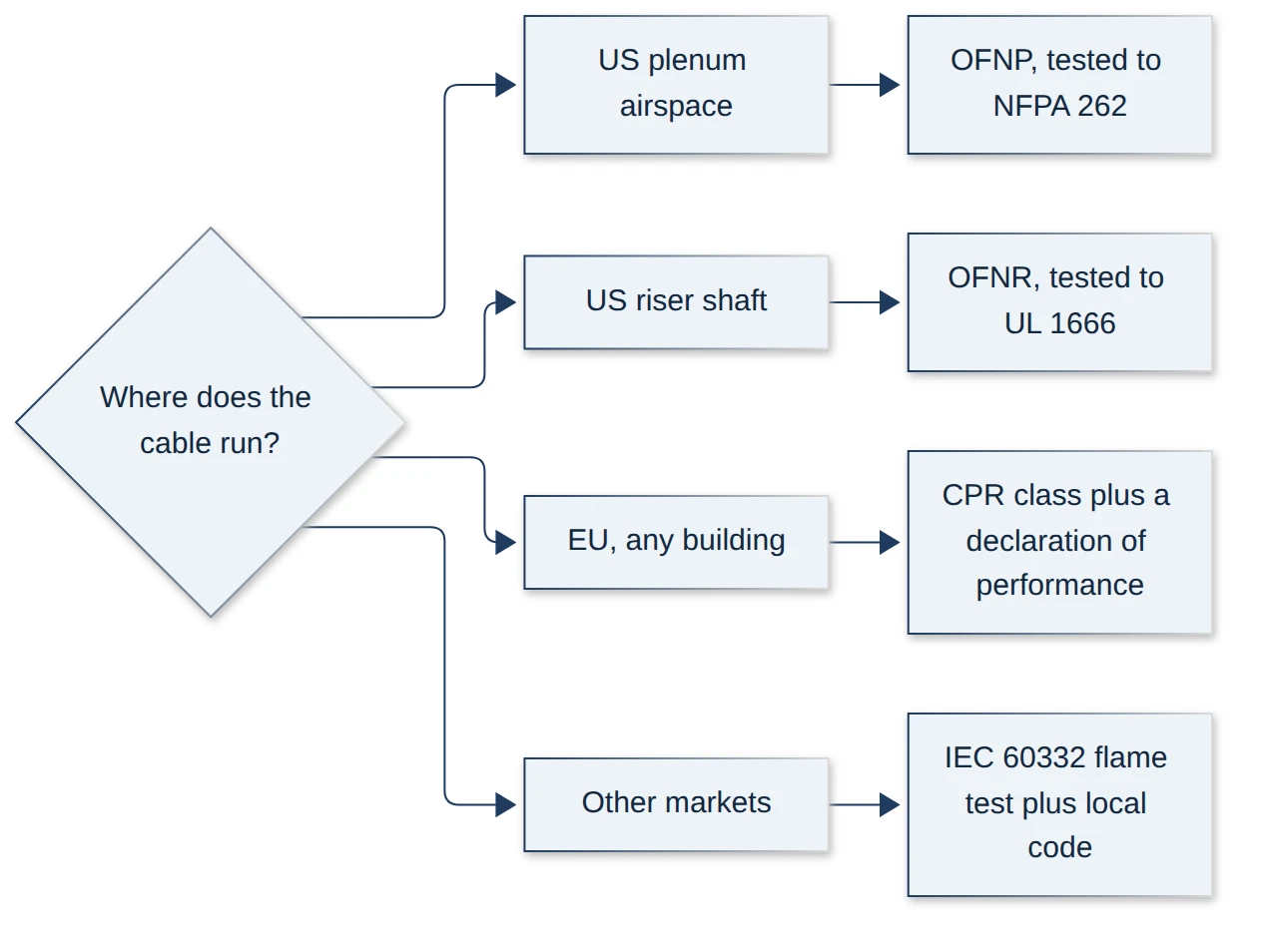
Figure: the fire field is decided by the space the cable runs through, not by the market alone — one construction can carry more than one of these ratings, but the space still sets the floor.
Whichever regime applies, add one sentence that closes the loophole: the listing must be held by the manufacturing site that will produce this order, and the file number must be supplied with the bid. A UL listing, a CPR DoP and an Anatel approval are all tied to a factory and a file, not to a brand — the same supplier's China and Vietnam plants are two separate audit sites. Verify the file number in the UL Product iQ database rather than accepting a certificate PDF. If the cable runs indoors at all, the OFNR versus OFNP comparison is the field guide for which rating belongs in which space.
Block 5: fiber optic cable standards worth citing
"Complies with IEC 60794" is not a specification. IEC 60794 is a series of documents covering optical fiber cables — the generic specification, the test methods, the family specifications — and a statement that a cable "complies with the series" commits the supplier to nothing you can measure. The usable citation has three parts: the document number, the test method inside it, and the pass criterion.
For mechanical performance, IEC 60794-1-2 is the test-method series, and its method identifiers are what belongs in your table. Tensile strength is tested under method E1, crush resistance under E3; cite the method, then the value and the condition:
Field | Cite it like this | Not like this |
|---|---|---|
Tensile strength | E1, 1,500 N short-term / 600 N long-term | "high tensile strength" |
Crush resistance | E3, 1,000 N/100 mm short-term / 300 N/100 mm long-term | "crush resistant" |
Bend radius | 20 × OD dynamic / 15 × OD static | "flexible" |
Temperature range | −40 °C to +70 °C operating and storage | "suitable for outdoor use" |
Attenuation | IEC 60793-1-40 method, ≤ 0.40 dB/km from 1310 to 1625 nm | "low loss" |
Those values are not hypothetical. Four of the five rows are the published figures from our own GYTS datasheet for a standard 24–48 fiber steel-armored loose-tube cable; the attenuation ceiling is the ITU-T G.652.D limit for the grade (0.40 dB/km anywhere from 1310 to 1625 nm, 0.30 dB/km across 1530–1565 nm), not a cable-specific number. That distinction is worth carrying into the RFQ itself: a standard limit is the floor every compliant bidder has to clear, while a datasheet figure is what this particular construction promises, and only the second one tells you what you are paying for. Either way, it is the level of specificity a bidder can price against without adding a risk allowance. For the bend radius in particular, the cable rating and the field installation rule are two different numbers — the RFQ should name which one you are contracting to, or the installer will choose for you.
Two standards are commonly requested on top of the IEC set: ICEA S-87-640 for North American outside-plant cable, and Telcordia GR-20 for carriers that still specify it. Cite them only if your acceptance testing will actually check against them — a standard named in the RFQ but not tested at goods-in is a line item that costs you money and buys nothing. The Fiber Optic Association's standards index is a usable map of which body owns which test if you need to check a claim a bidder makes.
Block 6: acceptance testing and what ships with the drums
Acceptance is where an RFQ either becomes enforceable or stays decorative. The clause that does the work is short: 100% attenuation measurement on every fiber in every drum, plus an OTDR trace for every fiber, delivered as a per-drum test report. "Sample tested" means the supplier tested the drum that was convenient.
Be explicit about the four things a per-drum report has to carry: the drum or reel ID, the lot number, the measured attenuation at each specified wavelength per fiber, and the OTDR trace files keyed to the same reel IDs. Without that keying, a report proves that a cable passed, not that your cable did. The guide to per-shipment test reports goes through the field list and the method-to-standard mapping if you want the longer version.
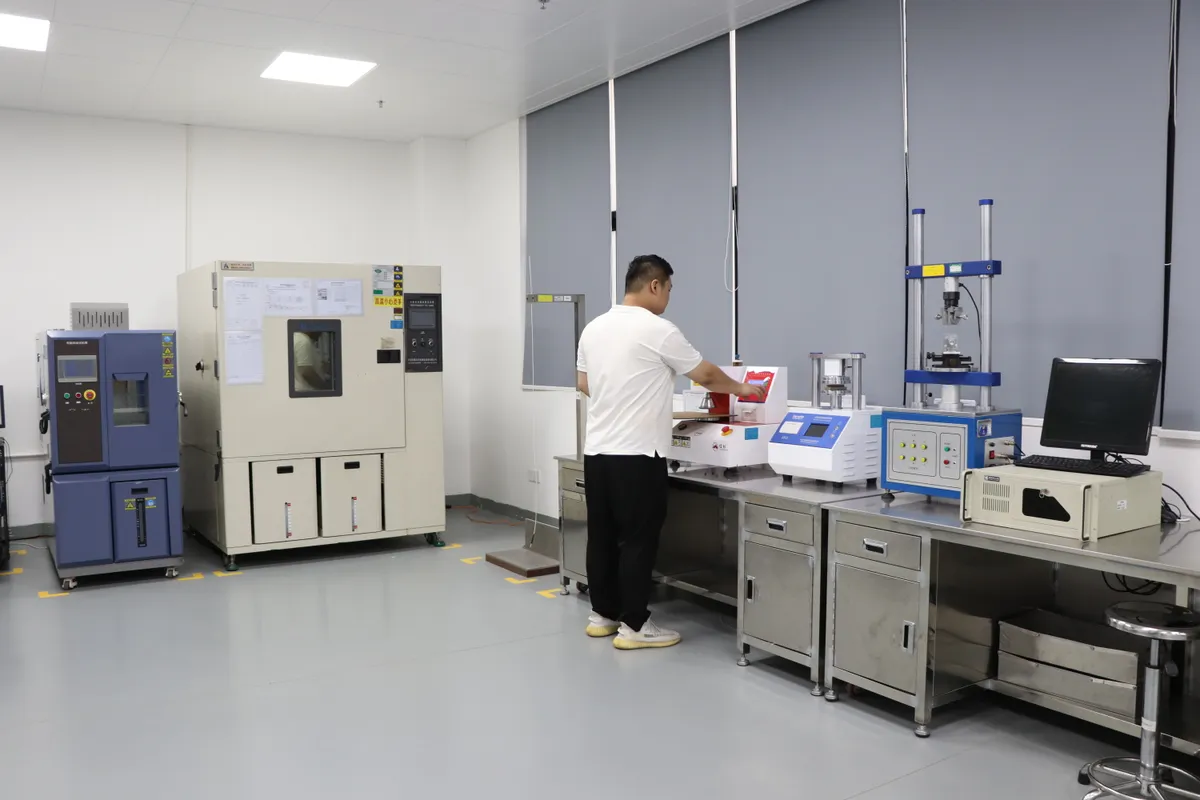
Figure: the tests in block 5 and block 6 happen on equipment like this — which is why the RFQ asks for the data, not the assurance.
For the non-optical characteristics — dimensions, jacket thickness, print legibility, packing — you do not need 100%. You need a stated sampling plan with an acceptance number, which is what lot acceptance sampling is for; the NIST handbook chapter on lot acceptance is a plain-language reference for choosing one, and citing a plan in the RFQ is what turns "shall conform" into a rejectable condition.
Then specify the print legend, because it is the cheapest traceability you will ever buy. A workable legend names the product, the fiber grade, the fiber count and the meter mark — something like OPTICAL CABLE SM(G652D) 24F GYTS 2026 1234M — printed at consistent intervals and legible after two years in a duct. Add reel marking, sealed cable ends against moisture ingress, and drum type. These lines cost a supplier almost nothing to meet and cost you a site argument every time they are missing.
One document belongs in the package even though it only exists after award: the approval drawing. Ask for it before production starts, and ask it to restate the outer diameter, tube count, print legend and drum length, with every value on the fiber optic cable datasheet keyed to the test method that produced it. A datasheet that gives results without methods is a brochure; a datasheet keyed to E1, E3 and IEC 60793-1-40 is a document you can hold a supplier to. The UL file number or the CPR declaration of performance attaches to the same package, not to a separate email after the award.
Block 7: commercial terms that move the landed cost
The last block is the one that most RFQs omit entirely, and it is the single largest source of unusable price comparison. Four clauses carry most of the weight.
Incoterms and a named place. "FOB" without a port, or "CIF" without a destination, is not a delivery term. FOB Shenzhen and DDP Rotterdam are different products at different prices, and the spread between them is routinely wider than the gap between two bidders' unit prices — which is how a "cheapest" quote becomes the most expensive order.
Lead time with its starting point. Thirty days from what: purchase order, deposit receipt, or drawing approval? Those three starting points are two to four weeks apart in practice, and the difference lands on your installation crew. Ask for the release schedule by drum, and for the lead time on a repeat order separately from the first order.
Price validity and the basis of the unit price. Fiber prices move, and a quote with no validity date is either padded or unsafe. Ask for the price per meter, the currency, the validity window, and whether test reports and drum returns are included. The mechanics of what drives the number are covered in the breakdown of fiber optic cable pricing.
MOQ stated per SKU, not per order. A 20 km order split across four constructions can still fail a per-SKU minimum, and a supplier who only quotes the total is telling you the minimum will be discovered at the contract stage. How MOQ is actually calculated explains where the minimum sits in the production run.
Add payment terms and warranty length, and you have a comparable commercial envelope.
One caution before you pin everything down. Every field you fix also narrows the bidder pool and can close off the standard product a supplier would otherwise quote from stock: demanding ±0.1 mm on a jacket diameter, or 100% per-fiber OTDR on a 10 km order, changes the cost structure — quietly, and in your direction. Pin what you will actually enforce at goods-in, default the rest explicitly, and say which is which.
The one-page fiber optic cable specification sheet (copy and edit)
Paste this into your tender as an annex, fill every field, and delete nothing — if a field genuinely does not apply, write "not applicable" rather than leaving it blank. A blank field is an invitation.
1 ROUTE AND QUANTITY Installation method: aerial / duct / direct buried / indoor riser / plenum Route conditions: length, depth or pole spacing, rodent risk, water table Strand count: ___ (spare policy: ___) Quantity: ___ m, delivered as drums of ___ m (schedule attached) Delivery: drum 1-__ by week __, balance against site progress2 OPTICAL Fiber grade: G.652.D / G.657.A1 / G.657.A2 (state one) Attenuation ceiling: <=0.40 dB/km @1310-1625 nm, <=0.30 dB/km @1530-1565 nm (G.652.D limit; write a tighter figure here if you test to one) Connectors, if assemblies: type ___ polish UPC/APC Insertion loss / return loss limit per mated pair: ___ / ___3 CONSTRUCTION Tube type: loose tube / tight buffer, ___ tubes of ___ fibers Water blocking: gel / dry swellable Strength member: central steel wire / aramid (all-dielectric?) Armor: none / corrugated steel tape / double jacket Jacket: PE / HDPE / LSZH / PVC; outer diameter ___ +/- ___ mm Nominal weight: ___ kg/km4 FIRE RATING Space served: plenum void / riser shaft / indoor general / outdoor only US: OFNP (NFPA 262) / OFNR (UL 1666); EU: euroclass ___ + DoP Listing held by the producing factory, file number supplied with bid5 STANDARDS Tensile: IEC 60794-1-2 E1, ___ N short-term / ___ N long-term Crush: E3, ___ N/100 mm short-term / ___ N/100 mm long-term Bend radius: ___ x OD dynamic / ___ x OD static Temperature: ___ deg C to ___ deg C operating Attenuation method: IEC 60793-1-40; other standards: ___6 ACCEPTANCE 100% attenuation test plus OTDR trace, per fiber, per drum Per-drum report: reel ID, lot number, measured values, trace files Sampling plan for dimensional and visual checks: ___ Print legend: ___; reel marking; ends sealed; drum type ___7 COMMERCIAL Incoterms: ___ named place ___ Unit price per meter, currency ___, validity ___ days Lead time from ___ ; release schedule per drum MOQ per SKU: ___ ; payment terms: ___ ; warranty: ___ years
Six phrases that quietly make a quote non-comparable
If you inherit an RFQ you did not write, these six phrases are where to look first. Each one looks like a specification and behaves like a blank.
Phrase in the RFQ | Why it fails | Write this instead |
|---|---|---|
"Single-mode fiber" | Names a mode, not a grade or a loss budget | "G.652.D, ≤ 0.40 dB/km from 1310 to 1625 nm" |
"LSZH jacket" | Names a compound, not a fire class | "CPR Cca-s1,d1,a1 with DoP" or "OFNR to UL 1666" |
"Complies with IEC 60794" | Names a series, not a test | "Tensile per IEC 60794-1-2 E1, 1,500 N short-term" |
"Standard export packing" | Drum type, length and marking all undefined | "Wooden drum, 2,000 m ± 2%, reel marked with length and lot" |
"Delivery within 30 days" | No starting event, no phasing | "30 days from drawing approval and deposit; drum 1–2 in 15 days" |
"Best price" or "competitive" | No basis, no validity, no inclusions | "Unit price FOB Shenzhen per meter, valid 30 days, test reports included" |
The pattern behind all six is the same: an adjective where a number belongs. Adjectives survive translation, negotiation and re-quoting unchanged, which is exactly why they cannot be priced.
Specification first, price second. If you can only fix one thing in an RFQ this quarter, fix strand count and fire class — those two fields decide the construction and the compliance path, and almost every downstream surprise traces back to one of them. If you would rather check a candidate construction against your route before you write the sheet, our cable selector walks the same seven blocks, and our engineering team will review a draft specification against the factories that would actually produce it.