

Sourcing
MOQ in Fiber: Why Rigid Minimums Break Rollouts
MOQ in fiber procurement is an allocation rule, not a number. It decides how much of which specification you have to buy at each point in a project, and in a multi-phase rollout that rule is usually written for the wrong phase. A supplier who quotes a minimum order quantity per order is implicitly assuming you buy everything at once, from one frozen specification list, in one shipment. Almost no fiber project works that way.
If you searched for MOQ in fiber and landed here expecting a generic "what is a minimum order quantity" explainer: the short version is that a fiber optic cable MOQ is set by manufacturing setup costs, not by retail merchandising, and the numbers cannot be compared across suppliers unless you know what unit they are counted in. The rest of this guide assumes you already have a quotation in hand and want to know whether its MOQ is a wall or a negotiating position.
Why MOQ in fiber is an allocation rule, not a number
Consider three quotations that all read "MOQ: 1,000" — illustrative figures, not an industry norm.
- Counted per order, that means every purchase order must contain 1,000 units of something, and a rollout that needs 180 of one length, 240 of another and 90 of a third cannot be placed at all.
- Counted per SKU, it means 1,000 of each distinct specification. For a project with forty cable and assembly variants, that is forty minimums — the number just became forty times larger.
- Counted per program, with releases scheduled against a committed project quantity, it means the supplier's setup cost is covered by your total commitment, and each call-off can be whatever the site actually needs this month.
The number never changed. The obligation did. This is why two quotes that look identical can differ by an order of magnitude in working capital, and why "we can be flexible on MOQ" means nothing until you ask flexible relative to what.
For the parts of supplier evaluation that sit around this question — audit, capability, specification control — the fiber optic cable manufacturer sourcing guide covers the wider decision. This page stays on the quantity structure.
What actually drives a fiber cable MOQ
A minimum order quantity on a fiber product is a stack of five separate minimums, and the supplier quotes you the largest one. Understanding which one is binding tells you what is negotiable.
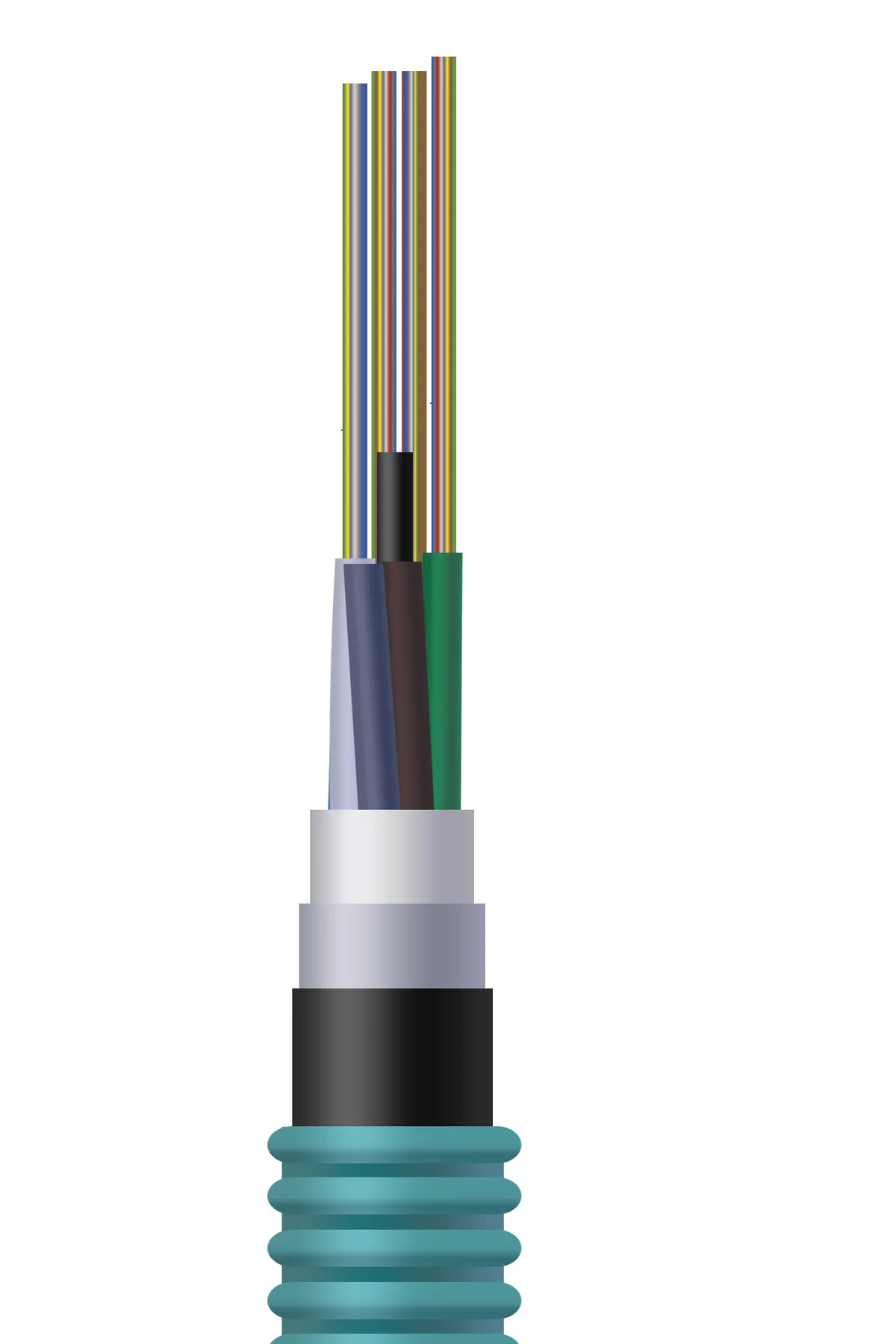
1. Material purchase lots. A cable is a composite: fiber, loose tubes or tight buffers, water-blocking tape or gel, strength members, armor, and jacket compound. Each of those is bought by the supplier in a lot sized by their own upstream supplier. A short production run still consumes a whole lot of at least one input, and that unused remainder is either carried as inventory or priced into your order. The more material layers a construction has, the more lots a short run has to absorb — a cutaway of a typical outdoor cable makes the count obvious before anyone quotes you.
2. Extrusion run length. Jacketing is a continuous process. The line has to reach stable diameter and wall thickness, and the material purged during setup and at the start of the run is scrap that somebody pays for. Below a certain run length, that scrap ratio stops being a rounding error. This is also why the drum length is a production decision rather than a packaging one — see the cable manufacturing process for where take-up length gets fixed.
3. Assembly setup and first-article approval. A pre-terminated assembly resets its setup with every new combination of connector, fiber, length and polarity: fixture setup, polishing or cleave parameters, curing, end-face inspection, and often a first-article sign-off with test data. Those costs are per configuration, not per unit, which is exactly why assembly MOQs are usually quoted per configuration.
4. Tooling and mold amortization. Anything molded — connector housings, terminal box bodies, dust caps, custom clips — requires a mold. If the mold is new, its cost is recovered across the run, and the run has to be large enough for that recovery to be sane. If the mold already exists and belongs to the supplier, the amortization is already sunk and the MOQ argument weakens considerably.
5. Print, label and packaging minimums. Printed cartons, spool labels, instruction sheets and branded tape all have their own print runs. A jacket-print change on the cable itself can also force a new extrusion setup. These minimums are small in money and large in friction: they are the reason a 200-unit "pilot" order sometimes comes back with a packaging surcharge nobody mentioned.
Why rigid minimums break a multi-phase rollout
Phases do not have the same shape, and that is the whole problem.
A first phase is typically a small geographic area or a pilot segment: many specifications, low quantity per specification. Six cable constructions, a dozen assembly lengths, a few closure types, a couple of splitter configurations. The buyer's goal is coverage, not volume — validate the design, the crews and the acceptance process.
A second phase is the opposite: fewer specifications, much higher quantity, because the winning configuration has been proven and is being scaled.
A third phase is operational: fill-in, restoration and moves, in small unpredictable quantities, for years.
A per-order MOQ is priced against the economics of the second phase and then applied to all three. Three specific failures follow.
The pilot cannot be placed. Every line item in phase one is below the minimum, so either the buyer aggregates everything into one oversized order or the supplier declines to quote. If the buyer aggregates, they commit capital to specifications that phase one has not finished validating — and if phase one changes the fire rating, the fiber grade or the connector, that inventory is stranded.
Phase two over-buys to reach a price break. Chasing a lower unit price means ordering past the phase's actual requirement, then carrying the excess. The saving is real on paper; the carrying cost, storage and obsolescence risk are not on that paper.
Phase three has no home. Fill-in quantities are the least predictable demand in any network build, and they are also the furthest below any per-order minimum. Programs that solved phases one and two with a single large buy discover in year two that they cannot buy 60 connectors at all.
There is a fourth, quieter failure: a specification change resets the MOQ. If the buyer moves from one fiber grade to another, adds a fire-rated jacket variant for one market, or changes a connector polish, that is a new SKU in the supplier's system, with its own setup and its own minimum. Programs that negotiated hard on MOQ for the original specification often find the concession does not transfer.
Where MOQ hides: cables, assemblies, and custom work
Cable. For bulk cable, the drum is the unit. Drum length is fixed by the factory's take-up and handling, and ordering a shorter length usually means paying for the full drum and receiving less — the remainder is scrap or a remnant somebody has to store. Buyers who compare cable prices per meter without checking the drum length and the cut-charge schedule are comparing numbers that will not be honored. Fiber specification itself constrains what is standard stock: a bend-insensitive grade such as those defined in ITU-T G.657 behaves differently from standard single-mode in drop applications, and the grade you choose determines whether your quantity sits in a stocked SKU or a made-to-order one.
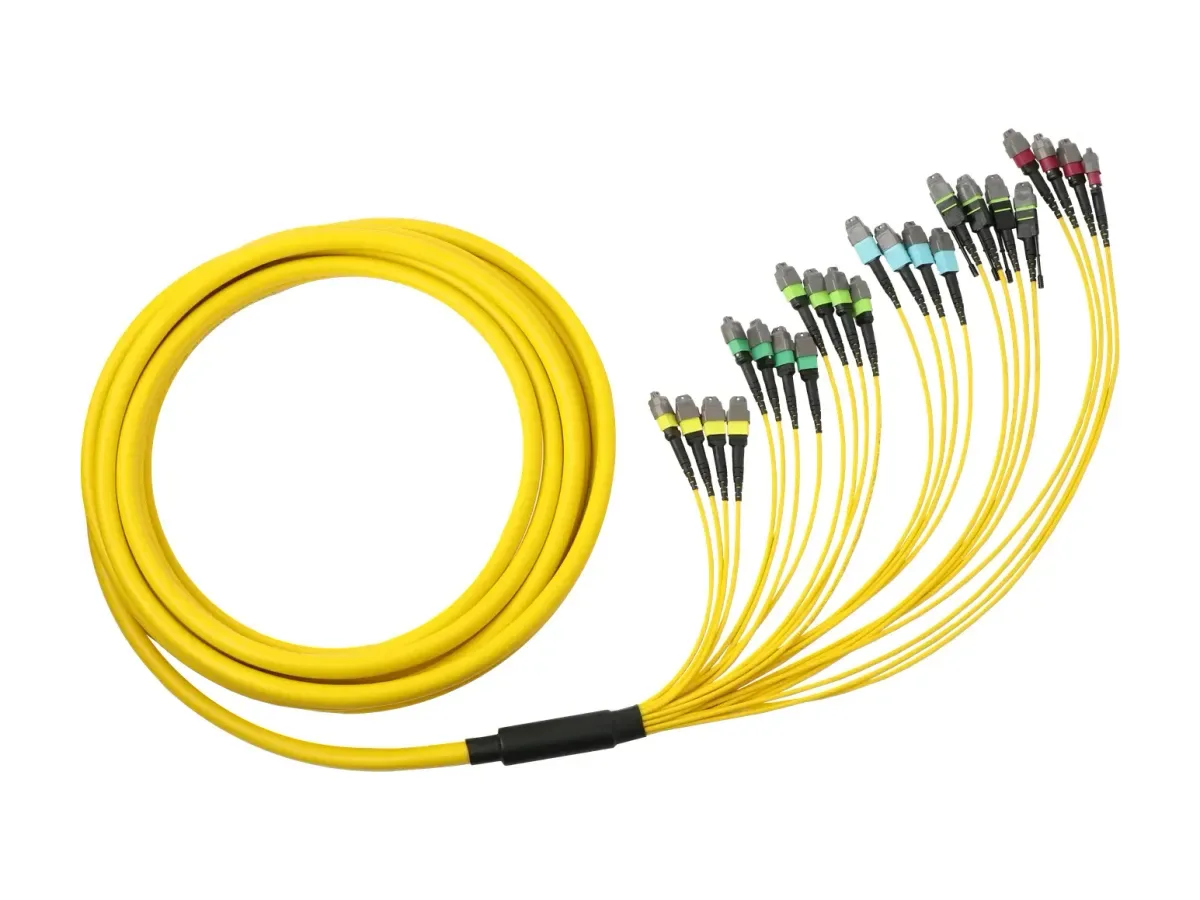
Assemblies. A pre-terminated assembly MOQ is per configuration, and configurations multiply fast: length × connector type × polish × polarity × jacket rating. A data-center phase that needs 38 distinct trunk lengths has 38 configurations even if the total end count is large.
Custom and OEM/ODM work. Here the minimums stack: a new mold plus a print run plus an assembly setup plus a material lot. The economics of OEM versus ODM in fiber optics matter directly, because who owns the tooling determines who absorbs the amortization — and therefore whose minimum it is.
Certification variants. The same cable construction sold into different markets is not one SKU. EU fire classification under the Construction Products Regulation and North American plenum testing under NFPA 262 are separate approval paths, and each approved variant usually needs its own production run. A multi-country rollout can therefore multiply SKU count, and total minimum commitment, without changing a single meter of cable design.
Where the minimum is counted, by product family:
Product family | What the minimum is usually counted against | What resets it |
|---|---|---|
Bulk cable | Drum length (a fixed take-up length per drum, with cut charges for shorter runs) | Fiber grade, jacket material, fire rating, print on the jacket |
Pre-terminated assemblies | Each configuration: length × connector × polish × polarity | Any change to one of those four |
Terminal boxes and closures | The molded body and the port configuration | New mold, new port count, new material |
Custom OEM packaging | The print run for cartons, labels and inserts | Any artwork or material change |
The price-tier trap: how MOQ and unit price lock each other
Quantity breaks and minimums are two faces of the same table, and reading only one of them is how buyers get surprised. A typical quotation has three or four quantity tiers; the MOQ is simply the lowest tier boundary. That structure creates two traps.
The saving that costs more than it saves. Moving up a tier lowers the unit price but raises the quantity. If the extra units are consumed within the project window, that is a straight gain. If they sit for a year, the carrying cost — storage, handling, insurance, capital, and the risk that a design change obsoletes them — can exceed the discount. The comparison worth making is total cost of the phase, not unit price of the item. The cost structure behind fiber optic cable pricing explains which components actually move between tiers.
The low-MOQ quote with a setup fee. Some suppliers will accept almost any quantity and recover the difference as a separate setup, tooling, minimum-run or small-order charge. That is not dishonest, but it is not comparable to a quote that folds the same cost into the unit price. Ask for both numbers on the same page: unit price at each tier, plus every fixed charge per order and per configuration.
The practical rule: negotiate the tier table and the MOQ together, never separately. A supplier who moves the MOQ without moving the tiers has usually just moved the cost somewhere less visible.
Three MOQ structures worth comparing
Structure | How the minimum is counted | Works when | Breaks when |
|---|---|---|---|
Per-order MOQ | Every purchase order must meet the minimum | One or two repeatable specifications, steady consumption | Multi-SKU phases, pilots, fill-in demand |
Per-SKU-family MOQ | Related variants aggregate into one minimum (same fiber grade and jacket family; same connector and polish family) | Many lengths or colors of essentially one product | Variants genuinely differ in tooling or approval |
Program MOQ with call-off | Minimum applies to a committed program quantity over a defined window; individual releases follow a schedule | Multi-phase rollouts with a known total and uncertain timing | Forecast is speculative or the program may be cancelled |
Under the third structure, commonly written as a blanket order with scheduled call-offs, the buyer commits to a total quantity and a validity window, and then releases against it. The supplier's setup cost is covered by the commitment; the buyer's exposure is limited to the commitment rather than to a single large delivery. Variants include a stocking agreement (the supplier holds finished or semi-finished goods and releases on request) and consignment (stock sits at the buyer's site and is invoiced on consumption). Both shift the inventory burden, and both cost something — usually a slightly higher unit price or a minimum consumption commitment.
The same three structures, read against the three phases from the previous section:
Structure | Phase 1: many SKUs, low volume | Phase 2: few SKUs, high volume | Phase 3: fill-in and restoration |
|---|---|---|---|
Per-order MOQ | Blocked — almost every line is below the minimum | Workable | Blocked — the smallest releases sit furthest below the minimum |
Per-SKU-family MOQ | Workable — variants aggregate to one family minimum | Workable | Blocked — one variant rarely covers a family minimum on its own |
Program MOQ with call-off | Workable — the program commitment covers setup | Best fit | Workable only if a minimum release quantity is written into the clause |
The fields to demand in every MOQ quote
A single number is not a quotation. Ask for these twelve fields explicitly, in writing, before comparing suppliers — copy the list straight into your RFQ:
- The unit. Per meter, per drum, per piece, per connector end, per assembly. Ambiguity here invalidates every other number.
- The level. Per order, per SKU, per configuration, per family, or per program.
- Mixed-specification allowance. Whether different variants can combine to reach one minimum, and at what ratio.
- Sample and pilot carve-out. Whether a sample or pilot order is exempt from the production MOQ, and for how long that exemption applies.
- Quantity tiers and their boundaries. The full table, not just the tier you expect to land in.
- All fixed charges. Setup, tooling, first-article, small-order, packaging-plate and documentation fees, each stated separately.
- Price validity window. How long the quoted price and MOQ hold, and what resets them.
- Restatement rule. Whether a specification change re-quotes the MOQ, and how much change triggers it.
- Lead time per tier. Whether the lead time quoted applies to the minimum quantity, the tier you are in, or the program total.
- Packaging and labeling minimums. Carton print runs, label batches, spool marking.
- Certification variants. Which approved variants share a production run and which do not.
- Minimum release quantity. The smallest call-off the supplier will accept under a program structure — this is the number that decides whether phase three is buyable.
If a supplier cannot answer 1, 2 and 12, the MOQ is not yet a term; it is a rumour.
How to write an MOQ clause that survives phase changes
The clause is where the structure becomes enforceable. Six elements do most of the work:
- Call-off schedule, with a floor and a ceiling per release. Define the smallest and largest release, and the notice period. A schedule without a floor invites the supplier to refuse small releases; one without a ceiling invites capacity surprises.
- MOQ true-up at phase gates. State that the committed quantity is reviewed at defined gates, and what happens if actual volume falls short — typically a price adjustment on the shortfall, not a penalty on the whole order.
- Specification-change rule. Say what counts as a new SKU (fiber grade, jacket rating, connector, polish, polarity) and that a change re-quotes only the affected configuration, not the whole program.
- Price validity and indexation. Fix the price for a stated window and name what may adjust it afterwards — raw material, freight, currency. A price that can be reopened at will makes the MOQ commitment one-sided.
- Excess and obsolescence handling. Agree in advance who owns committed-but-undelivered stock if the program is descoped, and whether it can be redirected to another specification.
- Acceptance per release. Tie inspection and test documentation to each call-off rather than the program, so a phase can be accepted independently. Per-shipment test reports are the practical mechanism, and the supplier's quality system is what makes the records credible — the telecom-specific TL 9000 standard exists precisely because operator buyers needed measurable supplier performance, not just a certificate on a wall.
Red flags in a supplier's MOQ answer
- A number with no unit. "Our MOQ is 500" tells you nothing until you know whether that is meters, drums, pieces or ends.
- MOQ quoted, tiers withheld. A supplier who will not publish the tier table is reserving the right to reprice.
- Sample orders subject to production MOQ. Fine for a stock SKU, a warning sign for anything custom.
- Mixed-spec aggregation refused without explanation. Sometimes legitimate — genuinely different tooling — but "we just don't" usually means the sales system cannot handle it, which will resurface at every change.
- Every change triggers a full re-quote. A specification change should re-quote the affected configuration. If it re-opens the whole program, the MOQ commitment was never real.
- MOQ disconnected from capacity. A low minimum with a lead time that quietly assumes a much larger run means the MOQ was a sales promise the factory has not agreed to.
A phased-rollout procurement sequence
- Profile the SKU set before talking to anyone. Count configurations, not units: cable constructions, assembly lengths, connector combinations, closure types. This number, not the budget, determines which MOQ structure is even possible.
- Group into families. Same fiber grade, same jacket family, same connector family. Families are what a per-family MOQ aggregates across, and they are your strongest negotiating unit.
- Request tier tables and the twelve fields above from two or three shortlisted suppliers, on the same specification basis so the numbers are comparable.
- Negotiate the program, not the order. Offer a committed program quantity with a call-off schedule and ask what MOQ and tiers that commitment buys. This is where a supplier's real flexibility shows.
- Write the clause, then verify the factory. A commercial structure is only as good as the plant behind it — auditing the factory is how you confirm that small releases can actually be scheduled without being bumped by larger customers.
DYS Fiber Optic runs both order shapes through one plant system: three factories (Huizhou, Mianyang and Hanoi), cable output of roughly 800 km per day, plus 50,000 MPO/MTP ends and 5,000 FTTX waterproof assembly ends per day. That mix is what makes a small multi-specification pilot and a large single-specification release schedulable side by side. Our quality system is ISO 9001-certified by SGS and TL 9000-certified, with testing before every shipment, and samples typically take 7–15 days, including mixed-specification sample shipments. Program-level MOQ and call-off terms are quoted per project, so ask for them against your phase list rather than relying on a page to promise them.
FAQ
What is a typical MOQ for fiber optic cable?
There is no single industry figure, and any supplier who offers one without asking about your construction is quoting a guess. Cable minimums are driven by drum length and extrusion run economics; assembly minimums are driven by configuration count; custom parts are driven by tooling. What is comparable across suppliers is the structure — unit, level, tiers and fixed charges — not the headline number.
What does an MOQ of 50 actually mean?
On its own, nothing. Fifty meters, fifty drums, fifty pieces, fifty connector ends and fifty assemblies are wildly different commitments, and suppliers quote all five forms. A minimum without a unit and a level (per order, per SKU, per configuration, per program) cannot be compared with any other quote, and it cannot be checked against your phase quantities. Ask for the unit and the level first; the number only becomes a term once both are attached to it.
Is a fiber MOQ negotiable?
The number is often negotiable; the cost behind it is not. Setup, scrap, tooling and print runs exist regardless of what the contract says, so a concession on MOQ usually reappears as a setup charge, a higher unit price at the low tier, or a longer lead time. The productive negotiation is to change the allocation level, from per order to per family or per program, so the supplier's setup cost is still covered while your releases stay small. That is what flexible MOQ should mean in practice: a different allocation level, not a smaller number.
Does customization always raise the MOQ?
It raises the number of minimums, which is the part buyers underestimate. A custom jacket color, a printed carton and a new molded part are three separate minimums stacked on one product, and a new connector or fire rating adds another configuration. Consolidating custom requirements into fewer changes — one print run covering several SKUs, one mold serving a product family — usually reduces total commitment more than arguing about any single minimum.
What if the later phases are not confirmed yet?
Then do not commit to a program quantity you cannot defend. Ask instead for a per-family MOQ for phase one, with a written price-and-MOQ restatement rule for the point at which phase two is confirmed. That keeps phase one buyable without pretending to a forecast you do not have — and it puts the re-quote mechanics on paper while both sides still have an incentive to agree them.
The one-line version
Rigid minimums do not break rollouts because they are large. They break rollouts because they are counted against the wrong thing — a single order, when the project is a sequence of differently shaped phases. Count the minimum against a program, aggregate it across a family, and schedule releases inside it, and the same factory economics that produced the number stop standing between you and phase one.
If you have a phase-one SKU list and a phase-two estimate, send both — our team quotes MOQ against a phased SKU list. Quoting against a real program structure is a different conversation from quoting against a single order, and it is the one worth having before the pilot order, not after.