
Fiber Basics
How Far Can Fiber Optic Cable Run? Distance Limits
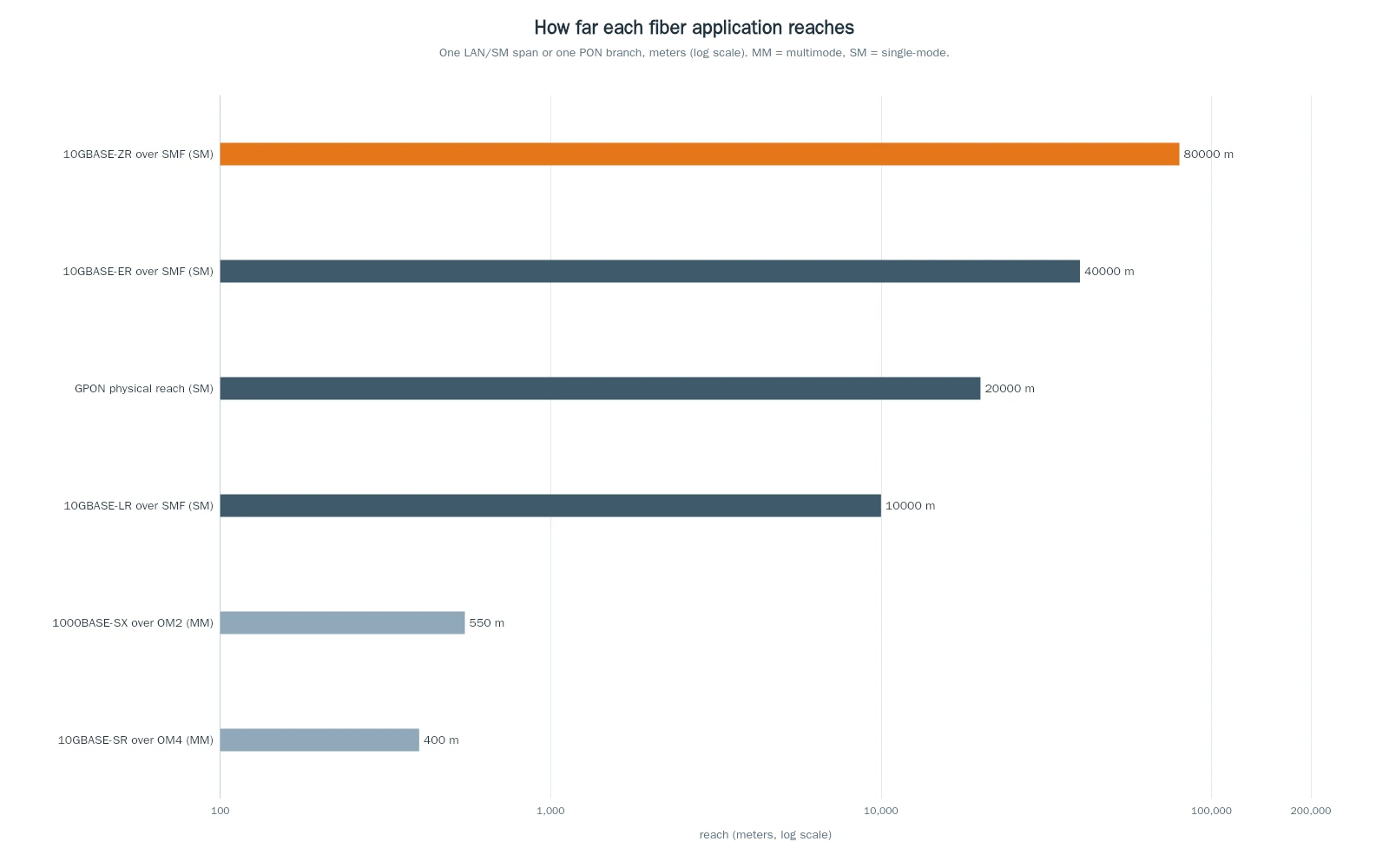
How far can fiber optic cable run? A single-mode run carries 10 Gbps for 10 km on standard LR optics and up to 40 km on ER optics; a multimode run tops out at 400 m on OM4 at the same speed. The glass itself has no fixed length limit — the transceiver at each end, the fiber grade and the optical loss budget set the number.
That is the whole answer in one paragraph. It is also why the same question returns numbers that differ by orders of magnitude: people are quoting different layers of the stack, and all of them are right. A 550-meter multimode patch and a 6,000-kilometer transatlantic system start from the same base material — silica glass — and the difference in reach comes from the fiber design and from what is attached to the ends.
The rest of this guide separates the layers, gives you the published distances for each fiber grade and data rate, and shows what the number should change on a purchase order.
One caveat before the tables: what follows is a summary of published specifications of the applications, fibers and modules named, not a design for your route. A real link still has to be budgeted for its own splices, connectors and temperature range — the optics vendor's datasheet, and your network design, have the final say.
How far can fiber optic cable run? The short answer
Fiber distance limits come in three layers. Keeping them apart is what stops the confusion in the first place.
- The medium. Single-mode glass loses so little light that the fiber itself imposes no practical length limit. Corning's SMF-28 Ultra product information sheet, a standard ITU-T G.652.D carrier fiber, specifies maximum attenuation of ≤0.32 dB/km at 1310 nm and ≤0.18 dB/km at 1550 nm. At 0.18 dB/km, 100 km of fiber costs 18 dB of optical power — a figure optical engineers design around every day, not a wall.
- The application. Every Ethernet application over fiber is published with a reach, and the reach belongs to the application, not the cable: 400 m for 10GBASE-SR over OM4, 10 km for 10GBASE-LR, up to 40 km for 10GBASE-ER. Passive optical networks use a different pair of numbers — 20 km physical reach, 60 km logical.
- The link budget. Each published reach assumes a loss allowance. Spend that allowance on splices, connector pairs and tight bends, and a link that is "rated for 400 m" can fail at 250 m.
Three conversions worth carrying in your head: 400 m is about 1,312 ft; 10 km is 6.2 miles; 40 km is just under 25 miles.
The cable is rarely the limit — the optics are
Search for a fiber optic cable length limit and you will find product pages claiming 990 ft, 300 m or even 100 km for the same spool of glass. None of them is quoting a property of the cable. The distance a link actually reaches is decided by three things, and the cable only contributes to the second.
The transceiver's reach rating comes first. Ethernet optics are named for their reach: SR (short reach), LR (long reach, 10 km), ER (extended reach), ZR. The number lives in the module datasheet. Cisco's 10GBASE SFP+ data sheet lists its 10GBASE-LR module at 10 kilometers over standard G.652 single-mode fiber, its 10GBASE-ER module at up to 40 kilometers, and its 10GBASE-ZR module at about 80 kilometers — the last one built to Cisco's own specification rather than to the 10 Gigabit Ethernet standard, which is why ZR reach varies by vendor. Swap the module and the same pair of fibers changes reach by a factor of eight.
The fiber grade comes second. Multimode grades are bought for cost and for the electronics that drive them, and their reach is capped by modal bandwidth — a property that punishes distance in a way single-mode fiber does not have to fight. That is the whole subject of the next two sections.
The loss budget comes third, and it is the one that is usually missed. Every connector pair, splice and bend removes light. The published reach already assumes a specific allowance for those losses, so a route with an unusual number of splices has less distance available than the table suggests. The allowances are not generous, and they shrink as the data rate rises:
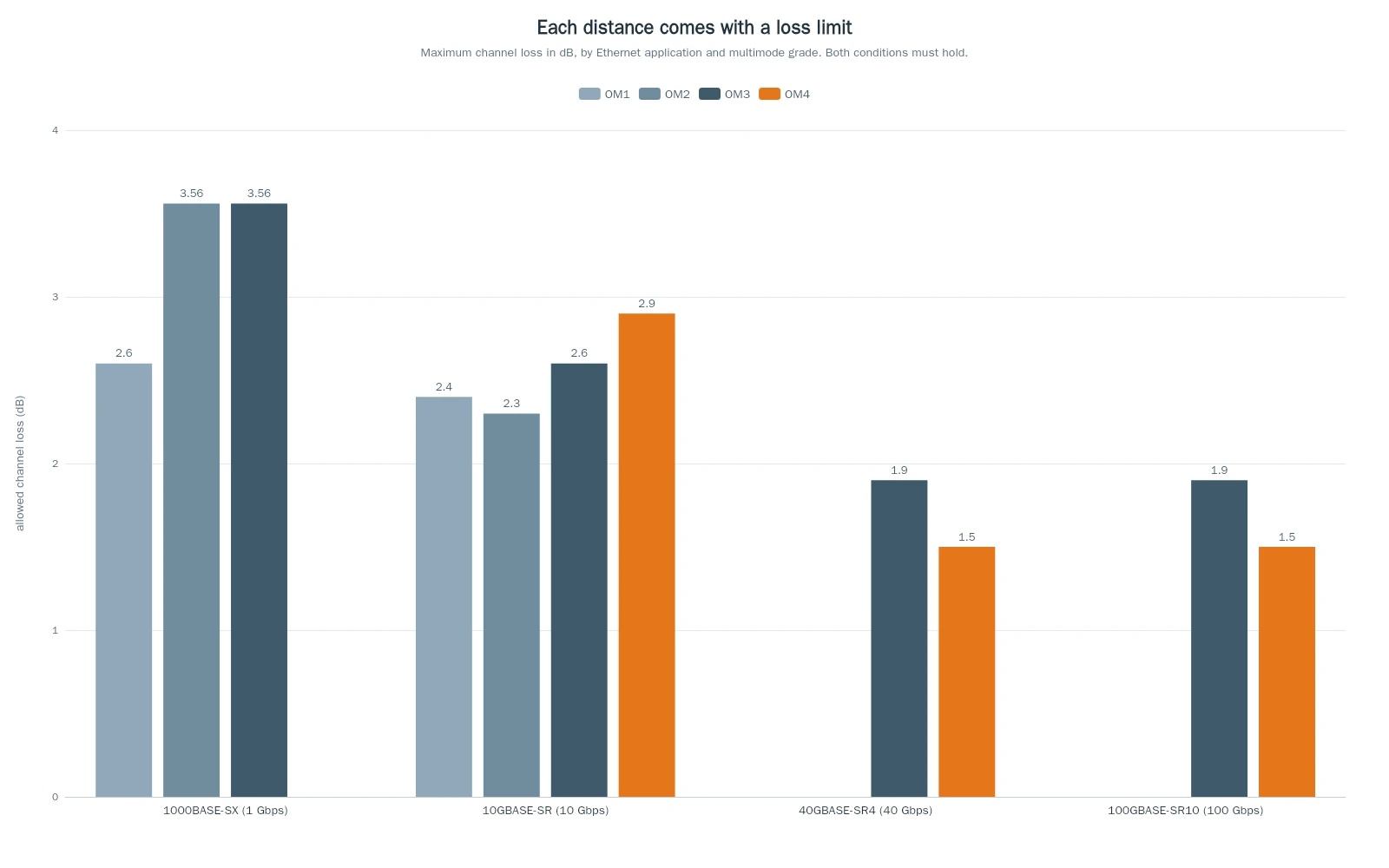
The values above are the channel loss limits published alongside the distance table in the Fluke Networks reference cited below; note how the 100 Gbps applications allow the least loss of all. If you want the arithmetic in full, our guide to building a loss budget for high-speed fiber links walks through it end to end.
There is a second reason the cable is not the limit: the limits are two-sided. The same Cisco data sheet notes a minimum cabling distance of 2 m for its SR, LRM, LR and ER modules, per IEEE 802.3ae, and it specifies inline optical attenuators for short runs — 15 dB below 5 km for one module, 10 dB between 5 km and 25 km. The stated reason is blunt: at short distances the receiver can be overloaded and damaged. A run that is too short is a real engineering problem, not a lucky one.
Links longer than 30 km are considered engineered links as per IEEE 802.3ae, as Cisco's data sheet puts it — a category that assumes the link was designed against its own fiber and loss rather than assembled from standard parts.
Multimode fiber distance limits, by grade and data rate
Multimode fiber carries several light paths at once. Its core is much wider than single-mode's — 50 to 62.5 µm against 9 µm — which makes it cheaper to connectorize and cheaper to drive, and which also sets the ceiling on distance: the paths arrive at slightly different times, and the further the light travels, the more the signal spreads out until a receiver can no longer tell the levels apart. That effect, modal dispersion, is the reason multimode distance limits exist at all, and it is why higher data rates shorten the reach instead of lengthening it.
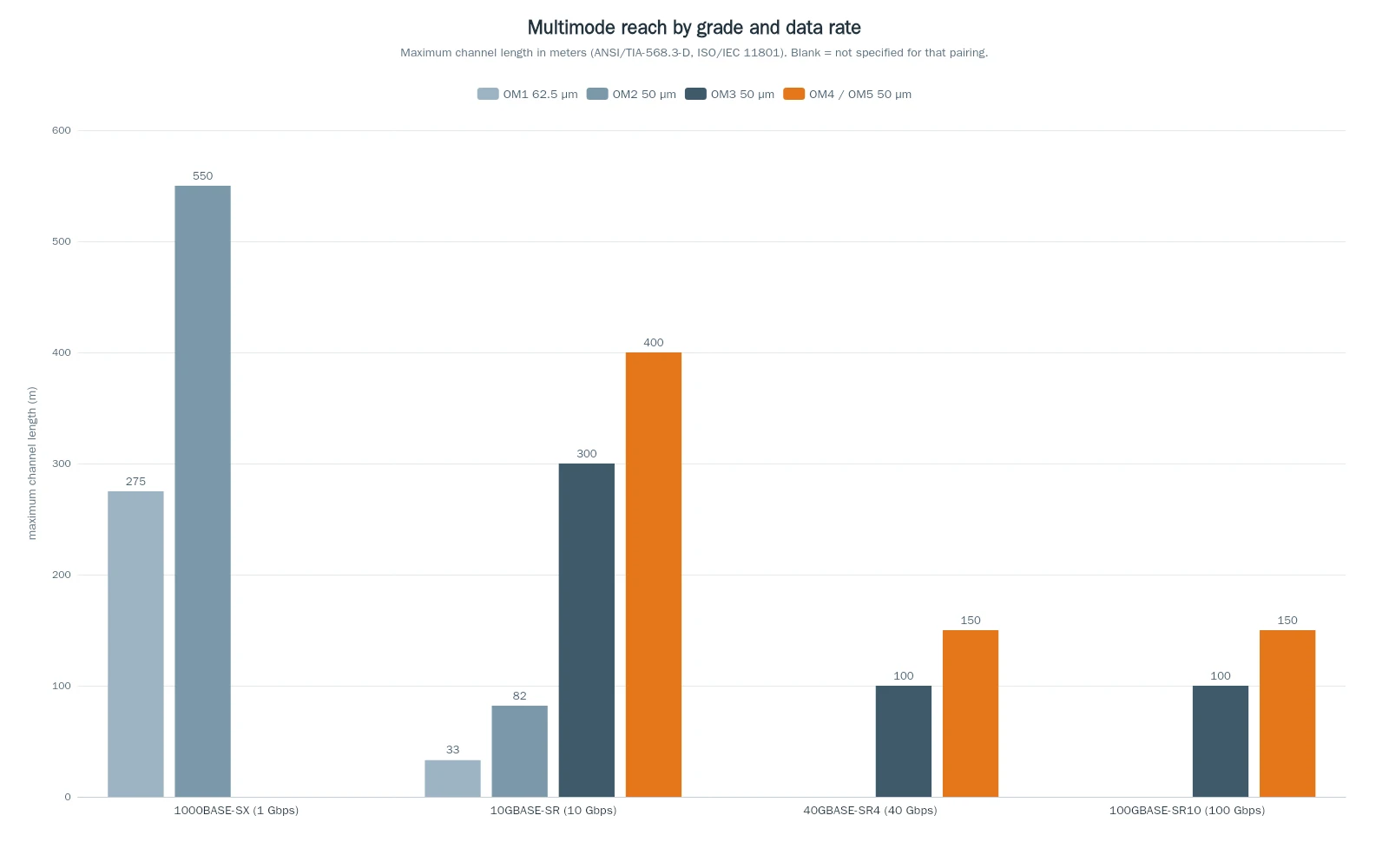
The published distances for Ethernet over multimode come from the cabling standards (ANSI/TIA-568.3-D and ISO/IEC 11801). Fluke Networks' reference table reproduces them grade by grade:
Ethernet application | OM1 (62.5 µm) | OM2 (50 µm) | OM3 (50 µm) | OM4 / OM5 (50 µm) |
|---|---|---|---|---|
1000BASE-SX (1 Gbps) | 275 m | 550 m | not specified | not specified |
10GBASE-SR (10 Gbps) | 33 m | 82 m | 300 m | 400 m |
40GBASE-SR4 (40 Gbps) | not specified | not specified | 100 m | 150 m |
100GBASE-SR10 (100 Gbps) | not specified | not specified | 100 m | 150 m |
A cell marked "not specified" is a pairing the standard tables do not publish — not a distance of zero. The practical reading is that multimode is a building-and-campus medium: its 10 Gbps ceiling is 400 m on the best grade, and at 40 and 100 Gbps the ceiling drops to 150 m.
Those distances are only half the specification. Each one is paired with a loss limit, and both conditions have to hold:
Ethernet application | OM1 | OM2 | OM3 | OM4 / OM5 |
|---|---|---|---|---|
1000BASE-SX | 2.60 dB | 3.56 dB | 3.56 dB | not specified |
10GBASE-SR | 2.4 dB | 2.3 dB | 2.6 dB | 2.9 dB |
40GBASE-SR4 | not specified | not specified | 1.9 dB | 1.5 dB |
100GBASE-SR10 | not specified | not specified | 1.9 dB | 1.5 dB |
The most useful sentence in the whole multimode literature is the cautionary note attached to that table: OM4 fiber needs a reduced fiber loss to support 100GBASE-SR10 at 150 m. Distance on its own does not get you there.
The underlying quality metric is modal bandwidth, measured in MHz·km at 850 nm. Effective (laser) launch bandwidth is the number that matters with modern VCSEL sources: OM3 is rated at 2,000 MHz·km and OM4 at 4,700 MHz·km, which is exactly why OM4 buys you the extra 100 m at 10 Gbps. OM5 fiber matches OM4's distances and loss figures but is designed to work at 880 nm, 910 nm and 940 nm as well as 850 nm, so it can carry four simultaneous wavelengths over one fiber — short-wavelength division multiplexing, which is a capacity play rather than a distance play.
Two details worth knowing before you quote a number to anyone:
- The grade table depends on the standard vintage. Fluke's page notes that older ANSI/TIA-568-B.3 assumed 160 MHz·km for 62.5 µm fiber, not the 200 MHz·km in the current edition; under the older assumption, 1000BASE-SX over OM1 drops to 220 m and 10GBASE-S to 26 m. If a datasheet and a standard disagree about an OM1 run, check which edition each is using.
- Vendors quote optimistic OM4 numbers. FS.com describes 400 m as a rule of thumb for OM4 at 10 Gbps while noting that ultra-high-quality OM4 can reach 550 m. Design to the standard figure; treat the longer one as a laboratory result, not a contract.
For the grades themselves, our cluster covers how OM1 through OM5 compare and the wider single-mode versus multimode comparison.
Single-mode fiber distance: 10 km, 40 km, 80 km — and who sets the number
Single-mode fiber has a 9 µm core and carries one light path, so modal dispersion leaves the equation and the reach becomes a question about optics and loss alone. That is why "single mode fiber maximum distance" has no single answer: it is 10 km, 40 km or about 80 km depending on which transceiver you plug in at each end.
The fiber sets the floor, not the ceiling. Single-mode cable is specified by attenuation class rather than by a distance. The Fiber Optic Association's summary of the ITU-T fiber specifications lists the G.652 family that carries most access and metro traffic: G.652.A at ≤0.5 dB/km at 1310 nm, G.652.B at ≤0.4 dB/km at 1310 nm and ≤0.35 dB/km at 1550 nm, and G.652.C and G.652.D at ≤0.4 dB/km from 1310 to 1625 nm with ≤0.3 dB/km at 1550 nm and a controlled water peak at 1383 nm. The same summary lists G.657 as the bend-insensitive single-mode family for tight indoor routes, and Corning's SMF-28 Ultra — the carrier fiber quoted earlier at ≤0.18 dB/km at 1550 nm — is G.652.D compliant while exceeding the G.657.A1 bend specification.
Those numbers are why single-mode distance is an optic choice. Cabling standards express the difference as two design allowances: the same Fluke reference table gives OS1 and OS2 fiber 1.0 dB/km inside plant and 0.5 dB/km outside plant. A 10 km outside-plant run on that allowance costs 5 dB; the same fiber inside a building costs 10 dB and changes what the optics have to deliver.
For OS2 routes in the field, the number that matters is the module class: LR at 10 km, ER at up to 40 km, and roughly 80 km from ZR optics — with engineered-link treatment above 30 km, which means the link has to be designed against its own measured loss rather than assumed from a table.
Access networks: how far an OLT can reach an ONT
Passive optical networks change the question. Instead of one transmitter per subscriber, one optical line terminal (OLT) serves many optical network terminals (ONTs) through passive splitters, so reach is published as a pair of figures — how far the light actually travels, and how far the protocol can address.
The ITU-T's own G.984 flyer states it plainly: GPON logical reach of up to 60 km, a basic physical reach of 20 km, and reach extension that provides 60 km of physical reach, with a maximum physical reach of up to 60 km at loss budgets in excess of 27.5 dB. Recommendation ITU-T G.984.7 takes the long-reach case further, specifying a differential distance of 40 km where conventional GPON assumes 20 km.
The budget is shared, and that is the operational point. Every splitter on the path spends part of the same loss allowance that distance consumes, so a heavily split network cannot also be a long one — the two have to be traded against each other in the network design. It is also why reach extension exists as a separate specification for rural and low-density routes rather than as a feature of the basic system. For the generation-by-generation picture, including where XGS-PON changes the budget, see our GPON versus XG-PON versus XGS-PON comparison.
The upper end: how far fiber runs once amplifiers are in the path
Nothing about the glass changes at long distances — only what sits at each end of it. Submarine systems illustrate the ceiling: the undersea fiber is chosen for its clarity, and by 2014 unrepeatered cables of up to 380 km were in service — these require unpowered repeaters positioned roughly every 100 km along the route; and as of 2012 operators had demonstrated error-free transmission at 100 Gbps over transatlantic routes of up to 6,000 km. Erbium-doped fiber amplifiers have been part of those systems since 1995, and Raman amplification adds reach from a pump laser — roughly 45 km of extra reach from a single watt of pump power.
Two lessons carry back to ordinary networks. First, when someone asks how far fiber optic cable can run, the honest top of the range depends entirely on how much terminal equipment is allowed: 400 m with a multimode SFP, tens of kilometers with an LR or ER optic, and thousands of kilometers with amplification. Second, the physical route starts to matter more than the glass, because bend radius, tensile load and crush protection are what turn a theoretical reach into a working link.
Running fiber to an outbuilding: what the distance number means in the field
This is the version of the question most people actually have: 1,000 or 1,500 ft from the house to a workshop, a barn or a neighbor, and a spool of fiber in hand. In meters, that is 305 m and 457 m — right at the boundary where the fiber grade decides the answer.
At 10 Gbps, multimode is out. The best multimode grade is specified at 400 m, so a 1,500 ft (457 m) run exceeds the standard limit before you count a single connector. Even the 1,000 ft (305 m) case sits at three-quarters of the published OM4 reach, which leaves very little of the loss allowance for patch panels and splices.
At 1 Gbps the picture is different but still tight: 1000BASE-SX is specified at 550 m over OM2 and newer 50 µm multimode, so 1,500 ft fits on paper at 83% of the limit — workable, but with almost no margin for the losses that accumulate in a real route.
Single-mode removes the argument. With 10GBASE-LR optics the reach is 10 km, and with a pair of 1 Gbps single-mode media converters it is typically 10 to 20 km, so a 1,000–1,500 ft run uses a small fraction of the available budget. What is left to manage is not distance at all:
- Every junction spends budget. A pre-terminated cable that arrives with factory connectors costs you connector loss at each end; a field-spliced route adds a splice every 2 km or so, plus the loss of each enclosure. Our guide to fiber drop cables covers how the last segment of an access network is built.
- Short can be as wrong as long. On single-mode, a receiver that never sees enough loss can overload — which is why the module vendors specify attenuators below a minimum distance and a 2 m minimum cabling length.
- The route is a separate question. Whether you may bury the cable yourself, and whether it must run in conduit, is a depth-and-route question with its own rules; our guide to fiber burial depth covers what governs it.
- The cable type changes before the distance does. Direct burial, aerial self-supporting and duct routes take different cable constructions, not different glass.
What the distance number should change on your purchase order
Once you know the reach you need, three specification items follow from it — and one test does not wait for anything.
Grade selection. Anything beyond 550 m at 1 Gbps, beyond 400 m at 10 Gbps, or beyond 150 m at 40 and 100 Gbps is a single-mode job. The economics behind that choice are not subtle: multimode systems are the cheaper build at short distances, which is why they dominate inside buildings, while single-mode is what carries traffic across any real distance.
An attenuation class, not just "single mode". Write the ITU-T class and the dB/km figure on the order — G.652.D at ≤0.3 dB/km at 1550 nm, or the vendor's tighter number such as ≤0.18 dB/km — because "single mode" alone does not distinguish a long-route fiber from a low-grade one.
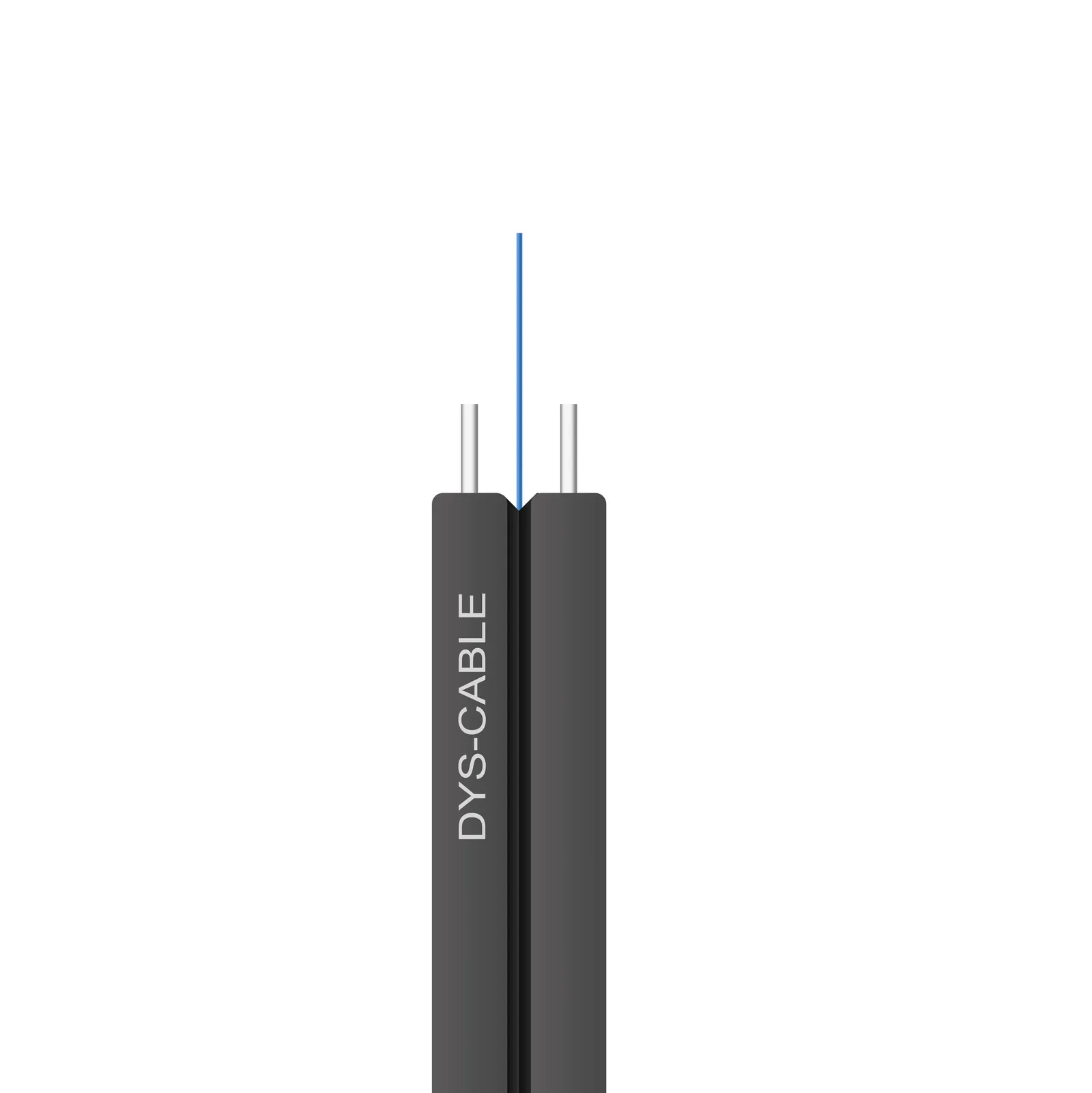
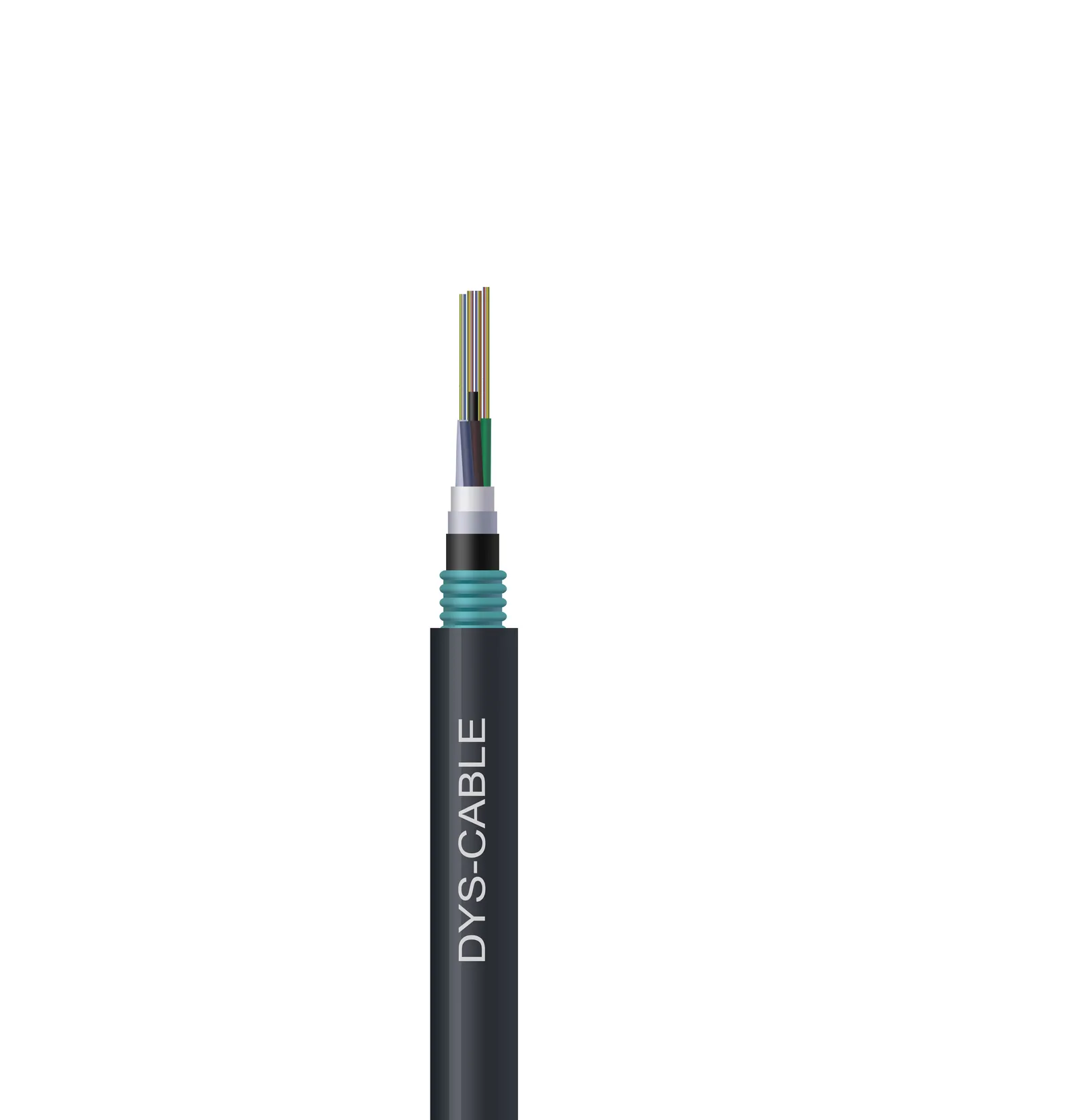
A cable construction that matches the route. This is where long routes stop looking like short ones: loose-tube armored cable for duct and direct-buried trunk, self-supporting figure-8 cable for aerial spans, all-dielectric designs where metallic elements are a problem. The constructions are published under the route conditions each design is built for, and it is worth matching them explicitly rather than ordering "outdoor cable".
Then measure. A published reach is a specification, not a measurement. Length and loss on the installed route are what determine whether the link comes up, so testing after installation closes the loop — and it also tells you how much margin you have left for the next splice.
Notably absent from that list is cost per foot. Cable and installation prices vary so widely with route conditions, labor market and volume that a generic number would mislead; the reach figures above are the part of the specification you can actually plan from a datasheet.
FAQ
Can fiber optic cable run a mile? Yes, on single-mode. A mile is 1,609 m — comfortable within the 10 km reach of 10GBASE-LR optics, and far beyond it for 1 Gbps single-mode converters. On multimode, no: 1 Gbps tops out at 550 m and 10 Gbps at 400 m over the best grade.
Is the distance limit in the cable or in the equipment? In the equipment, with the fiber grade setting the ceiling. The same single-mode fiber supports 10 km behind LR optics and about 80 km behind ZR optics; the same spool of multimode supports 550 m at 1 Gbps and 150 m at 40 Gbps.
How far can fiber run without a repeater or amplifier? With standard Ethernet optics, 10 km (LR), 40 km (ER, engineered above 30 km) and roughly 80 km (vendor-specified ZR). In access networks, GPON is specified at 20 km physical reach and 60 km with reach extension. Beyond that, amplification takes over — submarine systems place optical amplifiers along the route, and by 2014 unrepeatered spans of up to 380 km were in service using unpowered repeaters roughly every 100 km.
Fiber cable does not carry a length rating, and that is the useful conclusion: the distance you get is a decision made when you choose the optics, the grade and the number of junctions on the route. The Fiber Optics 101 pillar covers the cable side of that decision in full — types, construction and where each is used — and if your project starts at the long-route end, our outdoor fiber cable families set out the constructions built for duct, aerial and direct-buried routes.