

Data Center
Pre-Terminated Fiber Trunks vs Field Termination: Cost, Speed, and Quality Compared
Pre terminated fiber and field termination are not a fast option and a slow option. They are two ways to spend the same project budget. Pre-termination moves labor into a factory and charges you for it in mated pairs. Field termination keeps the material cheap and charges you for it in hours on site. Whichever currency your project is short of decides the answer, and both accounts can be worked out before you raise a single purchase order.
Most treatments of this choice hand you adjectives. Faster. Cleaner. More consistent. More flexible. None of those words survive contact with a project review, because none of them can be checked against a number. So this page does the arithmetic instead: a total cost per terminated end with a break-even point you can move to your own rates, and a per-channel loss ledger that shows what those extra mated pairs cost you in decibels.
This is from DYS Fiber Optic, a manufacturer of pre-terminated assemblies.
What "Terminated" Actually Means — and the Third Route
"Terminating" a fiber means making an end that can be connected: stripping the jacket and coating, exposing the glass, and either fusing a factory-made pigtail onto it or crimping and polishing a connector directly onto it. In the field that work happens at the rack or in the tray. In a factory it happens on a bench with a splicer, a polishing machine and a test set, and the finished assembly arrives as one piece with the connectors already on.
Only two routes get compared, but there are three. The one that gets skipped is the hybrid, and for a lot of projects it is the right answer.
Route | Factory end | Field end | What the crew actually does |
|---|---|---|---|
Fully pre-terminated trunk | Both ends | None | Pull, dress, plug in, label |
One end pre-terminated | One end | One end | Pull, then terminate the far end on site |
Fully field-terminated | None | Both ends | Pull bulk cable, then splice or connectorize every end |
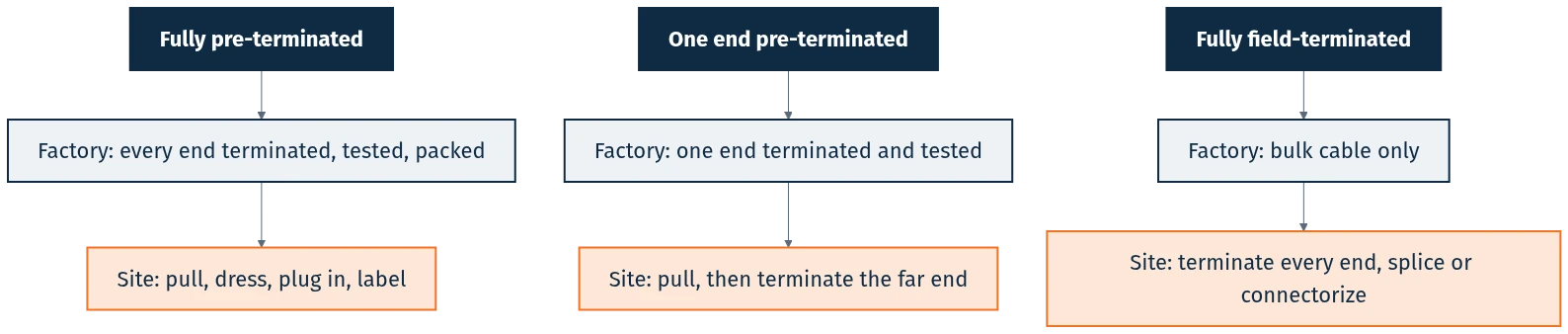
The split is not two ways, it is three — and the hybrid is the one that gets skipped in most comparisons.
Field termination is itself two different jobs with different cost structures — fusion splicing a pigtail and crimping a mechanical or field-polished connector are not interchangeable, and the labor per end can differ by a factor of two. If you have not settled that question first, settle it here: our walkthrough compares fusion splicing, mechanical connectors and connectorization side by side and it changes every number further down this page.
One other boundary worth fixing: the channel you are building is not switch-to-switch free of joints. Whether the ends are made in a factory or on a ladder, a channel that crosses an ODF or a patch panel picks up connectors and splices along the way, and those are counted against the cabling standard of the region you are building in — TIA publishes the North American ones and their equivalents apply elsewhere.
Those definitions are not hair-splitting: the difference between the three routes is exactly a difference in how many connection points land mid-channel, and that number is the one nobody publishes. Our MPO/MTP data center cabling guide is the hub this page sits under, covering trunk systems and loss budgets.
Pre-Terminated Fiber Trunks vs Field Termination at a Glance
If you read one section, read this table, then find your loaded labor rate.
Decision factor | Pre-terminated trunk | Field termination |
|---|---|---|
Material per terminated end | Higher — trunk, cassette or module, patch cords, factory labor | Lower — bulk cable, pigtails, connectors, consumables |
Site labor per terminated end | Low — route, clean, plug, label | High — strip, clean, cleave, splice or polish, inspect |
Break-even, at the placeholders used below | Wins above roughly $60 per hour loaded labor | Wins below it |
Connections added to a channel | Two extra mated pairs | None |
Schedule shape | Compressed, front-loaded into lead time | Spread across the whole fit-out |
Tolerance to design change after ordering | Poor — lengths are cut at the factory | Good — you cut cable where you stand |
Quality evidence | Per-assembly factory test data | Depends on the crew and the record they keep |
Damage repair | Replace the assembly | Re-terminate the end |
Stops working when | Route is unmeasured, conduit is tight, or late changes are likely | Nobody on site can splice or polish to spec |
Polarity is the one line item that moves between columns. Order a pre-terminated MPO trunk and the polarity method must be settled before the factory cuts anything, because it is built into the assembly; the polarity methods and their channel consequences are worth ten minutes first.
Cost: Why the Material Price Is the Wrong Number for Pre-Terminated Fiber
Compare the two options on material cost and pre-termination loses every time. Compare them on what the end costs you installed and the answer depends on one variable purchasing never asks about: what an hour of your crew costs fully loaded.
So build the model per terminated end — not per cable, not per reel, but per end, the unit both routes produce. The per-splice figure is the same arithmetic: splice minutes ÷ 60 × loaded rate, which at a 12-minute splice and a $60 rate is $12 of labor per splice.
Cost per terminated end = material + (minutes ÷ 60 × loaded labor rate) + (rework rate × rework minutes ÷ 60 × loaded labor rate)
The variables, with the placeholder values used for the chart below. Replace every one of them with your own numbers before you show this to anyone.
Variable | Placeholder used here | Your value |
|---|---|---|
Material per end, field-terminated | $1.80 | |
Material per end, pre-terminated | $12.00 | |
Minutes per end, field | 12 | |
Minutes per end, pre-terminated | 3 | |
Rework rate, field | 8% | |
Rework rate, pre-terminated | 2% | |
Rework time per bad end | 20 minutes | |
Loaded labor rate | $20–$120 per hour | |
Fixed tooling, field (splicer, cleaver, kit) | $5,500 | |
Fixed engineering and freight, pre-terminated | $1,500 |
Run the arithmetic and the two lines cross at a loaded labor rate of $60 per hour. Below that, field termination is the cheaper way to produce a terminated end. Above it, the factory is.
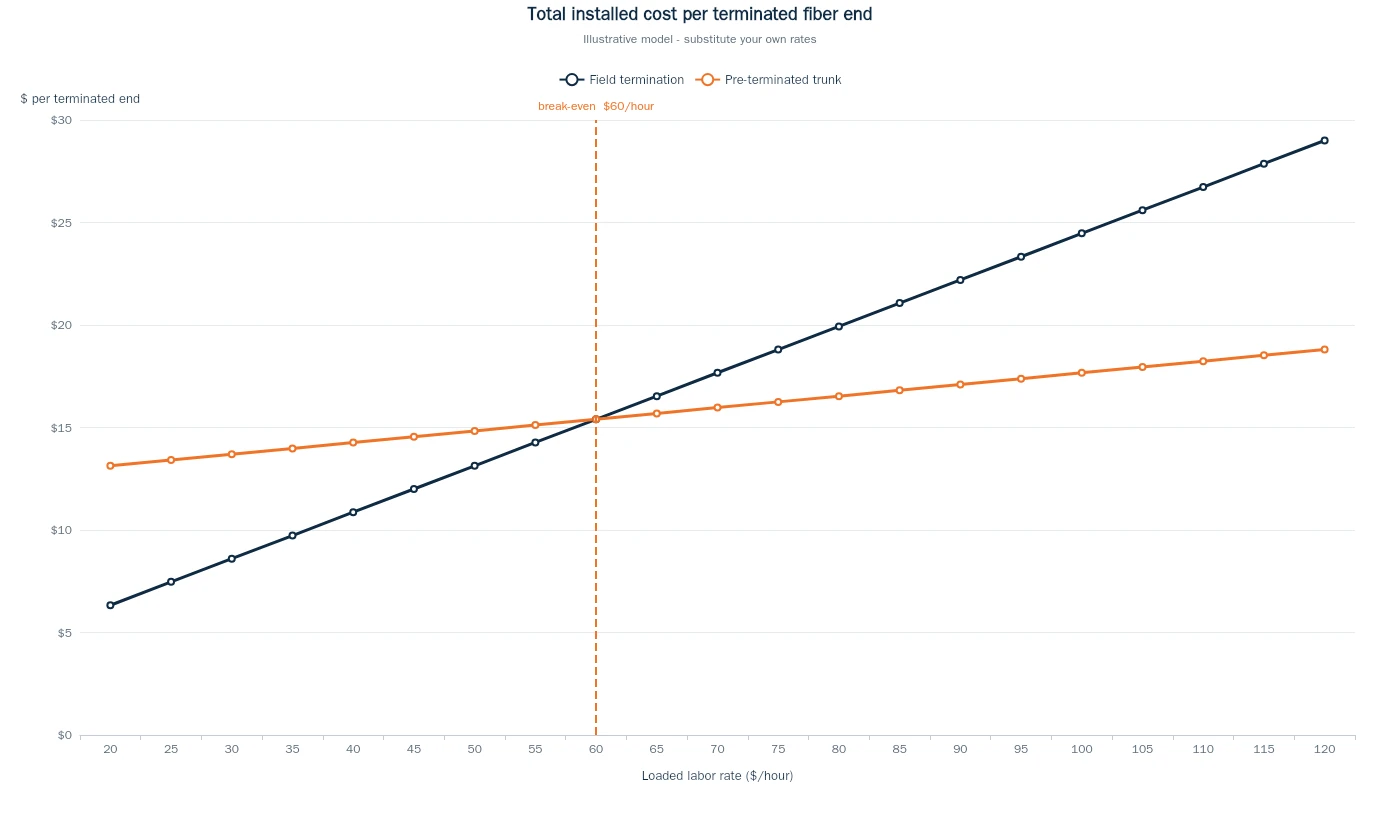
The whole argument in one picture: the factory trades material cost for labor, and the exchange rate is your wage bill.
The shape of the two lines explains what looks like an industry disagreement. Contractors in low-labor-cost markets are right when they say pre-termination is expensive. Contractors in high-cost markets are right when they say field termination is. Neither is describing a property of the products; both are describing their own payroll. At $40 an hour the field route costs $10.87 per end against $14.27 — a $3.40 gap in the field team's favor. At $90 an hour the same two formulas give $22.20 against $17.10, and the gap has swung $5.10 the other way.
Move the inputs and the crossover moves with them. Push field termination time from 12 minutes to 15 or 20 and the break-even falls to roughly $46 and $34 an hour; raise pre-terminated material from $12 to $20 and it climbs to about $107. Sixty dollars is a placeholder, not an industry constant — and the range used here straddles it.
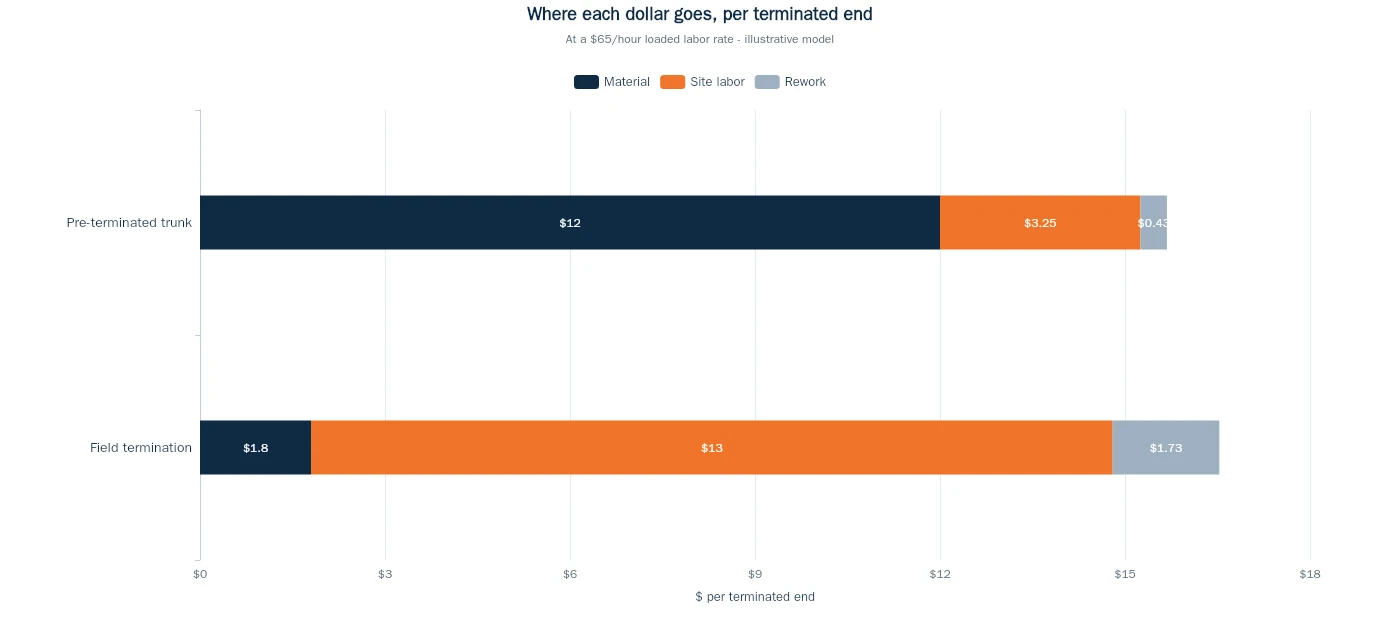
Break the same two totals into components and the reason becomes obvious: one option is mostly material, the other is mostly hours.
A second threshold hides in the fixed costs, and it only exists on the side of the crossover where field termination is the cheaper variable option. If your crew does not already own a fusion splicer, that route carries roughly $5,500 of capital before the first end is terminated, against roughly $1,500 of engineering and freight for custom assemblies. At a $55 hourly rate, where field termination is about $0.85 an end cheaper, the $4,000 of extra fixed cost needs roughly 4,700 terminated ends — call it 2,300 duplex ports — before the purchase repays itself. At $65 an hour the same $0.85 runs the other way, and the splicer never pays back on this project. The threshold also disappears if you would keep the capability for restoration anyway, in which case that $4,000 is not incremental and the two options compare on variable cost per end alone.
Three things the model leaves out on purpose, because they belong to your risk appetite rather than your spreadsheet: schedule compression when the completion date is contractual, change orders after the factory cuts lengths, and a splice that fails its test after the ceiling goes back up. If those matter more than a few dollars an end, the arithmetic is the floor of the case, not the whole of it.
Loss Budget: Factory Termination Buys Labor with Mated Pairs
Now the second account, the one that never appears on an invoice and shows up when a link will not come up at 400G.
A pre-terminated trunk channel and a field-terminated channel are not the same optical path. The field-terminated one runs all the way through: cable, spliced to pigtails at each end, patch cord at each end. The pre-terminated one breaks twice more, because the trunk has to land in something — a cassette, a module, a panel — and that landing is a mated pair. The family at that landing is usually MPO or MTP. Two extra pairs per channel, no extra splices.
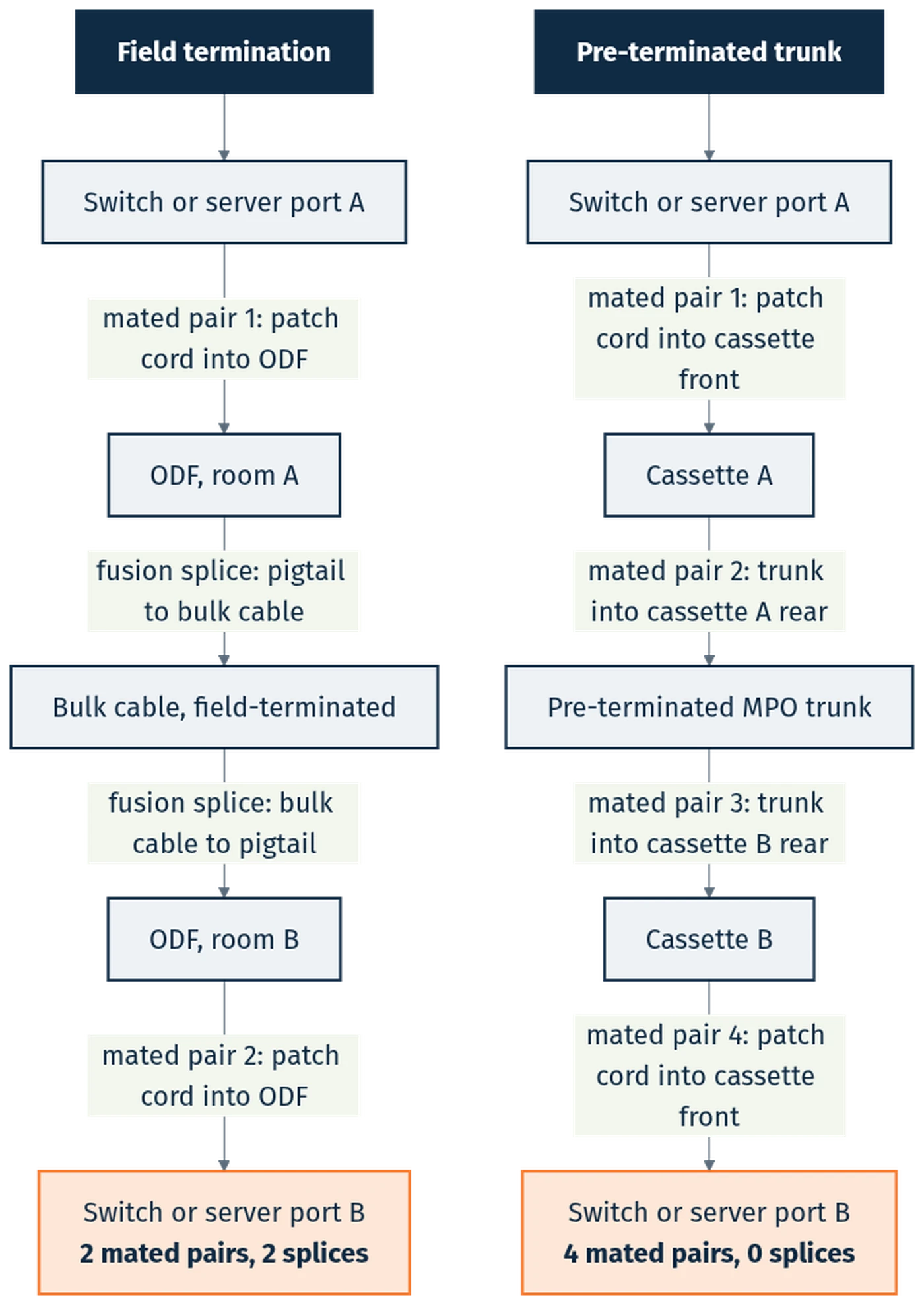
Same channel, different ledger: the factory removes two splices and adds two plugs.
Put values on both so the trade is visible — and put them on the same basis, because that is where this comparison usually goes wrong. Your assembly specification gives a maximum per mated pair that differs by connector family, and a maximum per splice. Charge each landing its own family's maximum, and hold both columns to one grade.
Loss item | Field-terminated channel | Pre-terminated trunk channel |
|---|---|---|
Mated pairs | 2 | 4 |
Fusion splices | 2 | 0 |
Basis A — standard grade, specified maxima | ||
LC patch pairs @ 0.30 dB max | 0.60 dB | 0.60 dB |
MPO landing pairs @ 0.70 dB max (0.75 dB at 24–48F) | 0 dB | 1.40 dB |
Splice loss @ 0.30 dB max per splice | 0.60 dB | 0 dB |
Channel total | 1.20 dB | 2.00 dB |
Difference | pre-terminated 0.80 dB worse | pre-terminated 0.80 dB worse |
Basis B — elite grade, specified maxima | ||
LC patch pairs @ 0.20 dB max | 0.40 dB | 0.40 dB |
MPO landing pairs @ 0.35 dB max | 0 dB | 0.70 dB |
Splice loss @ 0.30 dB max per splice | 0.60 dB | 0 dB |
Channel total | 1.00 dB | 1.10 dB |
Difference | pre-terminated 0.10 dB worse | pre-terminated 0.10 dB worse |
Read the two bases against each other and the finding changes size, not direction: the pre-terminated channel is 0.80 dB worse on standard parts and 0.10 dB on elite ones, because two splices at their specified maximum are cheaper than two MPO landings at theirs. What holds under both is the direction: the factory route carries more mated pairs and fewer splices, and what that costs you in decibels is set by the grade of the landing you specify.
At elite grade that penalty is smaller than most comparison articles imply, and even 0.10 dB is the margin that matters. The IEEE project that standardized 400 Gigabit Ethernet over multimode and single-mode, IEEE P802.3bs, pushed reach and lane count hard enough that the gap between a working link and a marginal one is measured in tenths of a decibel, and the 800G generation feeding AI clusters has not loosened that. A tenth of a decibel is exactly the size of number that decides one.
Elite-grade parts are the cheapest way to remove most of the penalty. The tiers are quoted per mated pair and per family: LC and SC pairs at 0.30 dB standard against 0.20 dB elite, with 60 dB and 65 dB return-loss floors, and MPO landing pairs at 0.70 dB standard on 12-fibre APC (0.75 dB at 24–48) against 0.35 dB elite at 12–24F. Read the face type as well as the family and the grade, because a number quoted without them is half a specification: UPC single-mode and multimode PC connections in the same families are tighter on insertion loss (0.20 dB standard, 0.10 dB elite) and lower on return loss. Ask which face, which family and which grade your test data covers.
The failure mode also differs in kind. A field channel accumulates loss where nobody can see it once the tray is closed — the splices. A pre-terminated channel accumulates it at plugs you can clean, re-seat or swap without touching the cable, which makes a marginal link easier to diagnose.
Do the subtraction against your actual budget, not a rule of thumb. If you have not built one for a 400G link yet, the worked version — transmitter budget, connector allowance, splice allowance, margin — is set out in our worked example of a 400G link budget, and the two terms doing the work there are insertion loss and return loss.
Speed and Schedule: What Actually Sets Your Date
"The factory is faster" is true and useless. What matters is which task is on the critical path.
Field termination is a serial process bolted to the end of a cable pull. You cannot terminate a fiber that has not been pulled; once terminated there is a curing or inspection step, then a test. The crew cannot start the next row until the current one is dressed, so the labor scales with the number of ends and competes with everything else in the same commissioning window.
Pre-termination moves the slow half of that process earlier, off the critical path. What remains on site is pull, dress, plug, label — work a smaller crew can do, and work that does not need a splicer or a polish bench set up first. The field hours drop, and the number of people you need at the peak drops with them, which usually decides whether the fit-out window is achievable.
Then the schedule risk moves elsewhere, and it is not free. Custom assemblies have a lead time that starts when the lengths are frozen, not when you place the order. If the rack positions change after that, you are not adjusting a cut list; you are re-ordering. Judging a pre-termination schedule on the installer hours alone gets the labor line right and the delivery line wrong.
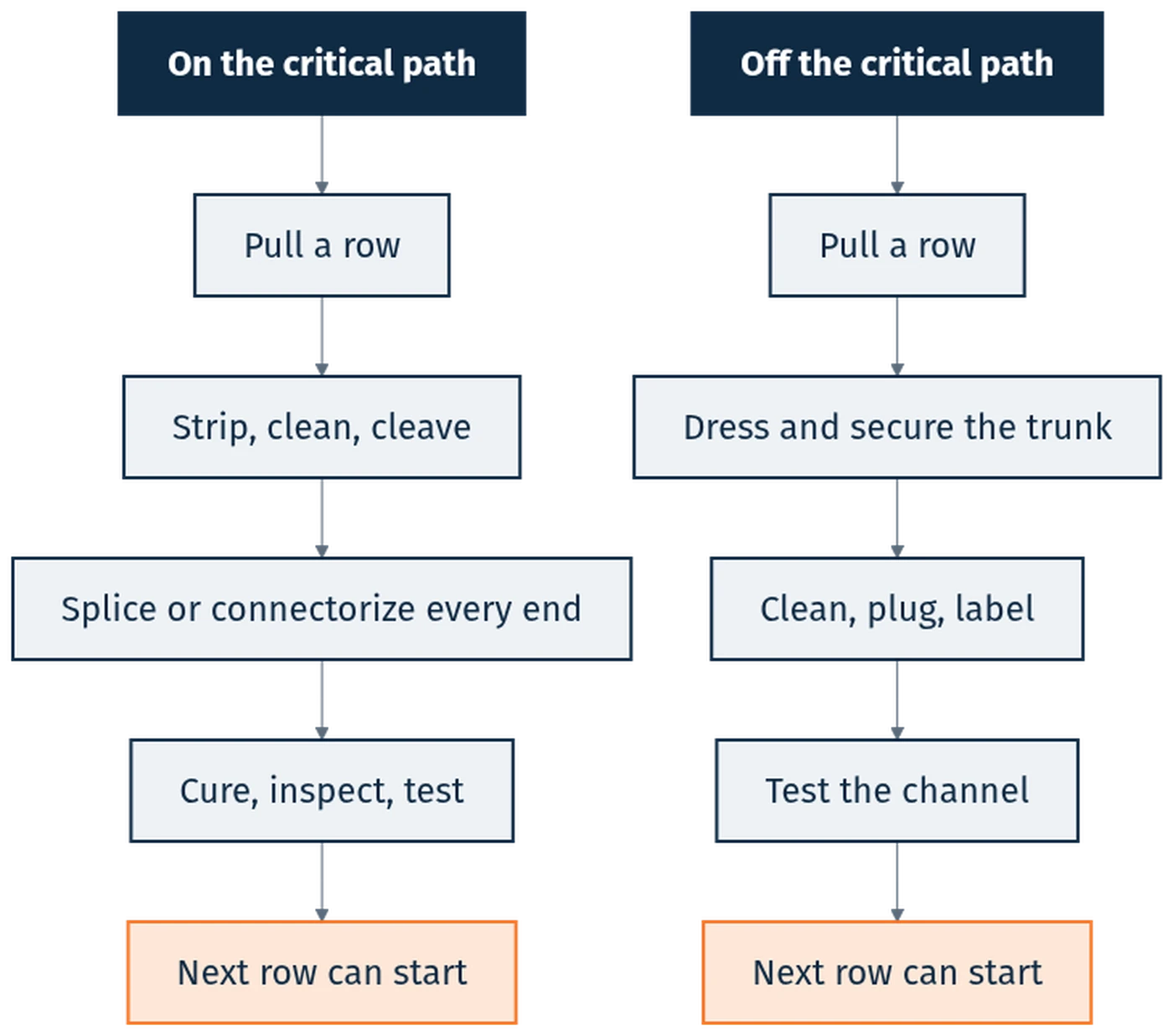
Both routes pull the same cable. Only one of them puts termination work between the pull and the next row.
Quality and Test Evidence: What You Can Still Verify in Year Three
"Higher quality" is the least checkable claim in this comparison, so replace it with the version that is: what evidence exists after the fact.
A factory-terminated assembly leaves the factory as a product rather than as cable plus consumables — measured, inspected and packed as one unit. Field termination can reach the same optical numbers. What it cannot reach as easily is the paperwork, and that is the part a specifier is buying three years later.
So treat the quality question as an evidence question, and every answer as something to demand before the order rather than assume.
Evidence to ask for | Pre-terminated trunk | Field termination |
|---|---|---|
Loss test data | Ask whether it ships per assembly or per batch, and see a sample | Yours, by definition — it depends on your tester and your paperwork |
Serial or batch traceability | Ask what identifier ships with the assembly | Usually absent |
End face inspection before installation | Ask which criteria the factory records against | Done on site, if the process exists |
Polarity confirmed | At build, before packing | At test, after the pull |
Same crew quality next month | Not applicable | Depends on retention |
End face inspection is the specific one to pin down, because it is the defect most likely to be invisible until a link fails and the most likely to be argued about. The acceptance criteria for it are published, not company-specific: IEC 61300-3-35 defines the visual inspection grades for fiber optic connectors and has become the reference that both factory QC and site commissioning are measured against. Ask any supplier which zone and defect criteria their records are based on, and ask for a sample record rather than a statement of policy.
That traceability is worth more than it looks. The assemblies we build are terminated and tested at fiber counts from 12 to 144, with fanout legs held to a 0.5 cm tolerance and jacket options covering LSZH, OFNR and OFNP — quoted as tolerances rather than adjectives because they can be re-measured on arrival. If your only record of quality is a purchase order and a delivery note, then "better quality" was never on the table.
Mechanical durability belongs here too, because it is the objection people raise against factory ends. That one has a named specification: a mated MPO pair still within 0.3 dB of its original insertion loss after 50 mating cycles is the GR-1435 requirement assemblies are qualified against, and LC and SC connections are held to 0.2 dB after 500 mating cycles under IEC 61300-2-2 — both well past what a fixed trunk in a rack will see.
Where Field Termination Is the Better Call
This is not a section where field termination loses gracefully. There are projects where it is simply the correct answer, and pre-termination is the expensive mistake.
No measured route. If the drawings show the pathway but nobody has measured it, a factory assembly is a guess with a lead time. Bulk cable trims to whatever reality turns out to be.
Tight conduit or a hard pull. A pre-terminated trunk with a fanout or a pulling eye is a fatter, less flexible package than bare cable, and conduits specified from an old plan are often at or past their fill limit. Where the fill ratio is close, or there are multiple tight bends, bare cable plus one factory end plus a spliced far end may be the only route that pulls at all. Where bend performance is the binding constraint, bend-insensitive fiber per ITU-T G.657 is the standard answer, and it applies to either route.
Late design change. Data center projects move racks. If final positions are not frozen, ordering cut lengths turns every change into a re-order.
Small counts. A two-room, 24-fiber job only points to field work if the crew owns a splicer; otherwise $5,500 of tooling never spreads across enough ends and the factory end wins on total cost.
Restoration and repair work. Adding capacity to a live rack, or replacing a damaged run at 02:00, is field work by definition. The distance from the spare reel to the patch panel is short; the alternative is holding a spare of every assembly length.
Nobody on site can terminate to spec. A two-person crew on a lighting job may have no splicer and no desire to buy one. Where the capability is absent, comparing methods on labor rate is academic.
Where the Pathway Decides: Armored, Direct-Burial and Plenum
Everything so far assumes an indoor route. Step outside and the field option starts disappearing, because the assemblies that survive those routes are not ones a site crew can make.
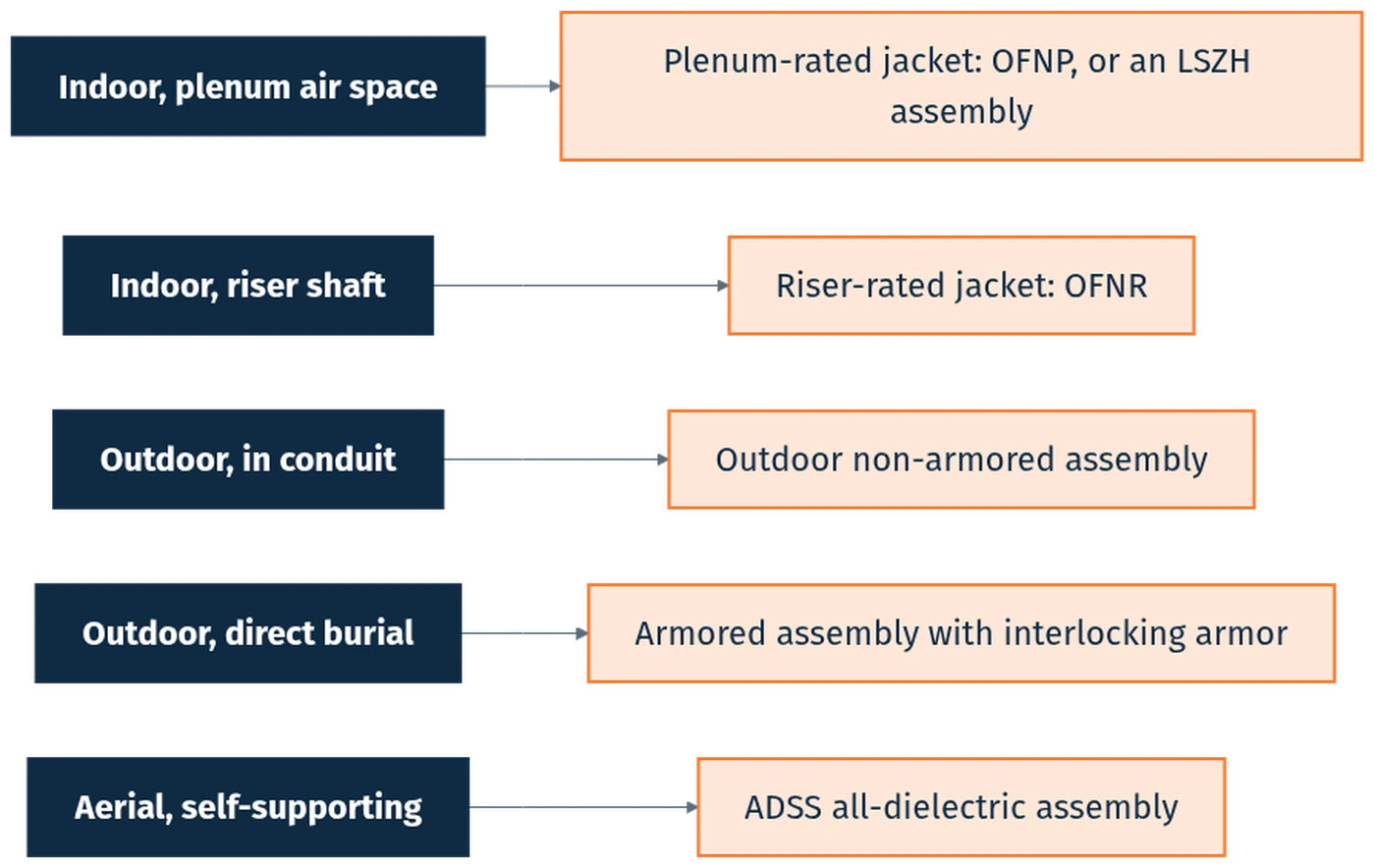
Pick the route first. It decides the cable construction — and for two of these five rows it decides the termination method as well.
Two of those routes put most of the assembly work in the factory. An armored assembly with interlocking armor, and an ADSS all-dielectric self-supporting assembly, both need strength members and water-blocking layers built and tested as one unit. Splicing a closure onto a buried or aerial run is ordinary practice and it works — but every closure is a joint your acceptance test has to cover, and a factory assembly arrives already tested as one piece.
Indoor routes split on the same kind of rule with fire performance instead of mechanical protection. A plenum air space wants an OFNP-rated jacket or an LSZH assembly; a riser shaft wants OFNR. Multimode assemblies for short indoor runs follow the identical logic at lower cost and tighter loss budgets, and are worth pricing against single-mode wherever the distances allow.
Cost does not disappear outdoors. Longer runs, tougher routes and armor push the pre-terminated material number up, and a higher material number moves the break-even labor rate up with it: on the model above, $20 per end instead of $12 lifts the crossover from $60 to about $107 an hour. The factory needs to be facing an expensive crew to win an outside-plant job, not a cheap one.
Where Pre-Terminated Trunks Are the Wrong Choice
Fairness runs both ways, and the failure modes of factory termination are just as specific.
- Lead time is a constraint, not a trade-off. Custom lengths mean the clock starts when the design freezes, and a schedule built on fast delivery puts the commissioning date at risk.
- Mistakes are expensive to correct. A wrong length is not re-cut on site. It is scrap plus a second lead time.
- The pull profile is worse. More diameter, less flexibility, and fanout legs that an over-enthusiastic pull can damage. Pull tension limits and a proper pulling grip are not optional, and the bend radius is a specified number rather than an estimate — the assemblies we build are rated at 20× the outer diameter while being pulled and 15× at rest, so it can be checked at selection time instead of discovered on site.
- Slack has to be stored. Assemblies arrive in fixed lengths, so surplus coils up somewhere, and service loops need space a rack and tray design does not always provide.
- Extra spares cost more. Holding a spare of every assembly length is an inventory. Field crews hold one reel.
- You still need somebody who can splice. Unless the contingency plan for a damaged assembly is a two-week delivery, the capability stays — so the tooling cost from the cost model does not fully disappear.
A Decision Rule You Can Apply Before the Next Meeting
Four questions, in order. The first one can be fatal, so do not skip it.
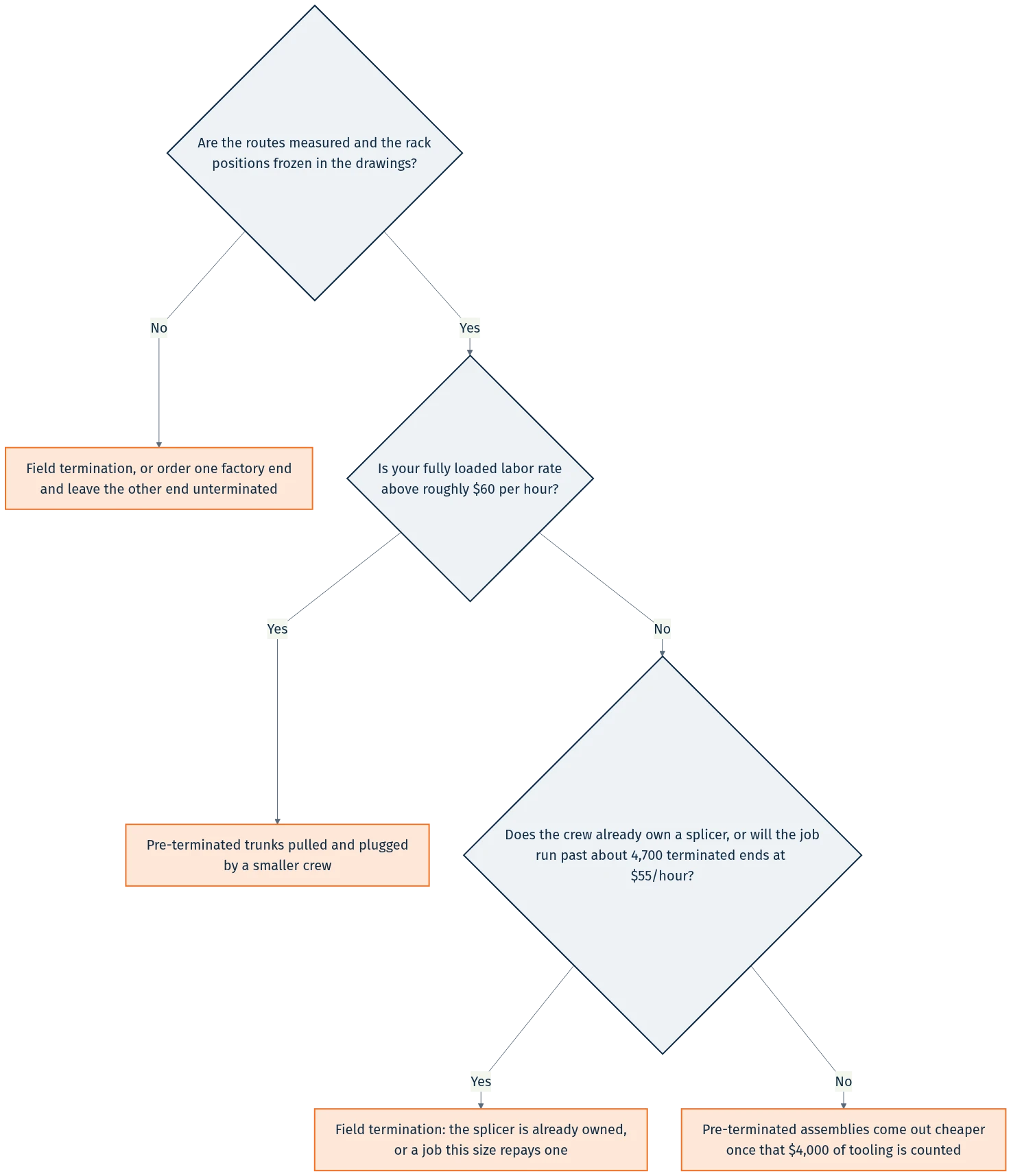
The order matters: a wrong answer to the first question makes the rest irrelevant.
One — are the routes measured and the rack positions frozen? If not, the honest answer is field termination, or factory termination at one end with the far end left for site work. Everything below assumes it is settled.
Two — what is your fully loaded labor rate? Below roughly $60 an hour, field termination is cheaper per end; above it, the factory is. If you do not know this number, that is the finding, not the obstacle.
Three — how big is the job? Under a few hundred ends the fixed costs decide, and below the crossover they point the other way: at a $55 hourly rate the $4,000 of tooling needs roughly 4,700 ends to repay — about 1,200 at $40 — so a small job favours factory assemblies unless the crew owns a splicer. Above it, pre-termination is ahead on both lines and size never rescues the tooling.
Four — is there a date you cannot move? A contractual completion date, a migration window, a customer go-live. If yes, the labor-hour reduction outweighs the per-end cost difference, and pre-termination wins on risk rather than price.
If questions two and four disagree, follow the date. A few dollars per end is a line item; a slipped migration window is a business event.
The rule, compressed: measured routes and a labor rate above about $60 an hour, and the factory terminates; anything still moving on the drawings, and you terminate on site.
One practical note on layout: whichever route you pick, the channel still terminates somewhere reachable. A pre-terminated trunk makes more sense against a patch panel and cross-connect layout designed for cassettes than against one built for direct field splicing, and swapping that decision late costs more than either termination method.
FAQ
What is pre-terminated fiber? It is a cable assembly with connectors installed at the factory instead of on site — a trunk, harness or fanout terminated, tested and packed as a finished product. In a data center that usually means an MPO/MTP trunk landing in cassettes or panels at each end, with patch cords plugged into the front. The only site work left is routing and plugging in.
What does it mean to terminate fiber? It means creating a connectable end, which in practice is one of two operations: fusion splicing a factory pigtail onto the bare fiber, or fitting a connector directly by mechanical splice, crimp or field polishing. Both require stripping to the bare glass, cleaning it, and cutting with a controlled cleave. Termination quality is set by the end face condition and the alignment of the two cores, which is why inspection matters more than the tool brand.
How much does it cost to terminate fiber? Per end, the total is material plus labor plus expected rework, and labor dominates it. In the model on this page a field-terminated end lands at $10.87 at a $40 rate and $22.20 at $90, against a pre-terminated end between $14.27 and $17.10. Those are placeholders, not quotes — substitute your own inputs and the same formula gives your number.
What are the two main types of fiber optic terminations? Fusion splicing and connectorization. Fusion splicing welds one fiber to another and is used where the lowest loss and the smallest package matter. Connectorization installs a pluggable interface, either factory-polished, field-polished or mechanical. Most real channels use both: splices in the cable route behind the panel, connectors at every point a human needs to plug or move something.
Is pre-terminated fiber more reliable than field termination? Not in the sense of surviving worse conditions — a pre-terminated assembly is more delicate to pull, not less. It is more repeatable: the termination process is identical for end number one and end number ten thousand, and the test evidence is a document you can ask for, not a promise about a crew. Reliability claims about field work are claims about a crew on a particular day.
Bottom Line
Both methods are correct, for different projects, and the deciding variables are knowable before you order.
Pre-termination fits when the routes are measured, the rack positions are frozen, the loaded labor rate is above roughly $60 an hour, and the end faces need to be traceable. Field termination fits when the design is still moving, the conduit is tight, the crew already owns the tooling, or the work is repair and capacity.
To check what a factory-terminated assembly can be specified to — fiber counts from 12 to 144, MPO and LC through to LSH and MU connectors, fanout legs to a 0.5 cm tolerance — the pre-terminated cable range is where those numbers live, and you can run them through the same formula.