

Data Center
MPO vs MTP Connectors: Differences and How to Choose
This is from DYS Fiber Optic, a manufacturer of both MPO and MTP-compatible fiber assemblies — here's an honest comparison. If you are choosing between MPO and MTP connectors, the short answer is: MTP® is a premium, trademarked version of MPO made by US Conec. Every MTP connector is an MPO connector, but not every MPO connector is an MTP. They share the same interface (IEC 61754-7 / TIA-604-5), so the two interoperate in the same panels and patch fields. Your real decision is not the name — it is which performance grade, fiber count, polarity, and gender to specify for your 400G/800G migration. This guide covers the mechanical differences, the compatibility rules, and a selection framework you can take straight to a spec sheet.
MPO vs MTP at a Glance
Dimension | MPO (generic) | MTP® (US Conec) |
|---|---|---|
Full name | Multi-Fiber Push On | Multi-Fiber Termination Push-on |
Standard | IEC 61754-7, TIA-604-5 | Same — fully compliant and intermateable |
Who makes it | Many manufacturers | US Conec (trademark); licensed builds |
Mechanical design | Plastic pin clamps, fixed ferrule, chamfered pins | Metal pin clamps, floating ferrule, elliptical stainless pins |
Insertion loss (mated pair) | ~0.6 dB multimode / ~0.75 dB single-mode typical | Elite grade: ≤0.35 dB |
Field reconfiguration | No | MTP PRO: polarity and gender changeable in the field |
Relative price | Lower | Higher (premium grade) |
Bottom line up front: for standard multimode builds with a comfortable loss budget, generic MPO is fine. When the budget is tight — 400G single-mode links, long runs, multiple patching points — specify Elite-grade parts at ≤0.35 dB per mated pair. The rest of this article explains why.
What Is an MPO Connector?
MPO stands for Multi-Fiber Push On. It is a connector that terminates an entire ribbon of fibers in one push-pull body, and it is the workhorse of high-density data center cabling. The interface is standardized by IEC 61754-7 and by TIA-604-5 (FOCIS 5), which is why an MPO from one vendor mates with an MPO from another. The alignment core is the MT ferrule, a glass-filled polymer ferrule that holds the fiber array; ferrules are available in 8, 12, 16, 24, and 32 positions, and trunk assemblies stack them to 48, 72, 96, or 144 fibers. Every MPO connector is either male (two guide pins protruding from the ferrule) or female (two holes that accept the pins), and mating always pairs a male with a female through an adapter. For general background on the family, the Wikipedia entry on multi-fiber push-on connectors is a reasonable starting point.
What Is an MTP Connector?
MTP stands for Multi-Fiber Termination Push-on, and it is the registered trademark of US Conec for its enhanced version of the MPO connector. MTP connectors are fully compliant with the MPO standards and intermate with generic MPO connectors — in cabling terms, they are compatible by design. What makes MTP different is a set of engineered upgrades inside the connector:
- Metal pin clamps instead of plastic, so the alignment pins stay put under repeated mating.
- A floating ferrule that moves slightly inside the housing, keeping fiber endfaces in physical contact under load (for example, when a cable is plugged directly into a transceiver).
- Elliptical, stainless-steel guide pins with tighter tolerances, which generate less debris and wear than flat-tipped pins across hundreds of mating cycles.
- An optimized spring design that protects the ribbon and centers the mating force.
US Conec also sells performance grades on top of the base design: MTP Elite, which guarantees ≤0.35 dB insertion loss per mated pair, and MTP PRO, whose field-removable housing lets a technician change polarity or gender on site with a simple tool.
One trademark note matters for procurement: only licensed manufacturers may label a product "MTP®". Many suppliers — including DYS — build MPO assemblies to the same Elite-grade loss specs without using the trademarked name. "All MTP are MPO, but not all MPO are MTP" is the rule to remember.
For context, the multi-fiber ferrule family traces back to NTT's MT ferrule in the 1980s; MPO (and later MTP as its enhanced variant) followed in the early 1990s as data centers began packing more fibers per port.
MPO vs MTP: The Real Differences
The differences that matter are mechanical design and optical performance. The table below summarizes the mechanical side:
Feature | Generic MPO | MTP® |
|---|---|---|
Pin clamp | Plastic, prone to breakage over many matings | Metal, stronger pin retention |
Ferrule | Fixed MT ferrule | Floating ferrule, keeps physical contact under load |
Guide pins | Flat-tipped, generate more debris | Elliptical stainless steel, less wear |
Housing | Non-removable | Removable on MTP PRO for field reconfiguration |
The optical side is where "grade" shows up on a data sheet. Per US Conec's published figures, standard MT ferrules reach roughly 0.6 dB (multimode) or 0.75 dB (single-mode) insertion loss per mated pair, while Elite-grade ferrules hold ≤0.35 dB in both cases. To show what that looks like in practice, here is the per-unit spec table DYS publishes on its MPO/MTP trunk cable data sheets:
DYS factory spec (per unit, 100% tested) | Standard grade | Elite grade |
|---|---|---|
Single-mode, 12F, APC — IL max | ≤0.70 dB | ≤0.35 dB |
Single-mode, RL min | ≥60 dB | ≥60 dB |
Multimode, 12F, PC — IL max | ≤0.50 dB | ≤0.35 dB |
Multimode, RL min | ≥20 dB | ≥20 dB |
ΔIL after 50 matings | ≤0.3 dB (GR-1435) | ≤0.3 dB (GR-1435) |
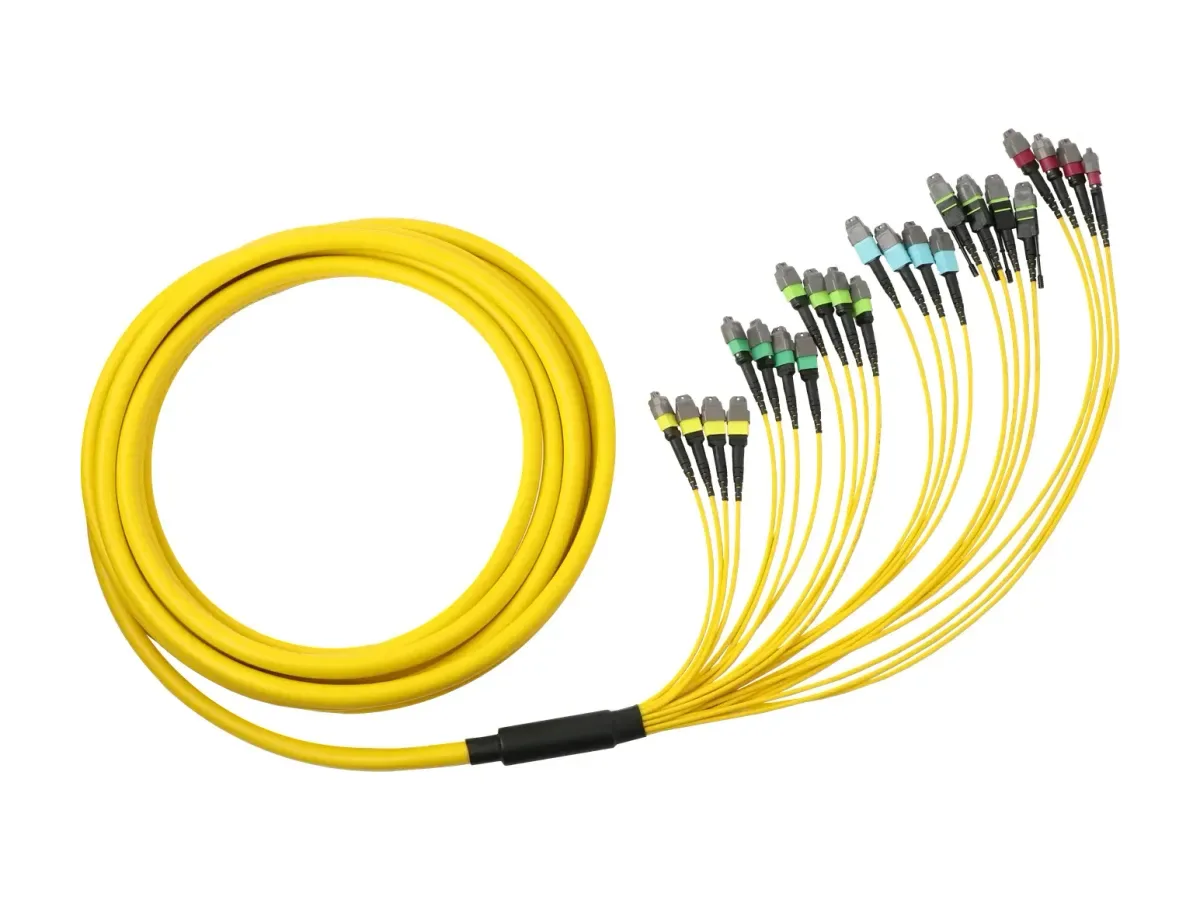
Factory-built MPO/MTP trunk cables are 100% pre-terminated and tested, so the loss on the data sheet is the loss you install.
At 40G/100G, both grades work comfortably. At 400G and beyond, every tenth of a dB in a mated pair becomes measurable headroom — which is why the grade, not the name, should drive your choice.
Compatibility and Polarity: Can You Mix MPO and MTP?
Yes. Because MTP conforms to the same IEC 61754-7 and TIA-604-5 interface as MPO, the two mate freely. What you cannot mix is gender (male must pair with female, using an adapter in a panel) and keying (key-up connectors mate with key-down connectors). Those rules are the same whether the parts are branded MTP or generic MPO.
The part buyers get wrong most often is polarity. TIA defines three polarity methods for MPO systems:
- Type A — straight-through: fiber 1 on one end connects to fiber 1 on the other (key-up to key-down).
- Type B — the array is flipped at one end: fiber 1 connects to fiber 12.
- Type C — pairs are flipped: fibers 1 and 2 swap, 3 and 4 swap, and so on.

Polarity method must match across trunks, cassettes, harnesses, and the transceivers they feed — a Type B trunk in a Type A network will not light up.
Pick one method for the whole path and verify it with the equipment vendor before ordering. If you need to change polarity or gender after installation, that is exactly the use case for MTP PRO field-reconfigurable connectors — or you order assemblies built to your polarity from the start, which is what MPO cassettes and pre-terminated trunks are designed for.
Single-Mode vs Multimode MPO/MTP
The fiber mode changes both the connector grade and the endface polish you specify:
- Single-mode MPO uses an APC (8° angled) polish and is the connector of 400G DR4 and 800G DR8 parallel optics, typically on 8-fiber or 16-fiber arrays. Angled endfaces keep return loss high (≥60 dB on DYS factory test data), which matters for coherent and PAM4 receivers.
- Multimode MPO uses a PC (flat) polish and is the connector of 100G SR4 and 400G SR4.2 in OM3/OM4 cabling, typically on 12-fiber arrays with 8 fibers populated.
Never mix APC and PC on a mated pair: the 8° angle and the flat face do not seat correctly, and the mismatch can damage both endfaces. If your cabling plan is multimode, the fiber grade matters as much as the connector — see our OM1–OM5 multimode grades compared guide for the distance and bandwidth math.
Which Should You Specify? A Practical Decision Framework
Work through these four steps and you will have a complete spec line for the RFQ.
Step 1 — Pick your base architecture. The fiber count of your cassettes and trunks should match your optics, not a habit:
- Base-8 (8-fiber MPO → 4 duplex LC): clean fit for 40G/100G SR4 and 400G DR4, with no stranded fibers.
- Base-12 (12-fiber MPO → 6 duplex LC): the legacy standard for 10G/25G duplex breakouts; still everywhere in existing plants.
- Base-16 (16-fiber MPO → 8 duplex LC): the emerging choice for 800G DR8, which needs 16 fibers per port.
Mixing bases across a path wastes fibers and creates dead ports — decide once, for the whole migration horizon.
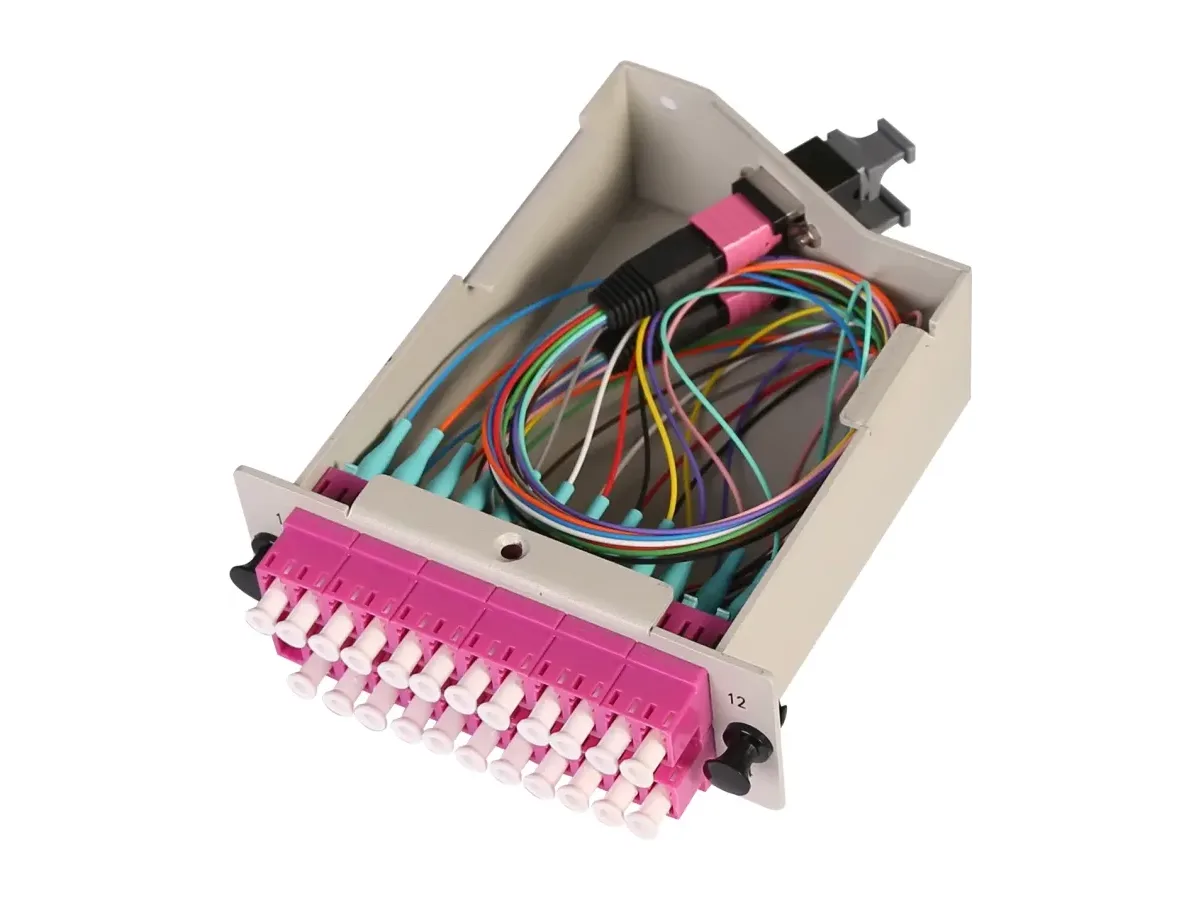
Step 2 — Do the loss-budget math. Loss adds up at every mated pair. A typical 400G single-mode link passes through two to four mated pairs (trunk to cassette, cassette to harness, harness to transceiver). Worked example with typical values: four pairs at 0.6 dB each eat 2.4 dB; four pairs at 0.35 dB each eat 1.4 dB. On a parallel-optics budget that is often only 2–3 dB end to end (check your transceiver data sheet for the exact number), that 1 dB is the difference between headroom and trouble. This is the calculation that justifies the Elite-grade premium.
Step 3 — Choose the grade by budget, not by name. Specify generic MPO when: multimode, 40G/100G, short links, few patching points, budget comfortably above the calculated total. Specify Elite-grade (≤0.35 dB) when: single-mode, 400G/800G, long runs, many mated pairs, or any budget with less than ~1 dB of margin. A supplier should quote you both grades with the max IL per mated pair stated on the data sheet. As of August 2026, MPO/MTP pricing is quote-based and varies with grade, fiber count, and volume — always request current quotes.
Step 4 — Fix polarity and gender. State the polarity method (A, B, or C), the keying (key-up/key-down), and the gender pairing on every line item, and keep trunks, cassettes, harnesses, and loopbacks consistent. Polarity mismatches are the most common cause of "the link is dark" after an MPO install.
For the full picture — loss budgets and the 400G/800G migration path — start with our data center fiber cabling guide.
What to Ask Your MPO/MTP Supplier
The name on the connector tells you less than the paperwork. And when you are choosing between data center cabling solutions, the same rules apply whether you buy from us or anyone else. Add these to your RFQ:
- Per-unit test data — an insertion loss and return loss report for every cable, with serial-number traceability, not a "typical" spec.
- The grade behind the quote — max IL per mated pair for the exact assembly (standard vs ≤0.35 dB Elite), stated on the data sheet.
- Built-to-spec, not off-the-shelf — polarity, gender, fiber count, and jacket (LSZH, OFNR, OFNP) configured for your architecture.
- Quality system — TL 9000 or ISO 9001 certified manufacturing, and factory testing per GR-1435/IEC 61300.
- Capacity and lead time — for a hyperscale rollout, the supplier must hold both volume and schedule.
When we quote an MPO/MTP data center cabling product range at DYS, every assembly ships with its measured IL/RL report and is built on a TL 9000-certified line — but the checklist above works with any vendor, and it will separate the manufacturers who know their numbers from the ones who do not. Two honest caveats from our side: DYS does not offer a field-reconfigurable MTP PRO equivalent — if you need on-site polarity or gender changes, buy US Conec's MTP PRO directly; and built-to-spec assemblies carry a short lead time, so plan your migration window when you order.
MPO vs MTP FAQ
Are MPO and MTP the same? No — they are the same interface at two quality tiers. MTP is US Conec's enhanced, trademarked version of MPO with better mechanical design and tighter optical tolerances. All MTP connectors are MPO connectors; not all MPO connectors are MTP.
Is MTP compatible with MPO? Yes. Both conform to IEC 61754-7 and TIA-604-5, so they intermate freely. Match gender (male to female) and keying (key-up to key-down) and they work together in the same network.
What is the difference between male and female MPO connectors? Male connectors have two guide pins protruding from the ferrule; female connectors have two holes. A mated pair is always one male plus one female, joined through an adapter in a patch panel or cassette.
What does MPO stand for in fiber optics? Multi-Fiber Push On. It describes a connector that terminates a ribbon of multiple fibers at once with a push-pull latching mechanism.
Can I break an MPO out to LC connectors? Yes — with an MPO-LC breakout cable (fanout or harness) or a cassette. Specify the same polarity method on the breakout as on the rest of the path, or the fiber order will not line up.
Which polarity do I need for my MPO system? It depends on your transceivers and architecture. TIA defines three methods — Type A (straight-through), Type B (flipped), and Type C (paired flip) — and the method must be consistent from transceiver to transceiver. When in doubt, ask the equipment vendor before you order.
Bottom Line
MPO and MTP are not competing connector families — they are the same interface at two quality tiers. Specify by loss budget, fiber count, polarity, and gender, not by name: generic MPO for comfortable multimode builds, Elite-grade ≤0.35 dB parts for tight 400G/800G single-mode budgets, and per-unit test data from whoever you buy from. Get those four decisions right and the name on the connector stops mattering. If you are working through a 400G build now, send your fiber count, polarity, and grade requirements to our engineers — they will come back with a spec that includes the loss math, not just a price.