
Fiber Basics
OS1 vs OS2 Single-Mode Fiber: What Actually Differs
Most OS1 vs OS2 single mode fiber questions arrive as a choice between two kinds of glass, and that framing is the first thing to drop. Both are 9/125 µm single-mode cable built on G.652-family glass — G.652.D, or its G.657.A bend-insensitive variants; both terminate on the same LC or SC connectors; both run on the same transceivers. What separates them is an attenuation ceiling measured on the finished cable — 1.0 dB/km for OS1 against 0.4 dB/km for OS2 — plus a 1383 nm requirement that OS2 carries and legacy OS1 does not.
Dropping the glass-versus-glass framing settles most of the practical argument. On a 300 m riser inside one building, OS2's optical advantage buys very little, while its construction and its price premium still arrive on the invoice. On a route that has to carry a CWDM channel plan, OS1 is the wrong ask — that band needs the 1383 nm guarantee. Leaving the building is a separate question, and that one is settled by jacket, water-blocking and fire rating, not by the OS letter.
OS1 vs OS2 Single Mode Fiber: The Short Answer
OS1 | OS1a | OS2 | |
|---|---|---|---|
Governing document | ISO/IEC 11801 (cabled fiber category) | ISO/IEC 11801, current editions | ISO/IEC 11801 (cabled fiber category) |
Maximum cabled attenuation | 1.0 dB/km at 1310 and 1550 nm | 1.0 dB/km at 1310, 1383 and 1550 nm | 0.4 dB/km at 1310, 1383 and 1550 nm |
1383 nm (water peak) requirement | Not specified | Specified | Specified |
Fiber classes that can sit inside | B1.1, B1.3 or B6_a | B1.3 or B6_a | B1.3 or B6_a |
Typical cable construction | Tight-buffered indoor | Tight-buffered indoor | Loose tube or blown; tight-buffered indoor/outdoor designs exist |
Environment it was written for | Inside buildings | Inside buildings | Outdoor, inter-building, long haul, FTTH |
Relative cable cost | Lower | Lower | Higher |
Every number in that table is a limit on the cabled fiber, not a description of the glass inside it. That distinction is the one most comparison pages blur, and it explains the rest of this article: why a cable built from G.652.D can be sold as OS1 and why the same fiber inside a different jacket clears OS2.
OS1, OS1a and OS2: What the Standards Actually Define
The three categories live in the ISO/IEC 11801 series, the generic cabling framework that also defines OM1 through OM5 for multimode — see single-mode versus multimode fiber for where those two families diverge. The OS letters are the single mode fiber types most specifications name directly, and they sit one level above the glass. OS1 was written for premises up to about 2 km, at a time when 1.0 dB/km at 1310 and 1550 nm was considered adequate and — importantly — did not discriminate between cable constructions. OS1a keeps that 1.0 dB/km ceiling but adds a limit at 1383 nm. OS2 halves the ceiling to 0.4 dB/km and applies it at all three wavelengths.
Underneath the categories sit fiber classes from IEC 60793-2-50, and above them sit the ITU-T recommendations that actually describe the glass:
- B1.1 corresponds to ITU-T G.652.A and G.652.B — conventional single-mode fiber, which may retain a hydroxyl absorption peak near 1383 nm.
- B1.3 corresponds to G.652.C and G.652.D — low-water-peak fiber, with the absorption peak suppressed.
- B6_a corresponds to ITU-T G.657.A1 and G.657.A2 — bend-insensitive fiber that still meets G.652 dispersion requirements.
OS1 cable may be built on B1.1, B1.3 or B6_a fiber, which is exactly why an OS1 designation tells you nothing about whether the cable will work at 1383 nm. OS2 is restricted to low-water-peak classes: B1.3 in the industrial-premises origin, B1.3 or B6_a in current editions. Read that way, an OS1 vs OS2 fiber comparison drawn only from the category letters leaves out the part that decides CWDM support. If you need the full CWDM band, "OS2" is the safe ask and "OS1" is not.
The regional split nobody quotes. The 1.0 and 0.4 dB/km pair is the ISO/EN reading. Under TIA TR-42 — the reference most North American specifications inherit — OS1 or OS2 cable intended for outdoor and indoor/outdoor use is specified at a maximum of 0.5 dB/km, while indoor cable is specified at 1.0 dB/km. That is a looser ceiling than ISO's 0.4 dB/km at the same wavelengths. A cable measuring 0.45 dB/km can therefore be perfectly acceptable as outdoor OS2 on a TIA-governed project and fail the ISO/EN OS2 limit on a European one. When the two markets share a bill of materials, the acceptance criterion has to name the standard, not just the category.
The class-to-category mapping and the TIA figures above are reproduced in the FOA's optical fiber types reference, which is the quickest place to check a supplier's claim against the 0.5 and 1.0 dB/km readings. The category attenuation limits at 1310, 1383 and 1550 nm are tabulated on the ISO/IEC 11801 page linked at the start of this section, not on the FOA page.
Attenuation: Where the 1.0 and 0.4 dB/km Numbers Come From
OS2 was not written because fiber makers got better at drawing glass. It was written because the benchmark applications changed. When the industrial-premises cabling standard ISO/IEC 24702 appeared in 2006, the design targets were 1000BASE-LX at 5 km and 10GBASE-LR at 10 km. A cable with a 1.0 dB/km ceiling cannot carry either application to its specified distance once connections and splices are counted against the same budget, so a tighter category was needed. Loose-tube and blown constructions were already achieving 0.4 dB/km because they do not stress the fiber during cabling — and that is the origin of the construction association, not the other way round. It also explains why OS2 single mode fiber for outside plant nearly always arrives in a loose-tube cable, and why a tight-buffered OS2 product is worth checking against its test data rather than its brochure.
The arithmetic is worth doing once, because it converts a spec-sheet difference into a number you can defend in a design review:
Route length | OS1 at 1.0 dB/km | OS2 at 0.4 dB/km | Difference |
|---|---|---|---|
0.5 km | 0.5 dB | 0.2 dB | 0.3 dB |
2 km | 2.0 dB | 0.8 dB | 1.2 dB |
5 km | 5.0 dB | 2.0 dB | 3.0 dB |
10 km | 10.0 dB | 4.0 dB | 6.0 dB |
20 km | 20.0 dB | 8.0 dB | 12.0 dB |
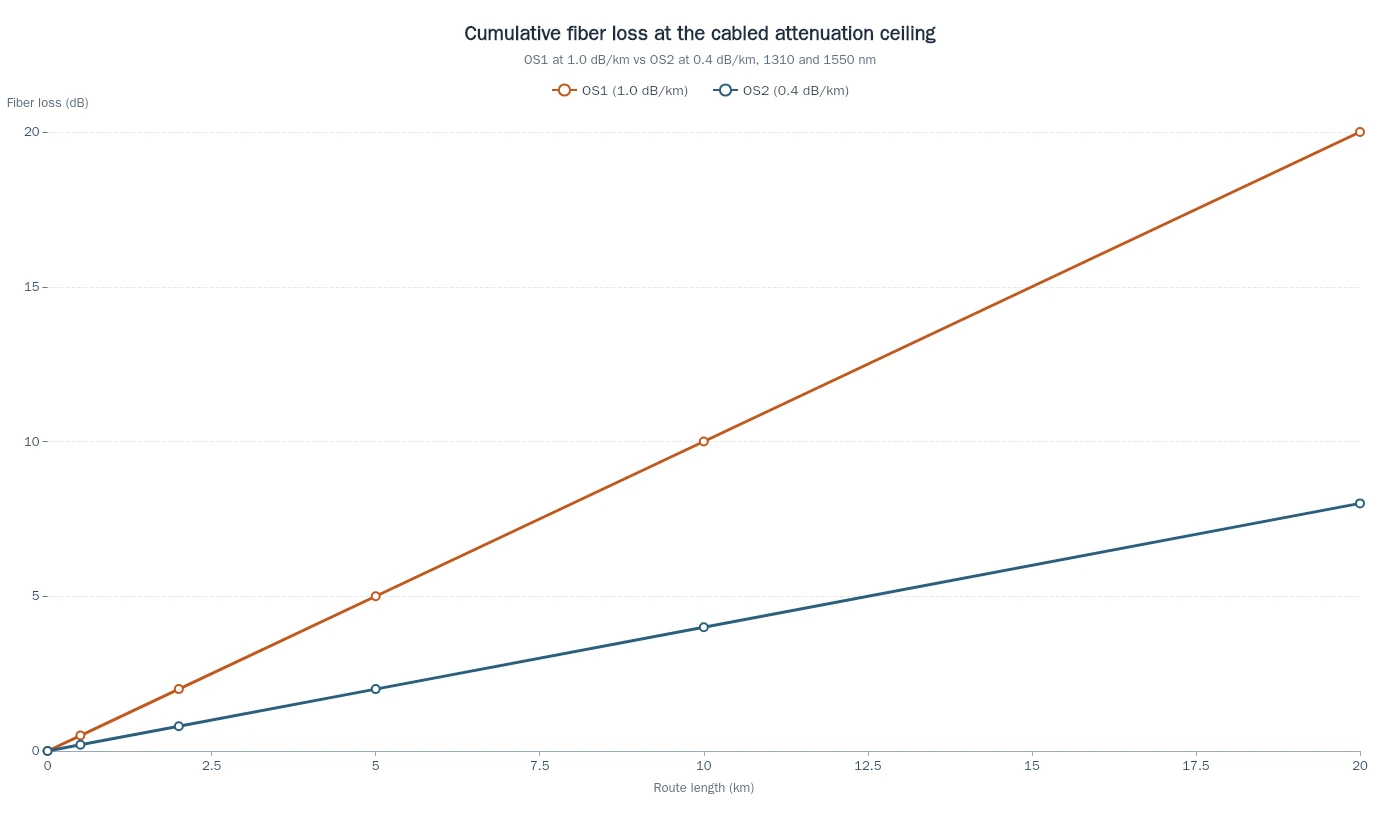
Read the difference column against the passive loss figures in the FOA loss budget reference: factory-terminated single-mode connections typically cost 0.1–0.2 dB each, TIA-568 allows up to 0.75 dB per mated pair, and a single-mode fusion splice is normally under 0.05 dB. At 10 km, the 6 dB gap between the two categories is the same as 30 factory connections at 0.2 dB, or eight at the TIA worst case. Below 2 km it is 1.2 dB — real, but inside the margin most designs already carry. That threshold, not a rule of thumb about indoor and outdoor, is what should decide the category on a short campus link.
"OS2 runs 200 km" is not a category property. Distance is a property of the link budget: transmitter launch power, receiver sensitivity, connector and splice count, plus whatever amplification or coherent optics the design uses. What the category fixes is loss per kilometer. At 0.4 dB/km a 100 km span costs 40 dB of fiber loss before a single connector is counted, which is far beyond the loss any short-reach single-mode optic will tolerate; the same cable on a 200 km route needs amplification regardless. Quote the budget, not the category, when a customer asks how far the cable reaches.
Tight Buffer vs Loose Tube: Why the Construction Follows the Ceiling
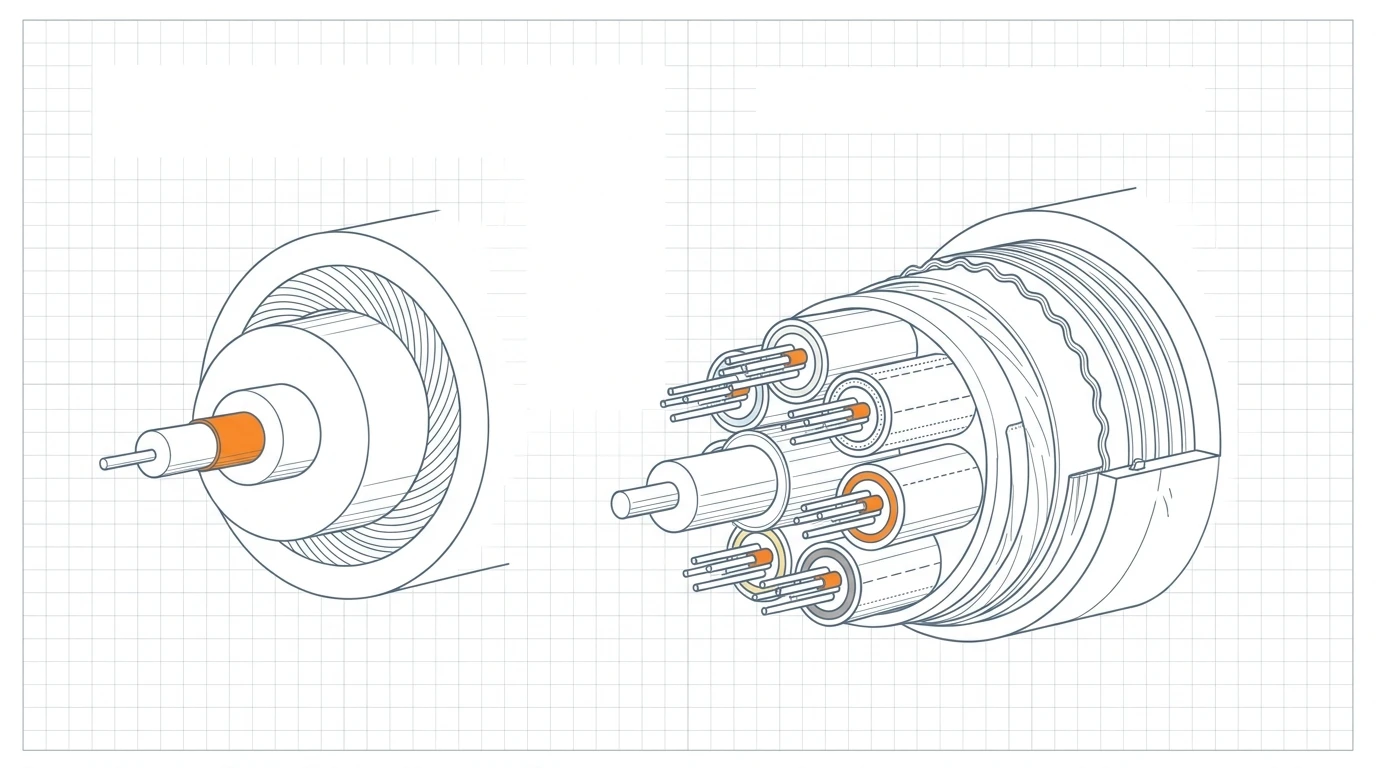
Tight-buffered cable applies a 900 µm buffer directly over the fiber's 250 µm coating. It is compact, easy to strip and terminate, and it holds the fiber still — which is what you want in a patch cord, a riser, or an equipment-room run. The trade is that bending and thermal movement in the jacket are transmitted into the glass, and microbending raises attenuation. Loose-tube cable gives the fibers a semi-rigid tube with excess length inside, so the cable can stretch and contract without loading the glass.
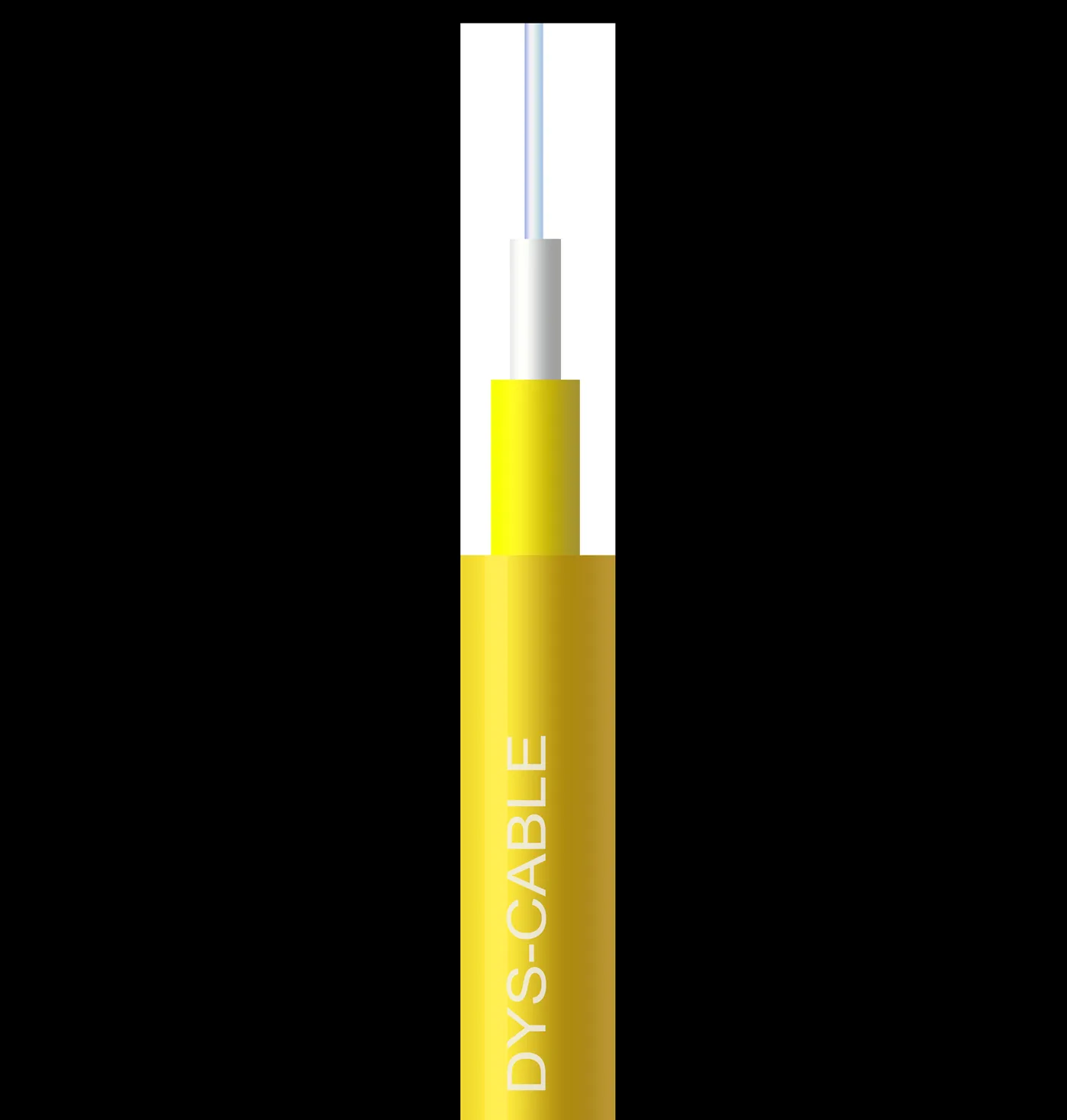
That is the mechanism behind the OS1-to-tight-buffer and OS2-to-loose-tube pairing. CommScope's note on tight-buffered single-mode cable makes the engineering argument directly: the confusion between OS1 and OS2 leads buyers to select cable that does not meet the requirement they actually have, in either direction. The reasoning behind the 0.4 dB/km ceiling is narrower than the folklore — it is a figure that loose-tube and blown constructions can hold because the cabling process applies no stress to the fiber. A tight-buffered design can hold it too, if the manufacturer controls the process, which is why indoor/outdoor tight-buffered OS2 products exist and are routinely specified for inter-building links that never leave a tray.
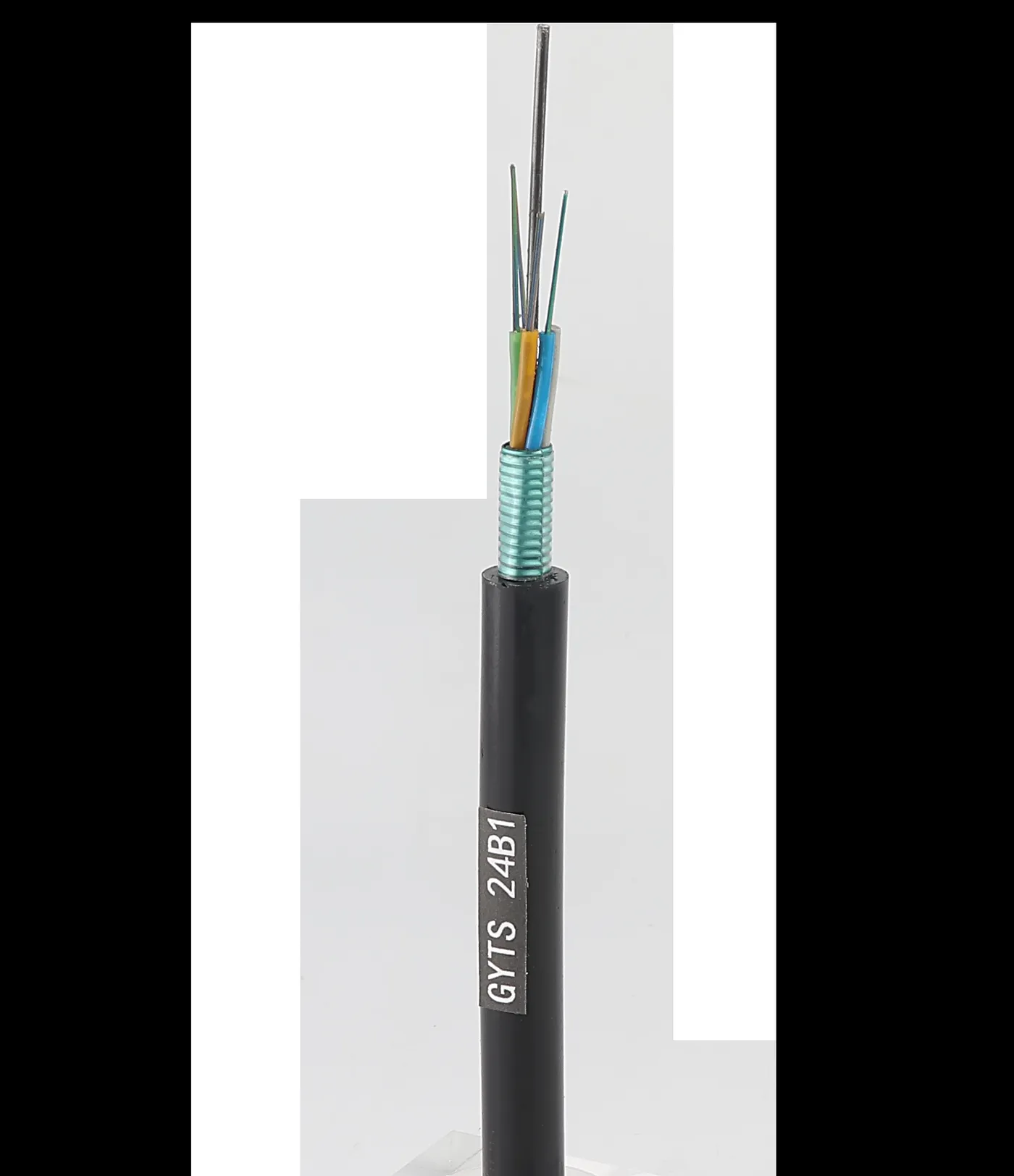
The outdoor cable above shows what OS2 cable normally looks like in the field: tubes stranded around a central strength member, a corrugated steel armor, and a polyethylene sheath, with the fibers free to move inside their tubes. The construction that earns the 0.4 dB/km figure is the same one that survives water ingress, rodents and tensile load. For the wider construction comparison — armor, jacket materials, indoor versus outdoor ratings — see indoor and outdoor cable construction.
Practical rule: choose the construction the route requires, then check that the cable's tested attenuation meets the category you need. Choosing a category first and letting it pick the construction is how outdoor cable ends up in a riser.
The 1383 nm Water Peak: The One Difference That Is Really in the Glass
Everything above is cable engineering. The 1383 nm requirement is the one place where OS1 and OS2 differ because of the glass. Hydroxyl ions left in the preform create an absorption peak near 1383 nm, in the middle of the E-band. Legacy G.652.A and G.652.B fiber is allowed to keep that peak; G.652.C and G.652.D suppress it, which is what "low water peak" means.
This matters only when the channel plan reaches into that region. A CWDM system running the 1270–1610 nm grid has channels sitting in the E-band, and a cable with a water peak will post losses there that no amount of link-budget margin absorbs. That is why OS2 is the default for CWDM and DWDM access and metro builds, and why the OS1a category exists at all: it keeps the OS1 attenuation ceiling but requires the 1383 nm limit, so a lower-grade cable can still be used across the full band.
If you are choosing between fiber grades rather than cable categories, the G.652.D, G.657.A1 and G.657.A2 compared breakdown covers the bend-radius and dispersion trade-offs inside the low-water-peak family.
Where Each Belongs: Route, Environment, and Fire Rating
Route | Category | Why |
|---|---|---|
Equipment room, patching, jumpers | OS1 or OS2 tight-buffered | Short runs; attenuation ceiling is irrelevant, handling and fire rating are not |
Riser and horizontal inside one building | OS1 (OS2 acceptable) | Distances are short; the indoor fire rating is the binding constraint |
Building-to-building on campus, in duct or tray | OS2 | 1–10 km puts the attenuation difference in play; outdoor jacket needed |
Underground duct, direct burial | OS2 loose tube, armored as required | Water blocking, crush and tensile performance come from the construction |
Aerial lashed or ADSS | OS2 | Same, plus span and wind load handled at cable level |
FTTH feeder, distribution and drop | OS2 | Operator channel plans, CWDM where used, and long feeder spans |
Any route carrying CWDM or DWDM | OS2 (or OS1a at minimum) | The 1383 nm limit is what makes the E-band usable |
Two corrections to the usual indoor/outdoor shorthand. First, OS1 is not what makes a cable compliant indoors — the fire rating is. A riser run needs OFNR, a plenum run needs OFNP, and a European project works to CPR classes; none of that follows from the OS category. Second, OS2 does not mean outdoor-only: tight-buffered indoor/outdoor OS2 is a standard product for links that run between buildings through trays and penetrations. The OFNR, OFNP and LSZH fire ratings article covers the classes and where each applies.
For the broader map of cable types and the environments they serve, the fiber optic cable types and where they are used guide is the parent reference for this cluster. And if the open question is how far a given link will actually reach on a given transceiver, how far a fiber run can go works through the reach limits by Ethernet rate.
Mixing OS1 and OS2 on One Link
You will read that OS1 and OS2 cable cannot be connected. At the fiber level that is wrong. Both are 9/125 µm with mode field diameters in the same family, so a fusion splice between them behaves like any other single-mode splice, and the connectors are interchangeable. What you cannot do is inherit the better category.
Three rules cover the real cases:
- Splicing and mating are fine. Expect the same sub-0.05 dB fusion splice you would get between two lengths of the same cable.
- The link takes the worst segment's attenuation. If 2 km of an 8 km route is OS1, the route's attenuation is no longer describable as 0.4 dB/km, and any acceptance test written against OS2 will fail on the fiber-loss term. Record the segment categories, not just the end-to-end length.
- Wavelength plans are the trap. A mixed link that is fine at 1310 and 1550 nm may lose a CWDM channel to the OS1 segment's water peak. If the channel plan uses the E-band, every segment has to be low-water-peak.
The one thing worth writing into the as-built documentation is a per-segment category table. Ten years from now, when someone adds a 100G wavelength to a link installed as "single-mode", that table is the difference between a planned upgrade and an unexplained outage.
Is There an OS3?
No. The ISO/IEC 11801 single-mode categories are OS1, OS1a and OS2, and there is no OS3 in the series, in EN 50173-1, or in the IEC 60793-2-50 fiber classes. Searches for "os1 vs os2 vs os3" are usually reaching for one of two real things: the OS1a category described above, or the next multimode generation, OM5, which is a wideband multimode category and has nothing to do with single-mode cable.
If a supplier offers you "OS3 fiber", ask which document defines it. There is no answer that survives a check against the standards, and that is worth knowing before the purchase order goes out.
What to Write in the Specification
Most OS1-versus-OS2 disputes are specification defects, not product defects. Four lines prevent nearly all of them:
- Cabled category and the standard edition — for example, "OS2 in accordance with ISO/IEC 11801-1", or "OS2 with a maximum cabled attenuation of 0.5 dB/km at 1310 and 1550 nm to TIA-568" where the project is TIA-governed. Naming only the category leaves the ceiling ambiguous across regions.
- Fiber class — B1.3 (G.652.D) as the default, B6_a (G.657.A1) where the route forces tight bends. This is what actually controls dispersion, mode field and bend behavior.
- Fire rating and environment — OFNR, OFNP, LSZH or the applicable CPR class, plus whether the cable must be water-blocked, armored or UV-rated.
- Acceptance test — attenuation per kilometer at 1310, 1383 and 1550 nm, measured on the delivered cable, with the test method named. A category claim without a test wavelength set is not verifiable.
Suppliers who build both construction families in one plant can usually tell you which of the two is easier to certify for your route, because the answer depends on the test data they already hold for that construction. DYS builds both: tight-buffered indoor cables for risers and patch fields, and loose-tube outdoor cables for duct, aerial and burial. The FTTH drop cable range is the usual starting point when the route ends at a subscriber.
FAQ
Is OS2 better than OS1?
Optically, yes: 0.4 dB/km is a tighter ceiling than 1.0 dB/km, and OS2 carries the 1383 nm requirement that OS1 legacy cable may not meet. Whether that matters depends on the route. Below roughly 2 km the difference is about 1 dB, which most designs already carry as margin; the construction and price difference is real either way.
Can you splice OS1 to OS2?
Yes. Both are 9/125 µm single-mode cable with compatible mode field diameters, so fusion splicing and connector mating work normally. What you cannot do is describe the finished link as OS2 — its attenuation is set by the worst segment, and a CWDM channel plan is limited by any segment with a water peak.
Is OS2 the same as G.652.D?
Not the same thing. G.652.D is a fiber specification from ITU-T; OS2 is a cabled category from ISO/IEC 11801 measured on the finished cable. G.652.D fiber is the usual input to OS2 cable, but the category also covers G.657.A1 and A2 fiber, and the attenuation limit is tested after cabling rather than on the bare fiber.
How far can OS2 single-mode cable run?
The cable does not set the distance — the link budget does. At the 0.4 dB/km ceiling, 10 km costs 4 dB of fiber loss and 40 km costs 16 dB, before connectors, splices and any amplification. Whether a given transceiver closes that budget is a question for the optics datasheet, not the cable category.
The specification line is where this decision stops being a debate. If your bill of materials currently says "single-mode, OS2" with no standard edition, no fiber class and no test wavelengths, it is describing a hope rather than a requirement — and the cable that arrives may meet every word of it while failing the link it was bought for.
If you are rewriting that clause, send us the route length, the environment it runs through and the standard your project is governed by. We will come back with the construction that suits the route and the test data behind the figure.