
Data Center
Buying MPO Trunks: Specs, Test Reports, Lead Time
An MPO trunk is rarely the largest line on a data center bill of materials. It is the line that decides whether the link comes up on the night you planned. A pre-terminated trunk is not a cable you can adapt on site: fiber count, ferrule generation, gender, polarity, fiber grade, jacket, length and end labeling are all frozen the moment the factory cuts the fiber. Buy the wrong polarity on a parallel 8-lane link, or a 12-fiber trunk for a 16-fiber SR8 port, and you own a perfectly good assembly that will never carry traffic. This guide covers the buyer's side of that transaction — the five specifications worth arguing about, what a test report has to contain before you accept a shipment, and the lead-time questions that separate a supplier who gives you a date from one who gives you a number. It sits inside our Data Center Fiber Cabling Guide, which covers the MPO/MTP system design behind these purchases.
Key takeaways
- The purchase order freezes eight things you cannot change later. Fiber count per connector, ferrule generation, gender and pinning, polarity method, fiber grade, jacket compound, length with tolerance, and end labeling. Every dispute after delivery traces back to one of them.
- "0.35 dB" means nothing until you know the measurement convention. Per-connector and per-mated-pair insertion loss are different numbers, and the same grade badge is used for both.
- Ask for per-fiber data, not a per-cable maximum. A report that lists one insertion-loss figure for a 144-fiber trunk documents nothing you can use during commissioning.
- Lead time is set by the scarcest step, not the cable. Ferrule supply, unique-length setup, and the 100% test queue move the ship date far more than fiber does.
- Two questions close most of the risk: which step is your critical path this month, and is this every assembly or a sample.
What the purchase order actually freezes
A pre-terminated MPO trunk arrives as a finished optical component: multi-fiber connectors polished and tested at both ends, a fixed length of cable between them, and a test record that is supposed to follow the serial number. Nothing about it is field-adjustable. You cannot re-polish an end face in a rack, you cannot reverse a pinned connector, and you cannot stretch a 28 m trunk to 31 m.
That is the whole commercial argument for the product — the loss is made in a factory under a microscope instead of in a tray under time pressure. It is also why the buying process is front-loaded. The comparison between pre-terminated trunks and field termination covers when the trade is worth making; this article assumes you have decided it is, and covers how to specify and accept the goods.
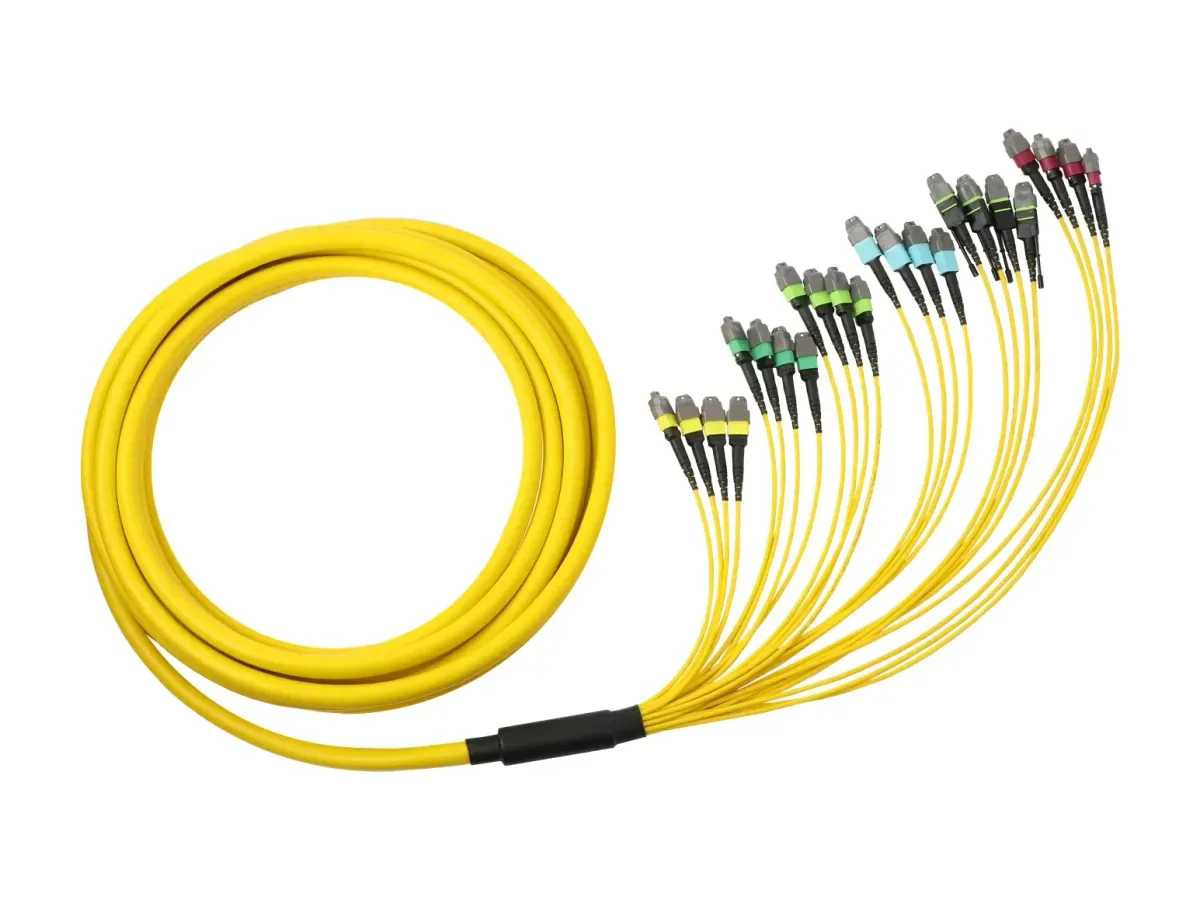
A factory-terminated assembly is a component, not a length of cable: every end is terminated, polished, measured, and serialized before it ships.
Decision | Frozen at factory? | Where it goes wrong |
|---|---|---|
Fibers per connector and total count | Yes | 12F trunk ordered for a 16-fiber SR8 port |
Ferrule generation (MPO-12 / MPO-16 / MPO-24) | Yes | Mixed generations across a channel |
Gender (male/pinned, female/unpinned) | Yes | Two female ends, no adapter will mate them |
Polarity method (Type A / B / C, Method B) | Yes | Link lights up dead or transmits backwards |
Fiber grade (OS2 / OM4 / OM5) | Yes | Reach or modal-bandwidth shortfall |
Jacket (OFNP / OFNR / LSZH, CPR class) | Yes | Code inspection failure after install |
Length and tolerance | Yes | Assembly too short to reach the panel |
End labeling | Yes | Hours of tracing during commissioning |
Spec 1 — Fiber count and ferrule generation
MPO connectors exist in 8, 12, 16, and 24-fiber formats, and a trunk with 144 fibers is simply a bundle of those connectors at each end. The format is not cosmetic: it decides which optics the trunk can serve, and it is the first number a supplier will quote back to you.
400G link type | Fibers used | Module-side connector |
|---|---|---|
400GBASE-SR8 (OM3/OM4, 8 × 50G) | 16 | MPO-16, APC |
400GBASE-SR4.2 (OM3/OM4/OM5, 4 × 100G) | 8 | MPO-12, APC |
400GBASE-DR4 (OS2, 500 m) | 8 of 12 | MPO-12, APC |
400GBASE-FR4 (OS2, 2 km) | 2 | Duplex LC |
The 400G physical layer definitions behind that table are split across three projects: the IEEE 802.3cm task force for the multimode types (SR8 and SR4.2), IEEE 802.3bs — published in 2017, so the standard itself carries no draft prefix — for 400GBASE-DR4, and IEEE 802.3cu for 400GBASE-FR4; the Ethernet Alliance 400GbE overview is a readable entry point. Confirm the row against your actual module datasheet before you order — vendors ship extended-reach variants with different assumptions.
The practical buying consequence: an installed 12-fiber plant cannot host 400GBASE-SR8 without a conversion, so if your design mixes SR8 and SR4.2 you are buying two ferrule generations into the same cable management space. Ask the supplier how many MPO-16 versus MPO-12 ferrules the quote contains, and whether they build both on the same line. If the answer is one generation only, your channel design has to change, not the order. For how the fiber-count decision maps onto the 400G and 800G migration, see the 400G to 800G cabling guide.
Spec 2 — Gender, pinning and polarity
Three fields get collapsed into the word "polarity" in most RFQs, and they fail in different ways.
Gender and pinning. An MPO connector is male (with guide pins) or female (without). Two connectors mate in an adapter, so every mated pair needs one of each. A trunk pinned male–female is the common default; trunks pinned female–female require pinned adapters or male patch cords at both ends. Specify which, and specify it per end — a quote that answers "standard" to the gender question has not answered it, and the answer has to be checked against the adapters you are actually installing.
Polarity method. Type A is straight, Type B flips the fiber order, Type C flips in pairs; which one you need depends on the patch panels and cassettes at both ends, not on the trunk alone. The MPO polarity explainer walks the full channel.
Connector family. MPO and MTP describe the same multi-fiber interface; MTP is a licensed brand name for a refined ferrule and housing from US Conec, and the two mate with each other. Whether the quote is MPO or MTP matters for ferrule tolerance and price, not for compatibility — MPO vs MTP covers the difference in detail.
The buying move here is documentation, not negotiation. Send the supplier your channel diagram — every patch panel, cassette, and adapter between the two transceivers — and ask them to confirm the polarity map in writing before production starts. A polarity error passes a loss test and fails traffic, which is the most expensive class of defect to find at 2 a.m.
Spec 3 — Loss grade: standard or low-loss, and per what convention
Insertion loss is where grade names get slippery. The numbers below are assembly limits for the connector at each end; they are the figures a factory can certify to.
Connector and fiber | Standard grade, IL max | Low-loss (Elite-class), IL max | RL min |
|---|---|---|---|
MPO, single-mode, 12F APC | 0.70 dB | 0.35 dB | 60 dB |
MPO, single-mode, 24F APC | 0.75 dB | 0.35 dB | 60 dB |
MPO, multimode, 12F/24F PC | 0.50 dB | 0.35 dB | 20 dB |
The figures are the limits these assemblies are built and certified to, taken from the product datasheet rather than from one universal public standard, and they are per connector, not per mated pair. The single-mode numbers are set per fiber count — 0.70 dB at 12 fibers, 0.75 dB at 24 — and multimode standard grade is commonly quoted at 0.60 dB by other suppliers. Compare the number, not the grade name.
Single-mode assemblies are tested at 1310 and 1550 nm, multimode at 850 and 1300 nm. The 0.35 dB low-loss benchmark is the figure US Conec publishes for its MTP connector line, and equivalent low-loss MPO grades are specified against it. For context on what the standards permit at the connection level, TIA-568.3 — maintained by the Telecommunications Industry Association — allows up to 0.75 dB per mated connection for component conformance, and the Fiber Optic Association's loss-budget reference gives planning values in the same range. Those are ceilings for conformance, not targets: a link budgeted at the ceiling has no margin left for aging or re-mating.
Two questions convert a grade badge into a purchase decision:
- Is the quoted figure per connector or per mated pair? A mated pair is two connectors joined in an adapter, so its loss is the sum of both. A supplier quoting "0.35 dB" for a mated pair and one quoting "0.35 dB" per connector are describing different hardware by roughly a factor of two.
- What does the arithmetic do to my channel? Take a 400GBASE-SR8 channel with a 1.9 dB allowance over OM4 and two mated pairs in the path — four connectors. At the 0.50 dB per-connector multimode figure in the table above, those four connectors consume 2.0 dB, which is past the 1.9 dB allowance before the fiber contributes anything. At 0.35 dB per connector the same four connectors consume 1.4 dB and leave 0.5 dB for the fiber run and the margin. Read that 0.50 dB as a per-mated-pair number instead and the channel looks like 1.0 dB — which is how a link budget quietly halves its connector loss. Our 400G loss-budget walkthrough does that arithmetic connector by connector, and the insertion loss vs return loss explainer covers the physics behind both columns.
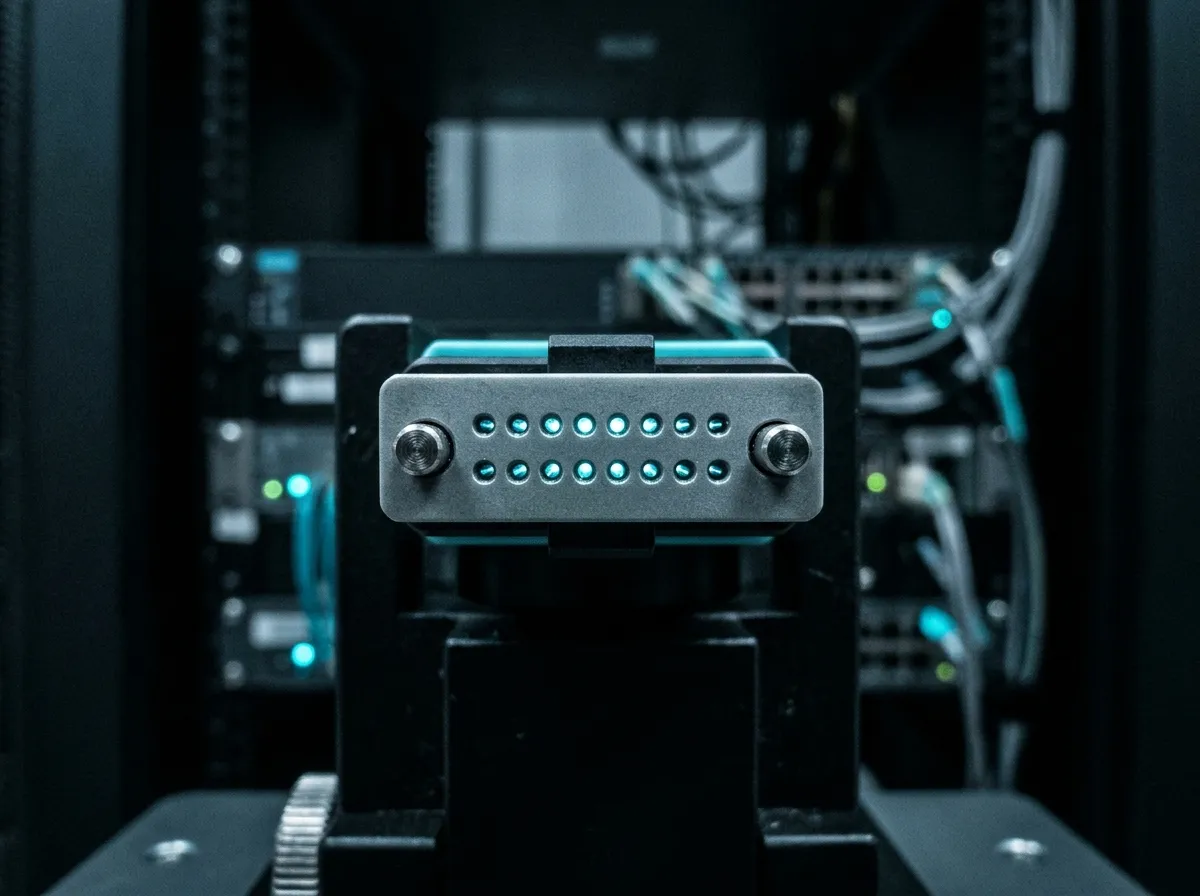
A 16-fiber ferrule puts eight fiber pairs in one interface. At low-loss grade, the polish and alignment of every one of those cores has to hold.
Spec 4 — Fiber grade, jacket and construction
Fiber grade follows from reach and from the optics you already own: OM4 for short multimode links, OM5 where wideband multimode is in the design, OS2 (G.652.D, or bend-insensitive G.657.A1/A2 in tight trays) for single-mode runs. Grade is not upgradable after manufacture, and the difference between OM4 and OS2 is not a price line — it is a different transceiver.
Jacket is a code-compliance decision. In North America the choice is between OFNP (plenum), OFNR (riser), and LSZH where the local authority accepts it; in the EU, the CPR reaction-to-fire class applies to cables installed in buildings. The OFNP, OFNR, and LSZH comparison sets out which rating belongs in which space. Jacket compound also has a lead-time consequence — plenum compounds are less available than LSZH and are commonly the reason a "3-week" quote becomes five.
Construction covers the parts that survive installation: minimum bend radius of 20 × cable OD under load and 15 × OD static, a pulling eye and protective sleeve for duct and tray routes, and armor where the run leaves the building. Most indoor assemblies are rated to IEC 61753-1 category C (indoor controlled environment, −10 to +60 °C, tested over five temperature cycles). If any part of the route is unconditioned, ask for an OP-rated construction (+70 °C test severity) instead of assuming the indoor rating carries.
Spec 5 — Length, tolerance and the route survey
Length is the specification buyers most often get wrong, because it is the one they delegate to a drawing. A trunk is cut once. Measure every route — riser, tray, detour around a column, the drop into the panel — and add the slack your design rules require at each end. Then state a tolerance. A supplier that cannot quote a length tolerance is telling you they cut to the nearest convenient meter.
Fanout legs deserve their own line: leg length, stagger, and tolerance. Assemblies can hold fanout tolerance to 0.5 cm, which matters when twelve legs land in twelve adapters on the same panel. Ask for the tolerance explicitly and put it in the PO, not the email thread.
Two more fields that cost nothing to specify and save hours later: labeling at both ends (rack and port, or cabinet and position), and packing format (coil diameter for tray routes, reel for long pulls, segmented boxes for multi-cabinet shipments).
What a test report has to contain
A test report is the only evidence you will have that the goods match the PO until you test them yourself. Insist on these nine fields, and reject a shipment that arrives without them:
- Identity. Assembly part number, serial number, PO line, length, fiber count, connector type per end.
- Per-fiber results. Insertion loss and return loss for every fiber at every connector — 12, 16, or 24 rows per end, not one summary row for the cable.
- Wavelengths. 1310/1550 nm for single-mode, 850/1300 nm for multimode, labeled per row.
- Method and instruments. Optical loss test set with calibrated source and meter, referenced to IEC 61300-3-4 practice, with the calibration date of the instrument recorded.
- Measurement convention. Per-connector or per-mated-pair values, and whether launch and receive reference cords are included in the number.
- End-face inspection. 100% of connectors inspected, pass/fail recorded against IEC 61300-3-35, including any re-polish or re-termination.
- Coverage. Every assembly tested, stated in words. "AQL sample" is a legitimate answer — it is just a different product, and it should change the price and your incoming inspection plan.
- Traceability. The serial on the report matches the label on the cable, and records are retained for the warranty period.
- Sign-off. Tester, date, and a revision number if anything is re-tested.
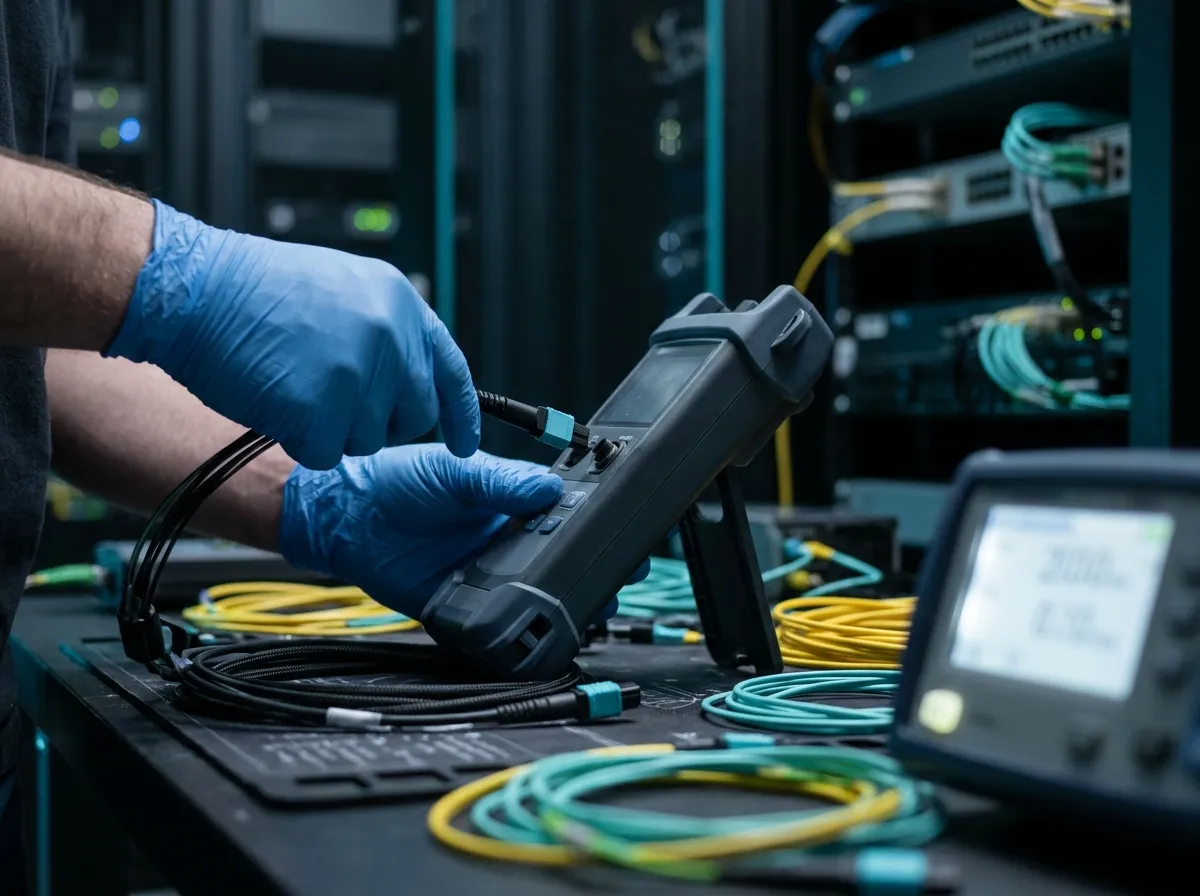
Every assembly should leave the factory with its own measured loss data, not a family datasheet.
Red flags that are worth an email before you release payment: a single max/min pair per assembly instead of per-fiber rows; a report with no serial numbers; "typical" values presented as measured data; a report dated after the shipment left; and a willingness to reissue a report without re-testing the hardware. Mechanical durability belongs in the same conversation. GR-1435 limits the change in insertion loss to ≤ 0.3 dB for standard and high-performance MPO connectors after environmental and mechanical testing, with 0.20 dB for ultra grade; its durability test runs 50 mating cycles, which is also the count IEC 61753-1 uses for connectors with rectangular ferrules. Single-fiber connectors are tested to IEC 61300-2-2, the mating-durability test method, and are commonly qualified to ≤ 0.2 dB change after 500 matings. If a supplier cannot say which of those their assembly is qualified to, the grade claim is marketing.
Lead-time questions that actually change the ship date
Lead time is not one number, and asking for "your lead time" gets you a marketing figure. Ask about the constraint instead.
- Which step is your critical path this month — ferrule supply, cable, assembly, or test? The answer tells you what to escalate if the date slips, and a supplier who can name it is running a schedule rather than quoting a hope.
- How many unique lengths are in this order? Every distinct length is a separate cut, measurement, and setup. Consolidating 40 lengths into 12 standard ones routinely moves a date more than a discount does.
- What is the polarity and gender mix? A single SKU at volume is a different production plan from eight polarity/gender variants at 50 pieces each.
- Which ferrule generation, and how many? MPO-16 and MPO-24 ferrules are less available than MPO-12, and the gap widens when the market is busy.
- Which jacket compound? OFNP plenum and CPR-rated constructions have longer material lead times than LSZH.
- What is your daily test capacity, and where is my order in the queue? 100% per-fiber testing is the bottleneck on high-count trunks; a factory that can terminate 50,000 ends a day can still only test what its benches allow.
- What is the MOQ per SKU, and will you ship partial? Partial shipment on the long-lead polarity variant is often better than waiting for a complete order.
- How long does first-article approval take? For a new part number, samples plus your approval sit on the critical path before mass production starts. Budget those days explicitly.
- How late can I change length or polarity without restarting the lead time? Get the change-freeze date in writing at PO acceptance.
- Is the quoted lead time ex-works or delivered, and by which route? Two weeks of factory time and three weeks of ocean freight are different promises.
The RFQ checklist: twelve questions to send before the quote
# | Question | What a good answer looks like |
|---|---|---|
1 | Fibers per connector and total fiber count? | Stated per end, matched to the optics table above |
2 | Ferrule generation and mix? | MPO-16 / MPO-12 stated explicitly, with quantities |
3 | Male or female at each end, pinned adapters included? | Per-end answer, not "standard" |
4 | Polarity method, and confirmation against my channel diagram? | Written confirmation of Type A/B/C map before production |
5 | Standard or low-loss grade, per connector or per mated pair? | Both numbers, with the convention named |
6 | Fiber grade and jacket rating, with CPR class if EU? | Grade plus certificate reference |
7 | Length, tolerance, fanout leg tolerance? | Numeric tolerance in the PO |
8 | 100% tested, and what does the report contain per fiber? | Sample report attached to the quote |
9 | End-face inspection standard and pass criteria? | IEC 61300-3-35, 100% inspected |
10 | Which step is your critical path, and daily test capacity? | Named process plus a capacity number |
11 | MOQ per SKU, partial shipment, change-freeze date? | Dates, not policies |
12 | Warranty, RMA terms, and who pays re-test on a return? | Written terms including re-test |
Four things that hide in the price
Price per terminated fiber, not per cable. A 144-fiber trunk at one price and a 12-fiber trunk at a twelfth of it are not the same product; compare cost per terminated end so the grade and test scope stay visible.
Whether the test report is included. A quote that excludes per-fiber test data is cheaper for a reason. Ask what a full report adds.
Who absorbs length-tolerance rework. If the assembly arrives 40 cm short, the cost is not the cable — it is the rescheduled install crew. Get the rework terms in writing.
Spares. Order 5–10% spares on the longest-lead SKUs. A single failed trunk in a 48-port row can hold a whole cabinet offline while a replacement crosses an ocean.
How we build these trunks
DYS Fiber Optic has run MPO/MTP assembly since 2014, with capacity of 50,000 MPO/MTP ends per day and an in-house precision mold workshop that controls connector tolerances rather than buying them in. Assemblies are 100% pre-terminated and factory-tested, available from 12F to 144F in OS2, OM3, OM4, and OM5, with LSZH, OFNR, or OFNP jackets, and low-loss grade at 0.35 dB maximum insertion loss for single-mode APC. The plant holds TL 9000 certification (2025) alongside ISO 9001. The MPO/MTP data center cabling range covers trunks, harnesses, cassettes, and patch panels built to the specification above.
What to do before you send the RFQ
- Draw the channel and count mated pairs — that number, not the cable length, decides your grade.
- Fix the ferrule generation from the optics table, then check the plant you are buying into can host it.
- Write the polarity map down and require written confirmation against it.
- Attach a sample test report to the RFQ and say which fields are mandatory.
- Ask for the critical path and the change-freeze date in the same email as the price request.
A supplier who answers all five in one reply is quoting a manufacturable product. One who answers only the price is quoting a cable.
If you already have the channel diagram, the length list and the report fields you need, send them in one RFQ — the reply comes back with the ferrule mix, the test scope and the change-freeze date, not just a number.