
Cable Selection
Ribbon vs Loose Tube Fiber Cable: 7 Differences
Short answer: ribbon cable wins when the route has few splice points and a lot of fibers; loose tube wins when the route has many taps, tight vaults, or a crew that splices single fibers. Everything else in the ribbon vs loose tube decision follows from four route facts — how many fibers you need, how many places you have to splice them, how many places you have to tap into them, and what your crews are equipped to do.
That is not the framing most pages use. Most ribbon fiber vs loose tube writing argues one construction against the other as if it were a generation gap. It is not: the two cables solve the same problem — getting glass from A to B without stressing it — and they differ in where they spend your money. Ribbon spends it on cable handling, duct capacity and splicer skill; loose tube spends it at the splice point, one fiber at a time.
Two clarifications before the numbers. "Ribbon" here means fiber-optic ribbon cable, a matrix of fibers bonded side by side — not dental ribbon, which is a live source of confusion in search results for this term. And if your question is broader than construction — grade, jacket, fire rating, application — the cable selection guide puts construction in its proper place as one of four independent choices.
Two constructions, one decision: what is actually inside the jacket
A loose-tube cable puts bare 250 µm fibers, or occasionally 200 µm fibers, inside gel-filled or dry tubes. The tubes are stranded around a central strength member, then wrapped in water-blocking tape, armor and a polyethylene jacket. The fibers float: they are longer than the tube that contains them, which is what lets the cable stretch under tension without stretching the glass.
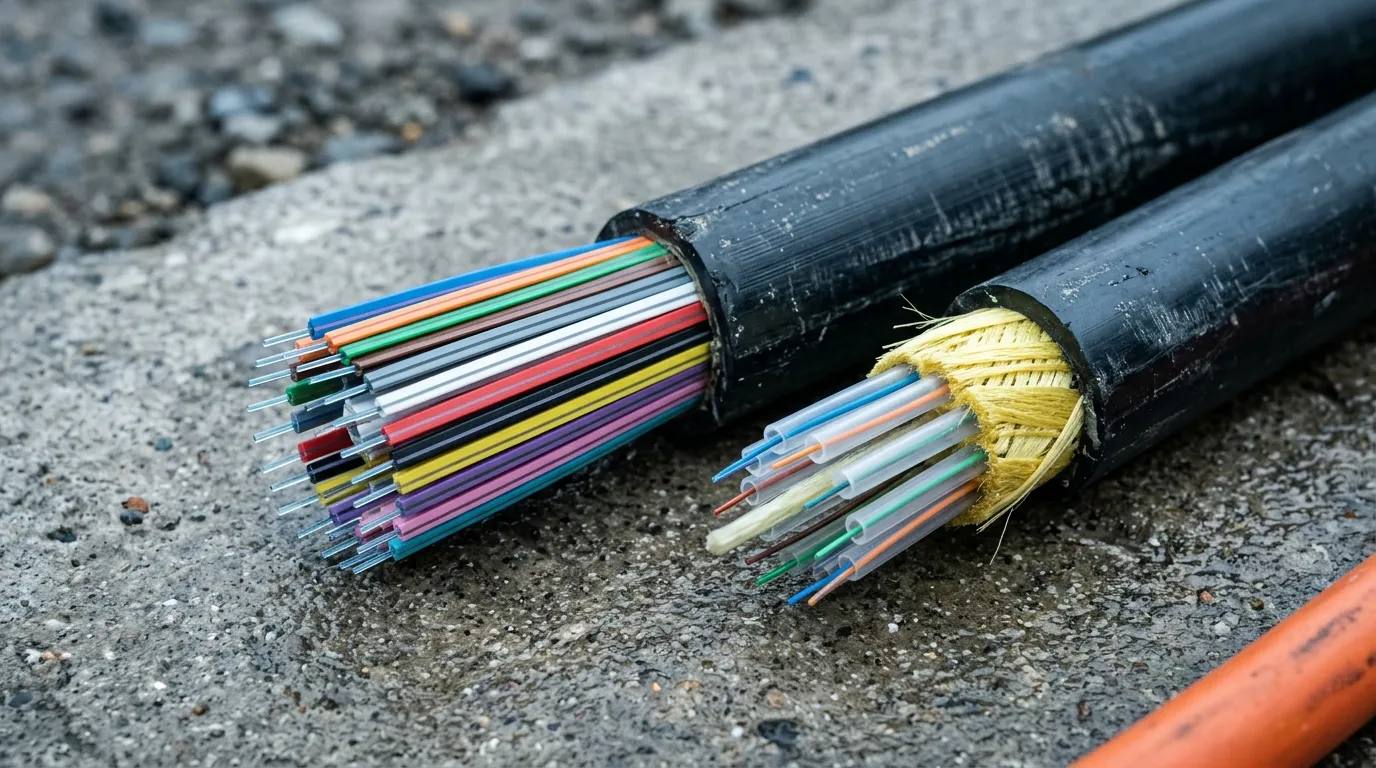
A ribbon cable bonds fibers into a flat matrix first — 12 is the standard count, 24 exists — then stacks those ribbons inside a central tube or distributes them across stranded tubes. Nothing floats: the fiber geometry is fixed at the factory, which is why twelve fibers can be fused at once and why the cable behaves differently in a bend.
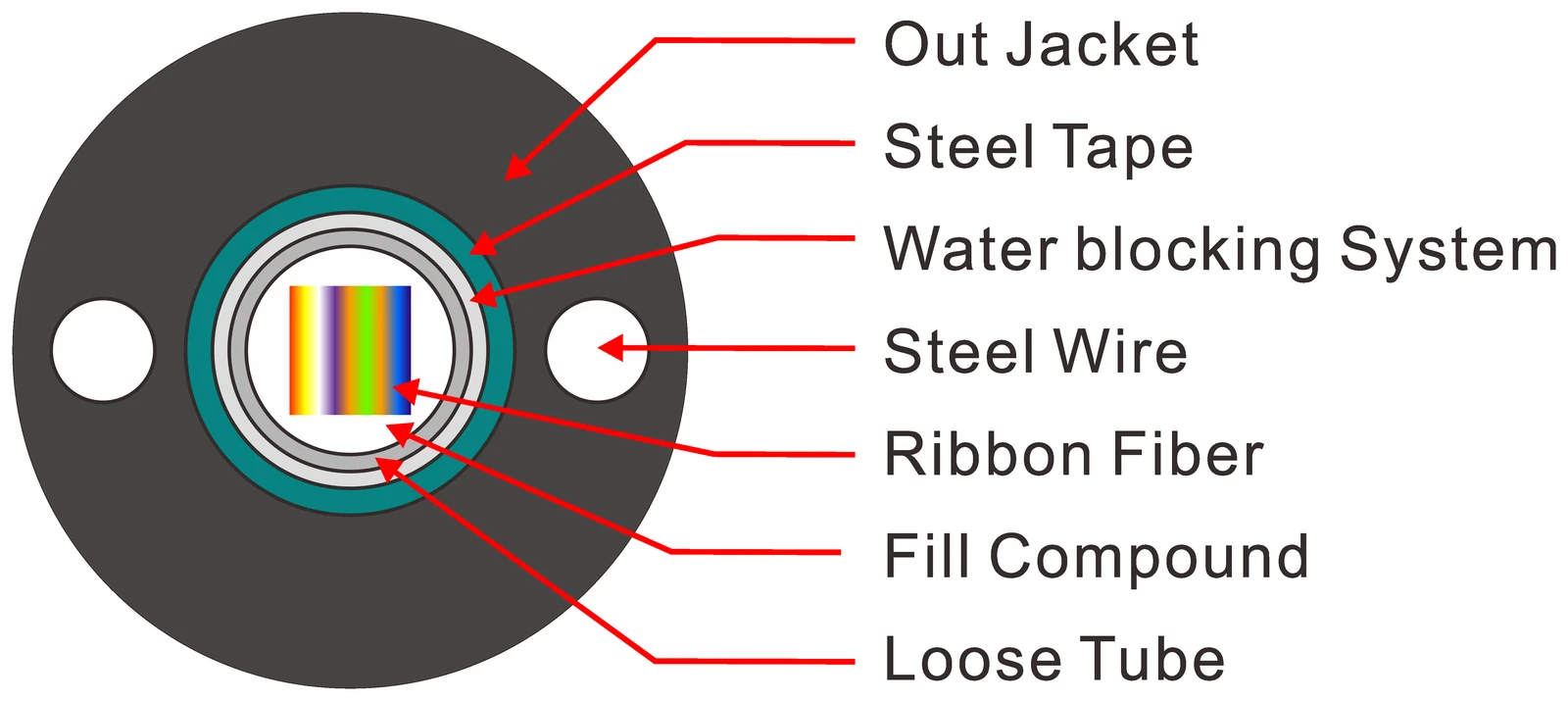
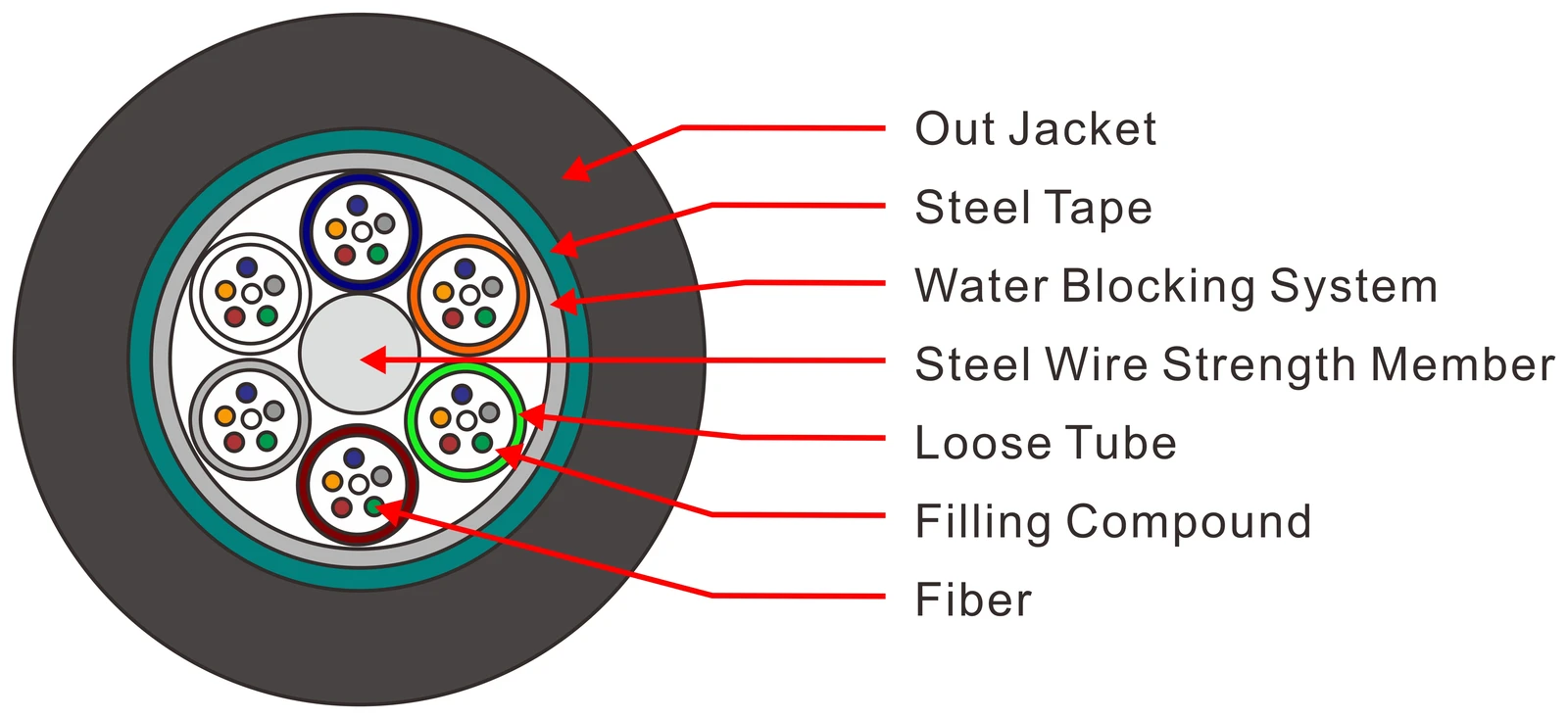
You can usually tell which one is on the reel before you cut anything, but do not read that off the jacket alone: print legends vary by manufacturer, so check the marking against the datasheet rather than assuming a convention. What does not vary is the end. A ribbon cable's tube opens to a flat, bonded strip that stays flat when you let go; a loose tube opens to a bundle of individually coated fibers that springs apart. The practical consequence is slit depth: on some central-tube designs the ribbon stack sits closer to the steel tape than a loose-tube bundle would, so a jacket slit that is safe on loose tube can score a ribbon. Cut shallow, then peel.
If construction language is already blurring into grade and jacket, how fiber cable types break into grade, construction and jacket keeps the three axes apart.
Difference 1 — fiber density: how much of the cross-section is glass
Density is the difference ribbon was invented for, and it is measurable. The Fiber Optic Association's reference on high fiber count cables reports that 54% of a 3,456-fiber ribbon cable's cross-section was fiber, against roughly 14% for a typical 144-fiber loose-tube cable and 36% for a 144-fiber microcable. The 1,728-fiber cable carries as many fibers as twelve 144-fiber cables in a cable of about twice the diameter.
Two levers got it there. Fibers are packed in a matrix rather than in round tubes with gaps between them, and the coating diameter drops from 250 µm to 200 µm. Those 200 µm fibers are bend-insensitive designs, specified under ITU-T G.657, because tighter packing means tighter bends in service.
At the top of the range the numbers stop being abstract: Prysmian publishes a 6,912-fiber ribbon cable that installs in a 2-inch duct at 77% fill, with the ribbons rolled into 288-fiber sub-units for routing. A loose-tube design cannot reach that count in that duct.
Density also hides a cost. A higher-count cable means fewer cables per route, fewer pulls and smaller duct banks — but more expensive cable per kilometer, and a preparation mistake wastes a far more expensive length. On a route with no duct constraint and 96 fibers to place, density buys nothing. If it avoids a second duct build, it buys the project.
For where your count sits against standard cable sizes, the fiber optic cable size chart is the faster reference than a supplier's line card.
Difference 2 — splice time: 12 fibers per burn versus one
This is the difference that pays for the cable, and it is arithmetic rather than opinion. A 1,728-fiber cable contains 144 ribbons of 12 fibers. A ribbon splicer fuses one ribbon per burn: 144 burns instead of 1,728 single-fiber splices for the same joint.
AFL measured the gap across three methods — traditional loose-tube single-fiber splicing, ribbonizing loose tube and then mass fusing, and mass fusing collapsible ribbon cable. In its comparison of the three splicing routes, fiber-to-fiber collapsible ribbon mass fusion came out about 90% faster than single-fiber splicing; fiber-to-cassette, about 75% faster. The stated reason is not the arc time. It is that mass fusion eliminates buffer-tube entry and gel cleaning, which is where single-fiber splicing actually spends its minutes.
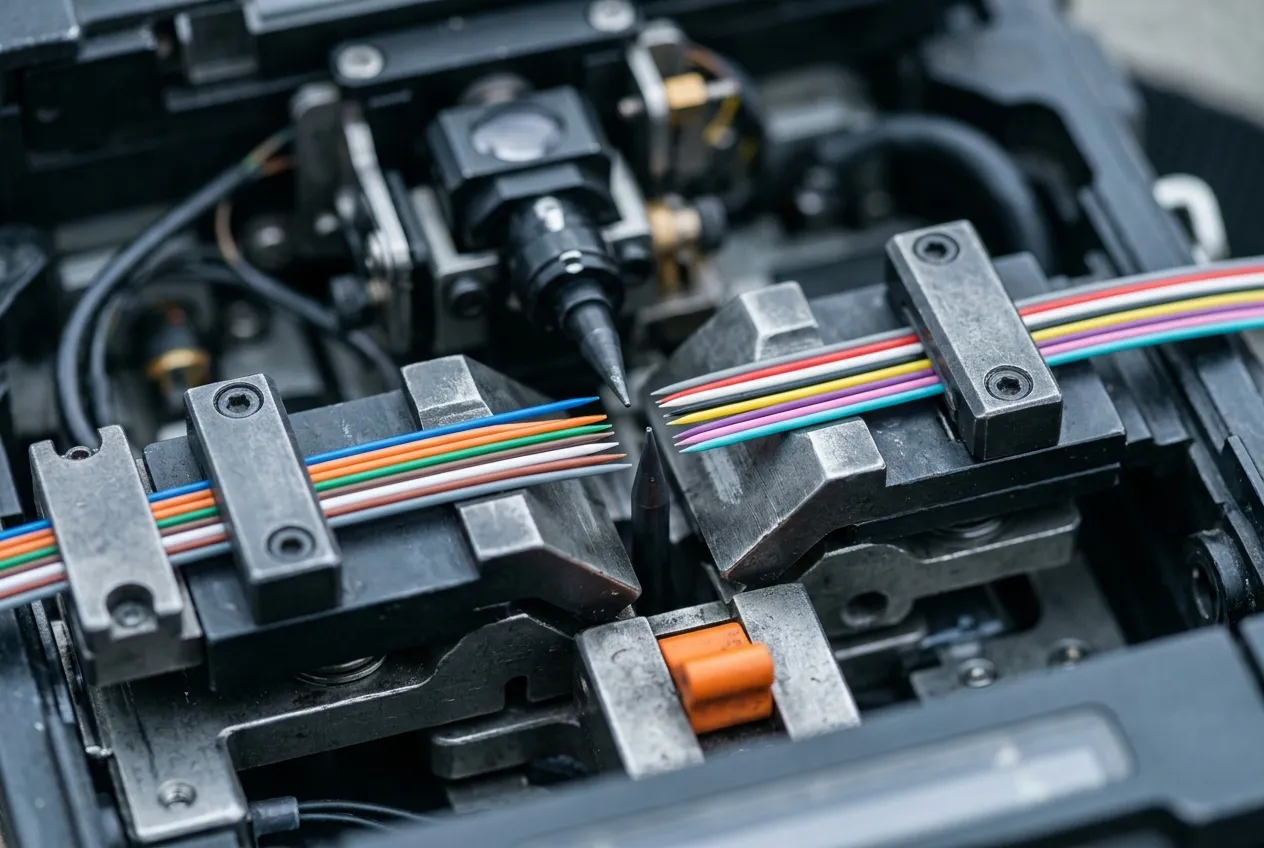
Electrode life tilts the same way. On AFL's figures, a ribbon splicer manages roughly 1,500 burns per electrode against about 5,000 for a single-fiber unit — but at 12 fibers per burn, that is 18,000 fibers per electrode versus 5,000.
Two caveats keep this honest. First, flexible and collapsible ribbons splice 50–100% slower than rigid ribbons in the field, according to the FOA, because the fibers have to be arranged and held at even spacing. Second, the prep is not free: ribbon fiber splicing still needs ribbonizing, cleaning 200 µm fibers and splicer program changes, all of which eat the time the burn saves. A 90% figure measured on a clean bench is a ceiling, not a schedule.
If you have not settled the splice method itself, fusion versus mechanical splicing versus connectorization is the upstream decision; ribbon only makes sense once fusion is the chosen method.
Difference 3 — splice loss and testing: the myth that ribbon costs you dB
The persistent objection to mass fusion is loss. It dates from the 1990s, when ribbon splicing genuinely carried a penalty. It no longer does: AFL reports average splice loss "extremely low" across hundreds of splices in current collapsible ribbon, and states plainly that the loss penalty is gone. A well-prepared mass fusion splice is not lossier than a single-fiber splice; it is the same fusion arc applied to twelve fibers at once.
Testing changes in speed, not in principle. Your loss budget is unchanged — the same connectors, splices and fiber attenuation. What changes is inspection throughput: in an MPO-style format, a technician inspects twelve fibers at once at roughly one second per fiber, instead of handling each one.
The real risk is equipment compatibility. Ribbon splicers must be set up for 200 µm fiber, and splicing 200 µm ribbon to 250 µm loose-tube fiber is harder than splicing like to like — the FOA calls it a work in progress among splicer manufacturers. If your network mixes both, ask which combination your splicer is qualified for.
Difference 4 — mid-span access: the difference that decides campus routes
This is where the neat story falls apart, and it is the factor most comparisons skip.
To tap a loose-tube cable mid-span, you open a window in the jacket, slit one tube, and pick out the fibers you need. The rest stay in their tubes, undisturbed and in service. On a 144-fiber cable with six tubes, adding two fibers to a building means handling two fibers out of twenty-four in that tube.
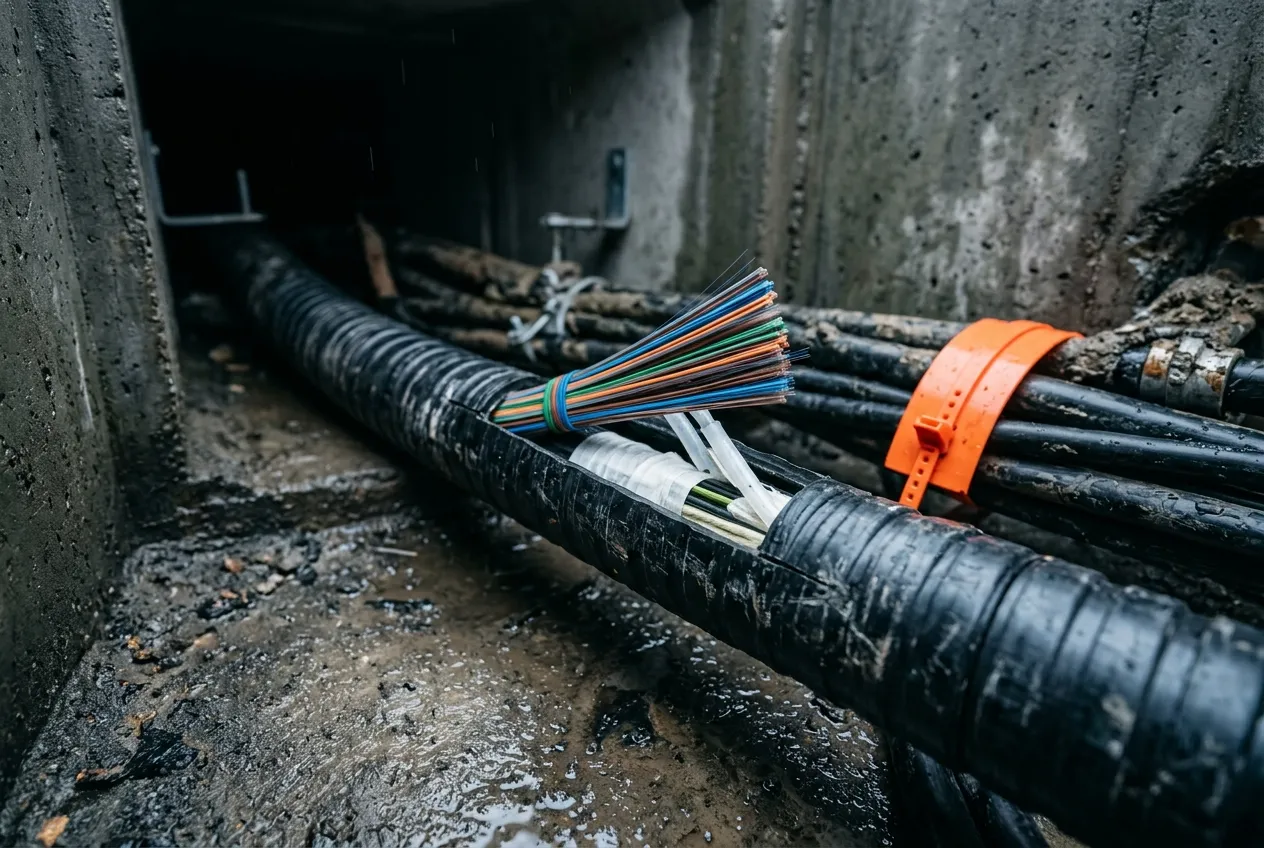
To tap an encapsulated ribbon cable, you cannot pick out one fiber; the matrix is bonded. You cut the ribbon, splice ten fibers straight through and splice two into the tap — twelve splices where a loose tube would need two, and every fiber in that ribbon is out of service while you work. If both downstream directions have to stay protected through a splitter, it becomes fourteen splices.
The splice minutes are not what makes that expensive. On these rates, a 2-fiber tap costs about 12 minutes in loose tube and about 17 in ribbon — under $25 a tap, and about $7 a tap more in ribbon. What costs real money is everything around it: the outage while the ribbon is cut and restored, a splice closure with 12-fiber tray capacity where a loose tube would have needed a pick-out window, and a re-entry every time another building is added to the same ribbon. On a route with twenty building taps, that bill — not the arc time — is what can outweigh the density saving, and it is why the rule below exists.
Collapsible ribbon — the intermittently bonded "web" construction sold under names like SpiderWeb Ribbon and FlexRibbon — deliberately restores the loose-tube behavior. As AFL's collapsible ribbon FAQ puts it, the fibers can be handpicked apart for single-fiber work and still function as a ribbon for mass fusion. That makes it the one ribbon family that survives a tap-heavy route, at a cost premium and with the slower splice times noted above.
The decision rule is blunt. If more than roughly a fifth of your splice points are taps rather than through-splices, price loose tube or collapsible ribbon before you price encapsulated ribbon — on those routes the closures and outages, not the splice time, decide the build. Count taps on the route drawing, not fibers on the datasheet.
Difference 5 — stiffness, bend radius and what the crew can physically do
A 1,728-fiber ribbon cable is about 25 mm in diameter, weighs 550–750 kg per kilometer, and carries a minimum bend radius of 15 times its diameter — roughly 375 mm, or a 750 mm bend diameter. The FOA's field account is worth quoting because it is the part datasheets omit: the cable is stiff, does not twist easily, and bends preferentially in one direction because of strength members on opposite sides. Fitting a service loop into a standard handhole is not possible; the same source describes needing close to 30 m of cable for a service loop and a vault large enough to hold it.
Loose tube is the opposite trade. Round, stranded and free of a bonded matrix, it routes through tighter spaces and tolerates the bends that real vaults impose — which is why bend-insensitive fiber grades matter most here.
None of this makes ribbon unmanageable; it makes it a different logistics problem. Reel trailers, sheave sizing, pull-tension monitoring and a two-person lift become part of the method statement. On long, straight, ducted backbone runs that is a fair exchange. In a congested urban vault with three other operators' cables in it, it is often why a crew asks for loose tube.
Difference 6 — closures, trays and the hardware you forgot to budget
Every mass fusion splice needs a tray slot, and every tray has a rated splice capacity. At 1,728 fibers per direction, a single splice point holds 144 ribbon splices through, plus the tap splices if it is a tap point — which is why high-count builds end up specifying closures by tray count and stacking arrangement rather than by port count.
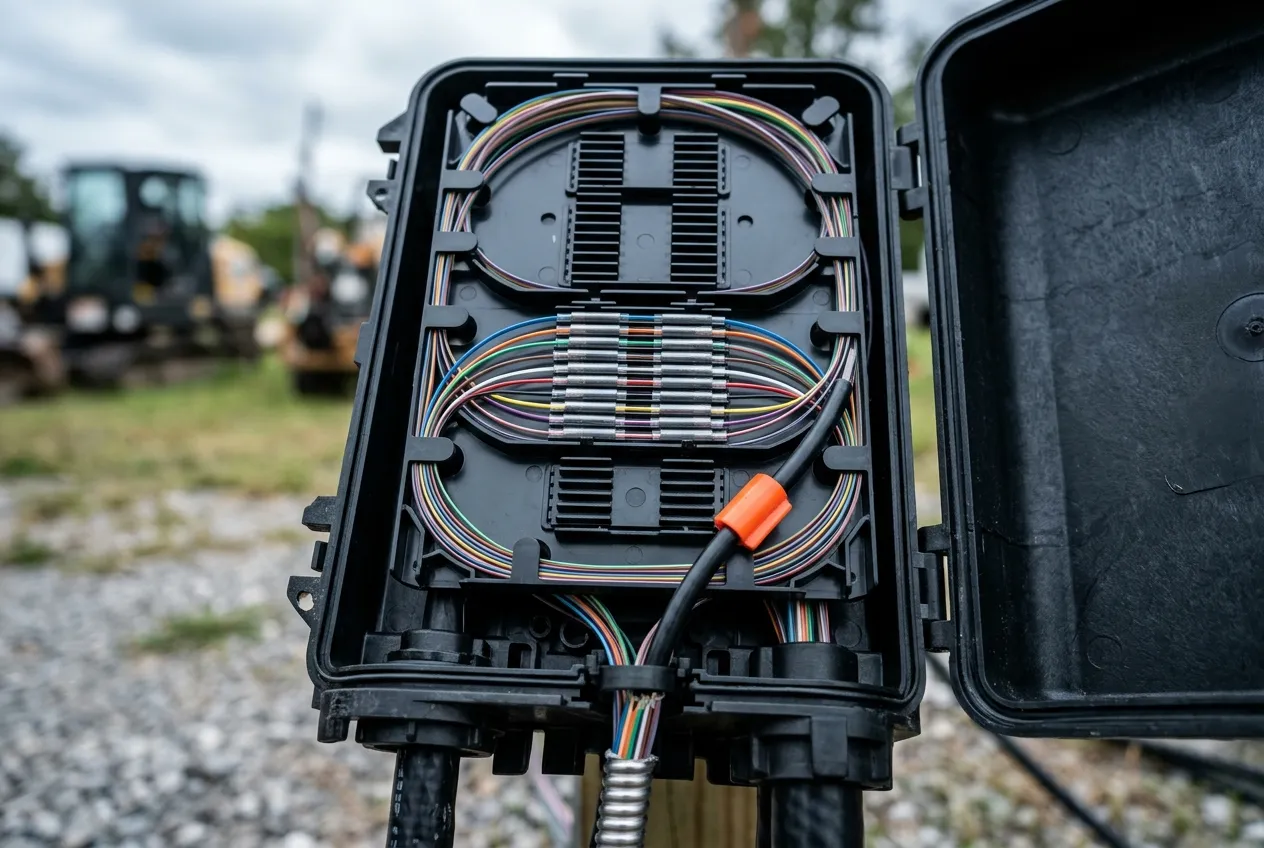
The closure, not the cable, sets the physical footprint of a splice point, and in a vault the footprint is the cost. Ribbon helps here in one specific way: a mass-fusion splice is compact, so tray capacity per liter of closure is higher than with single-fiber splices and their individual sleeves. It hurts in another: the ribbon slack loop has a minimum bend radius that a tight closure cannot accommodate.
Ask for the closure's ribbon tray capacity and its minimum bend radius before you finalize the splice-point design. A cable that fits the duct but not the closure is a redesign, not a purchase.
Difference 7 — cost: where the money actually goes
Cable price is the number procurement looks at first and the one that decides least. Labor is where the two constructions diverge, so run the arithmetic with your own rates. Here is the model, with every assumption printed so you can replace it.
Assumptions: a loaded two-person splicing crew at $85 per crew-hour (both technicians, fully loaded); 6 minutes per single-fiber splice including tube entry, gel cleaning, cleave, splice, sleeve and tray dress; 1.4 minutes per fiber for mass fusion, which is roughly 17 minutes per 12-fiber ribbon including ribbon prep.
288-fiber link, 6 splice points (1,728 splices) | 864-fiber link, 10 splice points (8,640 splices) | |
|---|---|---|
Single-fiber splicing | 173 crew-hours → $14,700 | 864 crew-hours → $73,400 |
Mass fusion (12F ribbon) | 40 crew-hours → $3,400 | 202 crew-hours → $17,100 |
Labor difference | ≈ $11,300 | ≈ $56,300 |
Per fiber | ≈ $6.50 | ≈ $6.50 |
At those assumptions the labor delta is about $6.50 per spliced fiber. It scales linearly with fiber count and with the rate: double the loaded rate and every figure doubles, because the delta is the rate multiplied by the 4.6 minutes a ribbon saves per fiber. Now weigh the counterweights: the ribbon cable's price premium per kilometer, a ribbon splicer that costs more than a single-fiber unit, ribbonizing tools, and training. And add the risk term — a badly prepared ribbon risks twelve fibers per burn instead of one, and a mis-prepared high-count cable wastes an expensive length that cannot be shortened indefinitely.
That is why the breakeven is a route question. Two splice points on a 288-fiber link will rarely repay the premium; six or more, on a route where the alternative is a second duct, usually will. If you are still at the stage of comparing supplier quotes, how fiber optic cable pricing is actually built explains which line items move.
Where each construction wins
Decision factor | Ribbon wins when | Loose tube wins when |
|---|---|---|
Fiber count | above 288, especially 864–3,456 | under 144, or 144–288 with few splices |
Splice points | few, large, accessible joints | many small joints, short spans |
Taps / mid-span access | rare; through-splices dominate | frequent building or distribution taps |
Duct capacity | duct is the constraint or a new duct is being avoided | duct capacity is not scarce |
Vault and handhole size | spacious, purpose-built | congested, existing, small |
Crew and equipment | ribbon splicer, trained crew, volume work | single-fiber splicers, mixed fleet, small crews |
Cable handling | long straight ducted runs, crane or trailer available | tight urban routes, manual handling |
Five rules that cover most routes:
- Under 144 fibers, choose loose tube unless a tap-free design and a ribbon-equipped crew say otherwise.
- Above 288 fibers with fewer than one tap in five splice points, price ribbon first.
- Tap-heavy distribution routes belong to loose tube or collapsible ribbon. Encapsulated ribbon turns a 2-fiber tap into a 12-splice interruption — 14 if the tap has to be protected both ways — and turns every tap into a closure rather than a window.
- Let the vault decide before the datasheet does. If the closure and service loop will not fit, the construction is already chosen.
- Count burns, not fibers. Schedule follows ribbon count × splice points, not total fiber.
DYS builds both families: central-tube ribbon cable from 2 to 144 fibers in the GYDXTW range, and stranded loose-tube outdoor cable such as GYTS up to 144 fibers, so the comparison above can be quoted against one supplier's datasheets rather than two.
Ribbonizing loose tube in the field: when it pays
The question technicians actually ask — do you ribbonize it or splice it single? — has a measurable answer.
Ribbonizing is bonding loose-tube fibers into a ribbon in the field. Modern tools do it without glue or cure time, which removed most of the reason crews avoided it. It pays when you have loose-tube cable on the reel but a ribbon splicer, ribbon trays and a closure built for mass fusion: you convert the cable to the splice method the rest of your kit already favors.
It does not pay when splice counts are low, when the crew would spend more time ribbonizing than the burns save, or when the closure is single-fiber anyway. And on 200 µm fiber it is fussier than on 250 µm, because the smaller coating gives less material to handle and less margin in the V-groove.
The honest test is a stopwatch, not a datasheet: time one ribbonized joint against twelve single splices with your own crew, on your own cable, then multiply by the number of joints on the route.
What to put in the RFQ
Most ribbon-vs-loose-tube arguments are settled by a datasheet too vague to compare. Require these line items and the comparison becomes mechanical.
Item | What the datasheet must state |
|---|---|
Construction | stranded loose tube, central tube, or ribbon; tube count and fibers per tube |
Ribbon | fibers per ribbon (12 or 24), encapsulated or collapsible, ribbon identification method |
Fiber | grade (G.652.D, G.657.A1/A2), coating diameter (250 µm or 200 µm) |
Standards | cable standard cited (IEC 60794 series, ANSI/ICEA S-87-640, Telcordia GR-20-CORE) |
Mechanical | tensile rating short/long term, crush resistance, minimum bend radius dynamic/static |
Environmental | operating and storage temperature range, water-blocking method (gel or dry) |
Testing | attenuation at 1310/1550 nm, OTDR trace per fiber, dimensional and mechanical test reports |
Delivery | standard reel length, marking legend, splice-ready packaging |
A worked example of the format: the GYDXTW ribbon datasheet covers 2 to 144 fibers, with 2,000 N short-term and 600 N long-term tensile, 20D dynamic and 15D static bend radius and −40 to +70 °C, published across five mechanical bands from 12 to 144 fibers. That is the level of specificity to demand, whichever construction you buy. How to spec fiber optic cable in an RFQ turns this into a full document.
Two questions buyers ask first
Can ribbon cable be spliced to loose tube? Yes. Ribbonize the loose-tube fibers or de-ribbonize the ribbon, and splice in 12-fiber batches. It costs prep time and needs a splicer qualified for both coating diameters.
Is ribbon better for FTTH? Usually not at the distribution layer, where taps are frequent and counts low. It earns its place in the feeder and backbone where splices are few and counts high.
If the route is still at the drawing stage, the useful next step is not a cable choice but a count: splice points, tap points, vault sizes, and the duct you already own. Those four numbers pick the construction for you — and if they point at ribbon, the cable selection guide carries the rest of the specification, from fiber grade to fire rating. If you already have the schedule, send those four numbers to our engineers and we will tell you which construction the route actually supports.