
Sourcing
What "Vertically Integrated" Really Means in Cable Assembly Manufacturing — and Why Buyers Should Care
A vertically integrated manufacturer owns two or more consecutive stages of making the product it sells. In cable assembly, that means mold and injection, cable extrusion, termination and assembly, and final test sitting inside one plant — instead of arriving as four purchase orders from four factories.
Most supplier pages stop at that sentence, which is why the phrase has become hard to use. Being told that a company is a vertically integrated manufacturer gives you nothing you can act on until you can name the stages it owns and the ones it still buys in. Only the owned stages are the ones it can control on the night your reels come off spec.
The generic explainers — and there are dozens of them — stay at the level of "integration reduces markups and improves quality." This one stays with the product: it walks the cable-assembly chain stage by stage, shows which numbers integration actually moves, names the situations where integration works against the buyer, and closes with six checks you can finish in a single factory visit.
What "vertically integrated" actually counts
Vertical integration is a count, not a badge. Two suppliers can both call themselves vertically integrated and mean completely different things. One owns an extruder, a mold shop and a termination line. The other owns the termination line and buys cable on reels. Both sentences are true. They are not the same supplier, and they will not fail in the same way.
Among the cable assembly houses an OEM buyer actually evaluates, the glass is bought. Fiber is drawn by a small group of global producers and arrives on spools; assembly work starts at coloring, buffering, stranding and jacketing. A supplier claiming to own the product "from sand to connector" is making a claim no assembly house we know of can substantiate. The useful question is never whether integration is total — it is where the boundary sits, and whether the boundary falls on the stages that decide your failure mode.
Stage | What it decides for your order | What an unowned stage looks like |
|---|---|---|
Mold and tooling | Housing and boot fit, seal geometry, latch strength | Tooling sits at a third party; every change becomes a purchase order |
Injection | Wall thickness, color and UV consistency, part-to-part repeatability | Parts arrive by the carton; defects surface at assembly, not at molding |
Cable extrusion | Jacket OD tolerance, fire performance, print legend, bend behaviour | Cable arrives on reels; your jacket spec is somebody else's catalogue line |
Termination and assembly | End-face geometry, insertion loss, connector retention | Assembly is subcontracted; two companies share the blame |
Final test and qualification | Who signs the IL/RL report, and against which standard | The report comes from a lab you have never audited |
Read that table as a checklist, not a scorecard. A supplier that owns five stages but not the one your project depends on is, for your project, a two-stage supplier with a long brochure. On an aerial FTTH drop through a windy corridor, the jacket and the strength member do the work; on an MPO trunk in an 800G link, termination and end-face geometry do. Integration that misses your failure mode is a fact about the supplier, not a benefit to you.
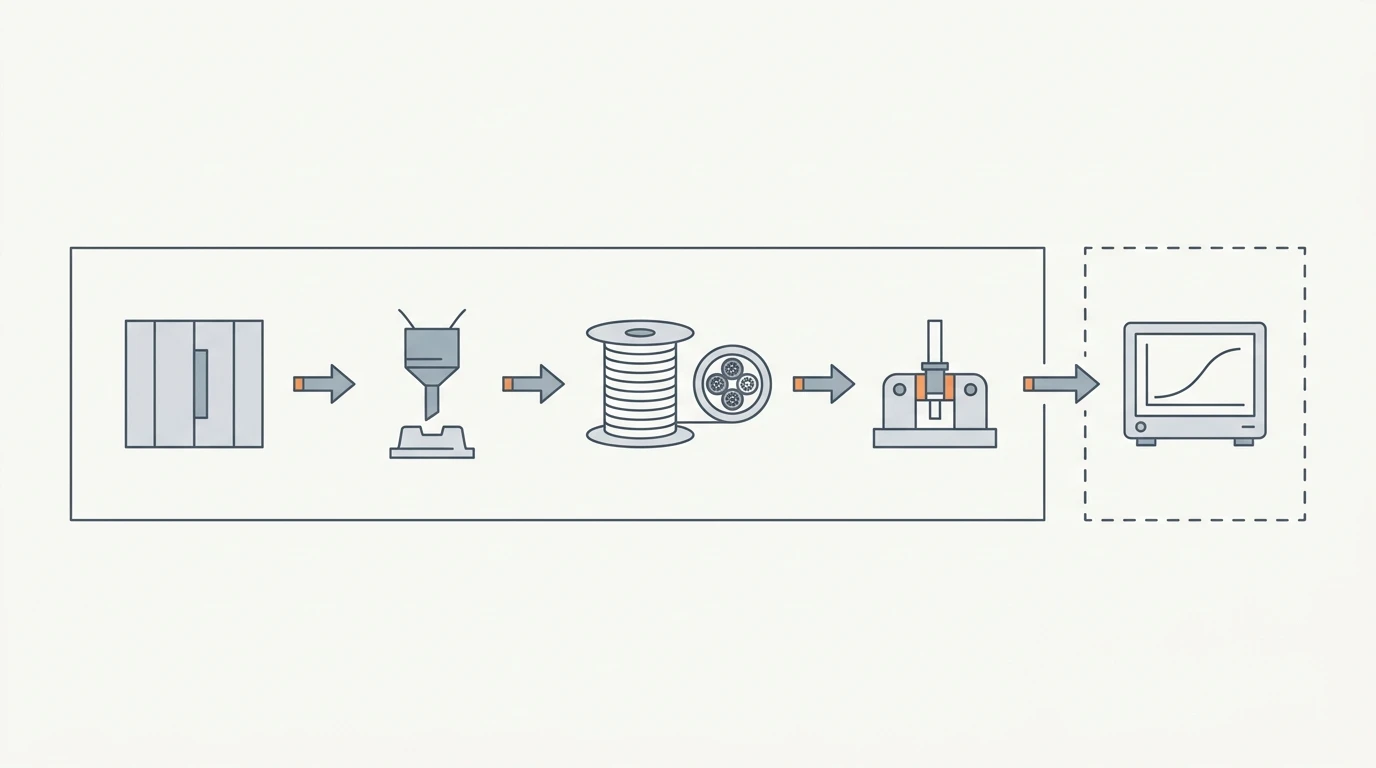
Figure: five stages of the same product, in order — mold, injection, extrusion, termination, test. The dashed box marks the stage buyers most often leave outside the gate.
What each stage decides for your order
The five stages in that table break into four conversations, because mold and injection fail together. The point of walking them is to find the one or two that matter for your order — that is the only part of the integration claim worth negotiating over.
Mold and injection: the tolerance you can feel in your hand
A connector housing a few hundredths of a millimeter out of tolerance will not hold a latch under vibration. An outdoor boot that is out of round fails a flood test at the seal, not at the cable. Those dimensions come from the tool, not from the assembly bench. A plant with its own tool room can change a gate or add a rib in days and re-run first articles the same week. A plant that outsources tooling quotes you a mold and a six-week lead time, and the small change you asked for turns into a project with a budget line.
This is also the earliest stage where the claim becomes visible on foot. You either walk past CNC and EDM machines, a tool store and a rack of production molds, or you don't.
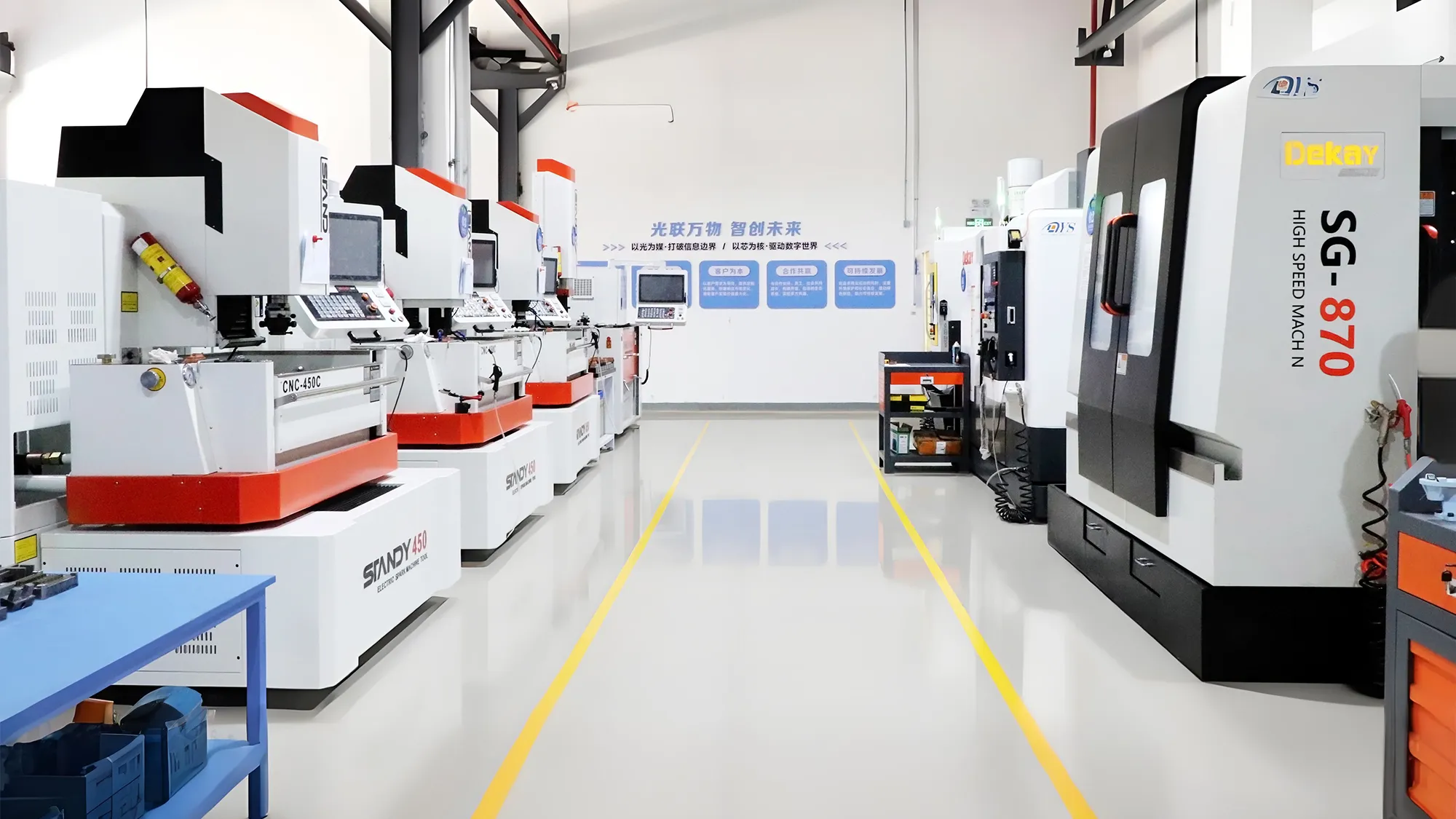
In-house tooling is the first stage a buyer can verify without reading anything.
Extrusion: your fire rating is decided on one machine
The jacket is where a cable's regulatory identity is set. Compound, line temperature and line speed determine wall thickness, OD tolerance and how the cable behaves in a fire test — the performance that a UL OFNP/OFNR fire rating or an EU CPR class actually certifies. A plant that owns its extrusion can run your compound, your print legend and your jacket color. A plant that does not is buying somebody else's standard construction and relabelling the drum.
The full process is worth walking once, but the buyer-relevant part is short: the line decides what you receive, not the catalogue.
Termination and assembly: where insertion loss is won or lost
Two assembly houses terminating the same LC connector will hand you different loss distributions. Cleave angle, polish geometry, epoxy or crimp, and the fixture that holds the ferrule during cure decide more about insertion loss than the connector brand does. When assembly is subcontracted, the end-face on your patch cord was made by a company you have never audited, and its scrap rate is not your supplier's problem — until it becomes your return.
Test: who signs the number
"100% tested" means something only when you know which instrument, which standard, which sample plan and what the pass line was. A plant with its own lab can test to your spec and hand you the file with the reel. An assembler that rents lab time tests to whatever the lab runs that week. This is the stage buyers skip most often and the cheapest one to verify: ask to see the calibration record and the raw data for the last lot, then compare it with how per-shipment test reports are supposed to read.
Put the four together and you get the practical version of the customization argument. A new jacket color, a custom print legend and a different housing rib are three internal work orders when the stages are owned, and three supplier contracts with three lead times when they are not.
The three numbers integration actually moves
Benefits lists say quality, cost and lead time. They are right and useless, because none of them says by what mechanism. In cable assembly the mechanisms are specific enough to put in a quotation.
Price: less markup, more opacity
Owning a stage removes a markup layer. It also removes the market price that would have told you what that stage should cost, which is why integrated quotes are harder to benchmark against each other. If you negotiate cost-plus, ask for three numbers: extrusion scrap rate, termination rework rate, and test fallout. Those are where the savings either exist or don't. A supplier who cannot produce them has not integrated as far as the brochure says.
Lead time: the queue you can see
When extrusion is in-house, your order queues inside one plant, and that queue can be seen and re-sequenced. When it is not, your lead time is your supplier's lead time plus their supplier's, and nobody at the first company can expedite the second. Ask for the changeover time between jacket colors. It is the single number that predicts whether a fifteen-day promise survives a busy month.
Risk: concentration, allocation, requalification
Integration concentrates your supply. In a shortage, an integrated supplier allocates its own extrusion across its customers, and you discover your rank at the worst possible moment. Switching away is also more expensive than switching a component vendor: you requalify several stages at once and the whole tolerance chain moves together. Neither point is an argument against integration. Both are arguments for writing allocation and exit terms into the contract while you still have a choice.
What "vertically integrated" does not mean
Four ideas get folded into the phrase. Each is a separate axis, and mixing them up is how buyers end up comparing the wrong suppliers.
- It is not OEM versus ODM. Design ownership is a different question from process ownership. A factory can own mold, extrusion and assembly and still be a pure OEM building to your drawing — or own none of those stages and be a pure ODM selling its own designs. The two axes are set out side by side in our guide to OEM vs ODM in fiber optics.
- It is not "one-stop supplier." A trader carrying 4,000 SKUs sourced from 40 factories is the exact opposite: maximum breadth, zero owned stages. Breadth answers "can I buy it here." Integration answers "who controls how it is made."
- It is not size. Capacity is output per day; integration is stages per product. A very large assembly hall can own exactly one stage.
- It is not automatically better. It means the supplier's control reaches further. Whether that helps you depends entirely on which stages it reaches, which is the subject of the next section.
When a vertically integrated manufacturer is the wrong answer for you
Most articles on this topic list benefits and stop. But a vertically integrated manufacturer shifts risk onto the buyer in ways that are predictable, and it is worth naming them before you sign.
Your situation | What integration probably costs you | What to do instead |
|---|---|---|
Your advantage lives in one component | Less access to the specialist who does that part well | Buy that part from a specialist; integrate the rest |
Low or intermittent volume | Queue position behind the accounts that fill the machine | Ask for written allocation and a reserved slot |
A quality problem in one stage | You inherit a stage the supplier is still learning | Audit that stage and keep a qualified alternative |
Business continuity is board-level | One point of failure across several stages | Split the scope across two suppliers on purpose |
Over-integration is real and rarely disclosed. A cable plant that added injection capacity last year may mold worse than the molder it replaced, and no sales deck will say so. A fully integrated supplier is also the hardest to dual-source, because no other supplier's parts are interchangeable across the same tolerance chain. And if origin is part of your risk model rather than your cost model, note that factory location is a separate axis again — the China versus Vietnam comparison covers that one properly.
None of this argues against integration. It argues against treating "integrated" as a synonym for "controlled."
Six checks that separate integration from assembly
Each of these has a binary answer, and all six fit into one visit. They are the integration-specific subset of a fuller factory audit, so they take an hour rather than a day.
- Get the stage list in writing, with site names. A real integrator names buildings and cities. "We are vertically integrated" with no site attached is a marketing sentence.
- Walk the extruder. Ask what compound is running, what OD tolerance they hold on your construction, and how long a color changeover takes.
- Find the tool store. Ask who owns the mold, where it physically lives, and how long a gate change takes.
- Ask which lab signs the IL/RL report. Then ask when the instruments were last calibrated and whether raw data travels with the shipment.
- Check who holds the certificate. A UL listing attaches to a plant and a file number; TL 9000 works the same way. A brand name printed on a box is not a listing — and if you are not yet sure which certificate your market requires, the certification checker maps UL, CPR, Anatel and RoHS by destination.
- Ask what is subcontracted, and what happens when the subcontractor is late. Every plant subcontracts something. The answer separates the suppliers who know their exposure from the ones who discover it along with you.
At DYS those six answers resolve to a named list: five workshops — cable, jumper assembly, mold design, injection, and FTTX waterproof assembly — plus an in-house reliability lab, spread across three manufacturing sites in Huizhou, Mianyang and Hanoi. The volume behind them is 800 km of cable and 50,000 MPO/MTP ends a day, with 25 mold sets a month coming out of the tool room. That is the shape of evidence worth asking any supplier for. The numbers matter less than the fact that someone can point at each of them during a walk.
Frequently asked questions
What does vertically integrated mean for a manufacturer?
It means the manufacturer owns consecutive stages of its own supply chain instead of buying the output of those stages. The standard definition also separates backward integration — moving upstream toward materials and components — from forward integration, which moves downstream toward distribution and service. Most cable and assembly factories are backward-integrated: they bought the process that used to supply them.
Is backward integration the same as vertical integration?
No. Backward integration is one direction of it. Backward means owning a supplier stage upstream; forward means owning a customer-facing stage downstream. A cable plant that adds its own extrusion is integrating backward. One that adds a pre-terminated assembly service for installers is integrating forward.
What is a vertically integrated supply chain?
A supply chain in which one company owns more than one consecutive link, so fewer handoffs happen between firms. The practical effect is that fewer contracts, inspections and blame conversations sit between the raw material and the box you receive.
Does a bigger factory mean more vertical integration?
No. Capacity measures how much a plant can output; integration measures how many stages it owns. The two correlate loosely and mislead often — a very large assembly hall can be a one-stage operation that buys every component it installs.
The question that settles it
If you take one thing from this: ask which of the five stages a vertically integrated manufacturer owns, on which site, and whether you can see the one that decides your failure mode. The answer will be specific or it will not be, and that tells you more than any sentence containing the word "integrated."
If you are still narrowing the list, the wider framework — rankings, factory audits, and how OEM and ODM sourcing differ — sits in our guide to choosing a fiber optic cable manufacturer. If you already know which stage matters and want to watch it run, that is a factory visit rather than a brochure.