
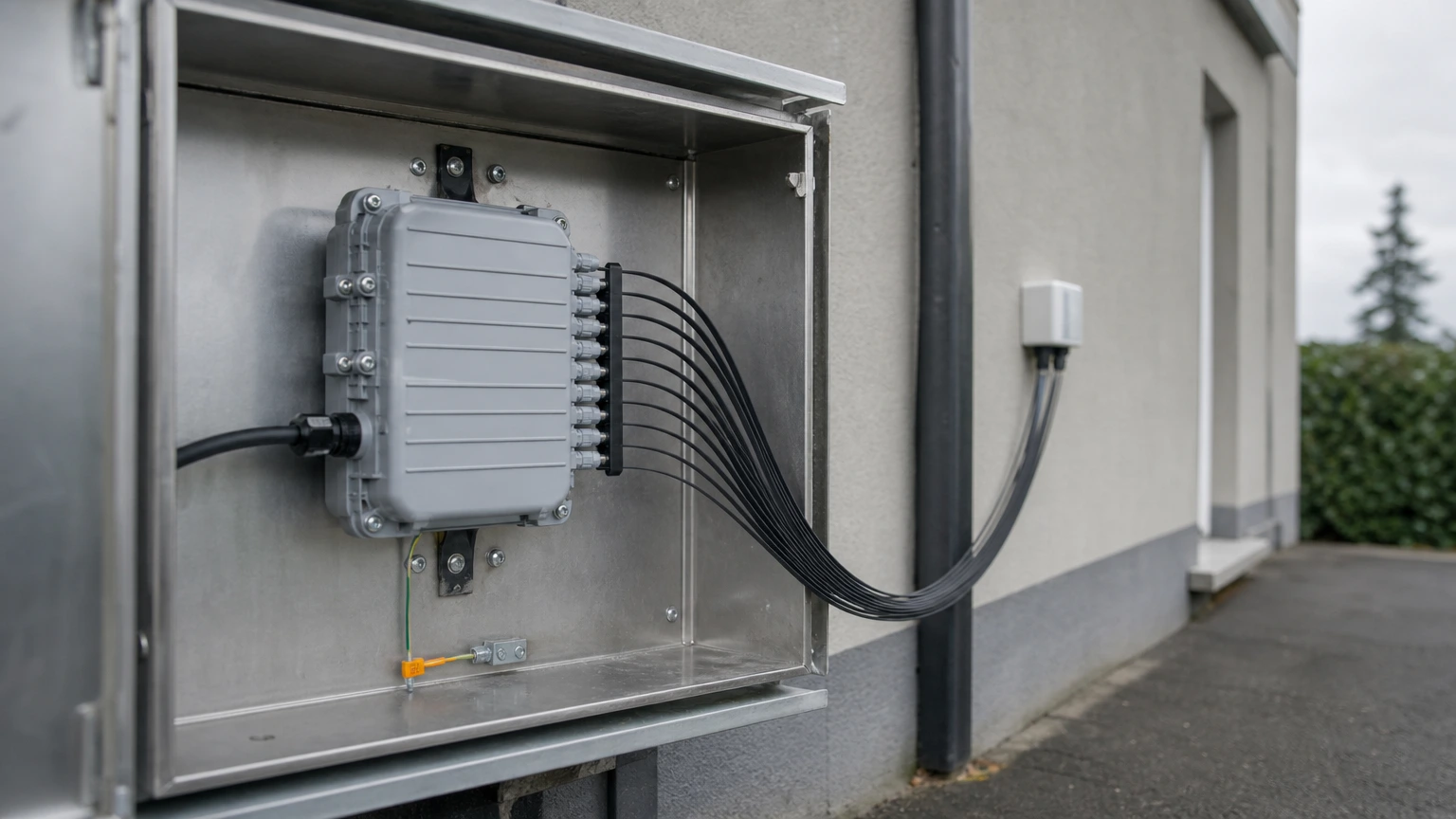
FTTH Access
What Is a PON? Passive Optical Network Architecture, Components, and Benefits
A PON, or passive optical network, is a fiber access architecture in which one fiber leaving a service provider's equipment is split — using optical splitters that need no electricity — to serve many subscribers, with no active or powered device anywhere in between. One laser at one end, one optical receiver at the other, and nothing in the middle that has to be switched on, cooled, or fed.
That is what what is a PON means in the networking sense, and the meaning this page works through. The three letters stand for other things too — a purchase order number in telecom billing, an executive program at Harvard Law School, a handful of non-English words — so if you landed here looking for one of those, the table below says which is which.
The rest of this page explains what makes a network "passive" and why that word decides the economics of an access build, walks the physical path from the provider's equipment to a subscriber's wall, and draws the boundary between a PON and the terms it gets confused with — FTTH, GPON and point-to-point Ethernet.
Which PON do you mean? Three letters, three different questions
The collision shows up in the search results themselves: two of the pages ranking for this term are a cable company's billing FAQ and a law school's program page.
You might be looking for | What it stands for | Where you would meet it |
|---|---|---|
The fiber network (this page) | Passive Optical Network | Broadband access, FTTH builds, ISP and operator networks |
A billing or procurement reference | Purchase Order Number | Telecom order systems, invoices, enterprise support desks |
An executive education program | Program on Negotiation | Harvard Law School's continuing-education offering |
A word in another language, or in slang | — | Variants such as man-pon and pon-pon are unrelated slang or other languages; they are not this term |
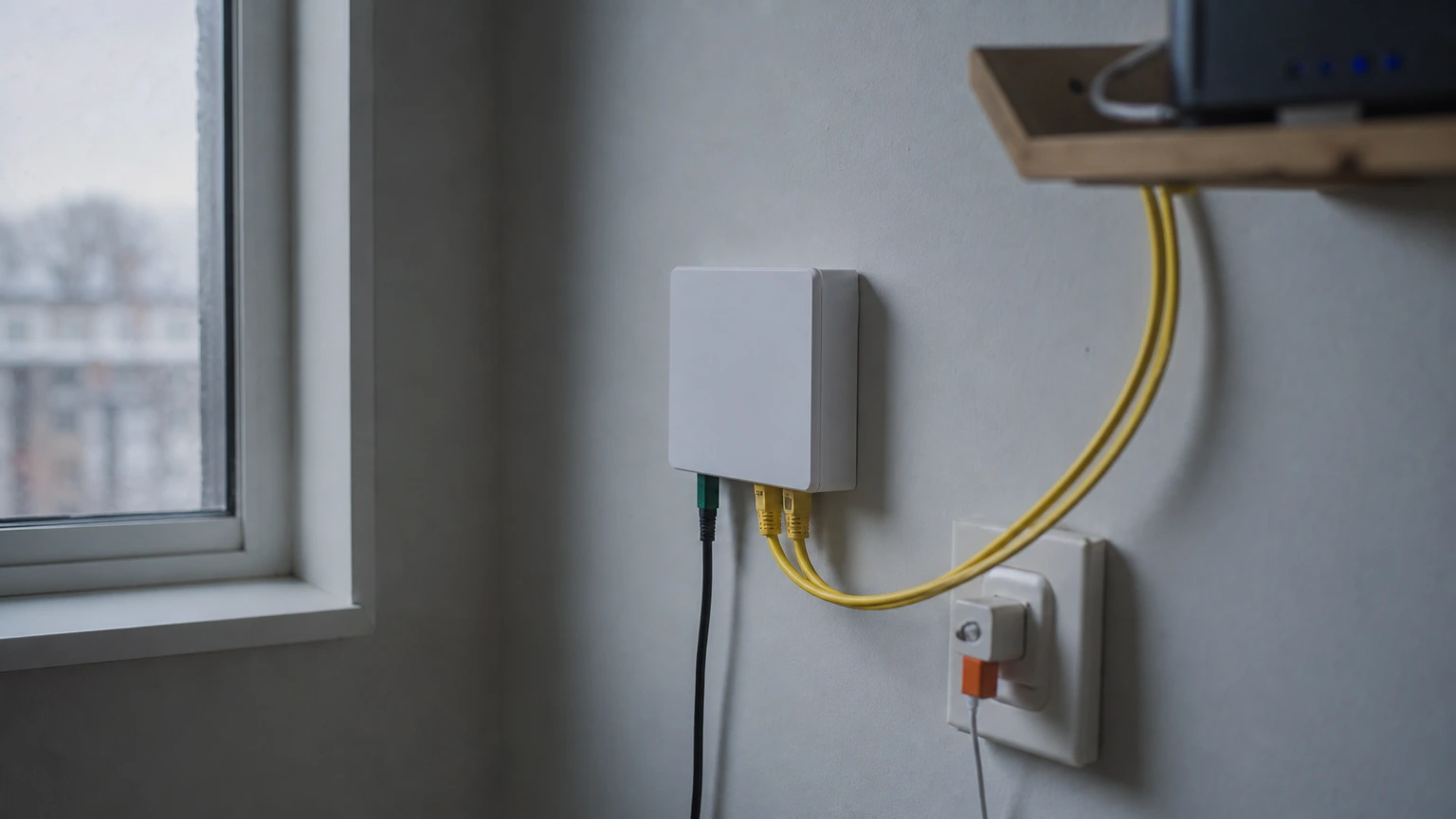
There is a fifth reading that matters more than it looks. "What does PON on a router stand for?" is a question people genuinely search, and the answer is that the port labeled PON on a home gateway is the fiber uplink — the socket where the incoming fiber, or the patch cord from the provider's termination box, plugs in. It is a PON because it is the subscriber end of one: same three letters, same technology, different vantage point.
So in fiber, networking and telecom procurement contexts, PON means Passive Optical Network — the sense used for the rest of this page. If you arrived from one of the other meanings, you now know why the results looked confusing: that confusion is the term's, not yours.
"PON video" is the other phrase that turns up, and it carries no separate technical meaning. It usually points either at RF video overlay — a legacy third wavelength on a GPON, and the only sense in which a PON carries "video" as a signal — or at one of the unrelated meanings in the table above.
What a PON is — and why "passive" is the whole point
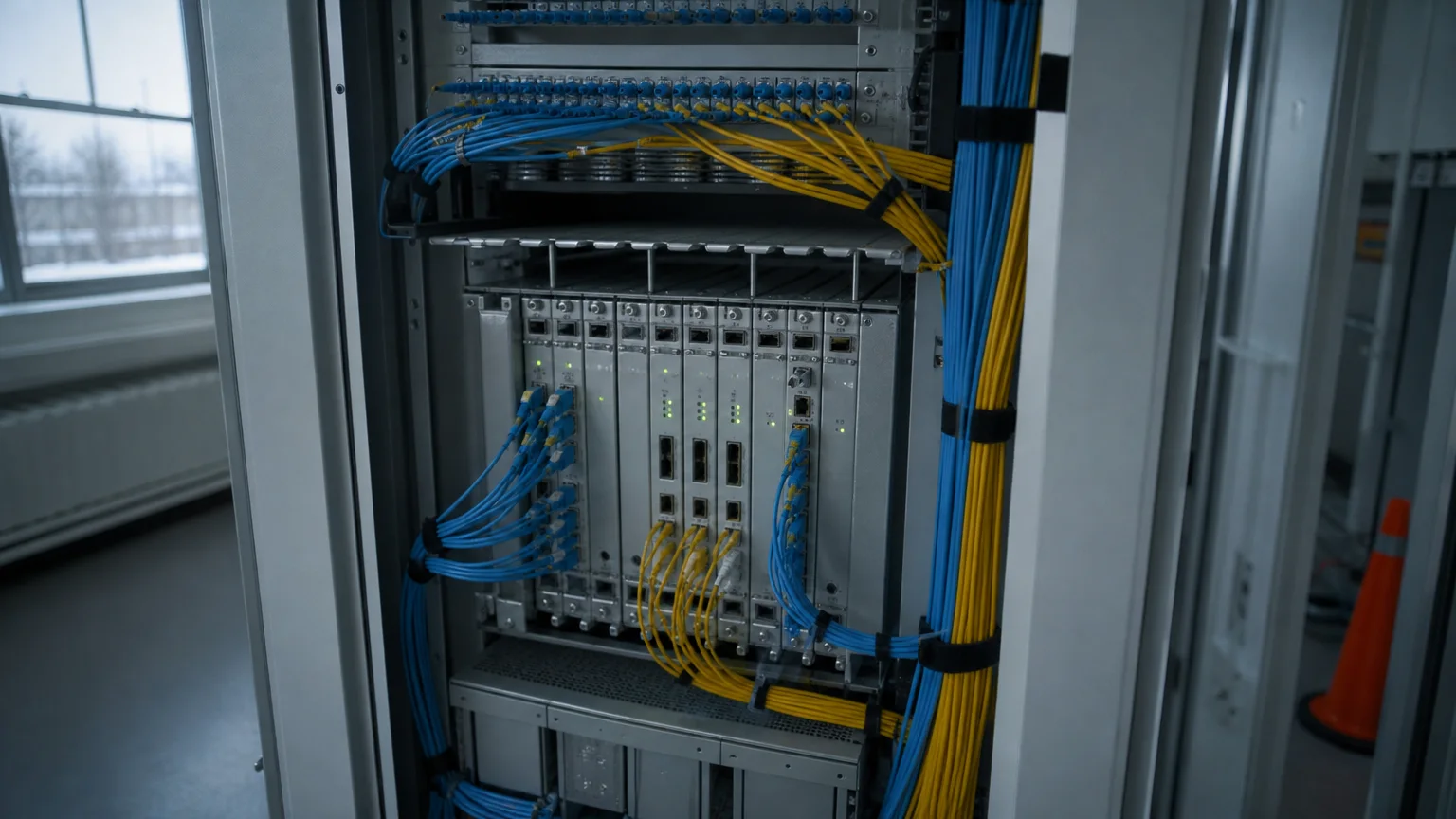
Strip the acronym back and the architecture is almost disappointingly simple. At one end sits an optical line terminal (OLT) in a provider's central office or street cabinet. At the other end sit optical network units, called optical network terminals when they terminate inside a subscriber's premises — the box that takes light in and hands Ethernet, Wi-Fi, voice or TV out. Between them there is fiber, splitters, connectors and enclosures. Nothing else. No amplifiers, no repeaters, no powered switches, no cabinet with a battery and a fan.
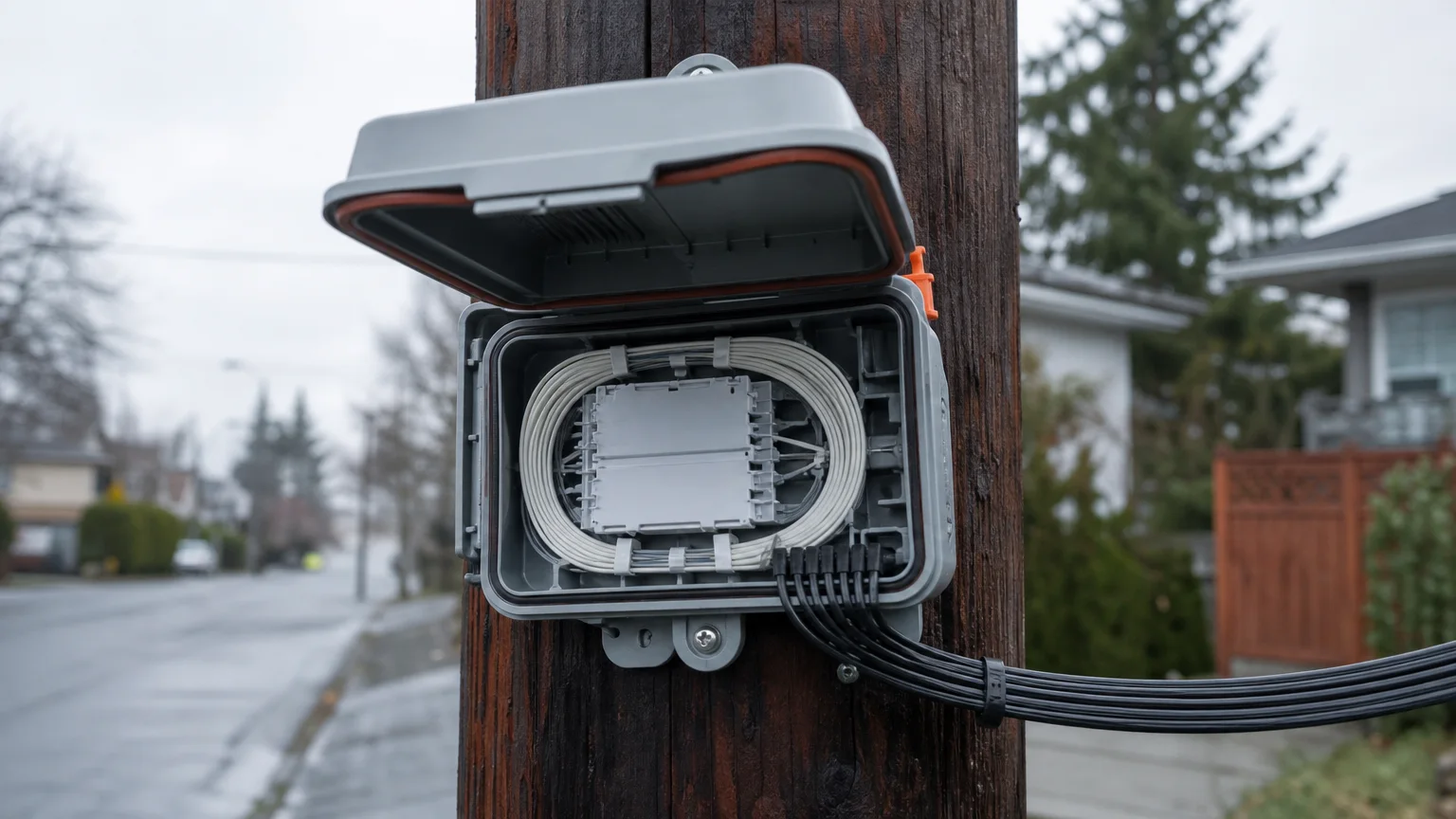
That "nothing else" is the point. In an active access network, every point where the signal is regenerated is a point that needs a power feed, a cabinet, an environmental rating, a maintenance visit and a failure mode. A PON removes all of them from the middle of the link. The splitter that turns one fiber into thirty-two is a glass waveguide with no electronics in it at all, and it sits happily inside a sealed plastic closure on a pole for twenty years.
Two consequences follow, and they are the reason operators keep choosing this architecture:
- The midpoint of the network stops being a cost center. Nobody buys electricity for it, cools it, or sends a technician to it. The plant in the ground and on the poles is inert.
- The expensive electronics move to the two ends, where they are cheap to reach. An OLT is a chassis in a building you already maintain. An ONT is a box in a customer's home. Neither is buried under a road.
The other consequence is less comfortable: because the splitters are passive, they are also outside the provider's control. Nobody can remotely reboot a splitter, and no software upgrade fixes a dirty connector. Whatever the passive plant is when it is built, it stays — which is precisely why it deserves more design attention than the electronics at either end, not less.
What holds the arrangement together as a system, rather than a pile of components, is a family of standards. Most deployed PONs follow ITU-T specifications developed by ITU-T Study Group 15, the group that owns the GPON series and the higher-speed generations that followed it.
If you want the four terms — OLT, ONU, ONT and ODN — separated properly, the OLT, ONU, ONT and ODN in one page takes them apart, including the positional rule that decides whether a given box should be called an ONU or an ONT.
One fiber, many subscribers: how the traffic actually flows
Downstream, the OLT broadcasts. Every packet leaves on the same fiber and reaches every endpoint on that tree. Each ONT filters out only what is addressed to it and discards the rest. This is how point-to-multipoint access has always worked, but it means the downstream direction has no privacy by construction — only encryption, and that encryption is part of the specification rather than an optional extra.
Upstream, the endpoints take turns. If every ONT transmitted whenever it liked, their light would arrive at the OLT on top of itself and the result would be noise. So upstream is time-division multiplexed (TDM): the OLT grants each endpoint a slot, and each ONT speaks only inside its slot. Before that can happen, the OLT has to learn how far away each endpoint is, because a subscriber two kilometers away and one twelve kilometers away experience different delays. It measures that distance — a process called ranging — and applies an equal delay to every endpoint so they all appear to sit at the same distance. Only then can the time slots be packed tightly enough to be efficient.
The two directions travel on different colors of light in the same single-mode fiber — wavelength-division multiplexing in its simplest form — which is why a PON can be upgraded later without rebuilding the cable:
Direction | Wavelength | What it means in practice |
|---|---|---|
Downstream, OLT → endpoint | 1490 nm | Broadcast to every endpoint on the tree; each one filters what is addressed to it |
Upstream, endpoint → OLT | 1310 nm | Time-shared; one transmitter at a time, scheduled by the OLT |
Video overlay (legacy) | 1550 nm | Historically reserved for RF video; often kept clear even where video is no longer sold |
10-gigabit generations | 1577 nm down / 1270 nm up | New lanes added on the same fiber — this is why an upgrade can reuse the plant you already built |
That allocation is the quiet reason a passive optical network ages well: the fiber does not care which generation of equipment is talking through it, so the same cable, splitters and closures can carry a later, faster standard, and an upgrade becomes a matter of changing cards at the two ends rather than digging up streets.
The double naming comes from the two lines of specification. The ITU-T GPON documents use optical network unit as the name for the device class and reserve optical network terminal for the single-subscriber case — the box at the premises — while the IEEE's Ethernet-based access work, IEEE 802.3ah — Ethernet in the First Mile, introduced EPON and also says ONU. Vendors blended the two, which is why a datasheet says "XPON ONU/ONT" while the box beside it says GPON ONT.
What "PON" covers today: GPON, XGS-PON and the next step
"PON" is a family name, not a single product, and the generations differ mainly in how much they carry and which wavelengths they use. The practical sequence is:
- GPON — the workhorse of the last two decades of FTTH, and usually what people mean when they say "a PON" in the field. ITU-T Recommendation G.984.1 is where its architecture is defined.
- XG-PON and XGS-PON — the next step up, with symmetric variants that matter to operators selling business services as well as residential broadband.
- 25G and 50G PON — the current higher-rate work, aimed at the point where a port has to feed more subscribers, more bandwidth, or both.
The detail worth carrying away is not the rate list but the relationship between generations and hardware. A change of generation changes the electronics at the two ends. It does not usually change the fiber in the ground, the split ratio you built, or the enclosures you sealed shut — which is why designing the passive plant for the generation after the one you are deploying is cheap at specification time and expensive to correct later. Which generation your plant has to carry works through that comparison in full.
From the central office to the front door: the five segments of the ODN
Everything between the OLT and the subscriber's terminal is the optical distribution network (ODN) — the half of a PON that is not a box, and the part that turns a network design into a construction project.
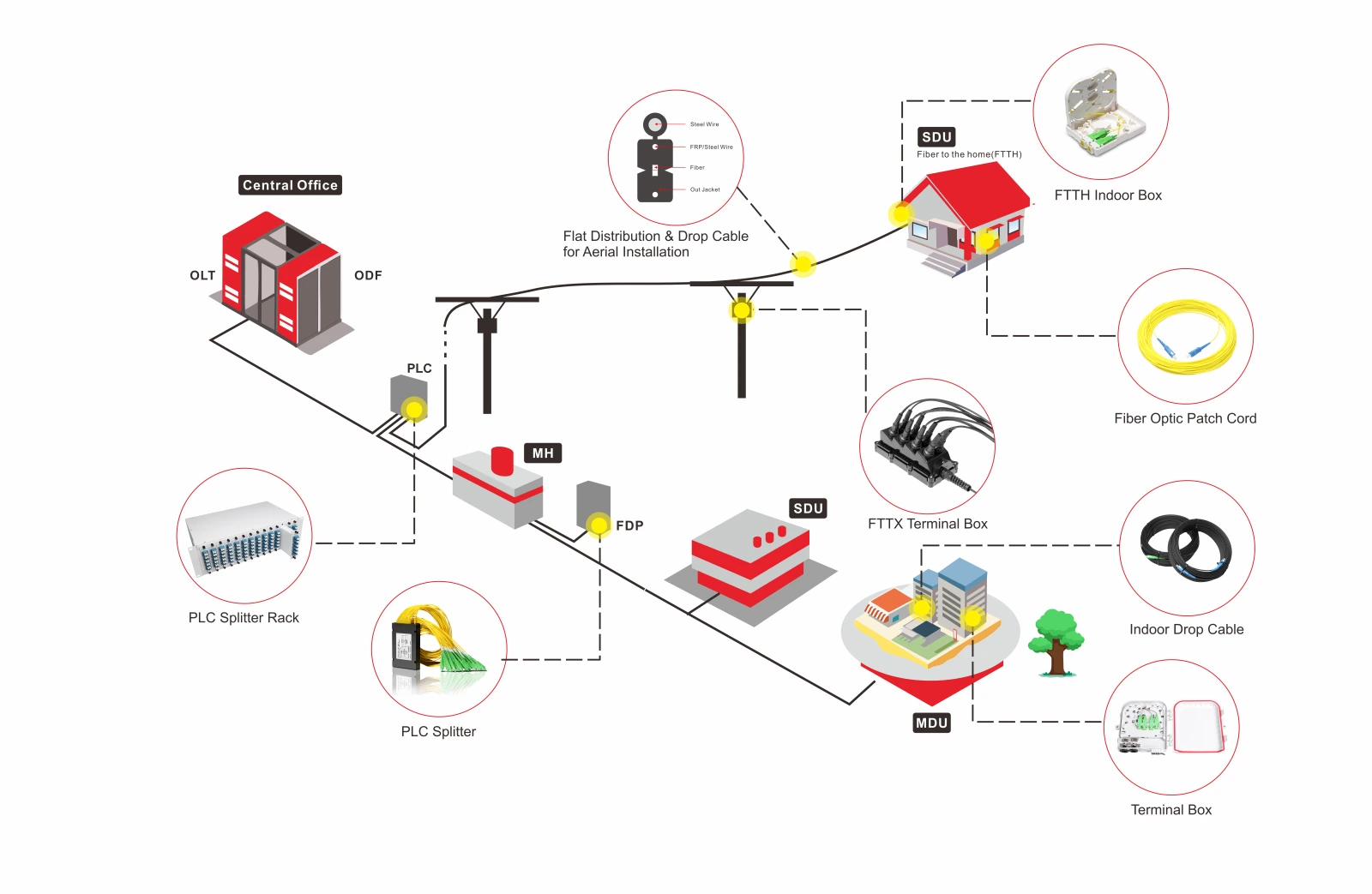
The ODN is usually described in five segments, in order away from the central office:
# | Segment | Runs from → to | What sits in it | What you specify |
|---|---|---|---|---|
1 | Feeder fiber | Optical distribution frame → optical distribution point | High-count cable, usually ducted or buried | Fiber count, cable construction, route protection |
2 | Optical distribution point | Feeder → distribution fiber | Splitter modules inside a closure, cabinet or rack | Split ratio, splitter package, enclosure type and ingress rating |
3 | Distribution fiber | Distribution point → access point | Lower-count cable branching along streets or risers | Fibers per branch, cable type, indoor fire rating |
4 | Access point | Distribution fiber → drop fiber | Terminal or access box where drops are connected | Port count, connector type, environmental sealing |
5 | Drop fiber | Access point → subscriber terminal | The short run to the premises, aerial or ducted | Construction (flat self-supporting or round), pre-termination, polish |
Two of those choices decide how a build feels in the field. The first is what you put at segments 2 and 4 — the difference between a terminal box, a distribution box and a junction box is a question about which connection point you are standing at. The second is the drop at segment 5, the only part of the ODN a crew touches house by house — often called simply the PON cable on site: its construction decides how long each installation takes, which is why install labor rather than cable cost dominates a last-mile budget.
The boundary matters as much as the segments. The ODN ends at the subscriber terminal's optical port; everything past it — the Ethernet runs, the Wi-Fi, the coax to a set-top box — is customer premises wiring, not part of the network you built. Getting that endpoint into the acceptance-test plan is what stops a subscriber's own router from becoming a truck roll your outside-plant budget never sized for.
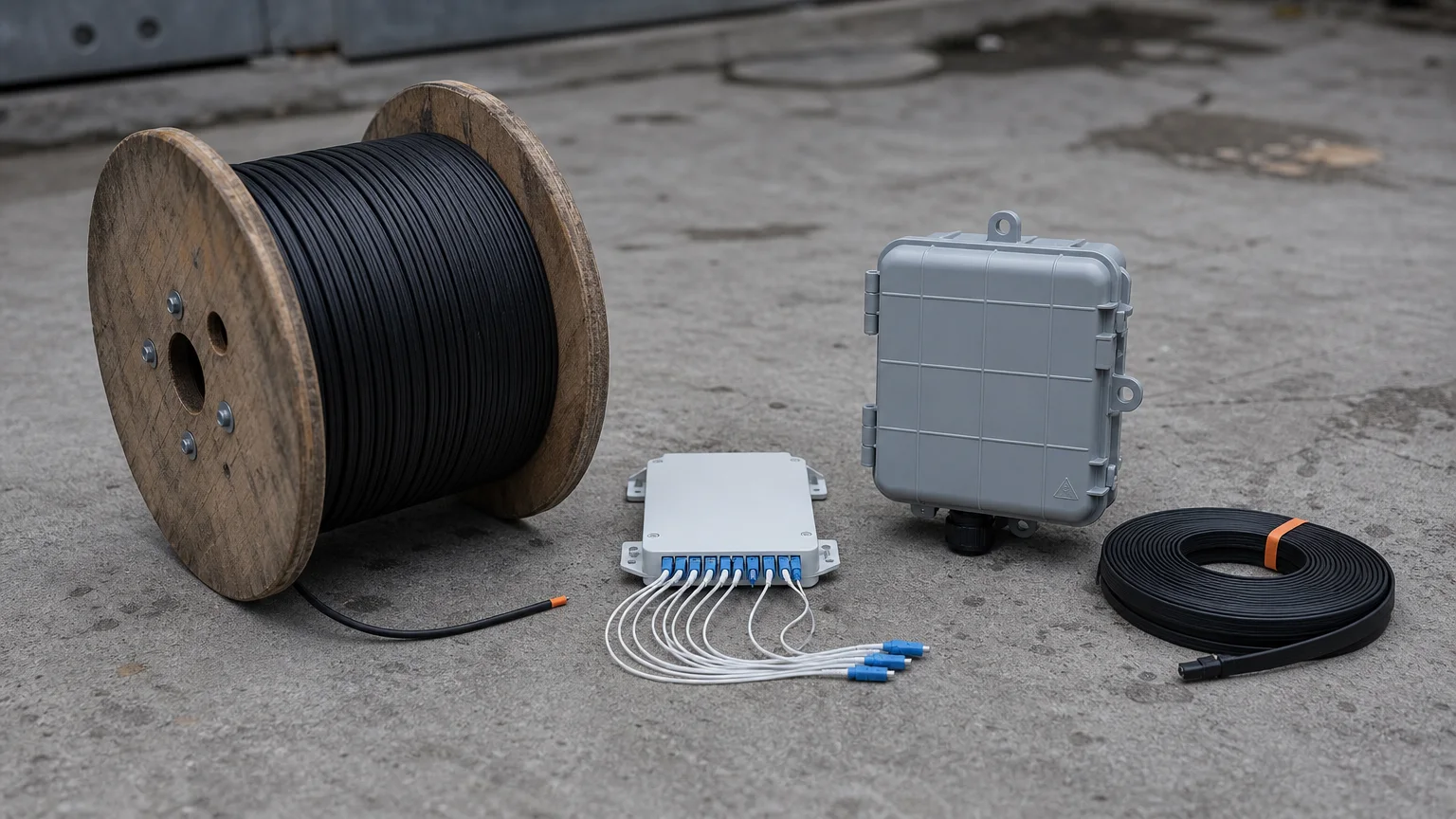
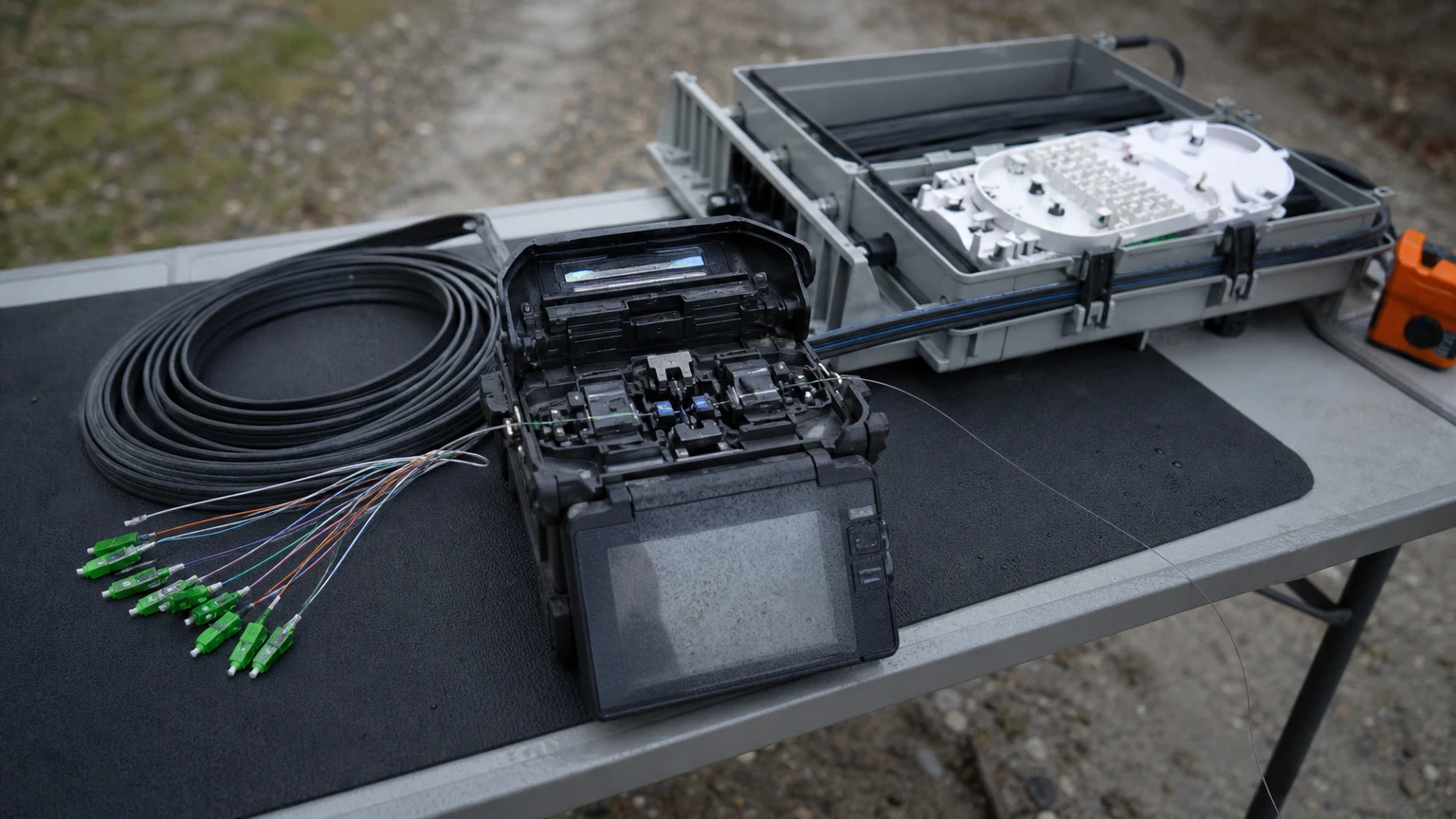
Most of this material is bought by the meter and terminated in the field, and where it is terminated is the third choice that shapes a build. Splice closures and connectorized access points are the two ways to join fiber at segments 2 and 4, and the trade between them — fusion splicing versus mechanical splicing versus pre-terminated assemblies — decides whether that work happens on site or in a factory. The drop is worth its own reading too, since flat or round drop cable construction is a decision you live with on every subsequent installation. For the design arithmetic behind the segments above, the Fiber Optic Association's FTTH design reference is a useful public starting point.
PON vs FTTH vs GPON vs point-to-point: what each term actually covers
Most confusion around PON is not about the technology. It is about four words that describe different kinds of thing and get used interchangeably in conversation.
Term | What kind of thing it is | What it actually tells you |
|---|---|---|
PON | An architecture | How the fiber is shared: one port, many subscribers, no powered device in between |
FTTH | A deployment target | Where the fiber ends: at a home. It says nothing about how it is split or shared |
GPON | A standard and a generation | Which specification the equipment follows, and roughly what it can carry |
ODN | A network segment | The passive middle — the part you build and buy |
FTTx | A deployment family | Where the fiber ends, whatever the answer is: home, building, curb or cabinet |
Point-to-point Ethernet | A competing architecture | One dedicated fiber per subscriber, with active electronics at both ends |
Read that table as axes rather than a hierarchy. A network can be FTTH and PON at once — the common case in residential broadband. A network can be FTTH and not PON: a point-to-point build reaches homes with dedicated fiber and active equipment, and that is the right answer in some circumstances. And a PON can be something other than FTTH: the same optical split reaches office buildings, apartment blocks and mobile sites.
The distinction that carries real weight is the last row. A point-to-point link gives every subscriber a dedicated fiber and dedicated electronics; a PON gives every subscriber a share of one port and one fiber. Point-to-point delivers predictable capacity per subscriber and simplifies fault isolation, at the price of more fiber, ports, power and equipment in the field. A PON trades dedicated per-subscriber capacity for a passive middle and a much smaller footprint. The Broadband Forum's access architecture work is built around exactly that layered split between the operator's network, the passive plant and the subscriber side.
The economics of passive — and where a PON stops working
The savings of a PON are not mainly in the fiber, which costs about the same either way. They are in everything a powered midpoint would have required: no power feeds, no cabinets with batteries, no cooling, no environmental hardening for electronics, and no routine visits to equipment nobody wants to drive to. A second saving is easy to miss: because one OLT port serves many subscribers, the operator's port count and central-office footprint shrink dramatically compared with a dedicated-fiber design.
Now the limits, which all trace back to the same root. Every split stage divides the available optical power, and every element in the path consumes some of it — cable over distance, each splice, each connector pair, each splitter stage. A PON works only while enough light still arrives at the far end, which means split ratio and reach trade against each other directly: the more subscribers you hang on one port, the less distance you can cover, and the fewer subscribers, the more ports you need. That is the calculation behind every PON design, and how split ratio changes the reach you can build works it through in detail.
Three further limits are worth keeping in view:
- Reach is bounded. PON specifications define a physical reach in the order of 20 km between the OLT and the furthest endpoint. That is a ceiling defined by the standard, not a performance promise, and the optical budget decides whether a given design gets anywhere near it. Long rural routes with high split ratios and several splice closures can miss it, usually as an intermittent fault rather than a clean outage.
- Capacity is shared. The bandwidth of one PON port is divided among every subscriber below it — unremarkable at residential traffic profiles; a real design question for business services or backhaul, where the answer is smaller split ratios or a different generation.
- A port failure is not a one-home failure. The blast radius of a PON port is every subscriber below it. Passive components rarely fail, but the fiber feeding them can be cut — and the outage is then larger than it would be on a dedicated-fiber network.
None of that makes PON the wrong choice; it makes the passive design the part that deserves the argument. A short route with a modest split and clean terminations sits comfortably inside the budget. A long route with a high split, several enclosures and marginal terminations does not — and the fiber, splitters and enclosures that decide which of those you built are the parts that stay in place for the next twenty years. The same splitting principle also reappears inside buildings as a passive optical LAN.
Quick answers
- What is the full form of PON? Passive Optical Network — a fiber access architecture that splits one provider fiber to many subscribers with no powered device in between.
- Is a PON the same as FTTH? No. FTTH says where the fiber ends; a PON says how it is shared. Most residential FTTH is built as a PON, but the two terms answer different questions.
- What does the PON port on my router do? It is the fiber uplink — the socket where the incoming fiber from the provider's termination box plugs in.
- How does a PON work without power in the middle? The splitters are passive glass components with no electronics, so the network is powered only at the OLT and at each subscriber terminal.
- What is a PON network made of? An OLT, an optical distribution network of feeder and distribution cable, splitters, enclosures, drop cable, and an ONU or ONT at each subscriber.
- How far can a PON reach? PON specifications define a physical reach in the order of 20 km; what decides a given design is the optical budget, which split ratio and the number of splices and connectors consume.
The short version
A PON is one fiber from the provider split to many subscribers through passive components, with active electronics only at the two ends. The word passive does the real work: no power, no cooling and no routine visits anywhere in the middle, which is where the cost advantage lives and why the plant is expected to outlast the equipment. Traffic runs downstream by broadcast and upstream in scheduled time slots on separate wavelengths, so an upgrade can reuse the fiber you already have. The part you build and buy — the ODN, its five segments, its splitters and its drop cables — decides both the reach and the bill, and the FTTH deployment guide walks that path end to end.
If you are specifying that middle, or replacing a supplier for it, DYS Fiber Optic manufactures flat and round drop cables, PLC splitter modules and racks, terminal and distribution boxes and sealed outdoor assemblies for operators and integrators, with certification documentation for the markets we ship into. You can review the FTTH cabling and accessories range, or ask for samples to test against your own plant before a design is frozen.