
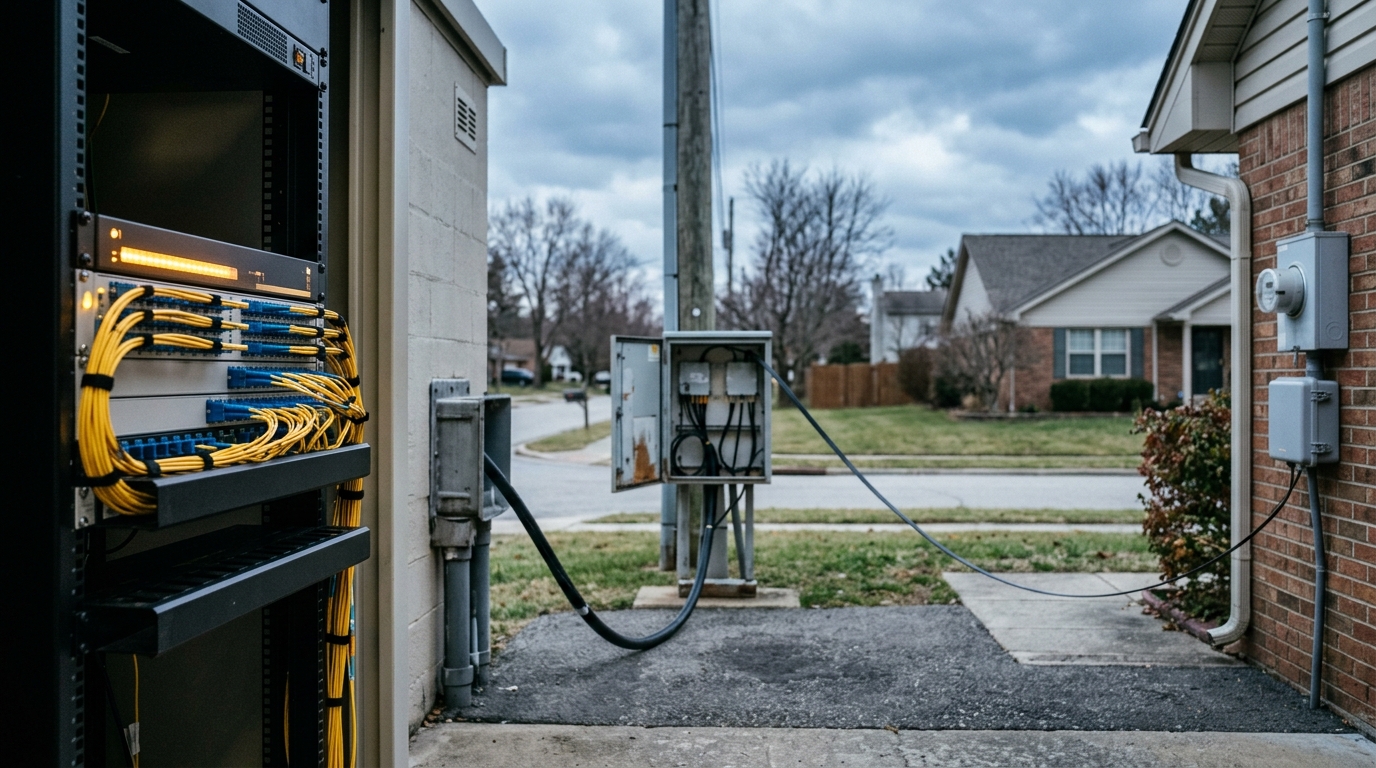
FTTH Access
OLT vs ONU vs ONT vs ODN: The Building Blocks of a PON Network
OLT vs ONU vs ONT vs ODN is not a choice between four competing products — it is a description of four positions along one passive optical link. The OLT (optical line terminal) is the operator-side box in the central office that owns the whole tree. The ONU (optical network unit), called an ONT (optical network terminal) when it terminates at the subscriber, is the box where the fiber stops and the electrical side begins. The ODN (optical distribution network) is everything in between: feeder, distribution and drop fiber, plus the splitters and enclosures that route it. Two of the four are active electronics. The other two describe plant you build and buy by the meter.
A PON has exactly two active endpoints, the OLT and the ONU/ONT, and one passive middle, the ODN. Almost every design question about a passive optical network turns out to be a question about that middle.
Most pages covering this comparison give you those definitions, and several say flatly that an ONU and an ONT are the same thing. True for the standards, useless for the person holding a bill of materials. This guide does three things they skip: it turns onu vs ont into a rule you can act on, it draws the boundary of the ODN, and it explains what caps PON reach.
Key takeaways
- The four acronyms split into two procurement worlds. OLT and ONU/ONT are active equipment you buy as units; the ODN is passive material — cable, splitters, closures, drop assemblies — you buy as quantities and build in the field.
- ONU and ONT are the same device named by two standards bodies, but the useful distinction is positional: an ONT terminates fiber at the subscriber, while an ONU often sits further upstream and feeds a remaining electrical segment.
- The ODN ends at the ONT's optical port. Everything after that — Ethernet, Wi-Fi, coax, phone — is inside the subscriber's premises and outside the passive plant you own.
- The 20 km figure is a standards-defined physical reach, not a performance guarantee. What you can actually build depends on split ratio and optical budget, and those two trade against each other.
- The passive plant is the part that has to survive your next equipment generation, so it deserves more design attention than the boxes at either end.
The four terms in one table
Read this as a placement map rather than a glossary. The column that matters most is the last one: it decides who you buy from.
Term | What it is | Where it sits | Supplied by | A box or a network? |
|---|---|---|---|---|
OLT — optical line terminal | The active endpoint on the operator side: aggregation, bandwidth allocation, service provisioning, subscriber management | Central office or street cabinet at the head of the tree | Telecom equipment vendors | A chassis with line cards and PON ports |
ONU / ONT — optical network unit / terminal | The active endpoint on the subscriber side: it converts between optical and electrical and hands off Ethernet, Wi-Fi, voice or CATV service | ONU: building, basement or curb node. ONT: the subscriber's premises | CPE and customer-premises equipment vendors | A box, wall-mounted or desktop |
ODN — optical distribution network | The passive middle: feeder, distribution and drop fiber, splitters, connectors, adapters, closures and access points | Between the OLT's PON port and the ONT's optical port | Cable, splitter and hardware manufacturers | A network — nothing in it has a power supply |
PON — passive optical network | The architecture the other three make up: one fiber from the OLT split to many endpoints, with no powered device in the path | The whole system | — | The system itself |
The word "passive" is doing real work in that table. Nothing between the OLT and the ONU amplifies or regenerates the signal — the splitting is done by optical splitters that need no power, which is why one PON port can serve up to 128 subscribers from a single fiber on optics built for that ratio, and why the ODN is where the money and the risk settle.
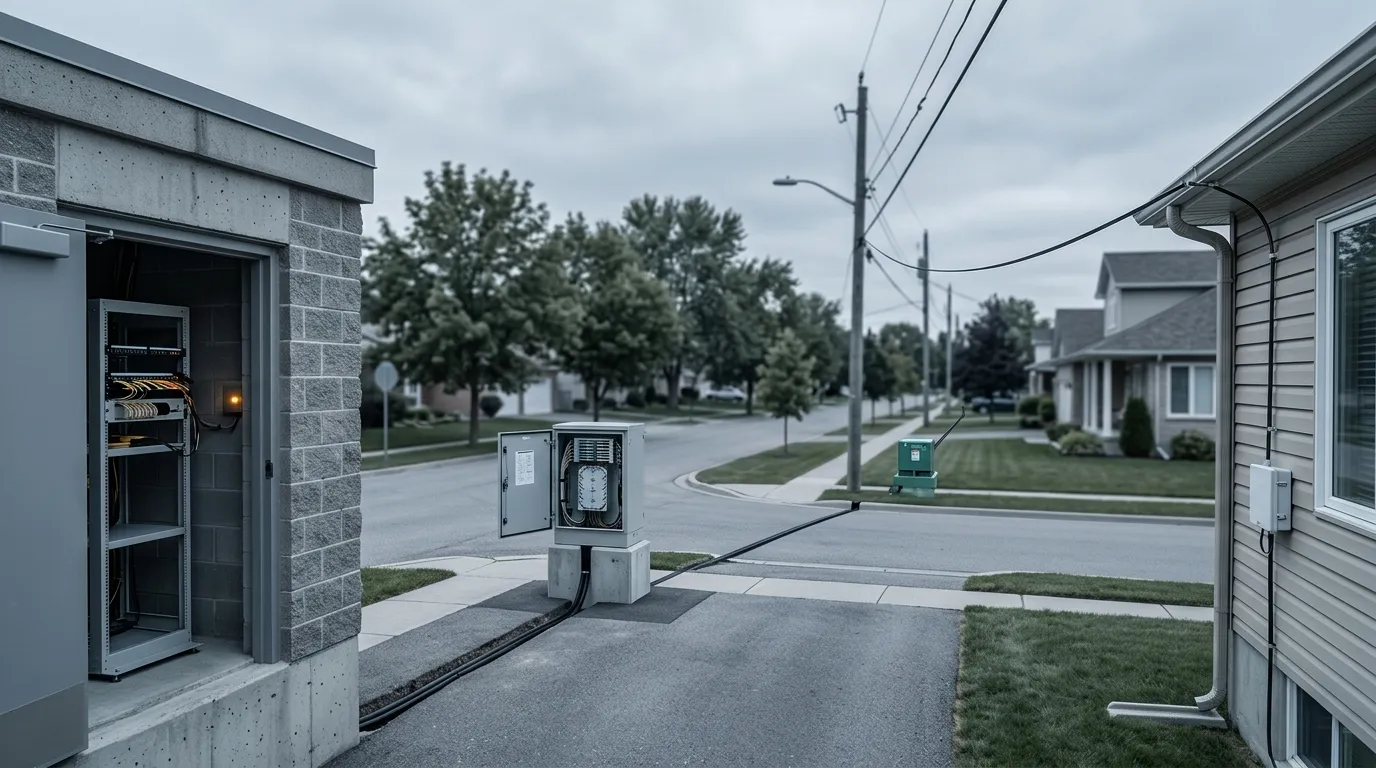
OLT vs ONU: it is not a choice between two devices
The "vs" in olt vs onu is a search convention, not a decision. The two do not compete; they are the two ends of one link, and the relationship between them is master and subordinate.
The OLT is the only device in the path that sees the whole network. It terminates the PON ports facing the subscribers and the uplink ports facing the core, and the network's rules live in it: which ONU may join the tree, how much bandwidth each one may have, and when each one is allowed to transmit. Downstream it broadcasts, and each ONU filters out only what is addressed to it; upstream that would collide, so the OLT assigns time slots and each ONU transmits only inside its slot. It also ranges the tree, so that every endpoint appears to be at the same distance before any of them transmits.
The ONU is the other half of that relationship: receive selectively, respond on command, convert between optical and electrical, and present service to whatever is behind it.
Three consequences follow, and they explain why difference between OLT and ONT shows up in the same search session as olt vs onu:
- The OLT is a capacity decision, the ONU is a count. You specify an OLT by ports and per-port split ratio; you specify ONUs by how many subscribers there are and what each one needs on the electrical side.
- The OLT is bought once and amortised, the ONU is bought per home. Faults cost differently too: a PON port takes up to 128 subscribers down at once, a failed ONU takes one.
- Management flows one way. Provisioning, firmware and fault reporting reach the ONU through the OLT. An ONU with no OLT behind it is a doorstop.
The layered standards that define this behaviour are maintained in the ITU-T's Study Group 15, which owns the G.984 GPON series and the later 10-gigabit generations that keep the same OLT–ODN–ONT structure. How the splitters cascade and how the cable is built behind all this is outside-plant work, and the FTTH access network deployment guide covers that side end to end.
ONU vs ONT: the same device, named by two different standards bodies
Ask what does ONU stand for and you get "optical network unit"; ask what does OLT stand for and you get "optical line terminal". The interesting collision is olt vs ont, because both acronyms point at the same class of device.
The origin is a standards split. ITU-T PON specifications speak of the optical network terminal. The IEEE's Ethernet-based PON line, IEEE 802.3ah — Ethernet in the First Mile, is where EPON comes from, and it speaks of the optical network unit. Vendors blurred the two, and modern XPON equipment is labelled either way — you will see "XPON ONU/ONT" on a datasheet and "GPON ONT" on the box beside it.
For a specification document the origin does not help: the usable rule is positional, and it comes from what is behind the box.
- ONT — fiber terminates at the subscriber. The device is at the customer premises, and the next segment is Ethernet or Wi-Fi inside that home. This is the FTTH case, and the one most people meet.
- ONU — fiber terminates somewhere short of the subscriber. The optical endpoint sits in a building basement, a curb cabinet or a street node, and a remaining electrical segment — copper pairs, coax — carries service the last stretch to individual units. This is the FTTB and FTTC case.
Your deployment | Write | Why |
|---|---|---|
Fiber to each individual home | ONT | Fiber terminates at the subscriber's premises |
Fiber to a building, copper to units | ONU | The optical endpoint serves a further electrical segment |
Fiber to a curb or street node | ONU | Same reason — the subscriber is still downstream on copper |
Mixed network, both patterns present | ONU/ONT on the shared bill of materials; resolve per site | The device class is the same; the position is not |
The practical payoff is the removal of a common error: a drawing that labels the basement node "ONT" and the dwelling unit's box "ONU" contradicts itself, and whoever is ordering hardware cannot tell a naming slip from a real requirement. Pick the convention once and get it into the legend.
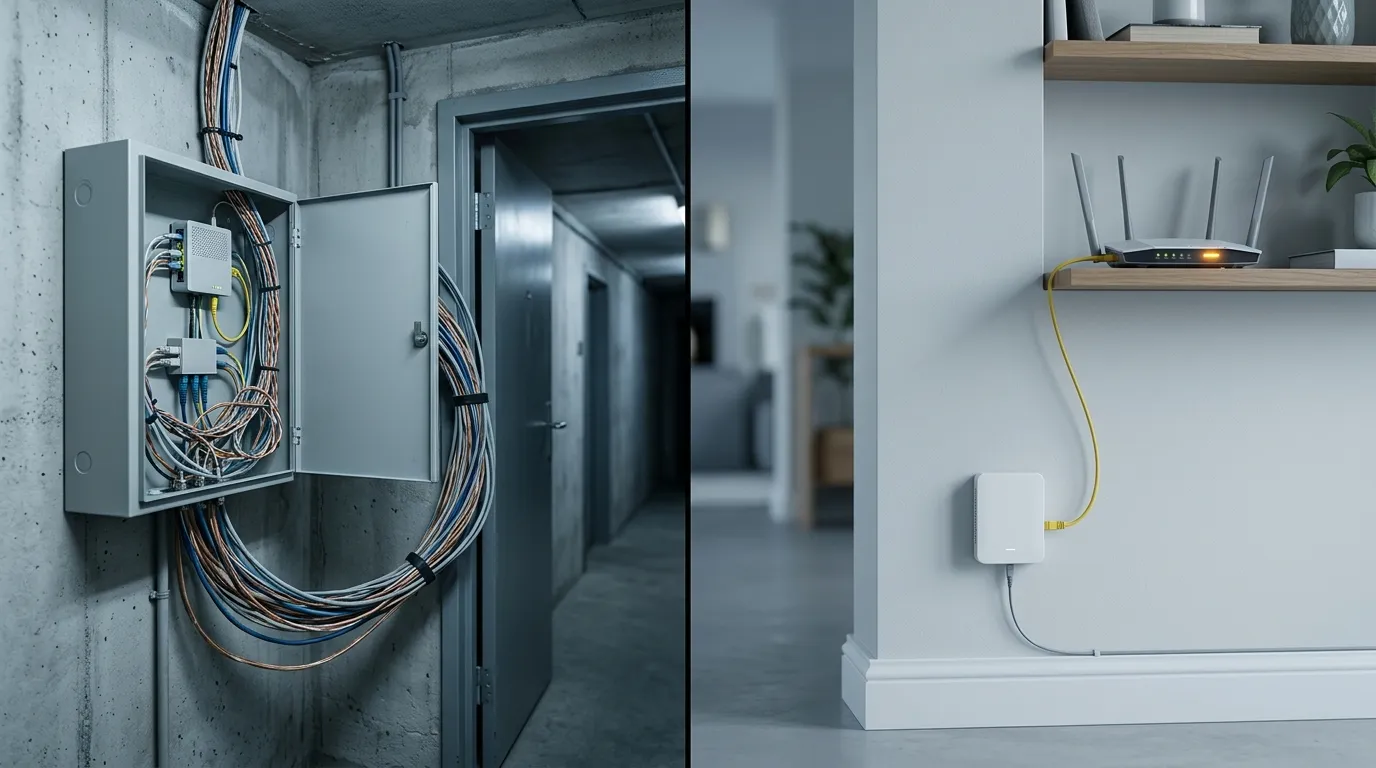
The ODN: the half of a PON that is not a box
Here the four terms stop being symmetrical. Three name devices. The ODN names a network, and it is usually the largest single cost line in an access build — which is why "what is ODN" deserves a segment-by-segment answer rather than one line.
The ODN is commonly described in five segments, in order away from the OLT:
# | Segment | Runs from → to | What is in it | What you actually specify |
|---|---|---|---|---|
1 | Feeder fiber | Optical distribution frame (ODF) in the central office → optical distribution point | High-count cable, often in duct or buried | Fiber count, cable construction, route and protection |
2 | Optical distribution point | Feeder → distribution fiber | Splitter modules, splice closures or cabinets | Split ratio, splitter package, enclosure type and IP rating |
3 | Distribution fiber | Distribution point → optical access point | Lower-count cable branching along streets or floors | Fiber count per branch, cable type, fire rating indoors |
4 | Optical access point | Distribution fiber → drop fiber | Access or terminal box where drops are connected | Port count, connector type, environmental sealing |
5 | Drop fiber | Access point → ONT | Short run, aerial or ducted, to the subscriber | Drop construction (flat self-supporting or round), pre-termination, connector polish |
Two choices in that table decide how a build feels in the field. The first is the enclosure at segment 2 or 4 — the difference between a terminal box, a distribution box and a junction box is a question about which connection point you are standing at, not a naming preference. The second is the drop: segment 5 is the only part most crews touch house by house, so its construction — flat self-supporting for aerial runs, round for ducted ones — sets how long each installation takes; the FTTH drop cable guide works through that against route types.
And here is the boundary. The ODN ends at the ONT's optical port. Everything past it — the Ethernet runs, the Wi-Fi, the coax for a set-top box — is customer premises wiring. That matters at acceptance testing: the subscriber's router or in-home cable is then not an ODN fault and not a truck roll the outside-plant budget was sized for, and end-to-end tests get a defined endpoint instead of an argument.
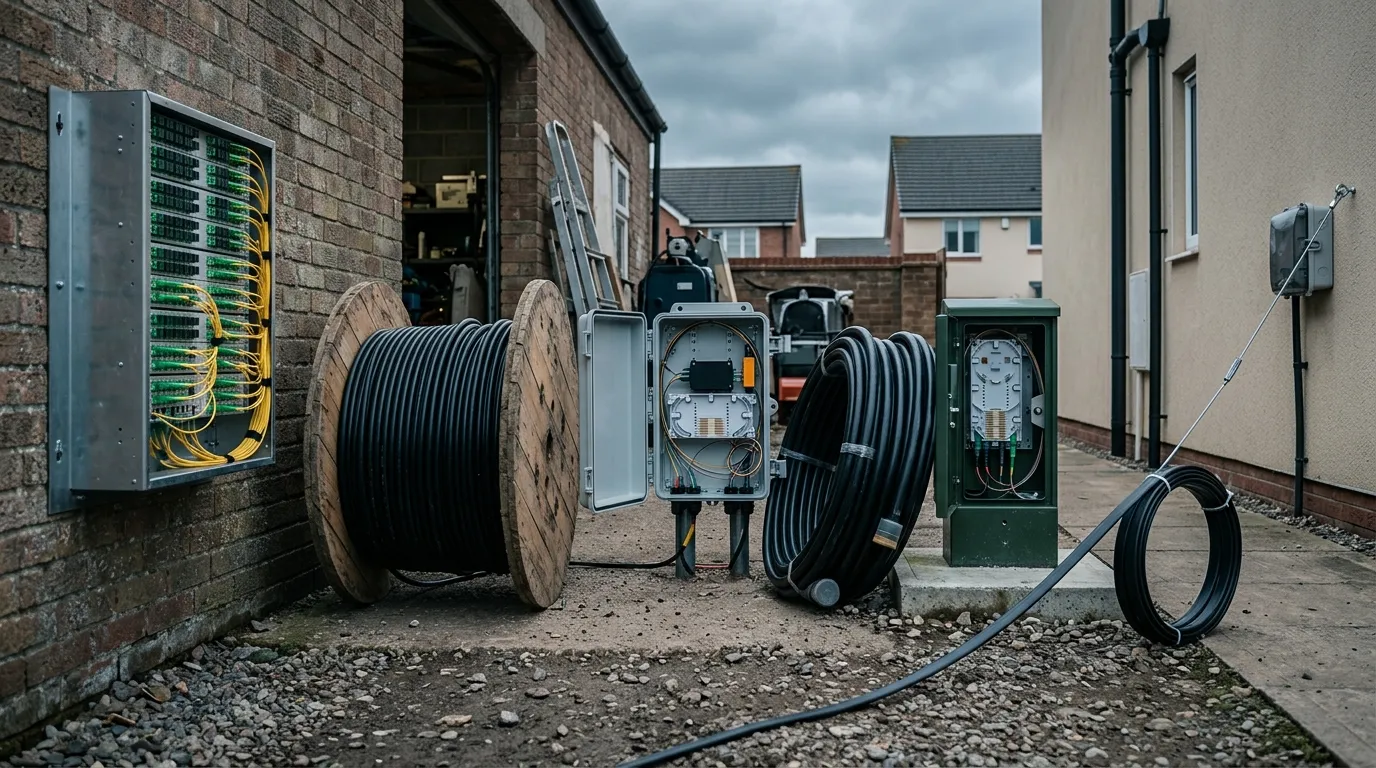
What really limits a PON: split ratio, loss budget, and the 20 km reach
Nearly every explainer repeats that a PON spans about 20 km, and almost none say where the number comes from. Three statements circulate — "usually 20 km", "up to 20 km", "20 km or greater" — a sign the figure is quoted without its definition.
The 20 km is a physical reach in the ITU-T PON specifications: the maximum length of fiber that may be installed between the OLT and the farthest ONT in a GPON tree. It is not the maximum logical distance the protocol supports, nor a promise about performance. Practically it is a ceiling you will rarely reach, because two other constraints bind first:
Split ratio. One PON port's capacity and its optical power are shared by everything downstream of it. Ratios are commonly written as 1:32 or 1:64, with 1:128 on newer equipment. Every doubling of the split halves each subscriber's share of the port's bandwidth, and each split stage also removes optical power — which feeds straight into the second constraint, as how split ratio changes the reach you can build sets out.
Optical budget. A PON works only if enough light arrives at the far end: the budget is the gap between the power the OLT launches and the ONT receiver's sensitivity, and every element in the ODN spends some of it — cable attenuation over the route, every splice, every connector pair, each splitter stage. The ITU-T defines GPON optical budget classes around this total; the class you meet most often, Class B+, allows 28 dB of loss between the two ends. A 1:32 split consumes roughly 17 dB on its own, so the arithmetic that decides whether a design runs is split loss plus fiber loss plus splice and connector loss, measured against the class your optics were built for — and the Fiber Optic Association's FTTH network design reference works that calculation through on a real design.
That is the honest version of the 20 km answer: the standard says 20 km, and the budget decides whether you get there. A short route with a 1:32 split and clean connectors sits comfortably inside it. A long rural route with a 1:128 split, ducted cable, several splice enclosures and marginal terminations can miss it — and will surface as an intermittent fault rather than a clean outage, which is the expensive way to learn it.
Wavelengths are the third constraint, and the one nobody mentions. A PON carries its two directions in separate windows of the same single-mode fiber, and the bands are allocated rather than chosen per project:
Lane | Band | What it means for the ODN |
|---|---|---|
Downstream, OLT → ONU | 1490 nm | Broadcast to every ONU on the port; each one filters out what is addressed to it |
Upstream, ONU → OLT | 1310 nm | Time-slotted; one transmitter talks at a time, which is what the OLT's scheduling enforces |
Video overlay | 1550 nm | Reserved historically for RF video — keep the band clear even if you no longer sell video |
10-gigabit generations | 1577 nm down / 1270 nm up | New lanes on the same fiber, which is why an upgrade can reuse the ODN you already built |
That allocation is why the fiber in the ground outlives an equipment generation. If you want the generation-by-generation comparison and what an upgrade changes, which PON generation the ODN has to carry works through it, and the loss arithmetic behind it — insertion loss versus return loss — is the pair of measurements your acceptance test records.
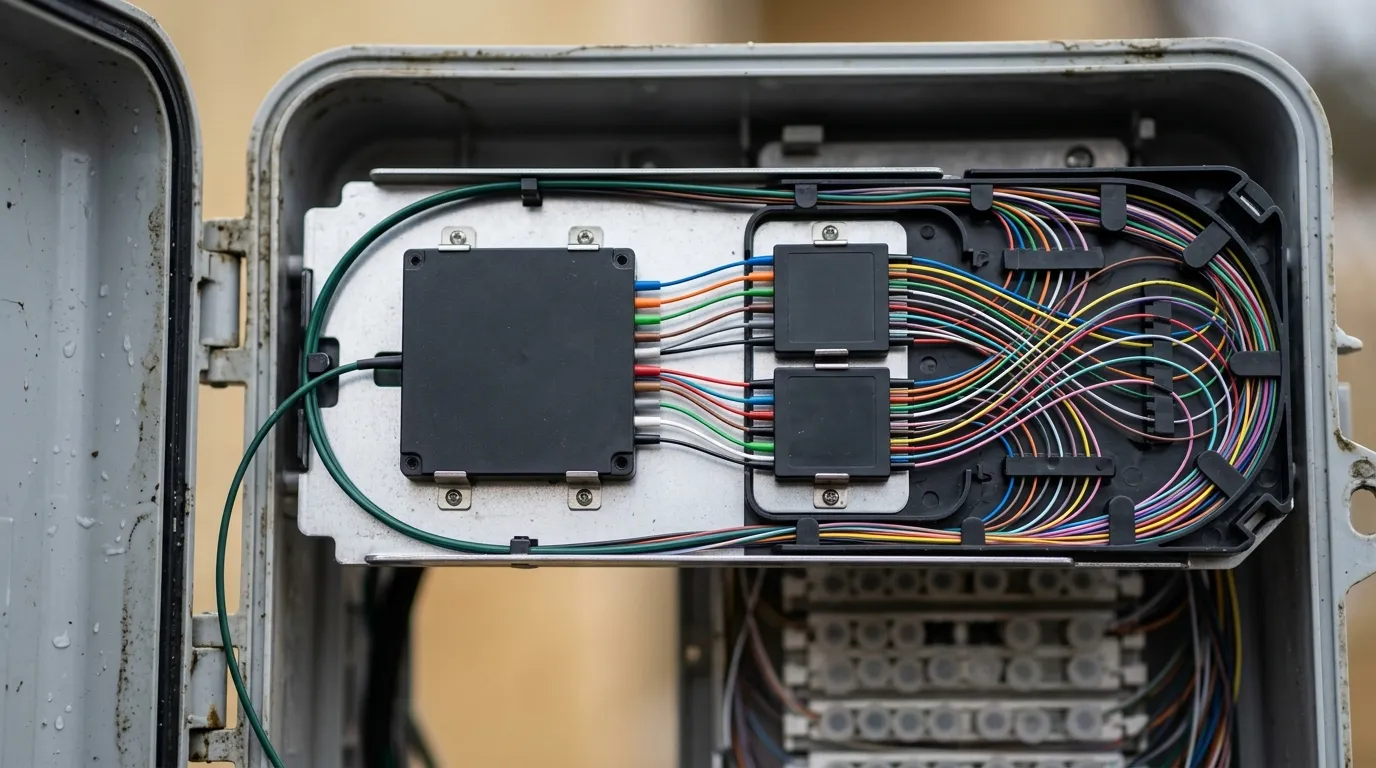
Where the active/passive boundary falls when you buy
The four terms also sort into two procurement channels, and mixing them up delays projects.
Active endpoints | Passive ODN | |
|---|---|---|
What you are buying | OLT chassis and line cards, ONU/ONT units | Cable, splitter modules, closures, boxes, drop assemblies, connectors |
Who supplies it | Telecom and CPE equipment vendors | Cable and passive-hardware manufacturers |
How it is specified | By port count, standard generation, management features | By construction, fiber count, split ratio, environmental rating |
Who owns the failure | The equipment vendor's warranty and support process | The installer's workmanship and the material's environmental rating |
Design lifetime | One or two equipment generations | Twenty years or more |
Read the last row again — it changes where design attention belongs. The OLT and the ONUs are the parts you expect to replace; the fiber itself stays put. The cable you bury, the splitters you seal into a closure and the drops you terminate on a subscriber's wall are the parts you will live with across that replacement. The Broadband Forum's GPON access architecture work, TR-156, treats the access network in exactly these layers, with the ONT as the boundary between the operator's network and the subscriber's.
So if there is one instruction to carry away from this page, it is a budgeting one: design the ODN for the generation after the one you are deploying. Prefer a single splitter stage where the reach allows it, standardise on one connector type and polish, choose splitter ratios for the distance you need, and insist on loss measurements and as-built records for every segment. Those decisions are cheap at specification time and the difference between changing cards and rebuilding streets later.
The four building blocks in one paragraph
An OLT is the active endpoint that runs the tree. An ONU, or ONT when it terminates at the subscriber, is the active endpoint that ends it. The ODN is the passive plant between them — feeder, distribution and drop fiber with the splitters and enclosures that route it — and it ends at the ONT's optical port. Put together they are a PON, and the reason it works economically is that nothing in the middle needs power. The terms get muddled because two of them name the same device class and the reach figures get repeated without their definitions, but the structure is simple: two boxes that talk, and a network in the middle that outlives both.
If you arrived here working out whether your home needs a modem or a router behind a fiber connection: the ONT is the fiber's endpoint — effectively the modem, light in and electrical out — and you need the router behind it.
Most of the cost and nearly all of the durability in that structure sit in the middle. DYS Fiber Optic manufactures the passive side of it — flat and round drop cables, splitter modules and racks, terminal and distribution boxes, and sealed outdoor connector assemblies — for operators and integrators in Europe, the US and emerging markets, with regional certification documentation for the markets we ship into. You can review the FTTH cabling and accessories range, or ask for samples to test against your own plant before a design is frozen.