
Fiber Basics
Copper vs Fiber Cost: What 10 Years Really Costs
Copper is cheaper. That is the honest answer, at least in year one: a Cat6A run costs less than a single-mode run of the same length, an RJ45 plug costs a few cents against a few dollars for a field-terminated LC connector, and any competent electrician can install it. The interesting question is not whether copper wins the first invoice. It is whether it still wins in year ten, when the copper vs fiber cost comparison has been running long enough for the second re-pull, the tenth electricity bill and the closet you had to build in the car park to keep every run under 100 meters.
Three of the four things that decide that comparison never appear on a cable quote. This article prices them as far as the public record allows: energy computed from wattages and a published tariff, facilities bounded by a trade-press range for the room, and refresh counted rather than priced — because a re-pull costs whatever your local labour market charges, and no published per-drop figure survives contact with a real building. Where a line can only be bounded, the article says so; every assumption behind the computed line is stated so you can replace it with your own.
One disclosure before the numbers. DYS sells fiber cable, so treat the fiber case here as an interested party's argument. The sources below are not a neutral panel either, and you should know which is which: one standard (ITU-T G.652), one standards reference table (the 802.3bt power classes), two government datasets (the EIA's monthly electricity prices and the USGS copper summary), one 2000 trade-press argument from ELECTRICAL CONTRACTOR, and two fiber-industry sources — a Corning study and an FTTH Council Europe position paper — which are interested parties on the same side as this page and are cited for figures we could check, not for conclusions. Nothing in the model is a DYS measurement.
Why Copper Wins the Quote and Loses the Decade
The hinge is 100 meters. Copper Ethernet is specified to 100 m for a reason that has nothing to do with build quality: the signal is a current, it attenuates with distance, and past roughly that point the physics stops cooperating. Fiber does not have that limit in any practical sense — single-mode glass specified under ITU-T G.652 carries a link for kilometers before anything needs regenerating, which is why the distance question has a completely different answer for the two media.
A quote does not measure that. A quote measures meters of cable, a count of connectors, and an hour rate. It cannot see that the 100 m rule has already decided how many telecom rooms your building needs, how many powered and cooled cabinets sit in them, and how many times the whole horizontal plant gets replaced when the bandwidth requirement steps up. Those are the three lines that compound.
So the argument is not "fiber is cheaper". It is narrower and more useful: copper's up-front advantage is real, and it is bought with three future liabilities whose combined size is usually larger than the advantage itself.
The Copper vs Fiber Cost Model: Four Lines and Two Adjusters
Any honest ten-year comparison has to hold six things, and most published comparisons hold one.
Line | What it contains | Who usually wins |
|---|---|---|
| Cable, connectors, patch panels, termination labor | Copper, modestly |
| Port power plus the cooling that removes it | Fiber |
| Rooms, power circuits, UPS, cooling, floor space | Fiber |
| Re-termination and re-pull inside the decade | Fiber |
Adjuster A | Faults, downtime, water ingress, theft | Fiber |
Adjuster B | Salvage value of the copper at end of life | Copper |
The two adjusters are real and they run in opposite directions, which is why a comparison that ignores both tends to land on whichever conclusion the author wanted. The four lines are where the money actually is.
Line 1 — Materials: Copper's Real but Small Win
Per meter and per connector, copper is cheaper, and no amount of modeling changes that. What the model changes is the quantity. A copper design is a star: every endpoint needs its own run back to a switch port within 100 m, so a 48-port floor in a long building becomes 48 home runs of 40 to 90 meters each, all of them terminating in the same closet. A fiber design is a line: one cable to the floor, a splitter or a small switch, and the endpoints feed from there.
That is where the materials advantage quietly inverts. Copper's unit price is lower; its unit count is usually higher, because you are paying for copper all the way back to the closet instead of glass to the floor and a short local run. Adding capacity has the same asymmetry: going from 12 to 24 fibers in one cable is a small increment in jacket and labor, while doubling copper port count doubles switches, panels and terminations. For what actually moves the fiber side of the bill — preform, fiber count, jacket construction, freight — the cost drivers of fiber optic cable are worth reading before anyone quotes you a per-meter number as if it were a constant.
We do not print a per-metre cable price or an installed cost per drop for either medium, and you should distrust any page that does: cable is a monthly commodity, the installed number is dominated by regional labour, and quotes are written per drop rather than per unit of cable. So Line 1 stays a ratio — copper cheaper per unit, more units — and the fiber side of it is the cost-driver page above.
There is one materials line where copper's disadvantage is not just a price but an avoidable build: interference. Copper near motors, variable-frequency drives or welding has to be shielded, separated or run in conduit past the noise source, and that is cable, containment and labour the fiber side never buys. The 2000 article puts the same point in a sentence — fiber's immunity from EMI removes the conduit you would otherwise need to get past an interference source — and it is the easiest cost in the copper case to miss, because it shows up as containment on a different page of the bill of materials.
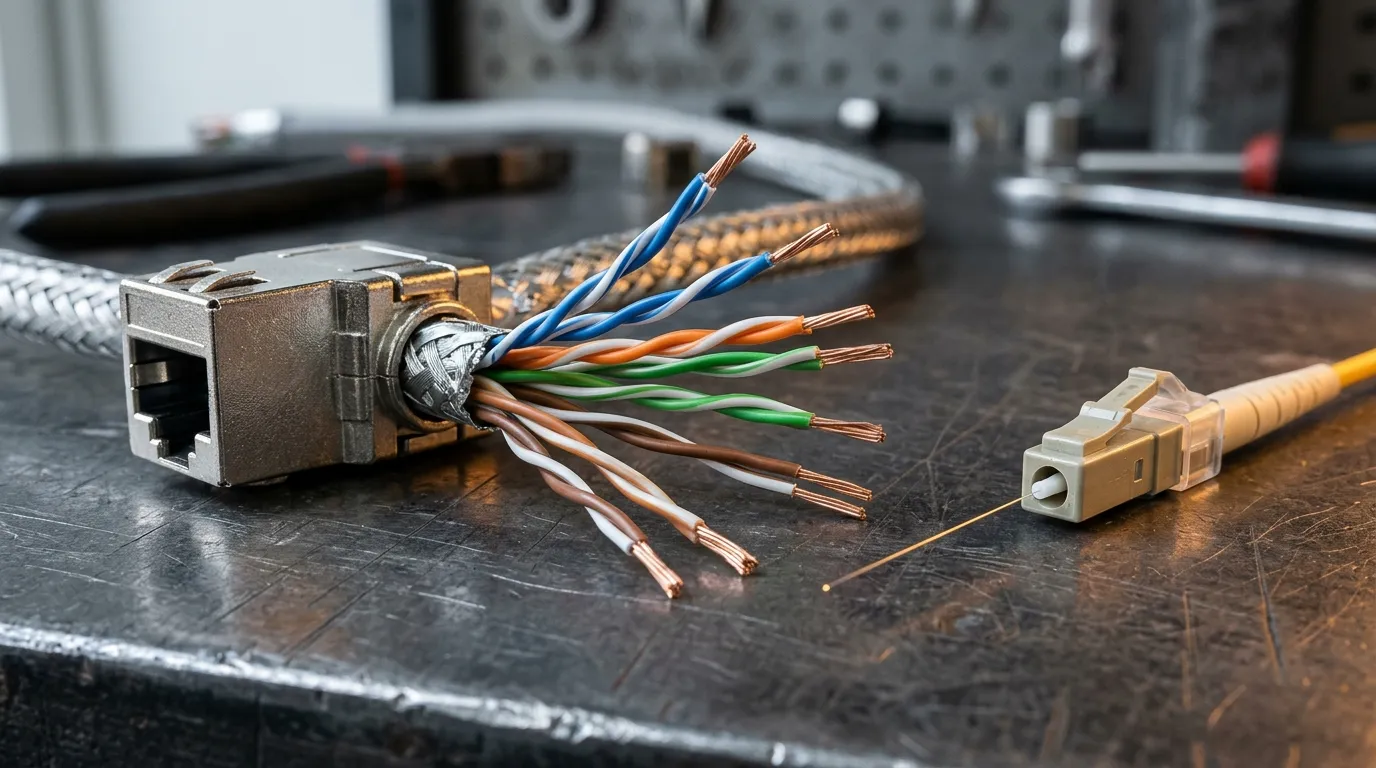
Eight copper conductors in four twisted pairs, and their terminations, on one side; one 125-micron glass strand on the other. The materials gap is real; the quantity gap is what eats it.
The old industry line — that cable is a small fraction of what a network costs — is still the right frame. A 2000 article in ELECTRICAL CONTRACTOR put the cable at a "miniscule part of the whole network cost" and argued that any valid comparison had to include electronics, facilities and support (ELECTRICAL CONTRACTOR). The part numbers in that article are antique; the framing is not, and it is the reason Line 1 cannot decide a ten-year question on its own.
Line 2 — Energy: The Three-Watt Gap, Priced
This is the one line you can compute from published numbers without asking anybody's sales team for a quote.
Copper 10GBASE-T switch ports draw roughly 4 to 5 watts each to do the signal processing that twisted pair demands; a 10GBASE-SR fiber port draws 1.0 W maximum, typically 0.5 W. Those are Corning's published figures in its 10G optical fiber energy comparison. Cooling is not free either: the same paper uses 2 to 2.5 kWh of cooling for every kWh of electronics, which is the multiplier most comparisons leave out.
Take a deliberately conservative case — 48 ports, 4 W of copper against 1.0 W of fiber, and the low end of the cooling range.
Copper (10GBASE-T) | Fiber (10GBASE-SR) | |
|---|---|---|
Port power, 48 ports | 192 W | 48 W |
Plus cooling at 2:1 | 576 W total | 144 W total |
Annual energy, 24×7 | 5,046 kWh | 1,261 kWh |
Annual cost at 14.47¢/kWh | $730 | $183 |
The tariff is the U.S. commercial average of 14.47 cents per kWh for August 2026, from the EIA Electric Power Monthly. The delta is 3,784 kWh and about $548 a year; over ten years, roughly $5,500 for 48 ports.
Per port it is easier to carry around: about $11 a year, or $114 over the decade. Scale it to a 1,000-port estate and the energy line alone is over $110,000 over the decade. Five caveats keep that honest. Half-loaded ports halve it. An industrial tariff of 9.64¢/kWh cuts it by a third. Using the 2.5× end of Corning's cooling range instead of 2:1 raises it to about $639 a year, or $6,389 over the decade. The 4 W figure is a generation behind the newest 10GBASE-T PHYs — if your vendor quotes 3 W, the gap narrows to about $7.60 per port-year. And these are undiscounted nominal dollars: at a 5% discount rate the same decade is worth about $4,230 in today's money, or $88 a port. Energy is the most reliable line in the model, and it is still not usually the largest.
Line 3 — Facilities: What the 100 m Rule Makes You Build
A telecom closet is not a cupboard. It is a room with a lock, a power circuit, usually a UPS, usually cooling, and a floor area you could otherwise rent out. Copper needs one within 100 m of every endpoint; fiber needs one within a few hundred metres on multimode — 300 to 400 m for the 10GBASE-SR optics this model uses — and kilometres only once you move to single-mode.
The cost of that room is the least-quoted number in the whole comparison. The 2000 article above put a telecommunications closet at $2,000 to $15,000 per closet plus floor space, with construction of a new one adding $5,000 to $15,000 — and it noted that estimates ranged far higher on prestige sites. Adjust for inflation if you like; the order of magnitude is what matters, because it is an order of magnitude larger than the cable bill for the same floor.
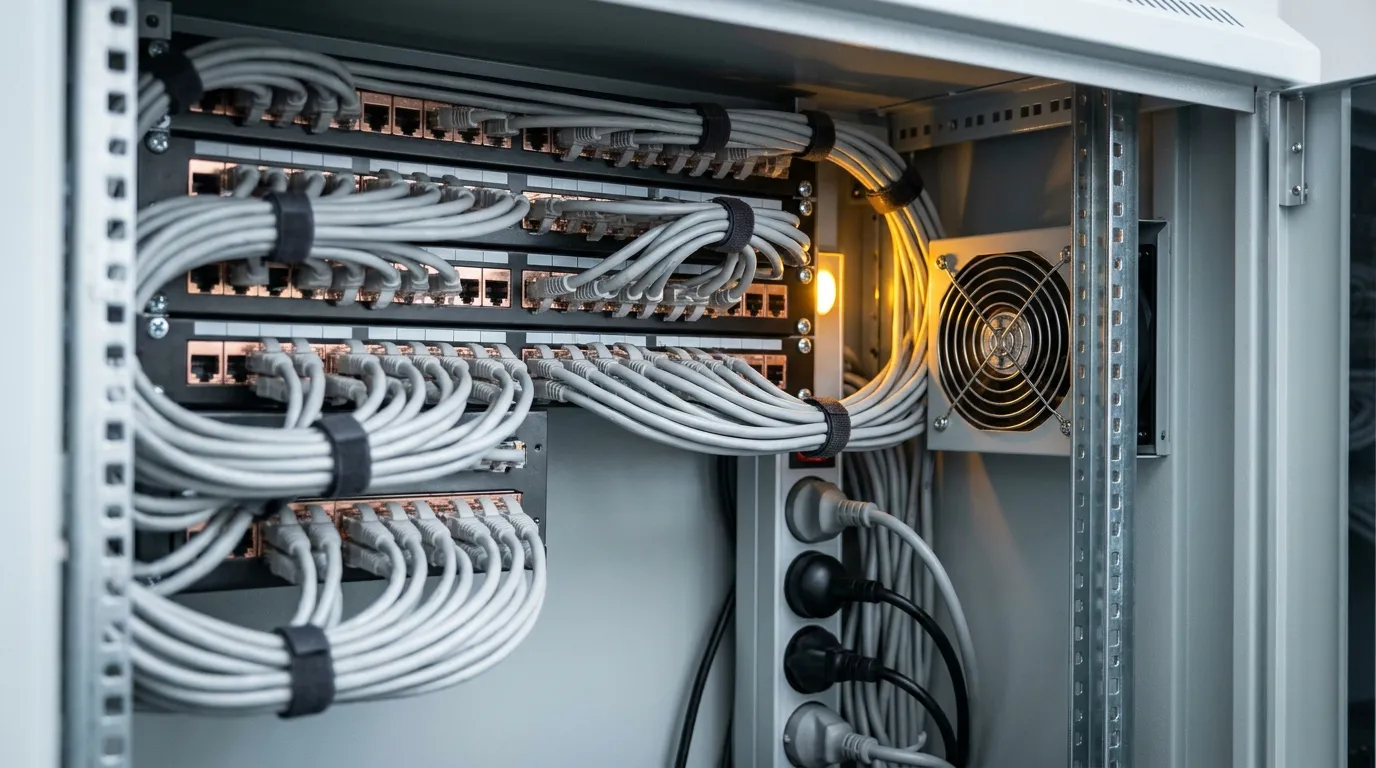
Every one of these runs has to terminate inside 100 m of its endpoint. That is a room, a circuit and a fan per zone — recurring cost that never appears on a cable quote.
Which brings us to the number this whole comparison has been missing: the premium itself. The premium is what fiber costs extra up front — more expensive electronics and termination per port. The only published figures we can point at are old ones, from the same 2000 article: fiber electronics ran $50 to $300 more per link, and a fiber NIC $100 to $400 against $60 to $80 for copper. Its author also notes that fiber's costs "continue to decline" while copper's rise with every new grade, so read $50–$300 a port as a ceiling set in 2000 dollars, not a 2026 quote — which is precisely why the model states a threshold you can test instead of a quote you would have to trust.
The threshold is checkable arithmetic. $5,476 over ten years is $114 per port, so on energy alone fiber repays a premium of up to $114 a port ($88 at a 5% discount). One avoided closet is worth $2,000 to $15,000 — $42 to $313 per port on a 48-port floor. At the top of that range a single avoided room is worth $313 a port — more than the $300 ceiling of the sourced band — and energy plus one closet together cover $156 to $427 a port. That is the break-even, expressed in the currency you actually spend.
Line 4 — Refresh: Buying the Same Link Twice
Copper's category ladder keeps producing new grades within a few years of each other: Cat5e, then Cat6, then Cat6A, then Cat8 for the short-reach 25G and 40G cases. Each step exists because the previous grade ran out of headroom, and each step means the same thing on site — new cable, new jacks, new patch panels, re-testing, and downtime for every desk on the floor.
A ten-year window therefore usually contains one refresh for copper in a slow-moving organization and two in a fast one. Fiber's side of that ledger is different in kind: the glass you install today is the glass that carries whatever the optics at each end can do, and optics generations change without touching the cable. That is why passive fiber plant is routinely described as outliving several generations of electronics.
Refresh cost is dominated by labor, not material. Pulling, terminating, testing and certifying a floor is the expensive half, and on outside plant it is worse: trenching and duct work usually dwarf the cable inside it, which is why direct burial versus conduit is a lifecycle decision rather than a first-cost one. The FTTH Council Europe's convergence work makes the same point from the operator side: civil works are a substantial share of deployment cost, and planning fiber once for both fixed and mobile use avoids repeating them.
There is an adjuster on top of this that most models skip. A copper plant is a metallic path into every room: it collects water, it collects lightning, and on some sites it collects thieves. Each of those events is a truck roll, and truck rolls at 2 a.m. cost more than the cable they replace. If you have ever priced a single outage, you already know the multiplier — the same logic that makes the true cost of a tower-top failure so much larger than the failed part.
The Ten-Year Ledger
Line | Copper | Fiber | Verdict |
|---|---|---|---|
Materials | Lower unit price, more units | Higher unit price, fewer units | Copper, modestly |
Up-front premium | — | $50–$300/port more for the electronics (2000 prices) | The bar the rows below have to clear |
Energy (48 ports, computed) | 5,046 kWh/yr, $730/yr | 1,261 kWh/yr, $183/yr | Fiber, $5,476 over 10 years |
Facilities | A closet per 100 m zone | One room per few hundred metres (multimode), per kilometre (single-mode) | Fiber, by the price of a room, $42–$313/port |
Refresh | 1–2 re-terminations in 10 years | None | Fiber |
Faults and downtime | Metallic path, water, theft | Passive, dielectric | Fiber |
Salvage | Copper scrap has real resale value | Negligible | Copper |
The break-even is not a single date; it is a set of thresholds, and each one can be compared to the premium on its own terms. Fiber pays back on energy alone if the premium is under $114 a port over ten years. It pays back on facilities if the copper design needs one more closet than the fiber design: $2,000 to $15,000 is $42 to $313 a port at 48 ports, and the top of that range covers the whole $50–$300 premium band on its own. It pays back on refresh if copper needs a re-pull inside the window you keep the building, and a re-pull is a labour bill per drop that you can price from your own last project. In most multi-building sites the closet threshold is crossed first, and it is crossed in year one.
Copper Price Risk: Your Cable Quote Is a Metals Bet
There is a risk in the copper line that does not exist on the fiber line: you are buying a metal.
USGS annual average prices for U.S. producer cathode ran $4.32/lb in 2021, $3.95/lb in 2023 and an estimated $4.90/lb in 2025 — a 9% fall followed by a 24% rise in four years, with the London Metal Exchange cash price averaging $4.40/lb over 2025 (USGS Mineral Commodity Summaries 2026). At $4.90/lb, copper is around $10,800 a metric ton before it becomes a cable.
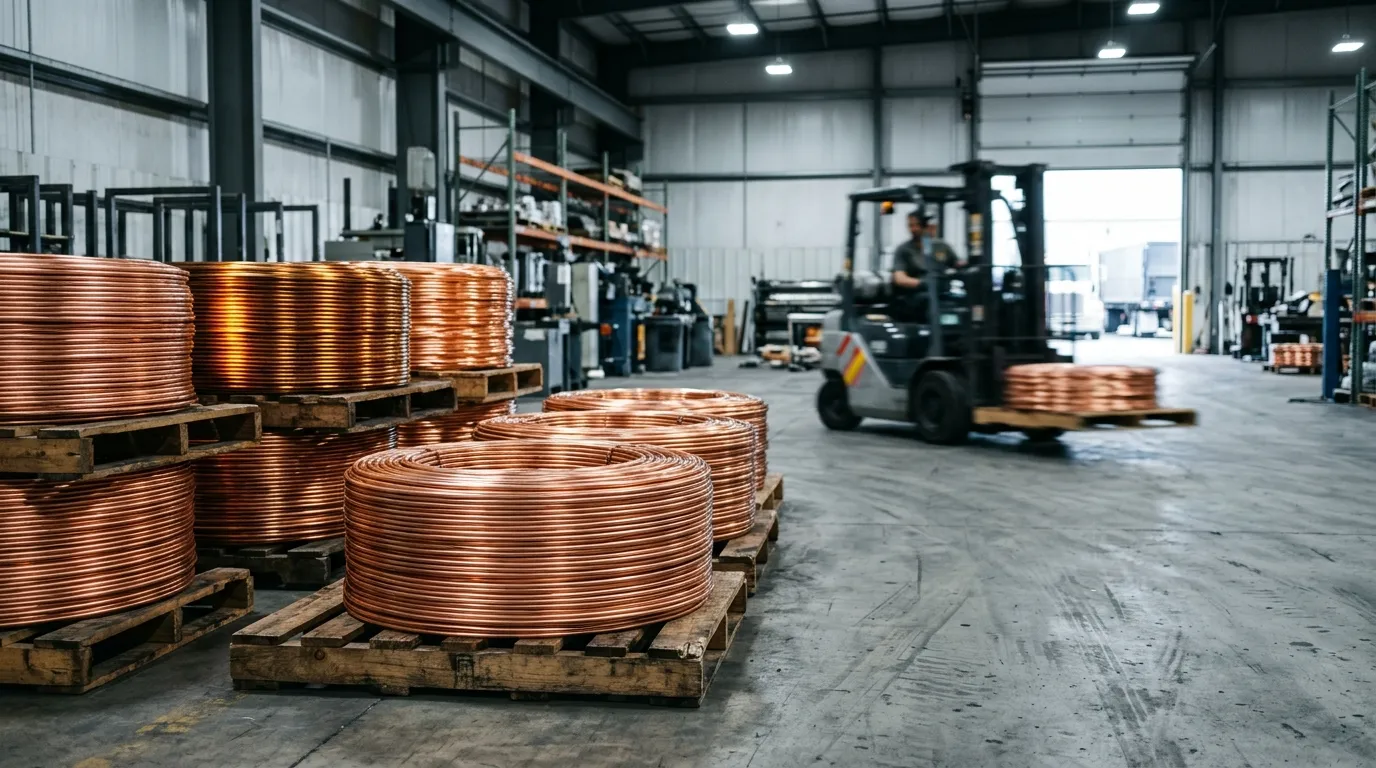
Wire rod waiting to become cable. The price on this floor is set by a metals market, not by a cabling vendor — and it moves while your ten-year plan sits on a desk.
Two things follow. First, a copper BOM quoted in year one is not a price you can hold for a ten-year plan; tariffs, scrap competition and grid demand all feed straight into it, and the 2025 spike is the demonstration. Second, the metal at the end has value — pulled copper is scrap, and scrap has a buyer. That is a genuine credit against copper's refresh cost and the reason the salvage row in the ledger is not zero. It is also the row most likely to be stolen before you get to claim it.
Fiber has the opposite profile: a higher conversion cost and a much flatter input curve, because the raw material is sand and the expensive part is the process, which keeps improving.
Where Copper Still Wins — and Should
A comparison that only concludes "use fiber" is a sales pitch wearing a spreadsheet. Run the ledger backwards and it names the sites where copper wins on total cost, not on sentiment.
One room, no growth, ten years. If the copper design already fits the closets you own and the bandwidth requirement will not step up inside your holding period, two of the three thresholds are dead on arrival: no extra room, no re-pull. What is left is the energy line, worth $114 a port over the decade, against a premium that can run to $300. On those numbers copper keeps the money, and the model above says so.
Plant with years left in it. Re-cabling a building that already meets its requirement is a spend with no threshold behind it. The ledger prices the next decision, not the last one: if the copper in the wall outlasts your requirement, that plant is a sunk asset and the comparison restarts from zero at the next upgrade.
Endpoints that need watts. Glass carries no current. Copper carries data and DC power on the same pair set, and IEEE's 802.3bt amendment pushed that to 60 W and 90 W classes at the power sourcing equipment — Type 3 and Type 4, at the top of the published class table — enough for cameras, access points, desk phones and a growing list of building devices. Where the endpoint needs watts as well as bits, copper or a hybrid cable is the answer, and no optical budget changes that.
Which is why the practical answer for most sites is not a choice between the two: glass where the run is long, crowded or likely to outlive its electronics, copper where the device needs watts. The full physical comparison — bandwidth, EMI, distance, where each medium breaks — is a separate question from this one and worth reading alongside it.
How to Run This Model on Your Own Numbers
Four inputs do most of the work, and all four are things you already know or can count.
- Count the closets, not the cables. Sketch both topologies on the floor plan and count the rooms each one needs. If the copper design needs even one more powered, cooled room, that line outranks everything else in this article.
- Count the refresh events inside your holding period. Be honest about how long you keep a building before its bandwidth requirement changes. Two copper refreshes in ten years is normal in a growing site.
- Use your own tariff and your own port count. The arithmetic above is
ports × watts × 8,760 × tariff × cooling factor. Substitute the numbers from your last electricity bill; the structure does not change. - Add the failure you have already had. Water in a duct, a lightning strike on an aerial span, a stolen earth bond — if it has happened once, price it once and put it in the ledger.
FAQ
Is copper really cheaper than fiber?
Per meter of cable and per connector, yes, and it stays cheaper for short runs and for anything that needs power on the same cable. The fiber vs copper cost argument only turns on quantity: over a ten-year life on a multi-building site, the cable saving is usually smaller than the energy, facilities and refresh costs that come with it.
Is fiber cheaper than copper?
On the cost of fiber optic cable vs copper, no — not on the invoice, and not on a single short run. The comparison reverses only when you price a decade of running it: on a 48-port floor the energy line alone is worth $114 a port over ten years, and one avoided telecom room is worth $42 to $313 a port. Set that against a $50–$300 up-front premium and you have the whole answer — which is why copper network cost wins in a single small room and loses on a site with several buildings.
How long before fiber pays back?
There is no single number, because payback depends on which threshold is crossed first. For a 48-port floor the computed energy delta is about $114 per port over ten years. The larger and faster threshold is the extra closet the copper design needs: one avoided room is worth $2,000 to $15,000, or $42 to $313 a port at 48 ports, which covers the entire $50–$300 premium band from a single room, in year one. Sites with one small room and no growth can run copper for a decade without crossing either threshold.
Does fiber cost more to install?
On materials and termination, generally yes — field-terminated connectors cost more than jacks, and pre-terminated assemblies cost more than bulk cable. On civil works the gap narrows or reverses, because one fiber cable replaces many copper runs in the same duct, and the duct is the expensive part.
Do I have to choose one medium for the whole site?
No, and most good designs do not. Fiber for anything that leaves the room, copper for the last few meters where a device needs power. The mistake is not mixing them; it is letting a copper default decide the backbone by accident.
A ten-year cost model will not tell you that fiber is always right. It tells you which of copper's three future liabilities you are actually signing up for — and on most sites with more than one building, that is the one question worth answering before the purchase order goes out. If you are re-planning a floor rather than re-arguing a quote, the fiber basics guide is where to start.