
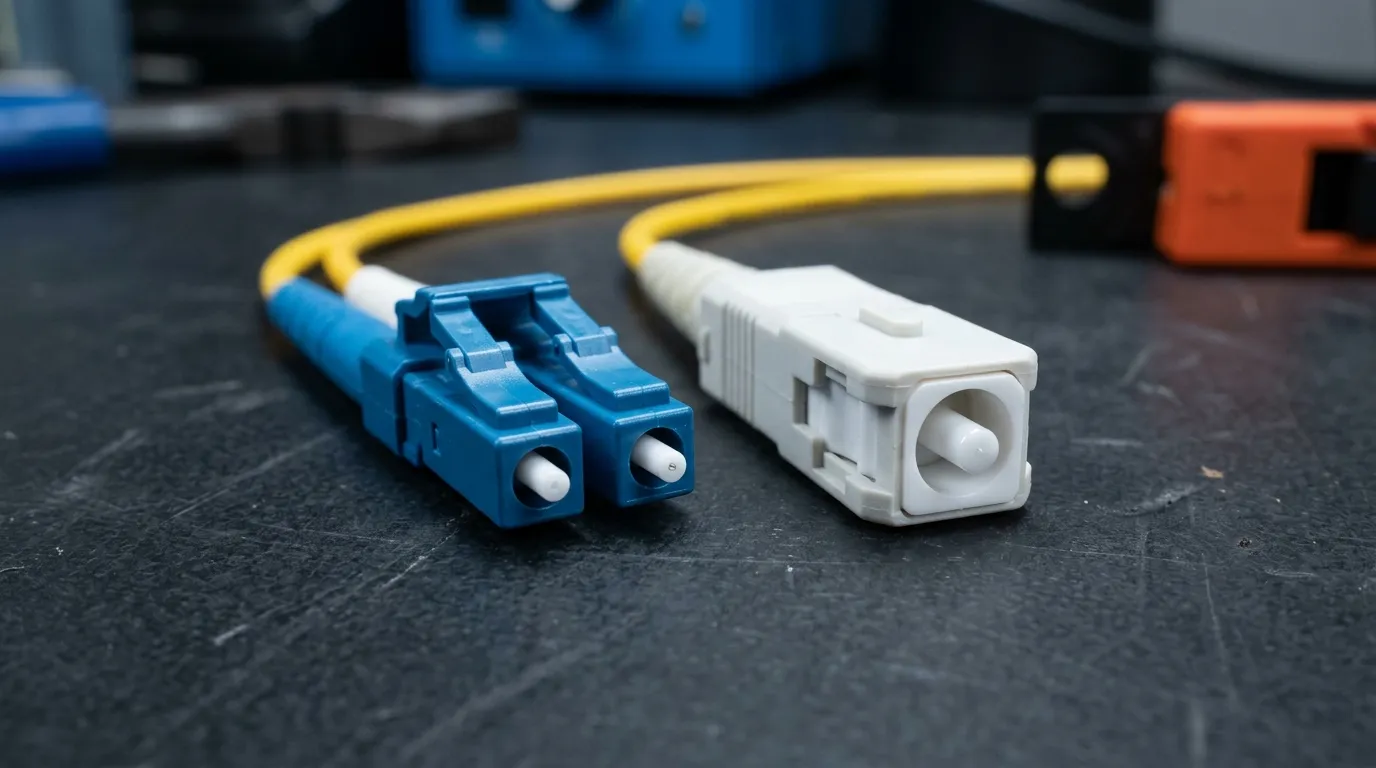
Connectors
LC vs SC Connectors: Size, Density, and Performance
LC and SC are the two connector types you will actually choose between for most fiber links, and neither is "better" in the abstract. LC (Lucent Connector) wins where density matters: its 1.25 mm ferrule is half the diameter of SC's 2.5 mm ferrule, which is why duplex LC is the interface on SFP transceivers and packs roughly double the ports into the same patch panel space. SC (Subscriber Connector) wins where robustness, ease of handling, and field termination matter: it is the de facto standard for FTTH, PON, and ODN deployments, with a larger ferrule that is easier to clean and a push-pull body that survives more mating cycles. This guide compares LC vs SC connectors across size, density, mechanics, durability, standards, and applications, then gives you a five-question path to the right choice for your specific build.
The two connectors share more than they differ: both use precision ceramic ferrules, both deliver typical insertion loss in the 0.25–0.5 dB range for a mated pair, and both come in singlemode and multimode versions with PC, UPC, or APC polish. Whether you searched "sc vs lc connectors," "lc vs sc fiber connectors," or simply "lc vs sc connectors," the question underneath is the same — size, density, and which one belongs where. SC and LC are two members of a larger family that also includes FC, ST, and MPO — if you need the full landscape first, our guide to fiber optic connector types: LC, SC, FC, ST, and MPO is the place to start. If a spec sheet, a patch panel, or a transceiver datasheet forced the LC-or-SC question, read on.
LC vs SC Connectors at a Glance: The 30-Second Comparison Table
Property | LC Connector | SC Connector |
|---|---|---|
Full name | Lucent Connector (also "Little Connector") | Subscriber Connector (also "Standard" or "Square" Connector) |
Ferrule diameter | 1.25 mm | 2.5 mm |
Relative size | Half the ferrule of SC; duplex LC ≈ RJ-45 footprint | Roughly twice the ferrule area of LC |
Coupling mechanism | Spring-loaded latch tab (press to release) | Push-pull with sliding sleeve |
Typical insertion loss | 0.25–0.5 dB (mated pair) | 0.25–0.5 dB (mated pair) |
Typical mating cycles | ~500 (manufacturer ratings) | ~1,000 (manufacturer ratings) |
Primary interface standard | IEC 61754-20 | IEC 61754-4 |
Typical home turf | SFP/SFP+/QSFP transceivers, data centers, high-density panels | FTTH/PON, ODFs, GBIC, CATV, outside plant |
Polish options | PC / UPC / APC | PC / UPC / APC |
One table row deserves emphasis before we go deeper — the insertion-loss row. Because both connectors use the same grade of ceramic ferrule and the same endface polishing technology:
LC and SC are optically equivalent at the mated-pair level. The differences that actually change your decision are size, density, mechanical design, and the ecosystem of equipment around them.
Those four differences drive the rest of this article.
Size and Density: What the 1.25 mm vs 2.5 mm Ferrule Really Buys You
The ferrule is the precision ceramic tube at the tip of the connector that holds and aligns the fiber. SC uses a 2.5 mm ferrule; LC uses a 1.25 mm ferrule — exactly half the diameter. Because connector pitch in panels and transceivers is driven by ferrule and housing width, that halving cascades into real space savings.
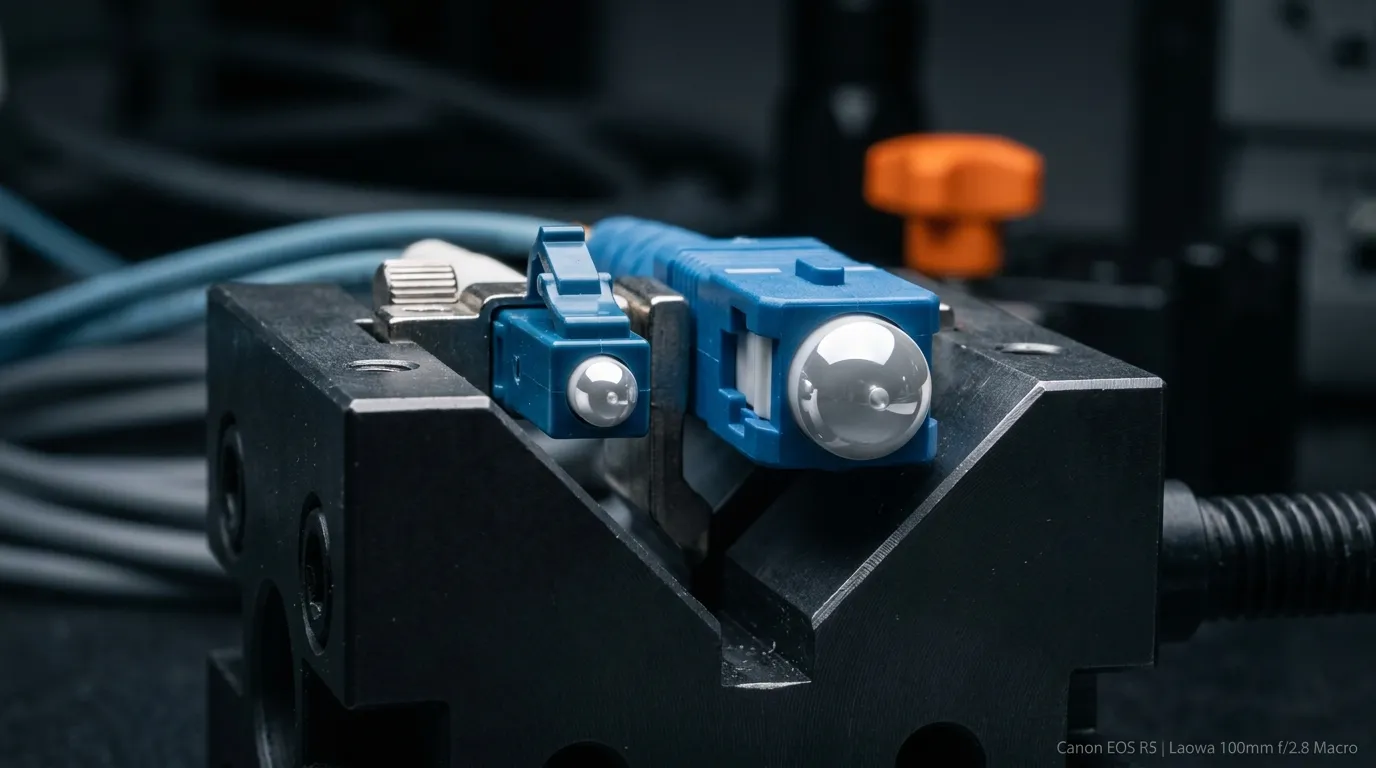
Side by side, the thinner LC ferrule and the thicker SC ferrule — the single fact behind LC's density advantage.
The practical numbers, in round terms:
- Transceiver interfaces. Every SFP and SFP+ transceiver — the dominant serial-optics format for the past two decades — uses a duplex LC receptacle, and QSFP modules with serial 10G/25G-per-lane optics (LR/CWDM types) do too. Parallel-optics QSFP variants (40G/100G SR4, DR4, and beyond) instead break out to MPO, which is why QSFP ports are finished in both LC and MPO in real data centers. If your switch, router, or media converter takes SFP or SFP+ optics, the port side of the link is LC by definition, regardless of what the cable plant uses.
- Panel density. A duplex LC adapter occupies roughly half the face area of a duplex SC adapter. In practice, a patch panel that fits 24 duplex SC ports will typically fit 48 duplex LC ports — close to double the fiber count in the same rack unit. Independent connector comparisons describe LC as delivering about twice the port density of SC in the same panel space, and note that the two types now cost about the same for equivalent grade — a shift from the early days when the LC's more complex latch design carried a premium.
- Cable management. Smaller connectors mean slimmer strain-relief boots and thinner cords, which matters when dressing hundreds of jumpers through horizontal managers in a data center aisle.
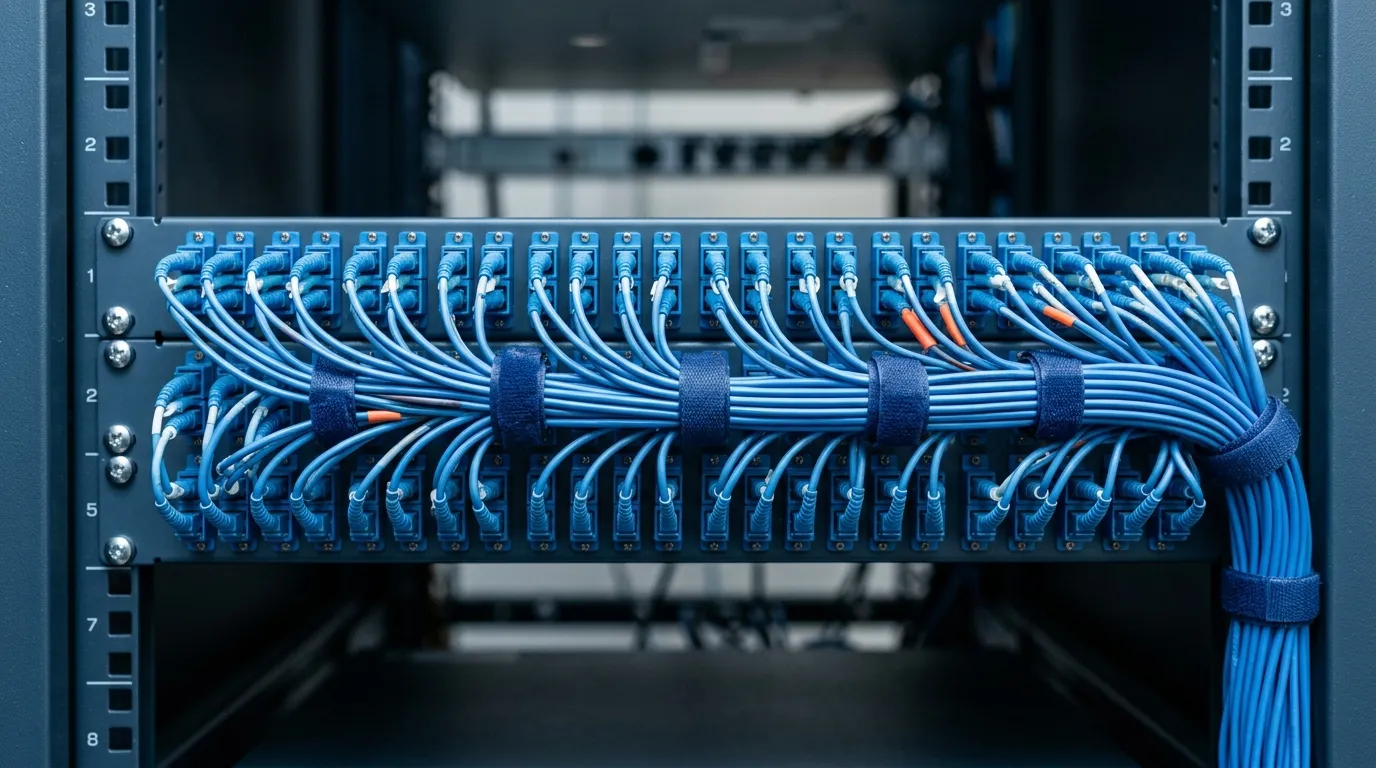
A 1U panel full of duplex LC ports — the density payoff of the 1.25 mm ferrule in data center patching.
The size comparison is also where the "lc vs sc connectors size" question that people actually search gets its answer: LC is smaller in ferrule, housing, and duplex footprint; SC is the larger, older form factor. Among legacy types, SC and FC share the 2.5 mm ferrule — ST, the older bayonet type, uses the same 2.5 mm ferrule — while LC shares its 1.25 mm ferrule with MU, a miniature connector common in Japan. For global projects, though, the realistic choice is LC or SC, with ST, FC, and MU appearing mainly in existing plant.
Mechanical Design: Latch vs Push-Pull, and the Real "Disadvantages of LC"
The coupling mechanism is the second big difference, and it is the source of most of the practical complaints about LC connectors.
SC uses a push-pull body with a sliding sleeve. You push the connector into the adapter until it clicks home; to release it, you grip the square body and pull. There is no small tab to break, the grip surface is large, and the mechanism tolerates gloved hands and repeated re-patching in ODFs and outside-plant enclosures.
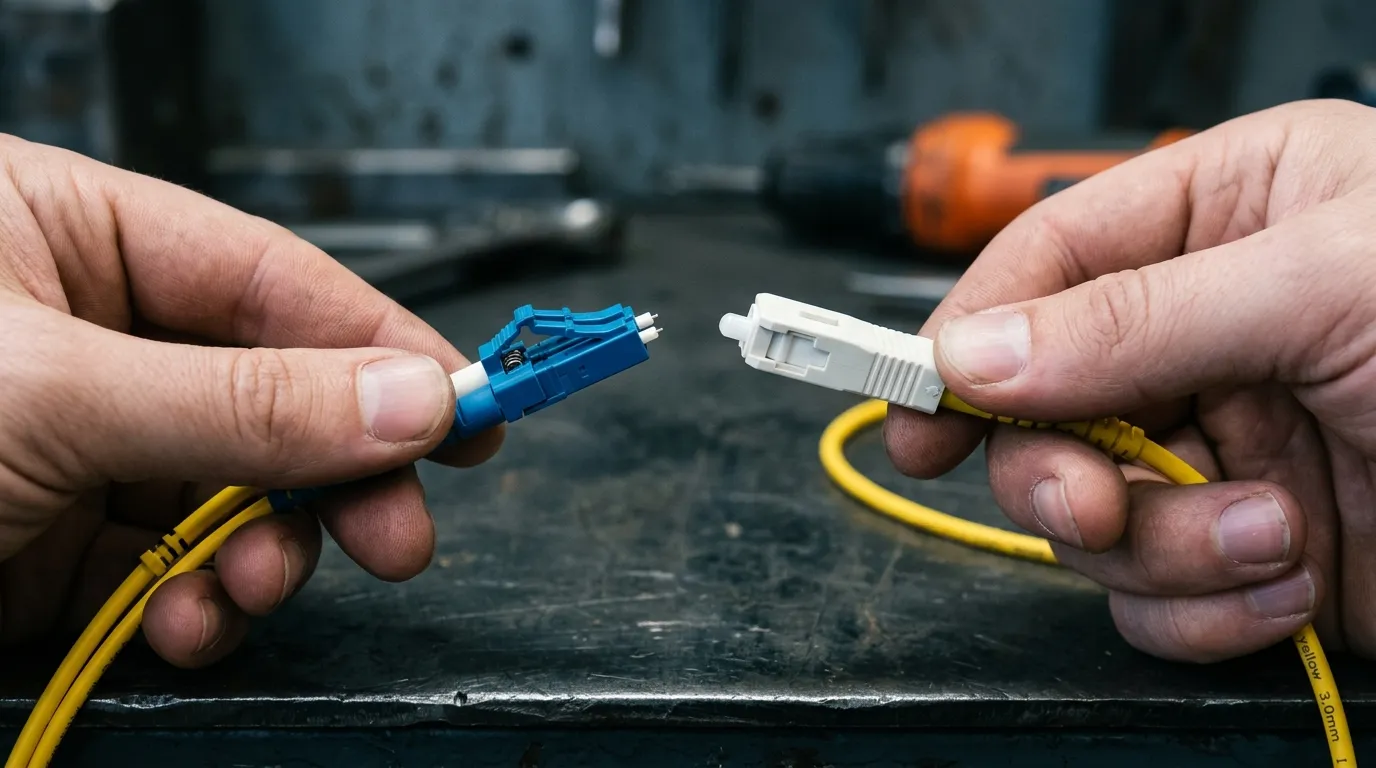
The LC latch tab is the part that snaps or catches in dense bundles; the SC push-pull sleeve has no small protrusion to break.
LC uses a spring-loaded latch tab, like a miniature RJ-45. You push until the tab snaps over the adapter lip; you press the tab down to release. The latch gives a positive, audible click and a very compact package — but it is also the part that gives LC its reputation:
- Latch breakage. The tab protrudes from a small housing and can snap if a patch cord is yanked by the body, caught on adjacent cords in a dense bundle, or stepped on. Broken latches are one of the most common reasons LC patch cords get retired early.
- Harder to clean and inspect. A 1.25 mm ferrule has roughly a quarter of the endface area of a 2.5 mm ferrule. Contamination a technician can see and wipe on an SC endface is easier to miss on an LC endface, which is why inspection scopes and one-click cleaners are non-negotiable in LC-heavy environments.
- Lower mating-cycle ratings. Manufacturer datasheets commonly rate SC at about 1,000 mating cycles and LC at about 500. For permanently patched links this rarely matters; in test labs and patching areas where connectors are plugged and unplugged constantly, it favors SC.
None of this makes LC a bad connector — it is the right connector for the majority of data center and transceiver applications. But when someone asks "what are the disadvantages of LC fiber connectors," these three are the honest answer, and they explain why SC has never been displaced in the field-accessed parts of the network.
Performance: Insertion Loss, Return Loss, and Durability
At the optical level, LC and SC are peers. Both use zirconia ceramic ferrules, both come with PC, UPC, or APC endface polish, and both deliver typical mated-pair insertion loss of 0.25–0.5 dB when terminated to specification. Loss in a connection is set by ferrule geometry, polish quality, and alignment — not by the form factor — which is why a well-made LC and a well-made SC measure essentially the same on an OTDR or loss test set.
Return loss follows the same logic, with one twist worth knowing: return loss is decided by the polish grade, not by whether the connector is LC or SC. A green SC/APC and a green LC/APC both deliver the ~60 dB return loss that PON and RF-video links need; a blue UPC version of either delivers ~50 dB. If you are choosing polish grades at the same time as form factors, our APC vs UPC connector comparison covers that second decision in depth — the two choices are orthogonal, and you will make both on most projects.
Durability is where the two diverge: the larger SC ferrule and simpler push-pull body generally outlast LC in mating-cycle tests. Corning's PPC connector comparison publishes the same industry figures used across this article — 2.5 mm vs 1.25 mm ferrules, 0.25–0.5 dB typical insertion loss, and roughly 1,000 vs 500 mating cycles — and the connector reference table on Wikipedia's optical fiber connector page confirms the ferrule sizes, interface standards, and typical applications cited here.
What the Standards Say: IEC 61754-4 vs IEC 61754-20
If you are writing a spec or checking a datasheet, the interface standards are the objective anchor. Two numbering systems matter:
Standard family | SC | LC |
|---|---|---|
IEC (interface dimensions) | IEC 61754-4 | IEC 61754-20 |
TIA (FOCIS series) | TIA-604-4 (FOCIS 4) | TIA-604-10 (FOCIS 10) |
A caution from real-world spec sheets: the IEC numbers are frequently swapped in vendor literature — some comparison articles and even product tables list SC as IEC 61754-20 and LC as IEC 61754-4, which is backwards. SC is defined by IEC 61754-4; LC is defined by IEC 61754-20. When a datasheet or test report cites the interface standard, checking that one digit saves you from propagating an error into your own documentation. Performance grades for both connectors are covered by the same generic specification framework (the IEC 61753 series and Telcordia GR-326 for singlemode), which is another way of saying the two form factors are held to the same quality bar.
Where Each One Wins: FTTH/PON vs Data Center and Enterprise
Application is the tiebreaker. Here is how the two form factors split across real network segments.
SC dominates FTTH, PON, and outside plant
SC is the connector of the access network. GPON and EPON equipment, optical network terminals (ONTs), fiber distribution hubs, and most field-terminated drop cables use SC — almost always SC/APC, identifiable by its green housing and boot. The forces keeping it there:
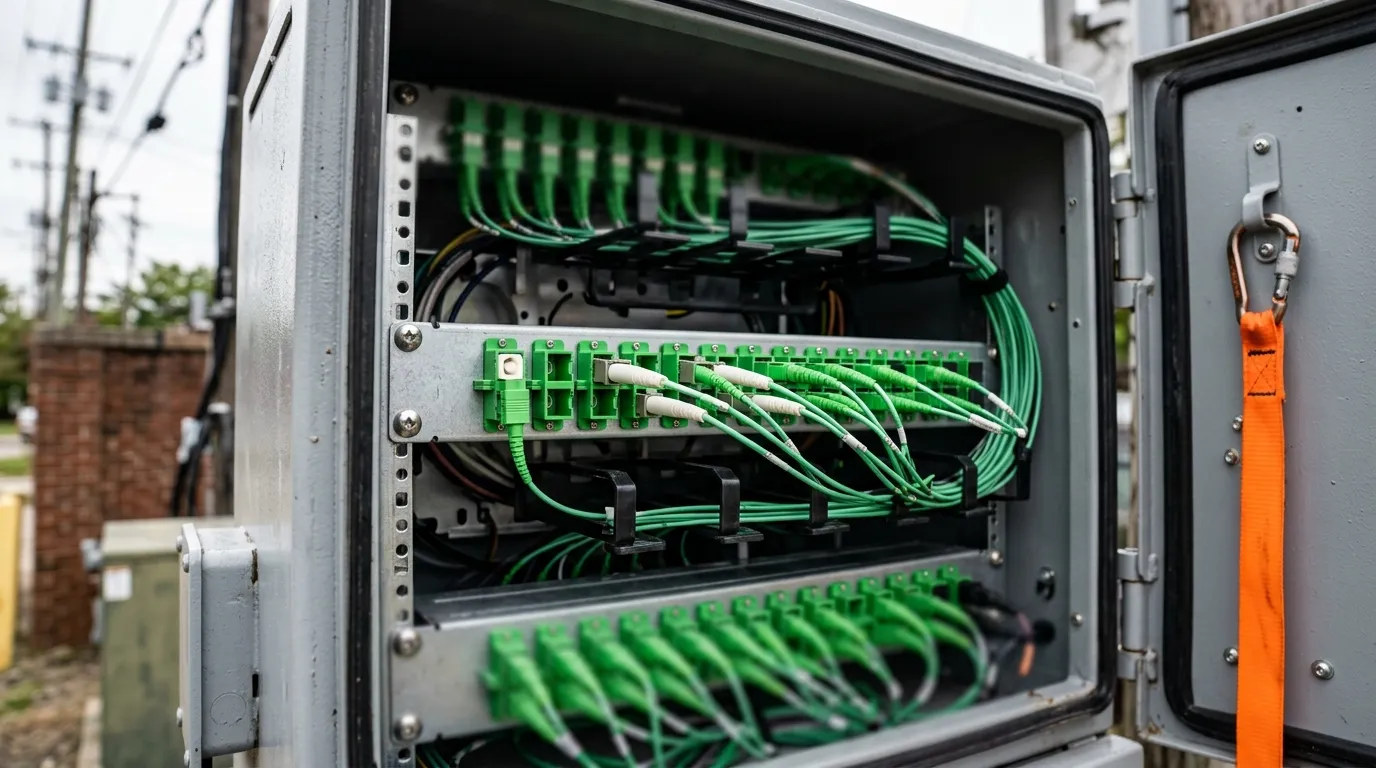
SC/APC is the working connector of the access network — green housings in an ODF are a reliable sign you are looking at SC.
- Field termination ecosystem. Fast-connector and field-polish products that let a technician terminate a drop cable at the side of a house or in a pedestal are overwhelmingly SC-based; the larger ferrule is more forgiving to terminate and inspect in the field. Field-installable SC connectors are the norm for FTTH builds — if you are deploying them at scale, our guide to fiber optic fast connectors walks through the options.
- Robustness in harsh environments. ODFs, outdoor enclosures, and aerial or buried plant get handled by gloved technicians in bad weather; SC's big grip surface and unbreakable push-pull body behave better there than a small latch tab.
- Installed base and color conventions. Millions of SC/APC ports are already deployed, and the green/blue coding that tells APC from UPC at a glance applies across form factors — see our fiber optic color code guide for the full chart.
LC dominates data centers, enterprise switching, and transceiver ports
LC owns the electronics side. Every SFP and SFP+ transceiver has a duplex LC receptacle, and serial-optics QSFP modules (LR/CWDM per-lane types) do too — so the equipment that runs serial pluggable optics — data center ToR switches, enterprise core switches, DWDM muxponders, storage arrays — terminates in duplex LC at the port. (Parallel-optics QSFP variants use MPO instead; that is the density escape hatch below.) Around that port interface, three more factors compound:
- Density. The roughly 2× port advantage of LC in the same panel footprint is decisive where every rack unit of patch panel space is budgeted — when 48-fiber or 96-fiber patching per RU is the norm, SC panels simply do not fit the bill.
- Uniboot and polarity management. LC's small duplex form factor enabled the uniboot patch cord (both fibers in one jacket with a single latch) and push-pull tab variants that make high-density patching manageable.
- A clear upgrade path. When duplex LC density itself runs out, the industry moves to MPO/MTP trunks and cassettes that break out to LC — if you are planning that step, our MPO vs MTP connectors comparison covers the multi-fiber side of the story.
Enterprise and campus: a mixed bag
Inside an enterprise or campus network you will find both, often in the same building: LC at the switch ports and in the main distribution frame, SC (or legacy ST/FC) deeper in the horizontal plant and in older risers. Most modernization projects converge active electronics on LC and leave SC only where it already exists in the passive plant. When in doubt, match the connector to the equipment port — never force an SC patch cord into an LC transceiver.
As a quick orientation map, the segments split like this in practice:
Network segment | Typical connector | Why |
|---|---|---|
PON/FTTH drops, ONT, ODF | SC/APC | Field termination, robustness, installed base |
Data center ToR & patching | LC (duplex) | SFP/QSFP ports, density, uniboot |
Enterprise switch ports | LC | SFP/QSFP ports on active gear |
Outside plant / hardened drops | SC (often hardened SC) | Outdoor enclosures, gloved handling |
Long-haul / WDM plant | LC or SC | Matches OLT/transponder ports |
High-density aggregation | LC → MPO/MTP | Density beyond duplex limits |
The middle column is a rule of thumb, not a law — the deciding factor is always the port on the equipment at each end, which is why the five-question path below puts equipment ports first.
How to Choose: A Five-Question Decision Path
Run these five questions in order — each one eliminates one side of the comparison:
- What does the equipment port require? If the device takes SFP/SFP+ serial optics, or a QSFP module with serial LR/CWDM optics, or has a fixed duplex LC receptacle, the port side is LC — this single question decides the majority of data center and enterprise links. If the transceiver is a parallel-optics SR/DR QSFP, the port side is MPO and the LC-or-SC question never arises at the port. If you are terminating an ONT, an ODF port, or a PON drop specified SC/APC, the field side is SC.
- How much density do you need per rack unit or enclosure? Budgeting more than ~24 fibers per 1U of patching, or tight panel space? LC roughly doubles the port count in the same footprint. Under 24 fibers per 1U with room to spare, SC's larger ferrule costs you nothing.
- Will the connector be mated and unmated often, or in harsh conditions? Frequent re-patching, gloved hands, and outdoor enclosures favor SC's push-pull body and higher mating-cycle rating. Permanent or rare-touch connections are indifferent.
- Do you need field termination? If technicians will terminate cable in the field with fast connectors or field polish, SC has the deeper ecosystem and the more forgiving ferrule. Factory-terminated patch cords and pigtails come in either form factor at equal quality.
- What does the existing plant and your operations team already use? Standardizing on one connector reduces inventory, training, and error rates. If your ODFs are already SC and your optics are LC, the plant will be hybrid by nature — plan the SC↔LC transition points explicitly (next section) instead of letting them appear by accident.
For most readers, the outcome is a hybrid network: LC at every transceiver and in high-density patching, SC/APC in the access and outside-plant segments. That is not a compromise — it is how the industry actually builds.
Converting Between LC and SC: Hybrid Patch Cords and Adapters
Because the two connectors are mechanically incompatible, you cannot plug an SC connector into an LC adapter. Where a link must cross from an LC port to an SC port, you have three honest options:
- Hybrid patch cord. A single jumper with LC on one end and SC on the other. Cleanest for point-to-point links between, say, an LC SFP port and an SC/APC ODF port. Specify the polish on each end explicitly — an LC/UPC-to-SC/APC hybrid is common in PON test setups, but mixing APC and UPC on a single endface is never valid.
- Hybrid adapter (coupler). An adapter block with an SC receptacle on one side and an LC receptacle on the other, letting two standard patch cords of different types meet in the middle. Useful at patch panels where you want both sides to stay standardized.
- Re-terminate or re-cable. When a permanent segment is being re-cabled anyway, terminate both ends in the connector the equipment actually needs instead of bolting on conversions.
The critical rule on any conversion: polish must match on each mated interface, and APC must never mate with UPC — the angled and flat endfaces are physically incompatible, and forcing them damages both connectors. The green/blue color coding exists precisely to prevent this mistake, and it applies to LC and SC alike.
Bottom Line: Two Good Connectors, Different Jobs
LC and SC are not competing technologies at different quality levels; they are two well-engineered solutions to different constraints. LC is the answer when density, transceiver compatibility, and modern data center practice dominate. SC is the answer when field termination, robustness, and the access network dominate. Their optical performance is equivalent, their cost gap has largely closed as LC manufacturing scaled, and most real networks end up with both — LC on the electronics and high-density patching, SC/APC in the PON and outside plant.
As a manufacturer that builds both — SC/APC FTTH patch cords and drop jumpers to IEC 61754-4, duplex LC and LC uniboot assemblies for data center and FTTA use, plus the outdoor hardened versions of each — DYS Fiber Optic is happy to be the neutral party here: tell us which segment of the network you are building, and we will recommend the form factor, polish, and assembly type that fits it, with per-unit test data either way.
If you are still mapping out the connector landscape, start from the fiber optic connectors hub, where this article sits alongside the connector family guide, the APC vs UPC comparison, and the fast-connector deep dive. When the choice narrows to a specific build, contact DYS with your port counts and environment — a sample kit with both LC and SC assemblies is the fastest way to settle the question in your own racks.