

Connectors
Fiber Optic Connector Types: LC, SC, FC, ST, MPO Guide
If you have worked with fiber for more than a week, you have met the same five fiber optic connector types everywhere: LC, SC, FC, ST, and MPO. More than a hundred connector interfaces have been introduced since fiber's early days — the optical fiber connector overview on Wikipedia catalogs them — but everything else in a catalog is a variant of these five, or a niche design for a single vendor's equipment. The good news is that you do not need to memorize a hundred interfaces — you need three visual cues. Every common connector can be identified by its ferrule diameter, its coupling mechanism, and its color and body shape. This guide shows you how to read those cues, what each of the five main types looks like, where each one is used, and what to check before you buy them in bulk.
How to Identify a Fiber Optic Connector: Three Cues That Tell You What You're Holding
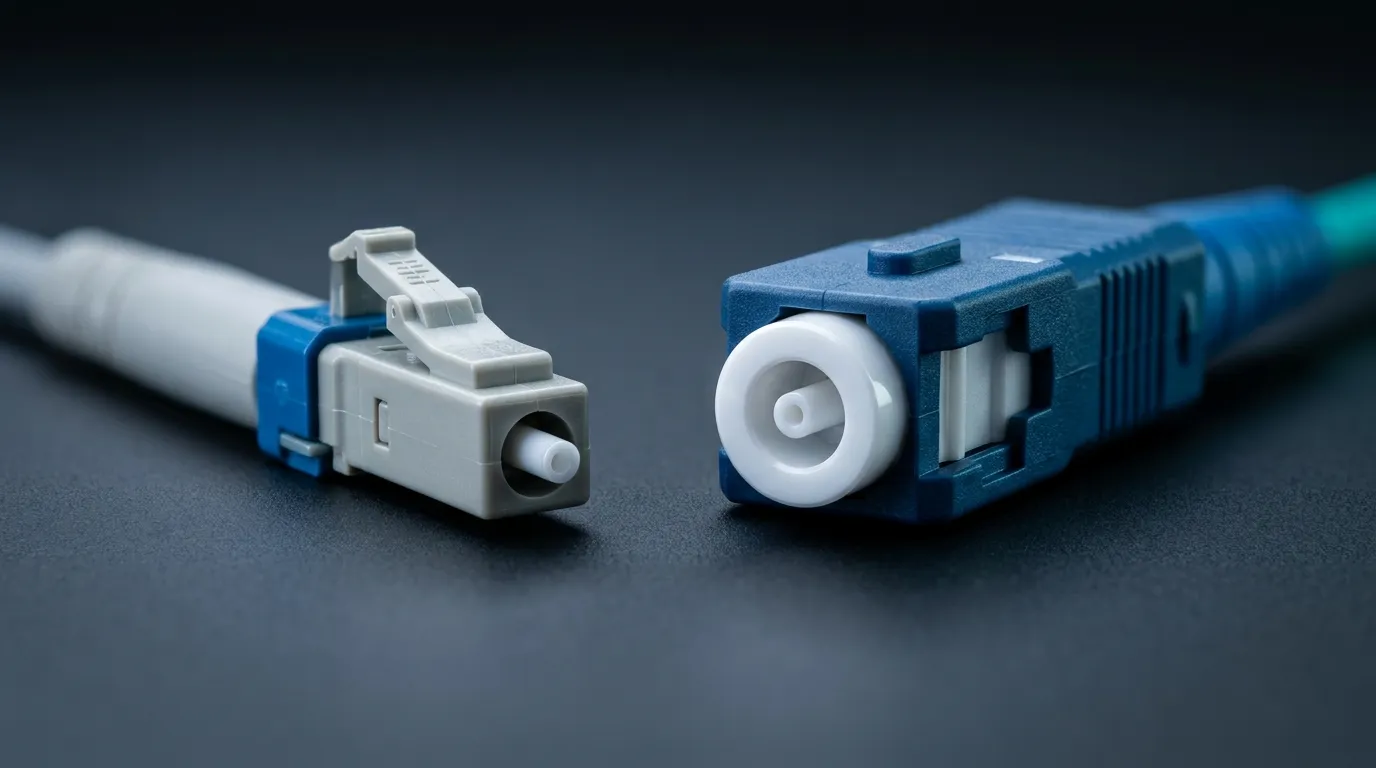
A fiber optic connector is a plug with a tiny ceramic tube — the ferrule — protruding from the tip. The ferrule holds the fiber and presses it against the fiber of the mating connector, so its diameter is the single most diagnostic feature you can look at. LC ferrules are 1.25 mm; SC, FC, and ST ferrules are 2.5 mm; MPO ferrules are a wide rectangle that holds many fibers in a row. If you can see two ferrules side by side, the diameter difference is obvious even without a caliper.
The second cue is how the connector locks. SC and LC use a push-pull latch: push in until it clicks, pull the boot to release. ST uses a bayonet — push and twist a quarter turn. FC uses a threaded collar that screws on. MPO pushes on with a spring-loaded latch, and its alignment comes from metal guide pins, not from the ferrule alone. Third, look at color and shape: LC is a small square, SC is a larger square, FC is round and metal, ST is round with a notched bayonet key, MPO is a wide flat rectangle. Blue or green plastic on the connector body usually points to the polish grade — more on that in the polish section below.
Identify these three features and you can name any connector in your hand in under a minute. Once you know what you are holding, the rest of the story — what it is for, what it mates with, what it costs — follows. For the full picture of how connector choice interacts with polish grades and performance specs, our fiber optic connector guide is the hub for this whole topic.
LC Connector: The 1.25 mm Small-Form-Factor Standard
The LC connector is the most widely used fiber optic connector today, and the reason is density. Its 1.25 mm ferrule is half the footprint of the older 2.5 mm designs, which lets more connections fit in a patch panel or a transceiver faceplate. The body is a small square with a latch on top; the duplex version clips two fibers side by side in one housing.
You will meet LC in three places more than anywhere else: data center cabling, where it terminates most of the patch cords and trunk links; SFP and QSFP transceivers, whose ports are built around the LC form factor; and FTTH and enterprise gear, where newer equipment has moved to LC from SC. It works with both single-mode and multimode fiber, so you will see LC on OS2 patch cords and on OM3/OM4 jumpers alike.
The practical trade-off: LC's small size makes dense panels possible, but it also makes individual connectors harder to grab in a crowded cabinet — technicians often keep an extraction tool nearby. It is a fair price for the density, and it is why LC keeps winning new deployments. If you are sourcing LC terminations for outdoor or industrial runs, the CPRI LC connector line is a reasonable starting point for comparing ruggedized options.
SC Connector: The 2.5 mm Push-Pull Workhorse
The SC connector is the other half of the fiber world's mainstream. It uses a 2.5 mm ferrule in a square body, and it locks with a clean push-pull action — push until it clicks, pull the housing to release. That mechanism is simple, tool-free, and forgiving, which is why SC has been the default for telecom networks and FTTH for decades and remains common in carrier patch panels and OLT connections.
SC and LC are not interchangeable: the ferrule diameters differ (2.5 mm vs 1.25 mm), so an LC plug will not seat in an SC adapter. The practical rule is that SC still dominates where technicians terminate in the field and connections are handled roughly — think drop cables and distribution frames — while LC has taken over the high-density interior of the network. If you need to bridge the two, a hybrid LC-SC patch cord does the job without adapters.
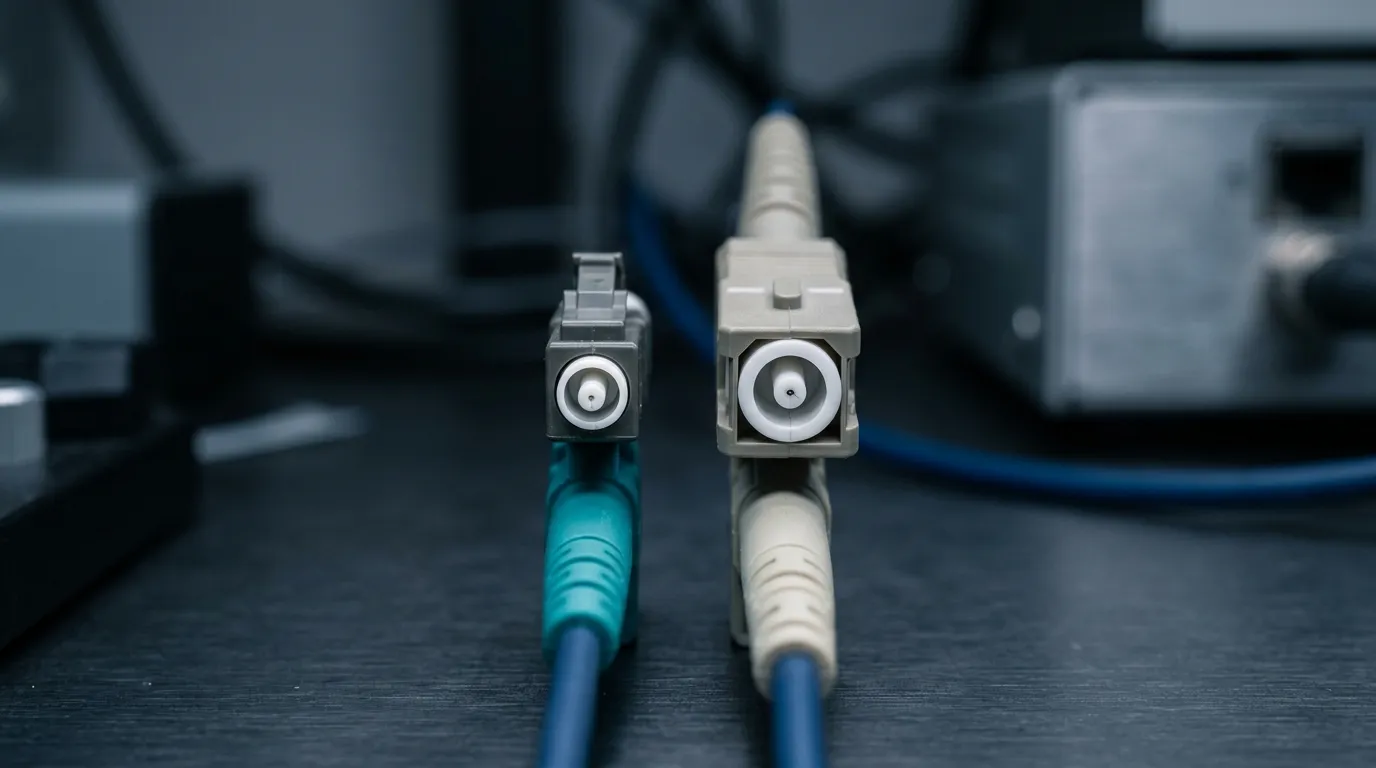
SC is a mature, low-cost interface, and it is usually the safe default for FTTH deployments and any link where simplicity matters more than squeezing in extra ports. When you are sourcing SC connectors for field assembly or replacement stock, the 4-in-1 universal SC connector page shows the kind of variants available on the market.
FC Connector: The Threaded Metal Connector for High-Vibration Links
The FC connector is easy to spot: a round, all-metal body with a threaded collar that screws onto the adapter. It uses a 2.5 mm ferrule and was one of the first precision connectors in single-mode telecom, which is why you still find it in test equipment, video transmission links, and high-vibration installations where a latched connector could be knocked loose.
FC's screw-on coupling is its whole personality. It is the most secure of the classic designs — no vibration is going to unscrew it — and that security is exactly what keeps it alive in environments where a dropped connection is not acceptable. The cost is speed: screwing and unscrewing takes longer than push-pull, and the metal body makes it bulkier in a packed panel. FC is also where you are most likely to meet the FC/APC variant, because angled polish plus threaded coupling is the standard combination for test and broadcast links that cannot tolerate reflections.
For new builds, LC and SC win on convenience, and FC's share keeps shrinking. But if you are maintaining lab equipment, broadcast infrastructure, or any link where the connection must survive vibration, FC is still the right call — and knowing it on sight saves you from ordering the wrong patch cord for a legacy port.
ST Connector: The Bayonet Lock You Still See in Legacy Networks
The ST connector is the one with the bayonet: you push it in and twist a quarter turn to lock, and the notched key on the body tells you which way round it goes. It uses a 2.5 mm ferrule and a round, spring-loaded body, and it was one of the first connectors deployed at scale in fiber networks — AT&T's original design.
Today ST lives mostly in legacy campus and enterprise networks, multimode backbone links, and some medical imaging equipment. It is durable and quick to mate, which is why it survived as long as it did, but its round shape and bayonet key make it awkward in tight patch panels, and new deployments have almost entirely moved to LC or SC.
If you are troubleshooting an older building, ST is the connector most likely to be on the far end of that orange multimode cable. It is also the one people misidentify most often — the round body and 2.5 mm ferrule make it easy to confuse with FC at a glance. The tell is the bayonet key and the twist-to-lock motion; if it turns, it is ST, not FC.
MPO/MTP Connector: Multi-Fiber, High-Density, and Polarity-Sensitive
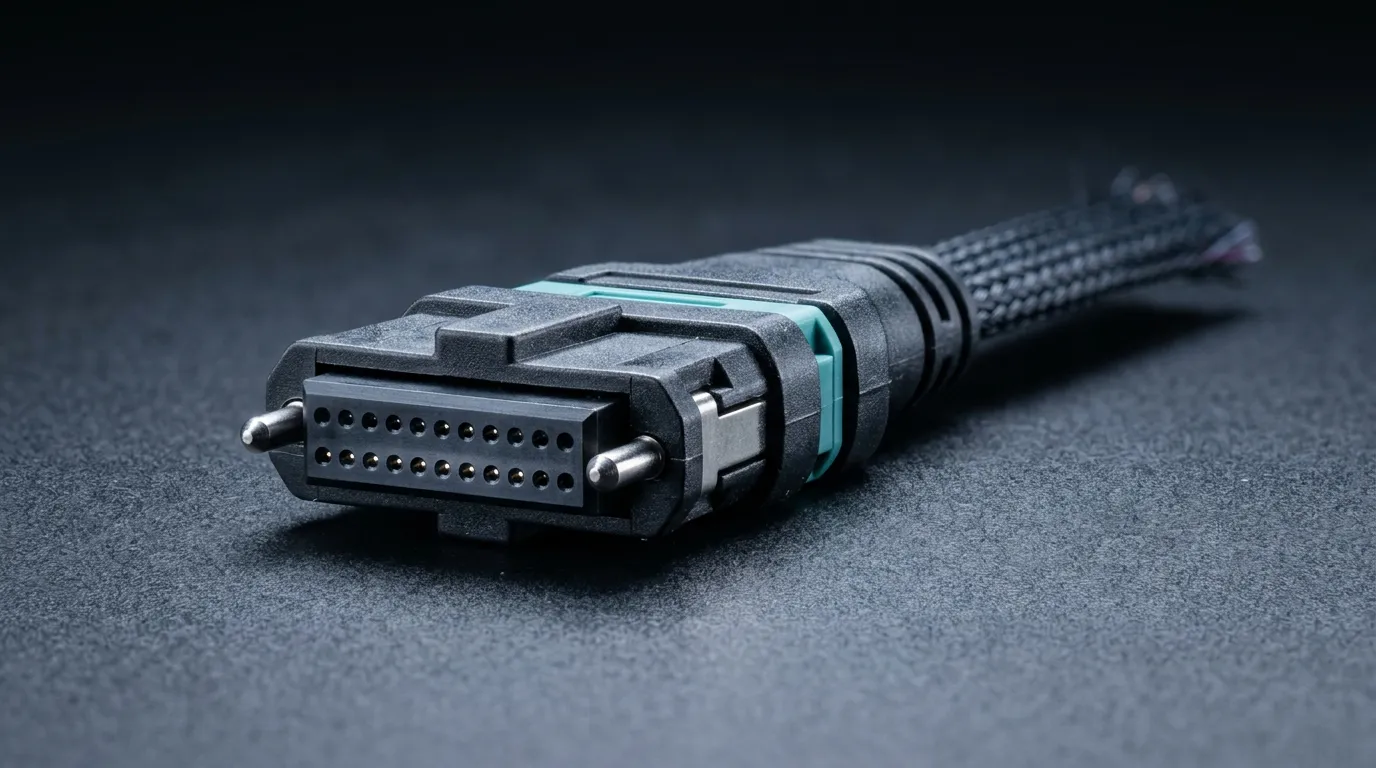
The MPO connector breaks the single-fiber pattern. Instead of one ferrule with one fiber, an MPO ferrule is a wide rectangle holding 8, 12, or 24 fibers in a row, and one plug mates them all at once. MTP is a higher-performance brand of the same interface; the two mate together, and the naming is often used interchangeably.
MPO is the engine of data center high-density cabling — 40G, 100G, 400G, and beyond are built on MPO-based trunks, breakout cassettes, and patch panels — because connecting twelve fibers with one click instead of twelve clicks changes how fast a spine can be deployed. It is also where polarity mistakes happen: with multiple fibers per connector, a mismatched pair can quietly swap transmit and receive paths. For a deeper look at the MPO versus MTP naming question, our MPO vs MTP connectors article covers it directly.
Identifying MPO is easy — nothing else has that wide rectangular ferrule with the two guide-pin holes at the ends. The trends are worth knowing too: as 800G and 1.6T links arrive, a new wave of very small form factor connectors (SN, CS, MDC) is pushing density even further, as fs.com's connector-type survey notes — but MPO remains the workhorse of current deployments.
Fiber Optic Connector Types at a Glance
Here is the whole field in one table. Use it when a patch cord lands on your desk and you need a verdict in ten seconds.
Connector | Ferrule | Coupling | Typical use | Polish you'll see |
|---|---|---|---|---|
LC | 1.25 mm | Push-pull latch | Data centers, transceivers, high-density panels | UPC (blue), APC (green) |
SC | 2.5 mm | Push-pull | FTTH, telecom, carrier frames | UPC (blue), APC (green) |
FC | 2.5 mm | Threaded screw | Test gear, broadcast, high-vibration links | APC (green), PC |
ST | 2.5 mm | Bayonet twist | Legacy campus, multimode backbones | PC, UPC |
MPO | Multi-fiber (8/12/24) | Push-pull + guide pins | Data center trunks, 40G–400G | UPC (beige/black), APC (green) |
Polish Grades and Connector Colors: UPC vs APC at a Glance
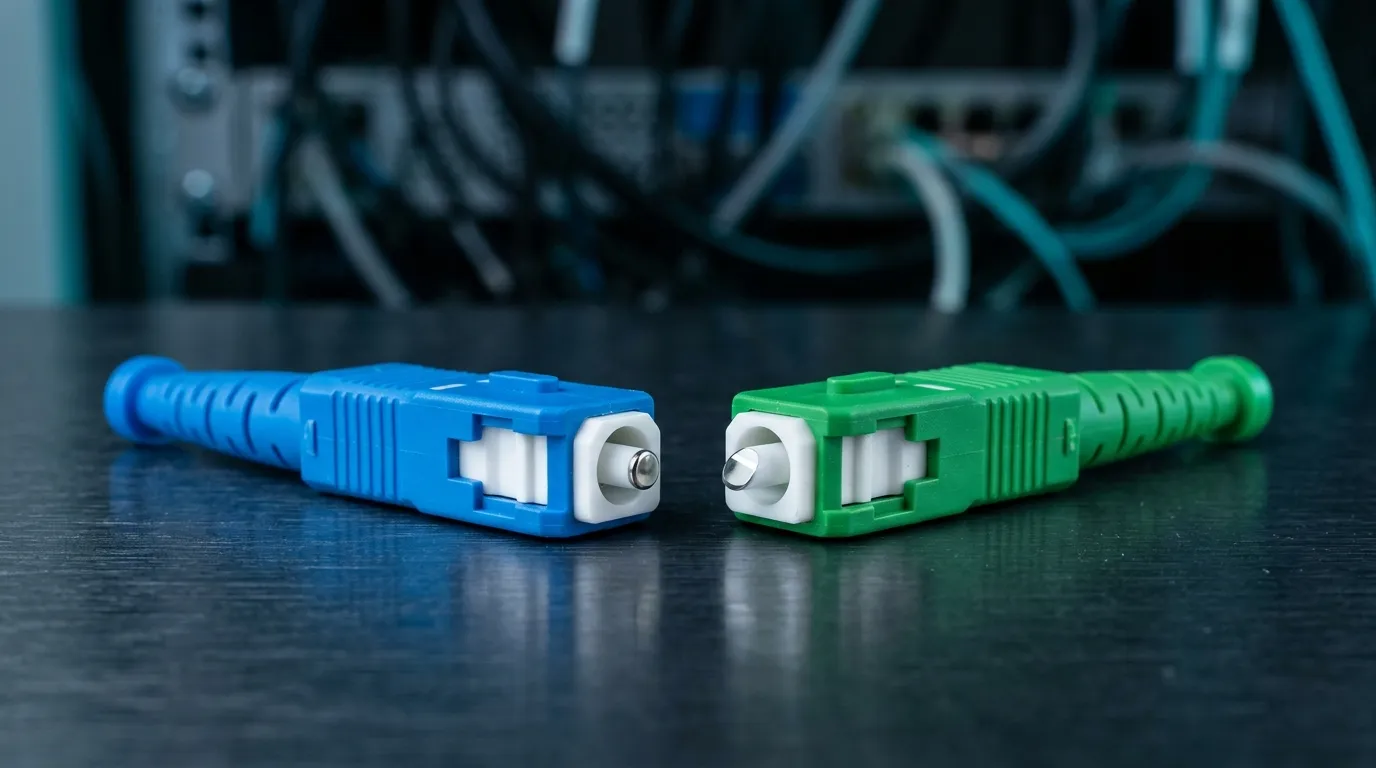
The end face of a connector is polished to one of three grades, and the industry uses color to tell them apart at a glance: green means APC, blue means UPC, and black or beige usually means PC. APC (angled physical contact) is polished at an 8-degree angle, which sends reflected light away from the source — critical for single-mode links and RF-over-fiber where even small reflections hurt. UPC (ultra physical contact) is flat but highly polished and is the default for most data center and LAN links. PC is the oldest flat polish, mostly found on legacy equipment and ST connectors today.
One identification trap: the polish color lives on the connector body and boot, not on the fiber itself. And connector colors are a separate scheme from the TIA-598 fiber sequence used inside cables — the fiber optic color code guide walks through that system, which follows the Fiber Optic Association's color reference. If you are weighing UPC versus APC performance in detail — insertion loss, return loss, and when each is mandatory — the connectors hub covers the comparison in depth.
How to Choose the Right Fiber Optic Connector
Match the connector to the job, not to what is cheapest in the catalog. The shortcut: data center and high-density → LC and MPO; FTTH and carrier access → SC; vibration and test environments → FC; legacy campus gear → ST.
- Data center / high density: LC for server-to-switch and breakouts, MPO for trunk links and cassettes. This is where the OM1–OM5 multimode fiber grades matter most, since grade dictates the distance a multimode link can carry.
- FTTH and access networks: SC dominates field terminations and distribution frames; LC is appearing on newer OLT and ONT gear.
- Industrial, vibration, outdoor: FC's threaded coupling is the classic choice; ruggedized variants exist for harsher sites.
- Legacy campus and enterprise: ST survives on installed multimode backbones — replace equipment before re-terminating, not the other way round.
Two more decisions ride along with the connector type. Single-mode or multimode is dictated by the fiber you already have — connectors are available for both, and mixing the wrong one costs you distance and loss. Simplex or duplex is dictated by the link: one fiber for one-way paths, two fibers (or one duplex housing) for bidirectional links. Both decisions are independent of the connector type, so settle them first and the connector choice narrows itself.
What to Verify Before Buying Fiber Connectors
When you buy connectors, pigtails, or pre-terminated assemblies in bulk — for an install, a rollout, or inventory — the type is only the first question. The specs that decide whether the batch actually performs are these:
- Insertion loss: the stated typical value, usually ≤0.3 dB for good LC/SC connectors. Ask for the test data on the actual batch, not just the datasheet.
- Polish grade: UPC or APC must match the rest of your network — and the color convention (blue/green) should be consistent across the batch.
- Ferrule material: zirconia ceramic is the standard; anything else is a red flag for a precision interface.
- Mating cycles: how many connect/disconnect cycles the connector is rated for, which matters for patch panels that get touched constantly.
- Compatibility: the connector's cable diameter and fiber type must match what you are terminating — a connector built for a 2.0 mm cable will not fit a 3.0 mm drop.
Sourcing from a manufacturer that terminates in-house has one quiet advantage: the connector and the cable leave the factory as one tested assembly, so the insertion-loss number is measured on the product you receive, not extrapolated from a catalog. If you are evaluating suppliers for connector or pre-terminated assemblies, send your specs to DYS Fiber Optic and compare the test data they return against this checklist.
FAQ
What are the different types of fiber optic connectors? The five common types are LC, SC, FC, ST, and MPO. LC and SC cover most of today's networks; FC and ST survive in test, industrial, and legacy installations; MPO carries multiple fibers in one connector for high-density links.
What is the most widely used fiber optic connector? LC is the most widely used connector in current deployments, driven by its 1.25 mm small-form-factor design and its dominance in data centers and transceiver ports. SC remains common in FTTH and carrier networks.
How to identify fiber optic connectors? Check three cues: ferrule diameter (1.25 mm = LC; 2.5 mm = SC, FC, or ST), coupling mechanism (push-pull, bayonet, or threaded), and body shape plus polish color (green = APC, blue = UPC). MPO is unmistakable — a wide rectangular ferrule with guide pins.
Are LC and SC connectors interchangeable? No. LC uses a 1.25 mm ferrule and SC uses 2.5 mm, so they cannot mate directly. To connect LC equipment to SC equipment, use a hybrid LC-SC patch cord or a hybrid adapter.