
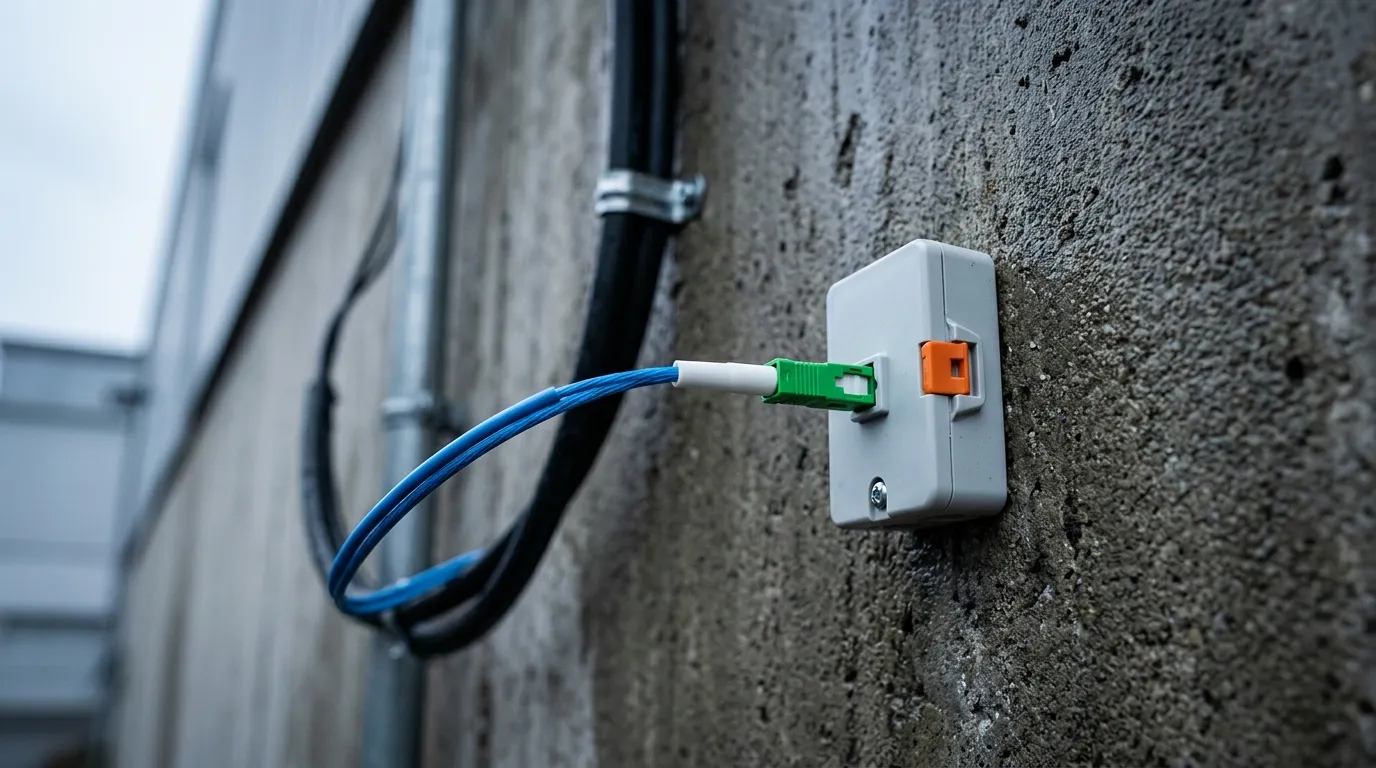
FTTH Access
FTTH vs FTTP vs FTTB vs FTTC: FTTx Architectures Compared for Network Planners
The FTTH vs FTTP question has a shorter answer than most comparison articles admit: FTTP is the category, and FTTH is one member of it. Fiber to the premises means the fiber reaches the subscriber's premises — a house, an apartment, an office. Fiber to the home means that premises is the living space itself. Neither is faster than the other, because they are not two technologies; they are two names for a reach boundary, and one name is broader than the other.
The decision that actually matters on a build is where that boundary sits. Fiber can stop at the home, at the building's shared equipment room, at a street cabinet, or at a neighborhood node — and that single choice fixes the last-segment medium, the split and ODN design, the bill of materials, and which cost line dominates the budget. That is the frame this comparison uses: the four acronyms name reach boundaries in an FTTx architecture, not four products competing on speed.
The Short Answer: FTTH vs FTTP Is a Naming Problem, Not a Speed Problem
Four acronyms, two groups. The split is not FTTH versus FTTP versus FTTB versus FTTC; it is architectures where fiber reaches the premises against architectures where fiber stops short and something else finishes the job.
- FTTP — fiber to the premises. Fiber runs from the operator's central office, through the optical distribution network, all the way to the subscriber's premises. The umbrella term.
- FTTH — fiber to the home. A form of FTTP where the fiber reaches the individual living or working space. Residential FTTH is the case almost everyone means.
- FTTB — fiber to the building. A form of FTTP where the fiber terminates at the building but not at the unit. Something else — copper twisted pair, coax, Ethernet, or a short fiber riser — covers the last segment inside the property.
- FTTC — fiber to the cabinet. Fiber stops at a street cabinet, pole or curb, and copper or coax runs the final few hundred metres to the premises.
That FTTB is also a form of FTTP is the part most articles skip, and it is why the FTTH vs FTTP vs FTTB triple confuses people: two of the three are the same architecture at different depths.
The definitions come from the FTTH Council — today Fibre Council Europe alongside its North American and Asia-Pacific counterparts — which agreed formal FTTH and FTTB definitions in 2006 and revised them in 2009, 2011 and 2015. The Councils never published formal definitions for FTTC or FTTN, which is exactly why those two terms drift between markets and operators. The Fiber to the x reference is the most complete public summary of how far the drift goes: FTTC is sometimes called fiber to the kerb or fiber to the closet, and FTTP itself is occasionally used for fiber to a utility pole that never reaches the premises at all.
Two market conventions explain most of the confusion a planner meets in the field:
- In the UK, regulators and wholesale networks sell "FTTP" as shorthand for full fibre to the premises, so FTTP and FTTH are used interchangeably in sales material.
- In North America, "FTTP" is often a marketing umbrella that includes both homes and businesses, while "FTTH" is reserved for residential builds.
Same glass, same optics, same splitter. Teams that search FTTP vs FTTH expecting a performance gap find none — only the word changes. If a vendor datasheet says "FTTP-ready" or "FTTH-capable", the question to ask is not which is better but where does your fiber stop — and the answer belongs in the purchase order, not the brochure. The full OLT-to-ONT picture, including splitter placement and drop hardware, sits in the FTTH deployment guide that this article belongs to.
Where Each Architecture Puts the Optical Boundary
The comparison below is the one to keep. Read it by column: the first column is the decision, the rest are its consequences.
Architecture | Where fiber stops | Last segment | Typical downstream ceiling | What it fixes in the design |
|---|---|---|---|---|
FTTH | Inside the living or working space | Fiber (or customer wiring after the ONT) | Set by the PON generation, not the topology — 2.5 Gbps on GPON, 10 Gbps on XGS-PON, shared across the split | Split ratio, drop route, ONT location, power at the premises |
FTTB | Building entry or riser closet | Copper pair, coax, Ethernet, or fiber riser to the unit | Same PON ceiling at the building; unit rate limited by the in-building medium | Where the ONT sits, who owns and maintains in-building wiring |
FTTC | Street cabinet, pole or curb (typically within ~300 m) | VDSL2 or G.fast over copper; coax on cable networks | 40–80 Mbps down, 10–20 Mbps up on VDSL2 at real loop lengths; G.fast reaches ~1 Gbps only on loops of ~100 m or less, and falls to a few hundred Mbps by 250 m | Cabinet siting, copper condition, vectoring, port count |
FTTN | Neighborhood node, often up to a mile away | Copper or coax | Lower and far more distance-sensitive than FTTC | Whether the copper plant is worth keeping at all |
Two rows in that table get conflated constantly, and the FTTN vs FTTC comparison is really a distance parameter: they describe the same architecture at different fiber depths. The closer the cabinet to the subscriber, the shorter the copper and the higher the achievable rate. A cabinet within 300 metres can carry VDSL2 at its top profile; the same electronics at a node a kilometre away cannot. Fiber-to-the-distribution-point — the junction box within metres of the premises — is the same idea pushed to its limit.

An FTTC or FTTN cabinet is a handover point: fiber arrives and terminates on one side, copper cross-connects leave on the other.
That handover is the cost of the architecture in physical form. Every cabinet needs power, cooling or at least ventilation, a DSLAM or OLT remote, and a technician visit for every fault on either side of it. FTTH moves that handover to the subscriber's wall, where the only active device is the ONT — which is why the OLT, ONU, ONT and ODN building blocks matter more than the acronym on the cover of the design document.
FTTB vs FTTH: the Building Case That Decides Most MDU Designs
FTTB deserves its own section because it is the one architecture where the cheaper option is often the correct one — and where the terminology trap does the most damage.
A multi-dwelling unit has a cost structure a single-family route does not. One fiber into the basement or the riser closet, terminated in a distribution box, serves a whole building with one trench, one duct run, one splice case. The in-building segment can reuse existing copper pairs or coax that the landlord already owns. For a mid-rise overbuild where the copper is in decent condition and the operator needs revenue this quarter, FTTB can be the difference between a business case that closes and one that does not. FTTH to every unit means fiber on every riser, an ONT in every apartment, and a truck roll per unit — real money, and real time.
What FTTB changes is not the PON. The same OLT, the same feeder, often the same splitter serve the building. What changes is where responsibility lands:
- The demarcation point moves. With FTTH, the operator's responsibility typically ends at the ONT inside the unit. With FTTB, it ends at the building entry or the riser closet, and everything beyond it — the in-building wiring, its condition, its faults — becomes a shared problem between operator and building owner.
- The rate ceiling becomes an in-building question. A building wired with Cat 5e and Ethernet can deliver hundreds of megabits per unit. A building on ageing copper pairs cannot, no matter what the PON delivers to the basement.
- Power and access change hands. An ONT in a shared closet needs power and building access for maintenance; an ONT in a unit needs neither from the landlord.
There is also a definitional trap worth naming. If the riser is fiber all the way to each unit and only the last few metres inside the apartment are customer wiring, that is FTTH by the Council definition, even if the project is called FTTB in the contract. The label follows the fiber, not the building type. Planners who inherit a "FTTB" project should check the riser medium before assuming a copper constraint exists — and if it is fiber, the design is a full-fibre MDU, with its own questions about splitter placement, riser cable fire rating and per-floor distribution. Those are covered in the FTTH MDU deployment guide.
FTTC and FTTN: What a Copper Tail Really Costs You
The FTTH vs FTTC comparison is where most markets actually make the decision, and FTTC is not a bad architecture — it is a time-limited one, and the limit is distance.
VDSL2 from a cabinet degrades predictably with loop length: the top profiles that sell as 80 Mbps downstream are only reachable on short loops, and the same line at 800 metres may deliver a third of that. Upstream degrades faster, which is what breaks symmetric working patterns — cloud backup, video calls, anything that treats upload as equal to download. The tail also costs latency: interleaving and retransmission on a VDSL2 line add delay that a passive optical link does not carry.
G.fast pushes the ceiling toward 1 Gbps, but only on loops of roughly 100 metres or less; by 250 metres, the loop length it was designed around, the achievable aggregate rate has fallen to a few hundred megabits. In practice that reach pushes fiber to the basement or the distribution point rather than the cabinet. On cable networks the same shape appears as hybrid fiber-coaxial with DOCSIS: fiber to a node, coax to the home, shared upstream.
The real cost of the copper tail is not the copper. It is everything the copper forces:
- Active equipment in the field. Every cabinet needs power, a DSLAM port per subscriber, and thermal management. That is opex and fault surface that FTTH does not have.
- Crosstalk management. Vectoring and its successors buy rate by coordinating lines inside one cabinet — engineering effort that produces no new revenue.
- A rate ceiling that caps what you can sell. If the competitive offer in the market is symmetric gigabit, an 80/20 line cannot be priced at parity, whatever it cost to build.
- Stranded-asset risk. Incumbents in several markets have published copper retirement dates, and a network built on a medium scheduled for withdrawal carries a write-down the business case rarely models.
None of that makes FTTC wrong everywhere. Where copper is in good condition, density is low, and the alternative is no service for several years, an FTTC or FTTN build gets revenue flowing while the fiber plan matures — which is precisely how both architectures were used historically, as interim steps toward full fibre rather than endpoints.
How the Choice Changes the Bill of Materials
The architecture decides which parts are shared across subscribers and which are bought per subscriber. That split, not the acronym, is what a procurement team should be costing.
Component | FTTH | FTTB | FTTC / FTTN |
|---|---|---|---|
OLT ports and feeder fiber | Shared, per PON port | Shared, per PON port | Shared, per PON port |
Splitters | In the ODN, at a distribution point or in the cabinet | In the ODN or at the building entry | In the cabinet |
Enclosure | Terminal box or wall box at the premises | Distribution box in the riser closet or basement | Cabinet, plus street furniture |
Last-segment cable | One drop per home, aerial or duct or façade | One riser feed plus in-building wiring | Existing copper or coax |
Subscriber device | ONT in the unit | ONT, bridge or switch at the building | VDSL2 or G.fast modem |
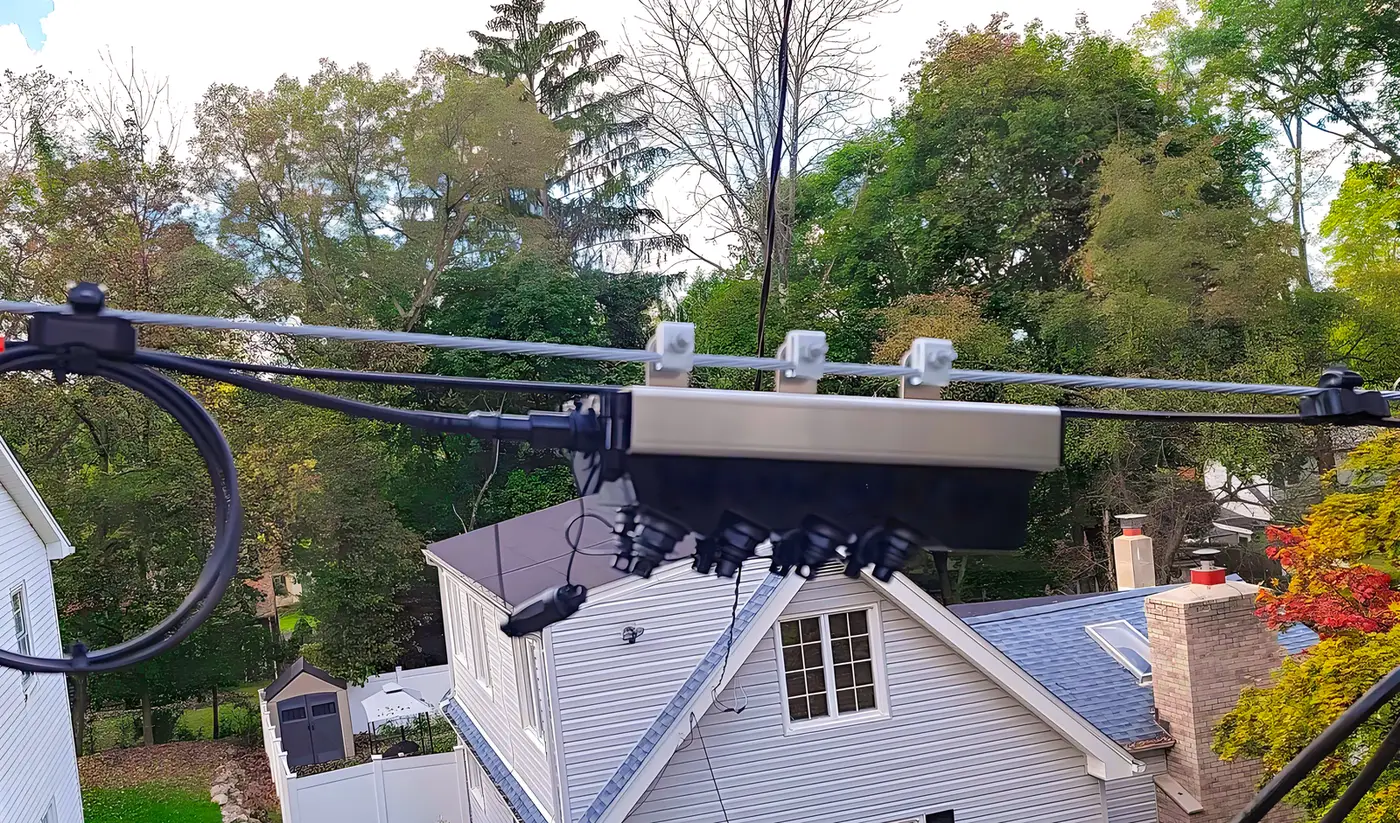
A distribution-point enclosure like this one is sized once and paid for once — the split it can hold decides how many drops it serves for the next decade.
The per-subscriber line is where FTTH costs more and where the cost is most controllable. Drop cable is one of the largest per-home hardware line items in a residential FTTH build, and the most controllable one, because it is bought per home passed rather than per home connected — which means the drop specification is one of the few places where a planner can reduce cost without touching the topology. A flat drop for duct and façade entries, a self-supporting figure-eight for aerial spans, and a round tight-buffered cable for exposed runs are three different products solving three different routes; specifying one type for all of them either overbuilds the easy routes or fails on the hard ones. The FTTH drop cable guide works through the selection by route.
Two numbers make the shared-versus-dedicated split concrete. A GPON port carries 2.5 Gbps downstream under ITU-T G.984, so a 1:32 split gives an average of roughly 78 Mbps per subscriber if every line is active at once — enough for residential service, thin for symmetric business products. An XGS-PON port at 10 Gbps, specified in ITU-T G.9807.1, on the same 1:32 split gives roughly 311 Mbps per subscriber. Same topology, same drop, four times the headroom: the PON generation, not the FTTx label, sets what the customer can buy. Splitter loss and the ratio arithmetic are in the PLC splitter guide.
Cost Structure: Civil Works, Drops, and Take Rate
Ask what an FTTx build costs per home and you will get numbers spanning an order of magnitude, all "typical". The honest answer is that the number is site-specific — but its structure is not, and the structure is what changes between architectures.
In outside-plant fiber builds, civil works usually consume the largest single share of capital: trenching, duct, microtrenching, aerial make-ready, permits. Cable and electronics come after. FTTC and FTTN lower that line by reusing the existing copper route, which is the whole basis of their savings — the fiber run stops where the copper already exists. FTTH pays the civil-works line in full, plus a drop per home, plus an ONT per subscriber.
Then the metric that decides whether the project works:
- Cost per home passed is capital divided by homes the network can reach. It is what the build costs.
- Cost per connected subscriber is that same capital divided by homes that actually buy. At a 60% take rate, cost per subscriber is 1.67 times cost per home passed. At 30%, it is 3.3 times.
An architecture that is cheaper per home passed but caps the product — FTTC at 80/20, or FTTB on ageing in-building copper — can lose on the second metric, because it limits both take rate and the price per subscriber. That is the argument for treating the copper tail as a commercial constraint rather than a construction saving. The reverse also holds: a full-fibre build in a market where demand is thin and ARPU is low can be the more expensive mistake, and the cost per subscriber will show it before the P&L does.
Choosing an Architecture for Your Route, Density and ARPU
There is no universal winner in FTTH vs FTTP vs FTTB vs FTTC, because one of the four is a category and the other three are reach options. The decision rules that hold across markets:
- Greenfield, single-family, fiber available at the street — build FTTH. There is no copper to reuse and no reason to create a copper segment you will have to remove later.
- Greenfield, high-rise — FTTH to the unit if the riser can carry it and the business case supports a per-unit ONT; FTTB where in-building wiring is already serviceable and speed to revenue matters.
- Brownfield with serviceable copper, low density — FTTC or FTTN as an interim step is defensible, provided the plan includes a fiber migration path and the copper retirement date is in the model.
- Brownfield where the copper is failing — skip the interim step. Replacing a copper segment you are about to abandon buys nothing but delay.
- Wholesale or regulated access obligations — check what the access product requires before choosing. A wholesale obligation written around FTTP changes what you can sell from an FTTB build.
Add one more test before committing: phasing. An architecture that can be upgraded one distribution area at a time — FTTC to FTTH, or FTTB to FTTH by pulling the riser — costs less to be wrong about than one that has to be rebuilt whole.
What This Means for the Hardware You Specify
Whatever the architecture, the hardware at the optical boundary is where a design either scales or accumulates exceptions. Three specifications do most of the work: a drop cable family that covers aerial, duct and façade routes without a custom order per route; terminal and distribution enclosures sized for the splitter and the port count you actually plan to fill; and connector and patch hardware whose loss budget matches the split ratio you chose. DYS manufactures that layer — FTTH drop cable, PLC splitters, terminal boxes and pre-terminated assemblies — and pre-termination is the lever that moves labour out of the field and into the factory, which is where FTTH economics are usually won or lost. If you are specifying for an upcoming build, send us the route and split plan and we will quote against it.
FTTx Questions Network Planners Actually Ask
What does FTTx mean? "Fiber to the x" — x is the point where the fiber stops, and the letter after FTT names it: H for home, B for building, C for cabinet, N for node. The meaning is a reach boundary, not a speed class.
Are FTTH and FTTP the same? Practically yes, strictly no. FTTP is the umbrella; FTTH is the residential case of it, and FTTB is the building case. If the fiber reaches the unit, the build is FTTH regardless of what the project is called.
Why is FTTH better than FTTN? Not because fiber is faster in the abstract, but because FTTH removes the shared, distance-dependent segment. A PON port's capacity is shared by design; a copper tail's capacity is shared and degrades with loop length, so the two limits multiply.
Is FTTH better than 5G? They answer different demand. Fixed wireless is cheaper where density is low and spectrum is available, but a sector shares its capacity across every household in it, and sustained high-volume use competes with mobile traffic. For dense, high-ARPU areas, FTTH is the architecture that scales; for sparse areas, fixed wireless is often the only case that closes.
Which cable is used for FTTH? The drop, and it is chosen by route: flat drop for duct, façade and short indoor entries; self-supporting figure-eight for aerial spans between pole and building; round tight-buffered constructions where the run is exposed or needs a smaller bend envelope. Inside the premises the same fiber continues as patch cord to the ONT.